
Equal parenting time is possible in California, but fathers aren’t automatically entitled to 50/50 custody. A father may seek that arrangement, and a co-parenting agreement lawyer in Los Angeles can explain how a proposed schedule fits the child’s best interests. Courts consider the child’s health, safety, and welfare when deciding custody.
It’s understandable to want a clear, consistent role in your child’s life, especially when separation makes routines and decisions feel uncertain. This article explains how California distinguishes legal custody from physical custody, what parenting schedules can include, and when a change in circumstances may lead parents to revisit an agreement.
You’ll also learn what can make a parenting plan more workable, how unresolved disagreements may proceed through Los Angeles County family court, and how legal representation can help you understand the issues involved. The focus is practical clarity: keeping your child’s needs at the center as you consider parenting arrangements.
Key Takeaways
- Build a parenting plan around practical details, including exchanges, holiday time, communication, and how major decisions will be handled.
- Compare schedule patterns such as a 2-2-3 rotation with your child’s routine and each parent’s ability to manage transitions.
- When circumstances materially change, understand the steps for seeking a formal custody modification rather than relying on an informal adjustment.
- Know how Los Angeles County mediation may fit into a custody dispute and what can happen if parents remain unable to agree.
- Put agreed custody terms into a court-approved plan; informal arrangements that differ from an existing order can create enforcement difficulties.
Why Speak to a Los Angeles Child Custody Attorney for Time-Sharing?
A California parenting plan sets out custody, schedules, and how parents coordinate care. Clear, thoughtful terms can support a child’s routine and reduce uncertainty after divorce or separation.
Co-Parenting Plans and Communication
A parenting plan can address legal custody, physical custody, parenting time, and how parents make decisions. California courts consider a child’s health, age, and maturity when determining the child’s best interests. Clear terms can also explain how parents share information about school, health needs, and schedule changes.
Set practical communication expectations rather than relying on broad promises to cooperate. For example, parents can specify how they will share routine updates and raise urgent concerns. Planning for disagreements can help keep discussions focused on the child instead of reopening every decision during conflict.
Parenting Time and Schedule Planning
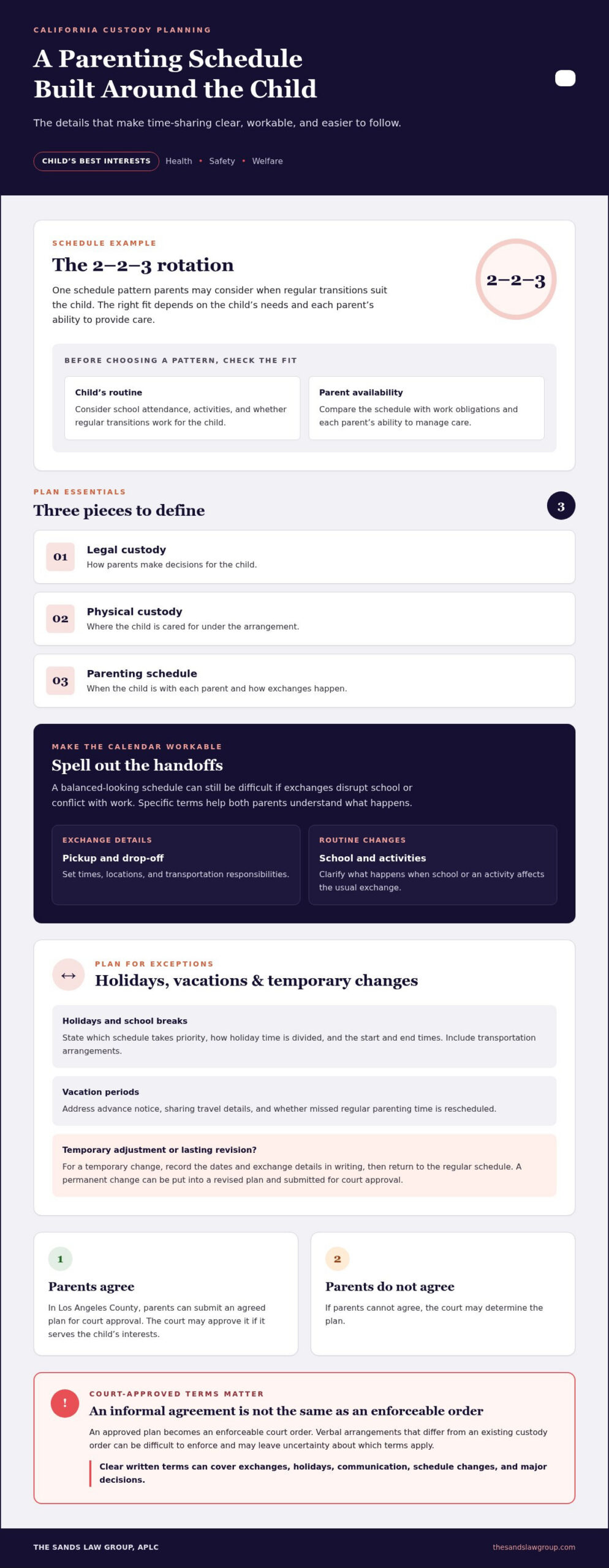
Parenting time should reflect the child’s needs and each parent’s ability to provide care. California courts encourage frequent and continuing contact with both parents, while the schedule must still serve the child’s best interests. A 2-2-3 rotation is one example parents may consider when regular transitions suit the child.
Consider how school days, transportation, holidays, and activities fit together. A schedule that looks balanced on paper may be difficult if exchanges disrupt school or conflict with a parent’s work obligations. Specific exchange terms can prevent disputes about pickup times, locations, and transportation responsibilities.
Choosing a Los Angeles Lawyer
A co-parenting agreement lawyer in Los Angeles can explain custody arrangements, identify unresolved terms, and help you understand the issues raised by a proposed schedule. When considering legal representation, look for guidance that addresses your family’s actual routines, communication needs, and any contested custody matters.
Negotiation generally involves identifying each parent’s priorities, discussing custody and schedule terms, resolving gaps, and drafting clear language for review. A template may omit important details, use terms that do not fit your circumstances, or leave disputes about exchanges and decisions unresolved. Those gaps can make an agreement harder to follow when conflict arises.
Drafting Agreements for Unmarried Parents
Unmarried parents can discuss and draft proposed parenting terms themselves; legal representation is not the only way to begin. The plan should still address legal custody, physical custody, parenting time, and how decisions will be made. The parents’ rights and responsibilities may depend on whether a court order is in place.
It is important to understand how proposed terms relate to each parent’s circumstances and the child’s needs. A lawyer can help identify unclear provisions and explain the legal issues involved in seeking a formal arrangement, rather than relying on assumptions or informal promises.
Visitation agreements and parenting schedules
A visitation agreement translates parenting time into clear arrangements for ordinary weeks, holidays, and schedule changes. In Los Angeles County, parents can submit an agreed plan for court approval.
The plan should address legal custody, physical custody, and a parenting schedule. If parents agree, the court may approve their plan if it serves the child’s interests; an approved plan becomes an enforceable court order. If they cannot agree, the court may determine the plan.
Setting Parenting Time Schedules
A set schedule identifies when the child is with each parent and how exchanges happen. Specify pickup and drop-off times, locations, transportation responsibilities, and what happens when school or an activity affects the usual routine. For example, parents can state whether school pickup replaces an evening exchange.
Compare the schedule with work obligations, school attendance, and the child’s activities. Child support calculations may consider the time each parent spends with the child, along with income and other factors, so accurate parenting-time terms matter beyond calendar planning.
Planning Holidays and Vacations
Holiday and vacation terms should explain which schedule takes priority when a special date falls during a regular parenting week. Parents can specify how holidays are divided, set start and end times, and arrange transportation. Clear terms reduce uncertainty around school breaks and family celebrations.
For vacation periods, address how much advance notice a parent gives, how travel details are shared, and whether missed regular time is rescheduled. A plan can also explain how parents handle a holiday that coincides with a child’s school event or established family tradition.
Formalizing Schedule Changes
Parents may agree to a temporary adjustment for a school event, illness, or work change, but should distinguish that exception from a lasting schedule revision. Record the agreed dates and exchange details in writing so both parents understand the arrangement and can return to the regular schedule afterward.
If a change is meant to be permanent, parents can formalize it through a revised parenting plan and seek court approval. Verbal arrangements that depart from an existing custody order can be difficult to enforce and may create uncertainty about which terms apply.
Making an Agreement Legally Binding
A private agreement and a court order do not have the same enforcement status. Parents who agree on custody and visitation terms can submit their parenting plan for court approval. The plan should state legal custody, physical custody, and the parenting schedule in clear, consistent language.
Once approved, the plan becomes an enforceable order. If parents disagree about terms, the court may decide the arrangement instead. A focused discussion about parenting time terms can help you identify what needs resolution before seeking approval.
When a change in parenting structure becomes legally significant
A parenting arrangement may stop fitting when a child’s needs or a parent’s ability to provide care changes. California parents seeking a custody modification must demonstrate a significant change in circumstances. A child’s new health needs or a parent’s reduced caregiving ability are examples that may affect how an existing parenting plan works.
Distinguish lasting changes from short-term adjustments. A temporary work shift may call for a practical schedule discussion, while a sustained change in care needs may prompt parents to reconsider the plan. Note what changed, when it began, and how it affects the child’s health, routine, or time with each parent. These details keep discussions focused on the child’s circumstances.
Parents who agree on revised terms can put the proposed changes into a parenting plan and seek court approval. If a change is contested, the parent seeking modification begins by filing a Request for Order with the court. Keep the existing custody order in view during this process; informal arrangements that depart from it can create confusion about the terms in effect.
For disputes that remain unresolved, mediation can provide a structured setting to discuss schedule and decision-making changes. Los Angeles County custody cases often involve mediation through Family Court Services before a full hearing. Mediation is described as faster, less expensive, and less adversarial than courtroom proceedings, though parents still need specific proposals to address outstanding matters.
Parenting coordination may offer another structure for managing ongoing conflict. Parenting coordinators are typically mental health professionals or family law attorneys with specialized training. Their involvement can be written directly into a custody order, giving parents a defined resource for recurring coordination issues. A family law attorney can explain how a proposed role fits the parenting plan and the disputes it is meant to address.
Legal separation can also bring parenting arrangements into sharper focus, as parents work through household and caregiving changes. California Courts states that until a court order is in place, both parents have the same rights. If separation changes where a child lives or who can provide daily care, identify those practical effects and address them through a clear plan.
Before seeking a modification, organize the current order, proposed changes, and concrete examples of their effect on the child. That preparation can make mediation more focused and clarify why a revised arrangement may serve the child’s needs. If parents reach agreement, they can submit the revised plan for court consideration; if they do not, the court may determine the arrangement.
Family law services in Los Angeles County
Los Angeles County custody matters involve local court procedures as well as deeply personal decisions about a child’s care. A custody case begins with a petition filed in the Los Angeles County Superior Court’s Family Law Division. Understanding that starting point can help parents organize their concerns and identify the decisions that need attention.
Family law disputes can involve legal custody, physical custody, parenting time, and child support. Legal custody concerns decisions about a child’s health, education, and general welfare; physical custody concerns where the child lives. For example, parents may need to address who communicates with the school, how they share health updates, and how exchanges fit around school attendance.
Los Angeles custody cases often involve mediation through Family Court Services before a full hearing. Mediation gives parents a structured opportunity to discuss disputed arrangements and develop proposals. Before participating, write down the specific issue, the current arrangement, and a workable alternative. A school pickup conflict, for instance, is easier to discuss when each parent can identify the problem and propose a practical exchange plan.
Prepare for discussions around the child’s actual situation, rather than a general preference for equal time. California courts consider the child’s health, safety, and welfare, and a parenting plan should address the child’s needs. Gather relevant details about school routines, health needs, transportation, and each parent’s ability to provide care. Concrete examples can help explain how a proposed schedule supports the child’s stability and relationship with both parents.
Communication also affects how a Los Angeles parenting plan works after a court process. Parents can identify a dependable way to share school notices, medical updates, and changes to pickup arrangements. They can also clarify how to handle disagreements over extracurricular activities. Specific expectations make it easier to separate urgent child-related information from broader disputes between parents.
If parents reach agreement, they can present their parenting plan for court approval. If they cannot agree, the court may determine the plan. Either way, it helps to distinguish decisions needing immediate attention from longer-term questions about custody and care. A clear record of the current schedule, unresolved issues, and proposed solutions can keep discussions focused.
For parents in Los Angeles County, the practical takeaway is to identify the custody issue, prepare child-focused proposals, and understand how Family Court Services mediation may fit before a hearing. Whether the concern involves school transitions, communication problems, or a proposed change in parenting time, these steps can turn a broad conflict into specific matters for discussion.
Is a co-parenting agreement legally binding in Los Angeles?
California child custody law is guided by the California Family Code. A co-parenting agreement’s legal effect depends on whether it remains a private arrangement or becomes a court-approved parenting plan. Parents can agree on schedules and decision-making, but court approval gives the plan a different status. For a parent relying on pickup terms or holiday exchanges, that distinction can determine whether the terms form an enforceable court order.
Parents who agree on a plan can submit it for the court’s consideration. The plan should clearly address legal custody, physical custody, and the parenting schedule so the court can understand the full arrangement. If the court finds that the agreement serves the child’s interests, it may approve the plan. The approved plan then becomes an enforceable court order, giving both parents formal terms to follow.
Specific wording matters. A plan that says parents will “share holidays fairly” leaves room for disagreement about dates, exchange times, and travel. A clearer provision identifies which parent has the child for each holiday period and when the exchange occurs. Parents should also distinguish decision-making authority from parenting time: legal custody concerns decisions, while physical custody concerns where the child lives.
A private agreement can help parents coordinate, but it may not be as enforceable as a court order. If one parent later refuses an agreed exchange, unclear or informal terms can make it harder to establish which arrangement governs. Keep written records of proposed changes and actual agreements, and compare them with any existing order before relying on a different schedule.
When parents cannot agree, the court may determine the parenting plan. If circumstances change after an order is issued, a parent seeking a custody modification must demonstrate a significant change in circumstances. The parent begins by filing a Request for Order with the court. A revised agreement should clearly identify the requested changes and explain how they affect the child’s care and schedule.
Before submitting an agreement, review each provision for clear responsibilities, dates, and decision-making terms. Check that the proposed schedule does not conflict with another provision, such as holiday time or transportation duties. A consultation about a parenting agreement can help you identify unresolved terms and prepare for the court-approval process. A precise plan gives parents a shared reference point when disagreements arise.
The Sands Law Group, APLC: Divorce Legal Representation
The Sands Law Group, APLC represents clients in child custody and visitation matters that intersect with divorce and broader family law decisions. Its Child Custody and Visitation Representation includes advocacy regarding custody arrangements and visitation disputes, including proposed parenting plans and changes to existing terms.
When separation involves additional issues, the firm also provides Divorce Legal Representation, Spousal Support Representation, and Property Division Representation. These matters can affect how parents plan for their children’s care and household transitions, so understanding how the issues relate can help clarify the decisions ahead.
To discuss custody or divorce-related concerns, contact The Sands Law Group, APLC to book a Free Case Evaluation.
Take the Next Step Toward a Workable Parenting Plan
Parenting arrangements shape more than a calendar. They influence how a child experiences transitions, how parents share responsibilities, and how future disagreements are handled. Before making a lasting change, consider what clarity your family needs and which questions remain unresolved. A co-parenting agreement lawyer in Los Angeles can help you understand the legal issues involved and prepare for decisions about parenting time.
The Sands Law Group, APLC represents clients in child custody and visitation matters, as well as divorce and spousal support proceedings. If your parenting concerns connect to a broader family law matter, understanding how those issues relate can help you prepare for the next step.
For guidance tailored to your circumstances, contact The Sands Law Group, APLC to discuss your situation. A considered next step can help you move toward a more stable arrangement for your family.
Frequently Asked Questions
Is Pursuing a Custody Battle Worth It for Your Child?
A custody dispute may warrant attention when unresolved arrangements affect a child’s safety, stability, or meaningful contact with a parent. Consider the effects of ongoing conflict alongside negotiated or court-resolved arrangements; repeated missed school pickups, for example, may point to a need for clearer terms. Parents in Los Angeles, Riverside, San Bernardino, and Kern can keep the child’s needs at the center when considering next steps. The aim is a workable arrangement, not simply winning an argument.
What Are the Types of Parenting Time Orders?
California orders may set a specific recurring schedule, leave reasonable parenting time for parents to arrange, or require supervised visits where concerns affect a child’s well-being. A 2-2-5 schedule is one option, but it can mean a child spends five days away from one parent at a time. A court may order no parenting time in extreme cases where even supervised visitation would harm the child physically, psychologically, or emotionally.
What Can I Do if My Ex is Violating the Custody Order?
If violations persist, a parent seeking to enforce a custody order can file a motion for enforcement with the court. Keep a factual record of missed exchanges, dates, messages, and the order terms involved. For example, note whether a parent repeatedly fails to bring a child to a scheduled exchange. A clear record identifies the pattern and the specific order provision at issue, rather than relying on broad accusations.
What Is a Parenting Plan and Parenting Time?
A parenting plan sets out how parents share custody responsibilities and when the child spends time with each parent. Parenting time refers to the periods when a parent cares for the child under the arrangement. For example, a plan might specify where the child stays on school nights and how transportation works after school. It can also explain how parents handle routine coordination, such as a school activity during one parent’s time.
What Does a Co-Parenting Agreement Cover in California?
A California co-parenting agreement can address custody, the parenting schedule, transportation, and how parents communicate about the child. It may also cover holidays, vacations, extracurricular activities, therapy, and substance-related prohibitions. For example, parents can clarify how they share notice of a therapy appointment and who takes the child. Specific provisions help distinguish routine coordination from decisions that require both parents’ involvement.
What Custody and Visitation Rules Apply to Co-Parenting Agreements in California?
California custody decisions focus on the child’s best interests, including health, safety, and welfare. Courts may consider a history of family violence or habitual and continued substance abuse when deciding a parenting plan. Joint physical custody means both parents share time and responsibilities, but it does not automatically mean equal time. Fathers are not automatically entitled to 50/50 custody solely because they are fathers.
Can a Co-Parenting Agreement Be Changed if Circumstances or a Child’s Needs Change?
Yes. A parent seeking to modify a custody agreement must demonstrate a significant change in circumstances, such as a child’s changing health needs or a parent’s ability to provide care. The process begins by filing a Request for Order with the court. The Sands Law Group, APLC website provides general information only, not legal advice. Contacting the firm does not create an attorney-client relationship until a formal agreement is signed.

Article by
Thomas D. Sands, Esq.
Thomas D. Sands is the founder and CEO of The Sands Law Group, APLC. A California attorney with more than two decades of experience, he represents clients in divorce and family law matters as well as civil litigation and real property disputes. His approach emphasizes attentive, practical, and cost-conscious representation.
Sands is a 2023 Litigator of the Year honoree of the American Institute of Trial Lawyers and a 2023 Lawyer of the Year honoree of the American Institute of Legal Professionals. His firm has also received recognition among the 2025 Best Law Firms in America, a 2026 Benchmark Best of award, and a 2026 Law Firm of the Year honor.
Article reviewed by
Thomas D. Sands, Esq.
Thomas D. Sands is the founder and CEO of The Sands Law Group, APLC. A California attorney with more than two decades of experience, he represents clients in divorce and family law matters as well as civil litigation and real property disputes. His approach emphasizes attentive, practical, and cost-conscious representation.
Sands is a 2023 Litigator of the Year honoree of the American Institute of Trial Lawyers and a 2023 Lawyer of the Year honoree of the American Institute of Legal Professionals. His firm has also received recognition among the 2025 Best Law Firms in America, a 2026 Benchmark Best of award, and a 2026 Law Firm of the Year honor.
TOLL-FREE: 855-SANDS4U