The first eligibility check is where you’ve lived, not simply where you plan to file. To begin the Los Angeles County divorce process, either spouse must have lived in California for the previous 6 months, according to California Courts, and in Los Angeles County for the previous 3 months, according to the Superior Court of California, County of Los Angeles.
The Los Angeles County divorce process involves more than filing paperwork. Knowing how to prepare and where records are kept can matter throughout your case. This guide explains how to assess residency eligibility, organize financial disclosures and records about child support and custody, understand the waiting period, and locate Los Angeles County divorce records. It also explains how filing and service fit into the process, so you can approach each decision with greater clarity.
Key Takeaways
- Keep financial documents organized early, and note that California Courts sets a 60-day deadline for the petitioner’s financial disclosures after filing the divorce petition.
- Maintain clear, dated records of child support payments and the custody arrangements followed during separation.
- Factor California’s six-month minimum waiting period into your plans; resolving the issues and completing final paperwork are also part of reaching a judgment.
- When locating older divorce filings from Central Los Angeles, account for their transfer to the County Record Center, which normally occurs within two to three years of filing.
- Understand how filing, service, financial disclosures, and decisions about children and property fit together before choosing your next steps.
Am I Eligible to File for Divorce in Los Angeles?
A contested divorce involves unresolved disagreements, while an uncontested divorce proceeds by agreement. Summary dissolution is a simplified option for eligible couples. Legal separation addresses spouses’ arrangements without ending their marriage, and its California residency rules differ from those for divorce.
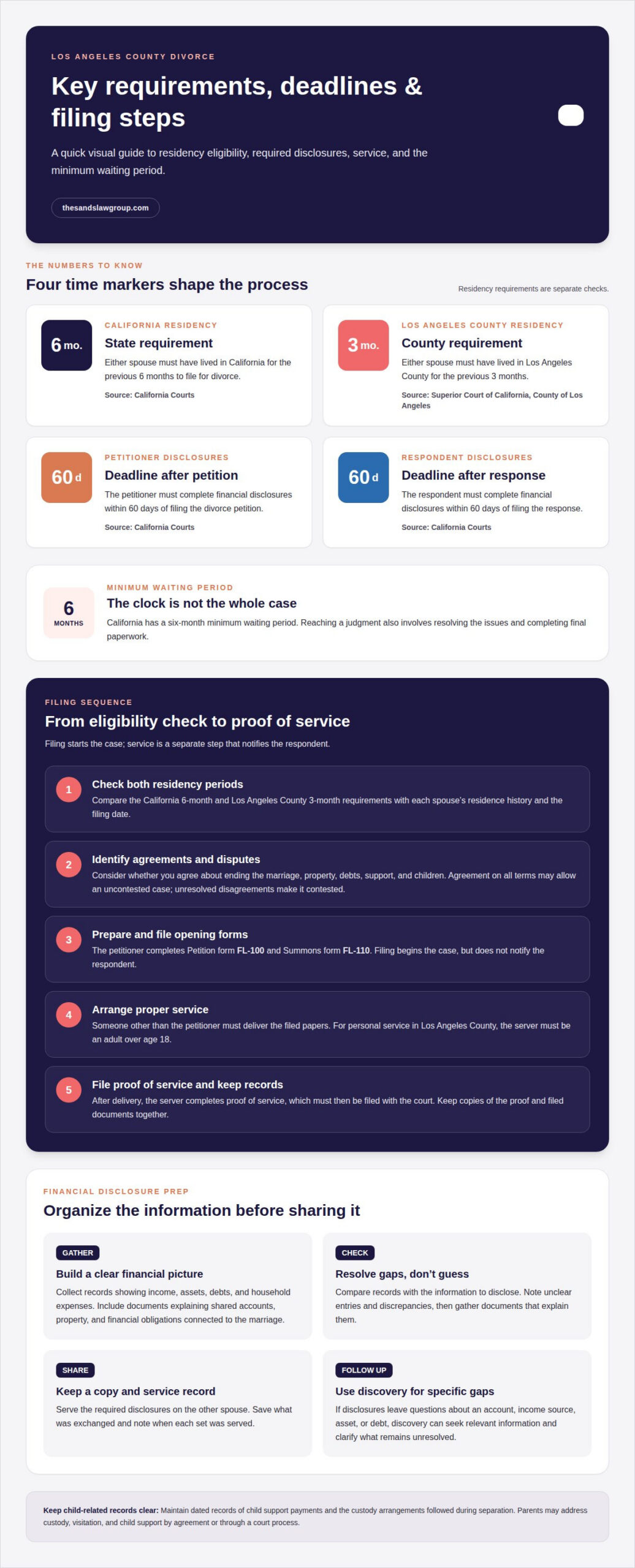
- Confirm residency before preparing a filing. According to California Courts, either spouse must have lived in California for the previous 6 months to file for divorce. The Superior Court of California, County of Los Angeles, also requires either spouse to have lived in Los Angeles County for the previous 3 months. These are separate requirements, so check both against the filing date and each spouse’s residence history.
- Identify the issues that may affect your case. List whether you and your spouse agree about ending the marriage, property, debts, support, and children. Agreement on all terms may allow an uncontested case and a settlement agreement; unresolved disputes make the case contested. If legal separation better reflects your goal, its residency periods differ from those for divorce. Summary dissolution is another route, but it is limited to eligible couples.
- Prepare the opening forms and file them with the court. The petitioner completes Petition form FL-100 and Summons form FL-110 to start a California divorce case. Filing begins the case, but it does not, by itself, notify the respondent. Keep a copy of the filed papers for service and later steps. If questions about disputed terms affect your filing choices, an attorney can help you understand the legal issues.
- Arrange proper service after filing. A person other than the petitioner must deliver the filed divorce papers to the respondent; the petitioner cannot personally serve them. For personal service in Los Angeles County, the server must be an adult over the age of 18. Provide the server with the complete service package and clear instructions, especially if the respondent’s address or availability creates practical complications.
- Complete proof of service and preserve the record. After delivering the papers, the server completes proof of service, which must then be filed with the court. Proper service is an important step in moving a divorce case forward. Keep copies of the proof and filed documents together, and confirm the record shows how and when service occurred. If the respondent files a response, that filing becomes part of the case record.
Financial disclosures
Financial disclosures help both spouses understand the marriage’s finances. Organize the information carefully, since incomplete or inconsistent records can complicate settlement discussions or a court hearing.
-
Gather financial information
Collect records showing income, assets, debts, and household expenses, then arrange them by category. Include documents that explain shared accounts, property, or financial obligations connected to the marriage. Compare each record with the information you plan to disclose, and note gaps or unclear entries rather than guessing. Discovery can help address unanswered questions by requesting relevant financial information.
-
Share financial disclosures
Prepare and serve the required financial disclosures on the other spouse, and keep a copy of what you provide. California Courts says the petitioner must complete financial disclosures within 60 days of filing the divorce petition. The respondent must complete disclosures within 60 days of filing the response. Track each deadline from the relevant filing or service event, and retain proof showing when disclosures were served.
- Review the information for consistency before sharing it. Check that account statements, income records, and debt documents describe the same financial circumstances. If figures differ, identify the discrepancy and gather documents that explain it. Clear, organized disclosures make it easier for both spouses to discuss property division, support, and settlement terms using the same financial information.
- Use discovery to address specific gaps. If a spouse’s disclosures leave questions about an account, income source, asset, or debt, identify the missing information and organize related records. Discovery is a process for seeking relevant information and can clarify what remains unresolved before settlement discussions or a hearing. Keep requests focused on issues that affect financial decisions, rather than collecting documents without a clear purpose.
- Keep a disclosure record through the case. Save the documents exchanged, note when each set was served, and preserve updated information when circumstances change. Before relying on a proposed settlement agreement, compare its financial terms with the records and disclosures available. If questions about disclosure obligations or disputed financial information affect your case strategy, discuss your divorce disclosure concerns with counsel.
Records of child support payments and custody arrangements
- Organize records before discussing parenting terms with your spouse. In a California divorce, parents decide custody, visitation, and child support by agreement or through a court process. Keep detailed records of support payments and the custody arrangements followed during separation, so discussions reflect what actually occurred.
- Keep parenting decisions distinct from property, debt, and spousal support issues. Spouses address these matters by agreement or through a court process. Child-related arrangements may be considered alongside financial matters, but remain separate from dividing assets and debts.
- Log every child support payment in one consistent record. For each payment, note its date, amount, method, and whether you received confirmation, then save related receipts or account records. If a payment was missed or differed from the expected amount, record that fact without changing the entry later. A clear chronology can help explain the payment history during negotiations or a court proceeding.
- Document the custody and visitation schedule actually followed. Record the dates children stayed with each parent, exchange details, and any agreed changes. For example, if a scheduled visit changed by agreement, note both the original plan and what happened. Keep entries factual and focused on the children’s schedule, rather than adding conclusions about your spouse.
- Preserve messages that clarify parenting or support arrangements. Save communications confirming a schedule change, payment, or agreement about child care. Keep them with the related calendar entry or payment record so each item has context. If the parents’ accounts differ, retain the original messages instead of relying on memory or rewriting the exchange.
- Use the appropriate court forms if you need a custody order. A parent seeking a court order on custody can file Form FL-300, a Request for Order. Form FL-311 is the California custody and visitation application form identified for these requests. Organize the records around the parenting or support issue being raised, and keep copies of the forms and supporting materials together.
- Review the record before proposing a settlement agreement. Compare the requested custody schedule with the pattern documented during separation, and distinguish existing child support payments from proposed terms. If you and your spouse agree, written terms can address child care, custody, visitation, and support. If disagreements remain, organized records can help define the issues for the court process.
California residency and waiting-period requirements
Residency eligibility and the mandatory waiting period affect when a California divorce can proceed and become final. Include both in your timeline before making plans around a court date or final judgment.
-
Meet California residency requirements
Confirm that California and Los Angeles County residency requirements are met before filing, using either spouse’s residence history. These are separate checks, so meeting one does not replace the other. If neither spouse meets the divorce residency periods, California legal separation may be an alternative. It follows the same steps as divorce, but the divorce-specific residency periods do not apply.
-
Account for the waiting period and timeline
Mark the petition filing date as the start of California’s mandatory divorce waiting period. A Los Angeles divorce cannot be finalized in less than six months from the date the petition is filed. That is a minimum, not a completion estimate: unresolved issues, required decisions, and final paperwork affect when the judgment can be completed.
- Build your case timeline around the issues that remain open. In an uncontested divorce, spouses agree on the terms, but they still need to complete the required process and submit final paperwork. An uncontested Los Angeles divorce can generally be finalized in around six to eight months. The six-month minimum still applies, so agreement alone does not make the divorce final immediately.
- Track service and filing milestones separately from the waiting period. Divorce judgment papers may be submitted 31 days after the spouse has been served, but that milestone does not shorten California’s six-month minimum. Record the petition filing date and service date independently; each relates to a different procedural step and helps prevent confusion when planning submissions.
- Use unresolved family law issues to assess whether your expected timeline needs adjustment. Spouses may need to settle property, debts, child care, and support by agreement or through a court process. Any disputed issue still needs a decision before the final paperwork can reflect the outcome. Keep a written list of open questions and agreements so the next procedural step is clear.
- Consider legal separation if remaining married is your intended outcome. California legal separation has no six-month waiting period, although the process otherwise follows the same steps as divorce. It does not end the marriage. Choose the case type based on the outcome you need, because the distinction determines whether the marriage is legally dissolved.
- Revisit your timeline when an agreement or court decision changes your case’s status. The waiting period sets the earliest point for finalization, while completing required decisions and paperwork determines what remains. Keep copies of filed documents and note each milestone, so your planning reflects the case’s actual progress.
Where Los Angeles County divorce records are kept
Start with the courthouse assigned to the case; Los Angeles County family law matters are handled at 12 courthouses, depending on residence and filing issue. Central Los Angeles divorce filings normally transfer to the County Record Center (Archives) within two to three years of filing.
The Los Angeles Superior Court filing fee for divorce forms is $435.00 unless the filer qualifies for a fee waiver. A person starting a divorce case must pay the filing fee or request a fee waiver.
- Identify the courthouse connected to the case before seeking records. Los Angeles County family law matters are assigned among 12 courthouses based on where a person resides and the issue being filed. Use the case paperwork to identify the filing location, then keep the courthouse name with your case information. This first step helps distinguish an active court file from older Central Los Angeles filings transferred to the County Record Center (Archives).
- For a Central Los Angeles case filed within the past two to three years, begin with the assigned courthouse. Central Los Angeles divorce filings normally transfer to the County Record Center (Archives) within two to three years of filing. Use the filing date to determine which location to approach first. Keep the case number and party names together when making an inquiry.
- For an older Central Los Angeles filing, account for the County Record Center (Archives). The normal transfer window is within two to three years after filing, so older records may be held there rather than at the original courthouse. Preserve the filing date and courthouse details to help connect an archived dissolution record with the correct case. A legal separation or divorce settlement may also appear in the case history.
- Keep a copy of each record request and any response. Organize documents by filing date and case event, such as the petition, a response, or final paperwork. If the respondent filed no response, preserve the papers showing the case’s procedural history rather than assuming the absence of a response means the divorce is final. The court’s final paperwork determines whether the dissolution is complete.
- Plan for the filing fee when starting a case. The Los Angeles Superior Court filing fee for divorce forms is $435.00 unless the filer qualifies for a fee waiver. If you need a waiver, request one instead of paying the fee; keep the request with your filing records so the fee decision is documented.
- If locating a record or understanding its place in your divorce case affects your next steps, schedule a conversation about your divorce records.
The Sands Law Group, APLC: Divorce Legal Representation
The Sands Law Group, APLC provides Divorce Legal Representation when filing requirements, disclosures, or disputed terms make the next step difficult to assess. The firm also handles Child Custody and Visitation Representation, Spousal Support Representation, and Property Division Representation when these matters shape your separation or settlement.
Consider legal guidance when you and your spouse disagree about parenting arrangements, financial support, or dividing property, or when you need help understanding how these issues affect your case. A focused discussion can clarify the decisions ahead and the records relevant to them.
Contact The Sands Law Group, APLC to discuss your divorce and the issues you need to resolve.
Choose a Clear Next Step
You do not need to resolve every question at once. Begin by identifying what remains uncertain, whether it concerns case strategy, a proposed agreement, or protecting your family’s interests as arrangements change. A focused conversation can help clarify which issues need attention now and what information will support a considered decision.
The Los Angeles County divorce process involves personal and practical choices that can be difficult to separate. The Sands Law Group, APLC provides Divorce Legal Representation, Child Custody and Visitation Representation, and Spousal Support Representation for people seeking guidance with these matters in Los Angeles, Riverside, San Bernardino, and Kern. You can discuss the circumstances shaping your next step without having every detail settled beforehand.
Contact The Sands Law Group, APLC to discuss your situation and consider a path forward that reflects your priorities. Clear guidance can help you approach the decisions ahead with greater steadiness.
Frequently Asked Questions
When Is Your Case Finished?
Your divorce is finished when the court completes the final paperwork after all issues have been decided. Filing the petition, serving papers, or reaching an agreement does not complete the divorce on its own. For example, spouses who settle property and parenting terms still need to submit the required final documents. Keep the filed judgment and related paperwork together to distinguish a completed case from one still in progress.
What are the steps to file for divorce in Los Angeles County, California?
To begin the Los Angeles County divorce process, confirm residency, prepare and file the opening papers, and arrange service. The petitioner starts with a petition and summons; another adult serves the respondent, and proof of service is filed. Next, spouses exchange financial disclosures and resolve property, support, and parenting issues by agreement or through a court process. After all issues are decided, submit the final paperwork.
What residency requirements apply to divorce in Los Angeles County?
Either spouse must have lived in California for the previous 6 months, according to California Courts, and in Los Angeles County for the previous 3 months, according to the Superior Court of California, County of Los Angeles. The residence history of either spouse may satisfy these requirements. If you are considering filing soon after a move, compare the relevant dates with your planned filing date before preparing the case.
Where do you file divorce papers in Los Angeles County, and can you file online?
Los Angeles County family law cases are assigned to 12 courthouses based on residence and the issue being filed. Divorce forms may be filed in person or by mail, and online filing may also be available. Use your residence and case type to identify the appropriate filing location rather than choosing a courthouse solely for convenience. Keep confirmation of the filing method and the case number with your records.
What forms are required to start a divorce in California?
The petitioner uses Petition form FL-100 and Summons form FL-110 to start a California divorce case. Prepare both as part of the opening paperwork, and retain copies of the completed forms and filed versions. Additional forms depend on the issues involved; for example, a parent seeking a custody order can use Form FL-300, with Form FL-311 identified for custody and visitation requests. Keep later requests distinct from starting forms.
How do you serve divorce papers in California, and what are the deadlines?
Someone other than the petitioner must deliver the filed divorce papers to the respondent, and proof of service must be filed with the court. For personal service in Los Angeles County, the server must be an adult over the age of 18. The respondent has 30 calendar days after receiving the summons paperwork to file a formal response. Record the service date, since it helps track the response deadline.
How long does a Los Angeles County divorce take, including the six-month waiting period?
The Los Angeles County divorce process has a minimum six-month period from the petition filing date before a divorce can be finalized. An uncontested Los Angeles divorce can generally take around six to eight months, while unresolved disputes can extend the timeline. The waiting period is only one part of the schedule: spouses must also resolve case issues and submit final paperwork. Track progress by the filing date and the decisions that remain.
What happens if a spouse does not respond to divorce papers in Los Angeles County?
If the respondent does not file a response within 30 calendar days after receiving the summons paperwork, the case does not become final automatically. The petitioner still needs to complete the remaining steps and submit final paperwork after the issues have been decided. Preserve proof of service and the filed documents, since they establish the procedural history. A lack of response also does not itself resolve questions about property, support, or children.

Article by
Thomas D. Sands, Esq.
Thomas D. Sands is the founder and CEO of The Sands Law Group, APLC. A California attorney with more than two decades of experience, he represents clients in divorce and family law matters as well as civil litigation and real property disputes. His approach emphasizes attentive, practical, and cost-conscious representation.
Sands is a 2023 Litigator of the Year honoree of the American Institute of Trial Lawyers and a 2023 Lawyer of the Year honoree of the American Institute of Legal Professionals. His firm has also received recognition among the 2025 Best Law Firms in America, a 2026 Benchmark Best of award, and a 2026 Law Firm of the Year honor.
Article reviewed by
Thomas D. Sands, Esq.
Thomas D. Sands is the founder and CEO of The Sands Law Group, APLC. A California attorney with more than two decades of experience, he represents clients in divorce and family law matters as well as civil litigation and real property disputes. His approach emphasizes attentive, practical, and cost-conscious representation.
Sands is a 2023 Litigator of the Year honoree of the American Institute of Trial Lawyers and a 2023 Lawyer of the Year honoree of the American Institute of Legal Professionals. His firm has also received recognition among the 2025 Best Law Firms in America, a 2026 Benchmark Best of award, and a 2026 Law Firm of the Year honor.
TOLL-FREE: 855-SANDS4U