
An emergency custody request is meant to address an urgent risk to a child, not simply to revisit a difficult custody dispute. In Los Angeles, a parent may ask a judge for temporary orders through an ex parte process, which can allow a decision before a regular hearing when a child faces immediate danger, a serious risk of abduction, or another urgent need for protection. An emergency custody order in Los Angeles is temporary, and the court must set a full hearing within 20 days when it grants temporary custody ex parte, according to the California Legislature.
It’s understandable to want immediate clarity when your child’s safety or stability feels at risk. The challenge is presenting specific, credible facts that support urgent action while meeting notice, filing, and service requirements that can affect what happens next.
This guide explains what an emergency custody order can do, which circumstances may qualify in California, and what evidence can support a request. It also covers the filing process, when personal service is required, and how the follow-up hearing fits into a longer custody matter, so you can approach the next steps with greater clarity.
Key Takeaways
- Emergency orders are temporary measures for urgent child-safety concerns, not a substitute for resolving the full custody dispute.
- Specific, dated facts and supporting evidence help explain why immediate court action is needed.
- The filing process involves required court forms, notice, and procedures that can affect how the request is considered.
- Personal service rules matter; learn who may serve the papers and what must be delivered to the other parent.
- California eligibility turns on the urgency and nature of the risk, so understanding the legal threshold can help clarify whether an emergency request fits your situation.
What Are Emergency Custody Orders?
A California emergency custody order is temporary relief a judge may consider through an ex parte process. The request must address an immediate risk and is followed by a court hearing.
-
Review Emergency Request Timelines
Identify the immediate risk and the court date before preparing an emergency request. Under California Rule of Court 3.1203, notice to the other party is due by 10:00 am on the court day before an ex parte appearance, according to the Judicial Council of California. A court day is generally a weekday when the court is open, excluding court holidays.
For the filing-cost question, the emergency-order request filing fee is $60 unless the filer has a fee waiver.
-
Work With an Attorney for the Ex Parte Hearing
Prepare a concise account of the immediate risk, the order requested, and the facts supporting urgency. At an emergency custody hearing, the judge may decide the request from the papers alone or require both parents to appear, under California Rule of Court 5.169.
Be prepared to explain why waiting for a regular hearing could expose the child to harm. The judge reviews the request and may issue temporary orders, but an ex parte decision does not resolve the full custody dispute.
-
Plan Follow-Up After the Ex Parte Order With Your Attorney
Record the follow-up hearing date and identify what the temporary order requires each parent to do. When a California court grants temporary custody ex parte, it must set a full hearing within 20 days, according to the California Legislature.
Use the follow-up hearing to address the longer-term custody arrangement and respond to the other parent’s position. The judge may continue the temporary terms, change custody or visitation, or dismiss the emergency order and restore the prior arrangement.
-
Have Papers Served Before the Hearing
Arrange service promptly and keep the hearing deadline in view. Unless the judge sets a different deadline, the other side must be personally served at least 16 court days before the hearing. Emergency papers also must be served as early as reasonably possible before the court considers the request.
Notice and service are related but distinct steps. If immediate notice could frustrate the order’s purpose or cause immediate harm, a judge may shorten or waive notice for good cause shown in a sworn declaration. Follow the court’s specific instructions for your case.
Facts and evidence supporting an emergency request
Build the request around specific facts showing immediate harm, not general conflict over a custody arrangement. An attorney may submit dated records, declarations, and evidence gathered through discovery. If the judge denies emergency relief, the requested temporary safeguards may not take effect, and the underlying custody issue will need to proceed through the court process.
-
Identify Immediate Harm
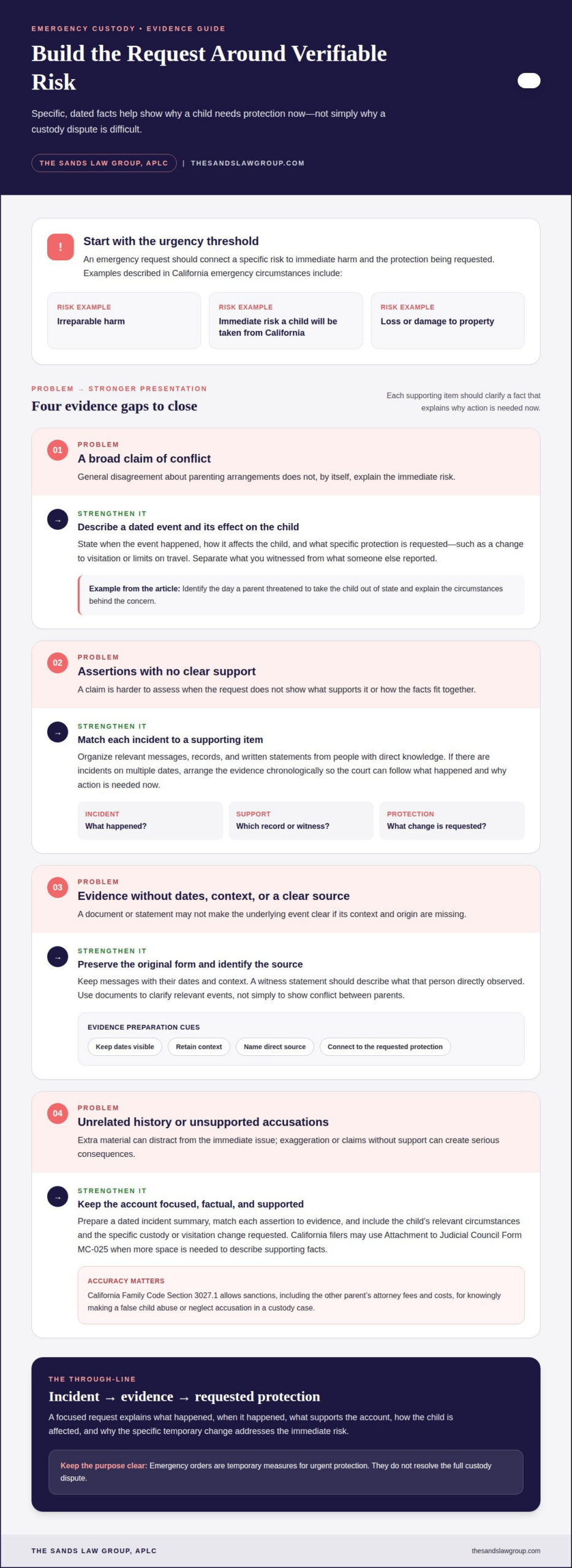
Describe the event creating urgency, when it happened, and how it affects the child. California emergency circumstances can include irreparable harm, an immediate risk that a child will be taken from California, or loss or damage to property. Connect each fact to the protection requested, such as a change to visitation or limits on travel.
A dated example is more useful than a broad claim. Identify the day a parent threatened to take the child out of state and explain the specific circumstances behind your concern. Keep the account factual, and distinguish what you witnessed from what someone else reported.
-
Work With an Attorney to Gather Supporting Evidence
Organize documents that support each incident, such as relevant messages, records, or written statements from people with direct knowledge. If the request involves harm on multiple dates, arrange the evidence chronologically so the court can follow what happened and why action is needed now.
A family law lawyer can assess which materials support the requested order and how to present them clearly. Avoid exaggeration or unsupported accusations; California Family Code Section 3027.1 allows sanctions, including the other parent’s attorney fees and costs, for knowingly making a false child abuse or neglect accusation in a custody case.
- Prepare a dated incident summary and match each assertion to a supporting item. Include the child’s relevant circumstances, the immediate risk, and the specific custody or visitation change requested. California filers may use Attachment to Judicial Council Form MC-025 when more space is needed to describe facts supporting an emergency request.
Use supporting documents to clarify events, not to add unrelated history. Explain how a recent incident affects the child’s safety or stability, then identify the record or witness that supports your account. A focused explanation helps distinguish urgency from ordinary disagreement about parenting arrangements.
- Preserve evidence in its original form and identify its source. Messages should retain dates and context; a witness statement should describe what the person directly observed. Discovery before a California custody hearing may involve documents, affidavits, and depositions, helping develop the broader record beyond the immediate emergency request.
Consider whether each item supports a particular fact, rather than submitting material simply because it reflects conflict between parents. To discuss how evidence may fit an emergency custody request, arrange a conversation about your evidence.
Filing emergency custody paperwork at the courthouse
California emergency filings require accurate forms, supporting documents, and attention to court deadlines. A lawyer can prepare and file the request while you provide the facts and records needed to explain the immediate concern.
-
Have an Attorney Prepare Emergency Custody Forms
Ask an attorney to prepare Request for Order form FL-300, the first filing for emergency custody. If no UCCJEA declaration was previously filed, include form FL-105. The proposed Temporary Emergency (Ex Parte) Orders form is FL-305; FL-306 may also be used for a proposed order.
Check that the requested terms match the facts and that every required field is completed. On page one of FL-300, item 7 indicates whether temporary emergency orders were granted. California’s emergency-orders rules are California Rules of Court 5.151 through 5.169.
-
Have an Attorney File the Emergency Request
Your attorney can submit the completed papers to the appropriate California court and follow its emergency filing process. A Los Angeles request may be reviewed on the same or next court day. The court may decide the request from the papers or require both parents to appear.
For the filing-cost question, the emergency-order request filing fee is $60 unless the filer has a fee waiver. Prepare an original and two copies of the forms. If the request involves finances, include Income and Expense Declaration form FL-150.
An attorney can manage preparation and filing, so you do not have to handle courthouse submission yourself. You still need to provide accurate information, relevant documents, and clear instructions about the custody terms you are seeking.
-
Have an Attorney Check Timing and Documentation
Ask the attorney to review notice, service, and filing deadlines together. Notice and service requirements for emergency requests can be exacting, so review them carefully. Rule 3.1204 specifies notice information, while Los Angeles Superior Court form FAM-075 is the Declaration Regarding Notice form.
After service, use FL-330 as the proof of personal service. File the original and a copy at least 5 court days before the hearing. A server must be at least 18 years old and not part of the case.
Include the required papers for service, including FL-305 and a blank Responsive Declaration to Request for Orders, form FL-320. The court’s notice and service requirements can be exacting; discuss filing support with an attorney to plan the paperwork and timing.
California courts may reject or delay papers with missing forms, inconsistent requests, or incomplete service proof. For example, an FL-300 request should align with the proposed terms in FL-305. The attorney can also check that the declaration explains the urgency and supports each requested order.
When temporary emergency orders require personal service
A temporary emergency order can set immediate custody or visitation terms, but it does not settle the long-term arrangement. Service and the follow-up hearing give each parent an opportunity to address those temporary terms.
- Confirm which papers must be served and who should receive them. In California, a parent must personally serve the other parent with certified court copies of forms FL-300 and FL-305. If the other parent or spouse has a lawyer in the case, the server must hand the papers to that lawyer instead.
Service is separate from giving advance notice of an ex parte request. California Rule of Court 5.167 requires emergency request papers to be served as early as reasonably possible before the court considers the request. Form FL-303 records notice and service information for a temporary emergency order.
- Choose a server who meets California’s requirements. The server must be at least 18 years old and cannot be a party to the case. The server completes form FL-330 as proof of personal service; the requesting parent should preserve that completed record for filing.
For example, if a parent serves FL-300 and FL-305, the proof should show which documents were delivered and to whom. If the recipient refuses to take the papers, the server may leave them nearby and explain what they are. Follow the court’s directions about filing proof and serving any additional papers.
- Calendar the full hearing as soon as the court sets it. When a California court grants temporary custody ex parte, it must set a full hearing within 20 days, according to the California Legislature. Unless the judge sets a different deadline, personal service must occur at least 16 court days before that hearing.
The temporary order remains subject to the court’s next decision. At the full hearing, the judge may continue the temporary order, change custody or visitation terms, or dismiss the order and restore the prior arrangement. A divorce or custody case may continue after the emergency hearing.
- Use the follow-up hearing to address the child’s best interests and the practical effect of each temporary term. When issuing temporary custody orders, the court must consider whether visitation should be suspended, denied, or supervised. Be prepared to explain why a particular arrangement protects the child and how the requested terms address the concerns raised.
Keep the signed temporary emergency order and hearing notice together, then follow every condition until the court changes it. Emergency orders are temporary and may expire within a few weeks unless extended. A continuing custody dispute may require further court proceedings to establish longer-term terms.
Emergency custody order eligibility in California
- Compare the situation with California’s emergency threshold. An emergency request generally concerns immediate danger to a child, serious abduction risk, or another urgent need for protection. California Family Code section 3064 addresses temporary emergency orders intended to help prevent immediate harm to a child.
In Los Angeles County, disagreement about a regular custody or visitation arrangement is not, by itself, evidence of immediate danger. Explain what happened, why the risk is current, and what temporary order would address it. The judge decides whether the facts justify emergency relief.
- Identify the concrete risk and the child’s connection to California. A request may be made in California family court when the child is in California, even if the primary custody case is in another state. This does not determine which state has jurisdiction over longer-term custody issues.
Under the UCCJEA, the child’s home state is generally the state where the child lived for the six months before the case began, according to the California Legislature. Give the attorney the child’s residence history and any information about an existing case, so jurisdiction is considered alongside the immediate request.
- Consider whether the facts show an urgent need for protection, rather than a future concern that can wait for a regular hearing. Examples under the stated California criteria include a serious risk that the child will be taken from the state or facts indicating immediate harm. Connect each event to the temporary order requested.
California custody or visitation emergency requests must meet California Rule of Court 5.151. A declaration should explain the situation clearly and identify why ordinary court timing would not address the immediate risk. An attorney can help distinguish relevant facts from background conflict that does not establish urgency.
- Include firearm access in the facts considered. Since January 1, 2025, California judges must consider whether a parent has illegal access to firearms or ammunition when deciding an emergency custody request. If this is relevant, tell the attorney what specific information supports the concern and how it relates to the child’s safety.
Eligibility depends on the circumstances presented, not simply on filing a motion or describing a dispute as urgent. A judge may grant a temporary order when the evidence supports immediate protection; the later hearing addresses the continuing custody arrangement. To discuss how the facts may fit the California standard, schedule a custody-order consultation.
The Sands Law Group, APLC: Child Custody and Visitation Representation
The Sands Law Group, APLC provides Child Custody and Visitation Representation for parents facing urgent custody concerns or an ongoing dispute. Legal guidance can help assess whether the facts support an emergency request, organize evidence, and prepare for the hearing and later custody proceedings.
Consider legal representation if you need help presenting immediate safety concerns, responding to an emergency request, or addressing how temporary orders affect an existing parenting arrangement. If custody issues arise during a divorce, the firm also provides Divorce Legal Representation.
To discuss your custody situation and possible next steps, contact The Sands Law Group, APLC.
Take the Next Step Toward a Clear Plan
An urgent custody dispute can reshape daily life, but careful thought is needed beyond the immediate crisis. Consider what stability should look like for your child, which concerns need attention first, and how temporary decisions fit into a lasting parenting arrangement. A focused legal strategy can help you approach those choices with purpose.
The Sands Law Group, APLC provides Divorce Legal Representation, Child Custody and Visitation Representation, and Spousal Support Representation. If you are considering an emergency custody order in Los Angeles, the firm can help you evaluate the legal path and related family-law issues.
You don’t need to map every future decision before taking a first step. A conversation can help clarify your priorities and the questions that deserve attention now. Contact The Sands Law Group, APLC to discuss your circumstances and possible next steps.
With a clear plan and steady guidance, you can move forward with greater confidence and focus on your child’s well-being.
Frequently Asked Questions
Are There Consequences for False or Exaggerated Claims?
Knowingly making a false child abuse or neglect accusation in a custody case can lead to sanctions under California Family Code Section 3027.1, including the other parent’s attorney fees and costs. Keep statements accurate, distinguish firsthand observations from information others provided, and avoid presenting assumptions as facts. In Los Angeles County, a focused, truthful account helps the court assess the actual safety concern and the orders requested.
Can Notice to the Other Parent Be Waived?
A judge may shorten or waive notice for good cause shown in a sworn declaration. Relevant circumstances include notice that could frustrate the request’s purpose or cause immediate and irreparable harm. Explain specifically why advance notice creates that risk, rather than treating urgency alone as a reason to omit notice. If the court changes notice requirements, follow its directions for serving papers and attending the hearing.
How Do You Stop a Parent From Taking Your Child Out of California?
You can ask the court for an order prohibiting a parent from removing the child from California or specified counties. A child abduction prevention request may use form FL-312. Explain the facts behind the travel concern, such as statements or actions indicating a planned departure, and identify the geographic restriction sought. The court evaluates the request and decides whether the requested safeguard is appropriate.
What Usually Does Not Qualify?
A routine disagreement about parenting time, communication, or a proposed schedule generally does not, by itself, show the immediate danger or urgent need for protection associated with emergency relief. Frustration over a missed exchange, for example, may need to be addressed through the regular custody process, though the surrounding facts matter. Describe any specific safety concern separately, including its timing and effect on the child, rather than relying only on parental conflict.
What if my spouse or the other parent has a lawyer?
If the other parent or spouse has a lawyer in the case, California service instructions require the server to hand the papers to that lawyer instead. Give the attorney preparing your case the other lawyer’s identifying information and any relevant case details. The person serving documents must still meet the applicable requirements, including being at least 18 years old and not a party to the case.
What is form FL-305?
Form FL-305 is California’s Temporary Emergency (Ex Parte) Orders form. It sets out the temporary orders a judge grants, so the signed version matters: read its terms carefully and follow them while they remain in effect. For example, check which custody or visitation provisions the order actually addresses. A proposed FL-305 is not the same as an order signed by the judge.
What is an emergency custody order in California?
An emergency custody order is a temporary court order addressing an urgent child-safety or protection concern before the court resolves the broader custody dispute. A parent requests emergency relief through an ex parte process, and the judge may grant temporary terms based on the circumstances presented. The order does not decide every long-term parenting issue; later proceedings address the continuing custody arrangement and each parent’s position.
How Can a Lawyer Help Me Request Emergency Custody Orders in Los Angeles County?
A family law attorney can assess how the facts relate to the requested custody terms, organize supporting records, prepare court papers, and represent a parent in custody proceedings. The Sands Law Group, APLC provides Child Custody and Visitation Representation. Its website content is for general informational purposes only and does not constitute legal advice. Contacting the firm does not create an attorney-client relationship until a formal agreement is executed.

Article by
Thomas D. Sands, Esq.
Thomas D. Sands is the founder and CEO of The Sands Law Group, APLC. A California attorney with more than two decades of experience, he represents clients in divorce and family law matters as well as civil litigation and real property disputes. His approach emphasizes attentive, practical, and cost-conscious representation.
Sands is a 2023 Litigator of the Year honoree of the American Institute of Trial Lawyers and a 2023 Lawyer of the Year honoree of the American Institute of Legal Professionals. His firm has also received recognition among the 2025 Best Law Firms in America, a 2026 Benchmark Best of award, and a 2026 Law Firm of the Year honor.
Article reviewed by
Thomas D. Sands, Esq.
Thomas D. Sands is the founder and CEO of The Sands Law Group, APLC. A California attorney with more than two decades of experience, he represents clients in divorce and family law matters as well as civil litigation and real property disputes. His approach emphasizes attentive, practical, and cost-conscious representation.
Sands is a 2023 Litigator of the Year honoree of the American Institute of Trial Lawyers and a 2023 Lawyer of the Year honoree of the American Institute of Legal Professionals. His firm has also received recognition among the 2025 Best Law Firms in America, a 2026 Benchmark Best of award, and a 2026 Law Firm of the Year honor.
TOLL-FREE: 855-SANDS4U