
Military status doesn’t erase California’s residency rules, but it can affect which filing path applies. Generally, one spouse must have lived in California for six months and in the filing county for three months, according to California Courts. A military divorce attorney in San Bernardino can help clarify how those rules apply when a service member is stationed in California or a spouse has recently moved.
It’s understandable to want a clear answer about where to file before making decisions about support, parenting, and retirement. Filing is only one part of a military divorce: compensation, pension division, Survivor Benefit Plan coverage, and protections for active-duty members can also shape the case.
This article covers residency requirements, how military pay may affect child support, and what to understand about custody, retirement benefits, and the Servicemembers Civil Relief Act (SCRA). Knowing the key rules can help you approach these decisions and understand when legal representation may be useful.
Key Takeaways
- Military housing and subsistence allowances may affect child support calculations, so understand how military compensation is evaluated alongside other income.
- TRICARE describes the 20/20/20 rule as requiring 20 years of marriage, 20 years of military service, and 20 years of overlap; those conditions can affect former-spouse coverage.
- Retirement division and Survivor Benefit Plan coverage are separate issues, and both may need careful attention in a divorce agreement.
- Under the SCRA, an active-duty service member who meets the requirements is entitled to at least one 90-day stay of divorce proceedings, according to the United States Congress.
- Military deployment can complicate parenting arrangements, so address custody and visitation in a way that accounts for the child’s needs and the service member’s circumstances.
What Are the Residency Requirements for Military Divorce in California?
California residency rules determine whether you can file for divorce in the state and county. Military service can affect the filing analysis, but it does not automatically resolve the residency question.
California Courts states that a spouse generally must have lived in California for 6 months and in the filing county for 3 months. For a military divorce in California, either spouse must meet the state’s residency requirements or the service member must be stationed in California.
When comparing military divorce attorneys in San Bernardino County, consider whether they can clearly explain residency, military service, and property issues. Look for practical answers about how these factors affect filing and the next steps in your case.
In a consultation, ask which spouse’s residence may support filing, how county requirements apply, and which federal rules could affect your case. Also discuss how the attorney would address military benefits and California property division.
California Residency Rules
A residency review considers where each spouse has lived and where the divorce may be filed. A service member stationed in California may have a different filing path from a spouse relying on California residence.
Before choosing where to file, determine whether either spouse meets the state and county residency periods. This distinction can matter when a service member has moved during active duty, because residence and duty station may not be the same.
Residency and Court Jurisdiction
Residency and court jurisdiction are related, but they are not interchangeable. State and county residency requirements address where a divorce may be filed. A service member’s stationing in California is also relevant under the military-divorce filing rule.
When assessing jurisdiction, clarify which spouse’s connection to California may support the case and which county is under consideration. This frames the filing question before you address property, support, and other divorce issues.
California and Federal Divorce Laws
California law governs state residency requirements and property division, while federal law also affects military divorce. The Uniformed Services Former Spouses’ Protection Act (USFSPA) governs the division of military retirement pay.
These rules apply to different parts of a case. A military divorce attorney in San Bernardino can assess how the filing location, federal retirement rules, and California property issues fit together, including whether military benefits are part of the division analysis.
California property division is often summarized as 50/50 on paper. The practical analysis focuses on identifying community property and separating it from other assets and debts. A clear inventory helps keep property questions distinct from military retirement questions, which are governed by federal rules.
Before filing, organize the key facts for legal review: each spouse’s California residence, the county connection, and the service member’s duty station. These details help clarify possible filing options and keep residency questions separate from decisions about property and military benefits.
Military income and child support calculations
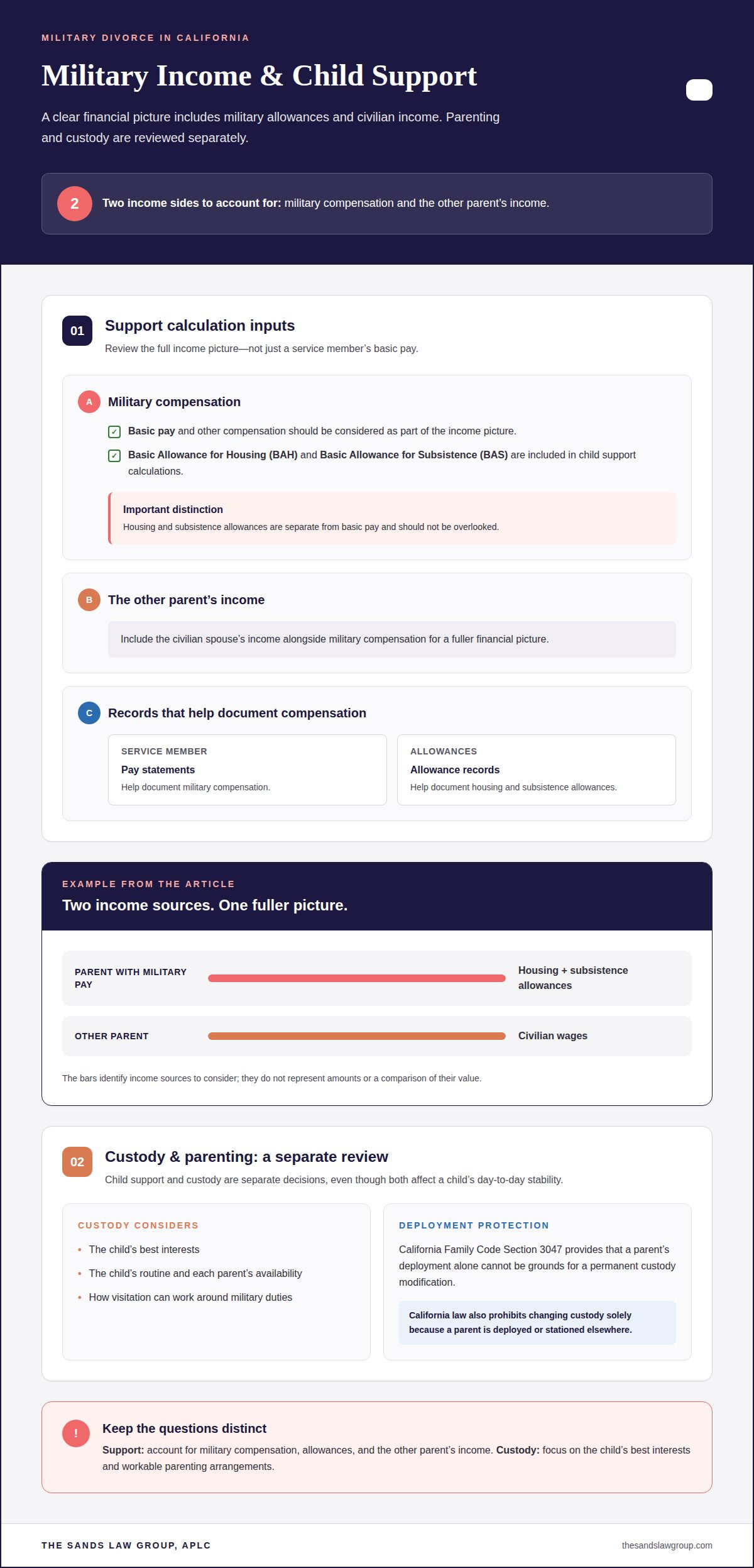
Military compensation can include more than regular pay, so a child support review should consider the full income picture. Basic Allowance for Housing and Basic Allowance for Subsistence are included in child support calculations. For a service member stationed in California, these allowances may matter alongside other income considered in the case.
Military and civilian spouses may receive income in different forms. A clear financial review identifies each source and how it relates to support. Pay statements and allowance records can help document a service member’s compensation, while the other spouse’s income provides additional context.
For example, if one parent receives housing and subsistence allowances while the other earns civilian wages, the calculation should account for both. The allowances should not be overlooked because they are separate from basic pay. Accurate information gives the court a fuller picture when assessing support.
Child support and custody are separate decisions, even though both affect a child’s day-to-day stability. California courts determine custody based on the child’s best interests. A parenting plan should address practical matters such as the child’s routine, each parent’s availability, and how visitation can work around military duties.
Deployment creates a particular concern for parents who fear losing time or decision-making authority. California Family Code Section 3047 provides that a parent’s deployment alone cannot be grounds for a permanent custody modification. California law also prohibits changing custody solely because a parent is deployed or stationed elsewhere. These protections do not remove the need to address the child’s needs and workable parenting arrangements.
A custody and support review can organize the issues around concrete information:
- Identify military compensation, including housing and subsistence allowances.
- Include the civilian spouse’s income in the financial picture.
- Describe how deployment or stationing affects the existing parenting schedule.
- Keep support calculations separate from custody decisions, while considering the child’s needs in both.
These details can help distinguish a temporary scheduling challenge from a lasting change in the child’s circumstances. The focus remains the child’s best interests, not a parent’s military status alone. A careful review can also clarify how visitation may work when a service member’s duties change.
For legal guidance on these connected issues, discuss child support and custody with The Sands Law Group, APLC. A focused review can address military income, support, and parenting arrangements together.
Military pension division orders and Survivor Benefit Plan coverage
Military retirement, health coverage, and survivor protection involve separate rules. The USFSPA governs division of military retirement pay, while TRICARE eligibility and Survivor Benefit Plan coverage require their own review.
According to TRICARE, the USFSPA 20/20/20 rule requires at least 20 years of marriage, 20 years of military service, and 20 years of overlap between them. This rule is a criterion for continued TRICARE health coverage after divorce. A former spouse who does not meet those conditions may not qualify for the same continued coverage.
The 20/20/15 rule addresses a different overlap period. It applies when the marriage and military service overlap for 15 years, alongside the applicable marriage and service requirements. Under this rule, a former spouse may receive full coverage for one year and may purchase TRICARE coverage for up to three years after that initial benefit period.
Those coverage rules do not determine the former spouse’s share of retirement pay. California courts may divide a military pension even when the former spouse does not meet the 10/10 rule for direct payments from the Defense Finance and Accounting Service. The pension division and the method of payment are separate questions.
A written retirement order should clearly state the share being divided and the service period used to calculate it. The dates of marriage and military service are central to that analysis. Clear terms can reduce confusion when retirement pay becomes payable and support an enforceable division.
The Survivor Benefit Plan (SBP) is a separate consideration. It can protect a former spouse’s future financial interests by providing survivor coverage, but it is not the same as pension division. Divorce terms should clearly state whether SBP coverage is part of the intended arrangement.
Other military-related benefits also need separate treatment:
- Thrift Savings Plan: TSP accounts may be divided in a military divorce, so identify the account and address it separately from pension pay.
- VA disability benefits: California courts cannot divide VA disability benefits as property, and military disability pay cannot be treated as community property.
- GI Bill benefits: Raise GI Bill questions separately from retirement division; do not assume they follow the pension terms.
How are military benefits, including TRICARE and a military pension, affected by divorce? TRICARE eligibility depends on the applicable former-spouse criteria, while pension division is governed by the USFSPA and California community-property rules. SBP, Thrift Savings Plan (TSP) accounts, VA disability benefits, and GI Bill questions each require separate consideration, so the final terms should address them individually.
Military retirement division and the time rule
California’s time rule links the period of marriage with the period of military service when calculating a former spouse’s share. Both the overlap and the final order matter.
The Military Retirement Time Rule
The time rule uses a marital-service fraction multiplied by 50% to calculate a former spouse’s share of military retirement. The fraction reflects the portion of military service during the marriage. A divorce lawyer can help identify the relevant service and marriage periods and explain how they affect the calculation.
A key step is establishing accurate dates for the marriage and military service. If the marriage covered only part of the service member’s career, the time rule accounts for that overlap rather than treating the entire career as marital service.
Federal Pension Division
The USFSPA governs division of military retirement pay, while California courts may divide military pensions under state property rules. Federal and state law address related but distinct questions, including how an award is structured and whether direct payment is available.
Under the USFSPA 10/10 rule, the marriage must overlap with at least 10 years of the service member’s military service for direct DFAS payments. California courts may still divide a pension when the former spouse does not meet that threshold. The payment route and entitlement to a share are separate issues.
A clear order should explain how the pension share is calculated and identify the service period used. Vague dates or formulas can lead to avoidable disputes when retirement pay becomes payable. Federal pension division therefore requires careful attention to both the calculation and the written terms.
Pension and 401(k) Division
A military pension and a 401(k) are different retirement assets, so the division analysis should address each separately. The time rule applies to military retirement; a 401(k) requires an account-specific review of contributions and the period being divided.
For example, a marriage may overlap with part of a service member’s military career while a 401(k) account has its own contribution history. Keeping the records and proposed terms distinct helps avoid treating every retirement asset as though the same formula applies.
Military pensions should also be distinguished from other property in the divorce. A complete property division identifies each asset, the relevant period, and its proposed treatment. This helps show how the retirement calculation fits into the broader settlement without confusing pension division with the terms governing a separate account.
What Is The Soldiers & Sailors Civil Relief Act (SSCRA)?
The Servicemembers Civil Relief Act (SCRA), also associated with the name Soldiers & Sailors Civil Relief Act, provides protections for active-duty members responding to divorce proceedings. These protections can affect when a case moves forward and how a court handles a potential default.
Stays and Default Judgment Protections
A stay pauses proceedings, giving an active-duty service member time to respond when military duties interfere. Under the SCRA, an active-duty service member who meets the stated requirements is entitled to at least one 90-day stay of divorce proceedings, according to the United States Congress.
The SCRA also addresses the risk of a default judgment against a service member who cannot participate. Before entering a default judgment, a court must appoint an attorney to represent the member’s interests. A stay and this appointment are separate protections: a stay pauses the case, while the appointment safeguards the absent member’s interests.
For a spouse seeking a divorce, these protections do not decide the underlying issues. They affect process and timing. For example, a court may need to address a stay before proceeding with disputed matters such as property, support, or child custody.
Postponement Under SCRA
An active-duty service member may request a temporary stay while deployed or performing active service. This can matter when military responsibilities prevent meaningful participation in divorce proceedings. The court considers the request under the applicable protections, and the case may pause rather than proceed without the member.
A separate description of the SSCRA states that a judge may allow proceedings to be postponed until 60 days after the service member returns. That possible postponement is distinct from the SCRA’s at least one 90-day stay for qualifying members. The two periods shouldn’t be treated as interchangeable or automatic.
Deployment can affect a parent’s ability to attend hearings or follow an existing schedule. A stay concerns court proceedings, while custody and visitation concern parenting arrangements. Keeping these questions separate helps prevent a procedural delay from being mistaken for a permanent custody decision.
In practice, the court process should account for the service member’s duties and the other spouse’s ability to move the case forward. Relevant questions include whether the member meets the requirements for a stay, how military service affects participation, and whether a default judgment is being considered. These facts help frame the appropriate procedural response.
When a military absence may affect a divorce response or custody hearing, schedule a discussion about SCRA protections and how they relate to the proceedings.
The Sands Law Group, APLC: Divorce Legal Representation
The Sands Law Group, APLC represents clients in divorce cases involving military-related property, support, and parenting issues. Its attorneys handle filing questions, retirement division, child custody, and spousal support as connected parts of a legal strategy, so decisions in one area can be considered alongside the others.
Consider seeking legal guidance when preparing to file, responding to a divorce case, or working through an agreement involving military benefits or parenting arrangements. A military divorce attorney in San Bernardino can help explain the issues relevant to your circumstances and the decisions that may need attention.
To discuss your situation and possible next steps, contact The Sands Law Group, APLC.
Take the Next Step With a Clear Plan
A military divorce can involve decisions that reach beyond the immediate separation. Before moving forward, consider which issues most affect your family’s stability and future planning. Clear priorities can keep discussions focused, help prevent important concerns from being overlooked, and give your legal counsel a practical starting point.
Working with a military divorce attorney in San Bernardino can help you organize complex circumstances and plan a path forward. The Sands Law Group, APLC provides divorce, child custody and visitation, and spousal support representation, with guidance tailored to the issues you need to resolve.
You do not have to approach every decision without support. A conversation can help clarify your concerns and identify a practical next step, even if you do not yet have every answer.
Schedule a conversation with The Sands Law Group, APLC to discuss your circumstances. With thoughtful guidance, you can move toward the next chapter with greater clarity and confidence.
Frequently Asked Questions
Can a Military Divorce Attorney Help Me File in California If I Am Stationed Out-of-State or Overseas?
Yes. A lawyer can assess whether California may be a place to file based on a spouse’s residence or the service member’s California stationing. California’s filing rule considers residency, and military service can affect the available path. For example, an out-of-state service member may have a spouse who meets California’s residency requirements. Evaluate those connections before selecting a court rather than assuming the duty location alone determines where the divorce belongs.
What Is the Difference Between a Military & Civilian Divorce?
A military divorce can involve service-related issues such as military retirement, compensation, and protections affecting participation in court proceedings. A civilian divorce may not raise those questions. For example, deployment can create scheduling and parenting concerns, while pension division may require both California property analysis and federal rules. Spouses still need to resolve familiar family-law issues, including property, support, and custody, but military circumstances add legal and practical considerations.
How Can a Military Divorce Attorney Determine Where to File?
An attorney examines each spouse’s California residence, the county connection, and whether the service member is stationed in California. These facts can help identify a possible filing location and clarify jurisdiction questions. For instance, one spouse may satisfy California’s residence requirement while living in a different county from the other. The attorney can assess county filing eligibility and explain how military status affects the filing analysis before the case proceeds.
What does a military divorce attorney in San Bernardino County handle?
A military divorce attorney can represent a spouse through divorce issues involving property, support, custody, and visitation. The Sands Law Group, APLC handles divorce representation, child custody and visitation representation, spousal support representation, and property division representation. Those services can be relevant when military retirement or a changing duty schedule complicates family decisions. The firm serves clients in San Bernardino and nearby Los Angeles, Riverside, and Kern counties.
How do California divorce laws apply to active-duty service members?
California’s divorce rules apply to active-duty members when the state has a basis to hear the case, and military status can add federal considerations. For example, California residency requirements inform where a divorce may be filed, while federal law governs division of military retirement pay. Deployment alone cannot be grounds for a permanent custody modification under California Family Code Section 3047. The specific effect depends on which issue, such as filing, property, or parenting, is being addressed.
How does the Servicemembers Civil Relief Act affect divorce proceedings?
The Servicemembers Civil Relief Act can protect an eligible active-duty member whose duties interfere with participating in a divorce case. Under the SCRA, a qualifying member is entitled to at least one 90-day stay, according to the United States Congress. A court must also appoint an attorney to represent a service member’s interests before entering a default judgment against that member. These protections affect procedure and timing, not the final resolution of family issues.
How is military retirement pay divided in a California divorce?
California courts may divide military retirement pay as community property, using the service and marriage periods relevant to the time-rule calculation. The former spouse’s share depends on the portion of military service overlapping with the marriage and the applicable order. The USFSPA’s 10/10 rule concerns direct payment through DFAS, not whether a California court may divide the pension. Disability benefits are treated differently and cannot be divided as community property.
What are the residency requirements to file for divorce in San Bernardino County?
Generally, a spouse must have lived in California for 6 months and in the filing county for 3 months, according to California Courts. For San Bernardino County, the county period concerns residence in that county, not simply a California address. A military divorce may also be filed when the service member is stationed in California, even if neither spouse meets the state’s residency requirements. The filing basis should be assessed before choosing the court.

Article by
Thomas D. Sands, Esq.
Thomas D. Sands is the founder and CEO of The Sands Law Group, APLC. A California attorney with more than two decades of experience, he represents clients in divorce and family law matters as well as civil litigation and real property disputes. His approach emphasizes attentive, practical, and cost-conscious representation.
Sands is a 2023 Litigator of the Year honoree of the American Institute of Trial Lawyers and a 2023 Lawyer of the Year honoree of the American Institute of Legal Professionals. His firm has also received recognition among the 2025 Best Law Firms in America, a 2026 Benchmark Best of award, and a 2026 Law Firm of the Year honor.
Article reviewed by
Thomas D. Sands, Esq.
Thomas D. Sands is the founder and CEO of The Sands Law Group, APLC. A California attorney with more than two decades of experience, he represents clients in divorce and family law matters as well as civil litigation and real property disputes. His approach emphasizes attentive, practical, and cost-conscious representation.
Sands is a 2023 Litigator of the Year honoree of the American Institute of Trial Lawyers and a 2023 Lawyer of the Year honoree of the American Institute of Legal Professionals. His firm has also received recognition among the 2025 Best Law Firms in America, a 2026 Benchmark Best of award, and a 2026 Law Firm of the Year honor.
TOLL-FREE: 855-SANDS4U