

A father’s custody case is about more than how parenting time is divided; it can also shape who makes important decisions about a child’s life. If you’re considering a child custody attorney for fathers in Los Angeles, the cost depends on the case and is provided after a quote request. The level of conflict, court involvement, and issues such as a move-away dispute or decision-making authority affect the work required.
When your relationship with your child feels uncertain, it’s understandable to want a clear path forward. California law does not favor mothers or fathers in custody decisions. Courts focus on the child’s best interests and the family’s circumstances.
This article explains what can affect attorney costs, which matters Los Angeles custody courts handle, and how legal custody differs from physical custody. It also covers move-away disputes and the factors that can shape legal decision-making, so you can better understand what representation may involve and what to consider next.
Key Takeaways
- See what can shape the cost of custody representation, including the complexity of the dispute and the work involved.
- Understand how California’s best-interests standard guides decisions about parenting arrangements.
- Learn how custody mediation and litigation can address disagreements in Los Angeles County.
- Explore the issues that can arise when a parent seeks to relocate with a child.
- Distinguish legal custody from physical custody and understand how each affects a father’s role in a child’s life.
Are you searching for a top father’s rights lawyer in Los Angeles, California?
A custody case can affect your time with your child and your role in important decisions. California courts focus on the child’s best interests, not a parent’s gender.
Custody Laws and Desired Outcomes
California custody orders address legal custody, physical custody, or both. Legal custody covers major decisions about a child’s health, education, and welfare; physical custody concerns where the child lives. If you’re seeking more parenting time, distinguish that goal from a request for decision-making authority. The distinction helps define the parenting plan and the evidence relevant to your request.
Parentage for Unmarried Fathers
For an unmarried father, establishing legal parentage is a distinct issue from arranging custody and visitation. A signed voluntary declaration of parentage may be relevant, but a DNA test or birth certificate alone does not establish legal parentage in California. According to the California Legislature, either parent generally has 60 days to rescind a signed voluntary declaration of parentage. A parentage action may address legal status when parentage is disputed.
Evidence of Parenting Involvement
Keep consistent records that show your role in your child’s daily life. Relevant examples include school attendance, caregiving responsibilities, parenting time, and communications about the child. A lawyer can organize this information around the schedule and decisions you’re requesting. Clear, dated records can help explain how a proposed plan supports continuity in your child’s routine.
A parenting plan turns a requested outcome into practical arrangements. It can cover the regular schedule, exchanges, and how parents will communicate about important decisions. The plan should reflect the child’s actual routine, including school and each parent’s caregiving role. For example, a request for additional weekday time is stronger when it explains how school transportation and established caregiving would work.
When parents disagree about a child’s needs or each parent’s capacity, the court may order a Section 730 custody evaluation. It is typically conducted by a court-appointed mental health professional. The evaluation can give the court additional information about the family and disputed custody issues. A lawyer can explain how an evaluation may relate to the requested parenting arrangement and prepare a parent for the process.
Parentage and custody may require separate legal steps, especially when the parents were never married. Establishing parentage addresses legal standing; a custody request addresses decision-making and parenting time. A father’s plan should account for both questions. A lawyer can review relevant documents and caregiving history, then help identify the court order needed to formalize parental rights and arrangements.
How Much Does It Cost to Hire a Child Custody Lawyer for Fathers Serving Los Angeles?
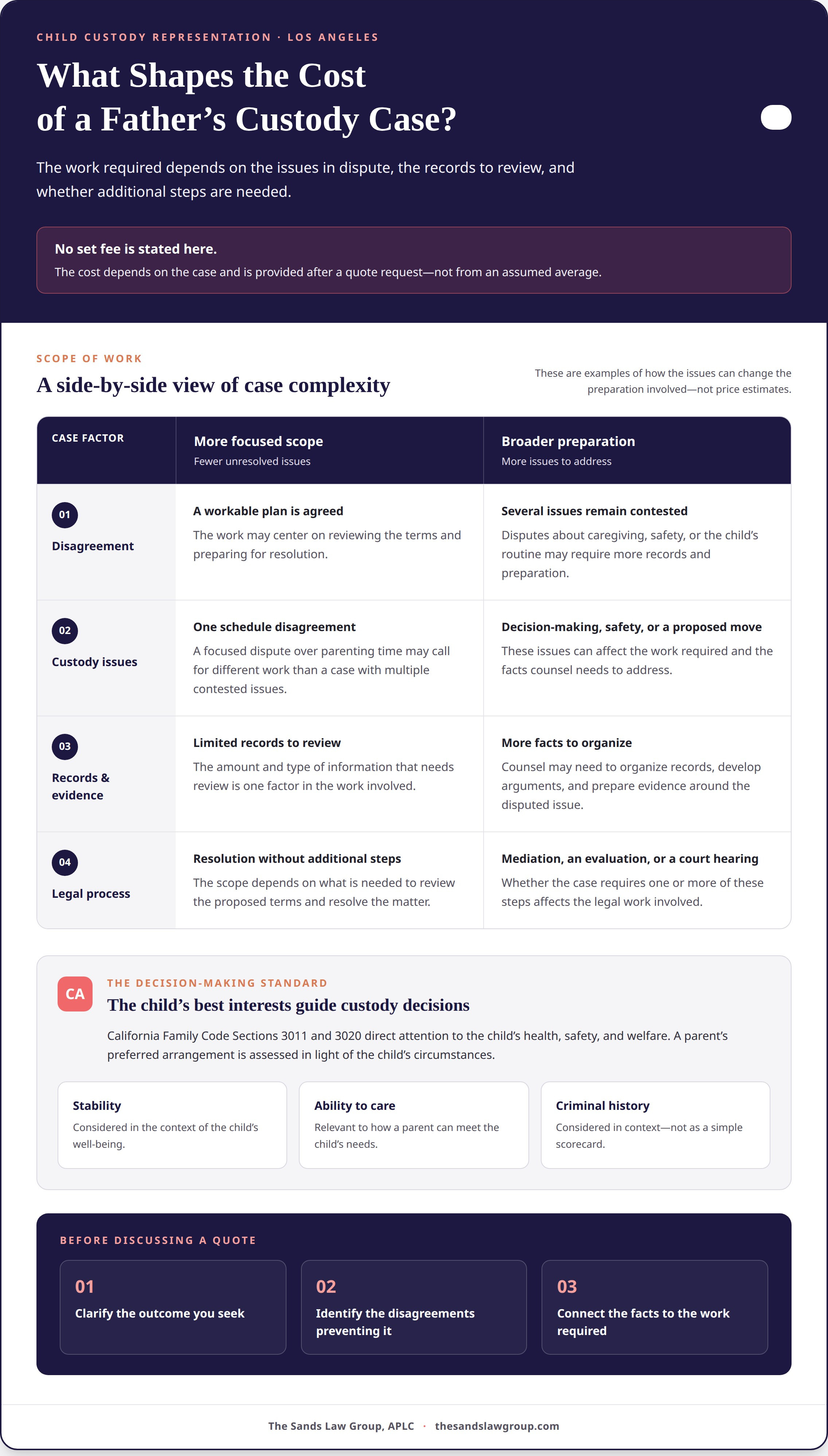
The cost depends on the case and is provided after a quote request. Factors include how many custody issues are contested, the records that need review, and whether the matter requires mediation, an evaluation, or a court hearing. A disagreement over one schedule may require different work from a dispute involving decision-making, safety concerns, or a proposed move. The relevant question is what legal work your situation requires, not an unsupported average.
California family law uses the child’s best interests as the central standard for custody decisions. Family Code Sections 3011 and 3020 direct attention to the child’s health, safety, and welfare. A father’s preferred arrangement matters as a proposed outcome, but the court assesses it against the child’s circumstances. For example, a request for primary physical custody should explain how that arrangement serves the child’s welfare and daily needs.
Best-interests considerations can include a parent’s stability, criminal history, and ability to care for the child. These factors are considered in context, rather than as a simple scorecard. A lawyer assessing a case can identify which facts relate to the child’s safety and well-being, then connect those facts to the requested custody order. A hearing may focus on disputed points, so evidence should address the actual issue instead of broad claims about either parent.
The issues in dispute shape the scope of legal representation. If parents agree on a workable plan, the work may center on reviewing terms and preparing for resolution. If they disagree about caregiving, safety, or the child’s routine, counsel may need to organize records, develop arguments, and prepare for mediation or a hearing. The number of unresolved issues and the evidence involved affect the preparation required.
Before discussing a quote, clarify the outcome you seek and the disagreements preventing it. A lawyer can then assess how California’s best-interests standard applies, which facts need development, and what steps may be required. This gives the cost discussion a practical basis without assuming a particular result or level of court involvement. A focused review of your custody concerns can help connect the legal issues to the work ahead.
What Matters Are Handled in Los Angeles Child Custody Courts?
A lawyer can review any existing family court case or custody order, then prepare and file a request describing the parenting arrangement you seek. Be ready to provide information about the child, the other parent, current orders, and why you’re requesting an initial custody decision or a change.
Custody Mediation and Litigation
In Los Angeles County, Family Court Services mediation is required before a contested custody hearing. It gives parents an opportunity to discuss parenting arrangements with a neutral professional before asking a judge to decide disputed issues. Topics may include custody schedules, exchanges, communication, and other practical terms affecting the child.
Prepare for mediation by organizing your proposed plan, identifying unresolved issues, and considering what questions may arise. For example, if you disagree about weekday exchanges, clarify the schedule you’re proposing and why it works for the child. Preparation can also help you distinguish essential terms from areas where compromise may be possible.
Mediation and litigation have different purposes. Mediation supports discussion and possible agreement; litigation asks the court to decide issues the parents cannot resolve. If mediation does not settle the dispute, each side can present relevant information at a contested hearing. A lawyer can help prepare your position, address disputed facts, and present the arrangement you’re requesting.
Filing a Los Angeles County Custody Case
Before filing, a lawyer can review whether a family court case or custody order already exists. This helps distinguish a request for an initial custody decision from a request to change existing arrangements. The lawyer can then prepare court papers explaining the custody and visitation terms you seek.
Specific information helps make the filing clear. Gather details about the child’s needs and routine, the parents’ current arrangements, relevant communications, and any existing court orders. A clear account of the disagreement helps explain what you’re asking the court to address.
After filing, the case proceeds through the court process, including required mediation before a contested custody hearing. A lawyer can help you understand which issues remain open and prepare for each stage. A dispute about school-week scheduling may call for focused preparation on exchanges and routines, while disagreements involving several parenting terms may require broader preparation.
Family law representation can involve more than appearing at a hearing. It can include defining the request, preparing for Family Court Services mediation, and presenting unresolved issues to the court. Clear communication between lawyer and client helps keep the requested outcome and supporting information consistent throughout the process.
Move-away disputes
A proposed move can disrupt a child’s routine and make an existing custody schedule impractical. In Los Angeles, even a move between neighborhoods may affect school transportation; a move farther away may interfere with weekday parenting time. The key is to address the effects on the child and each parent’s relationship, not treat relocation as a simple change of address.
Start by reviewing current custody orders and identifying which terms a proposed move would affect. Consider the child’s school, exchanges, travel, and time with each parent. For example, a schedule based on nearby school pickups may not work if the child would attend school in another community. These practical effects help define the issues for negotiation or court review.
If both parents can agree on workable terms, a move-away agreement can set out revised parenting arrangements. It may specify exchange locations, how school breaks are shared, and how travel responsibilities are handled. It can also explain how parents will communicate about school events and schedule changes. Broad wording such as “reasonable visitation” may leave important logistics unresolved when distance affects how often a parent can participate.
Negotiation is more useful when each proposal addresses the child’s day-to-day needs. One parent might propose longer visits during school breaks to make up for less weekday contact. The other might seek regular calls or clearly defined exchanges. A lawyer can help organize the proposal, identify open questions, and assess whether the terms fit existing orders and practical circumstances.
If parents cannot agree, the court may need to decide whether to approve the requested change and how it affects custody. A lawyer can review existing orders, prepare the request, and present relevant evidence about the child’s routine and proposed arrangements. Useful information may include school details, travel logistics, caregiving schedules, and communications about the move. Connect each piece of evidence to a specific effect on the child.
Raise a possible relocation with counsel before making plans that could conflict with current orders. A lawyer can identify which custody terms need attention and prepare for negotiation or court proceedings. If a divorce case also involves unresolved custody issues, coordinating the relocation discussion with the broader family law matter can help avoid inconsistent proposals. The goal is a workable plan that supports the child’s stability and meaningful relationships.
Child custody and legal decision-making
California courts apply the child’s best-interests standard to custody and parenting-time decisions. They consider the child’s health, safety, and welfare, as well as evidence about each parent’s ability to provide care.
Legal Custody Decisions
Legal custody concerns authority over major decisions, including a child’s education, health care, and welfare. A court may order joint legal custody, giving both parents decision-making rights and responsibilities, or sole legal custody. The relevant aspects include whether parents can communicate about significant choices and how each proposed arrangement supports the child’s well-being.
A disagreement about school placement, for example, may require the court to consider each parent’s reasons and the child’s needs. California courts assess the facts presented rather than assuming either parent should control decisions. A lawyer can explain how your requested order addresses particular decisions and relates to the child’s welfare.
Physical Custody and Parenting Time
Physical custody concerns where the child lives, while parenting time describes the schedule with each parent. Joint physical custody does not automatically mean an equal 50/50 split. Courts consider the child’s circumstances and the parents’ ability to provide care when evaluating a schedule.
A proposed plan should explain practical arrangements, including school-day transitions, exchanges, and time with each parent. Stability, caregiving, and relevant safety concerns can all shape the court’s assessment. A schedule built around school attendance, for instance, can address continuity while preserving meaningful time with both parents.
A child’s perspective can also be relevant. According to the California Legislature, in California custody cases, children who are 14 or older have the right to address the court about their preferences, while the judge makes the final decision. The child’s stated preference is therefore not itself the custody order.
Safety issues require particular attention. California Family Code § 3044 creates a strong presumption against awarding custody to a parent found to have committed domestic violence. A lawyer can explain how that rule affects the requests before the court and what evidence relates to the issue. More generally, the court may consider a parent’s stability, criminal history, and ability to care for the child.
To present a clear request, connect each proposed term to a concrete need: decision-making authority to a child-related issue, or parenting time to a workable routine. A law firm can explain how those aspects fit together and what outcome the evidence supports. Discuss your custody and decision-making concerns with counsel.
The Sands Law Group, APLC: Child Custody and Visitation Representation
The Sands Law Group, APLC represents fathers in child custody and visitation matters, including parenting time, legal decision-making, and proposed custody arrangements. The firm can help clarify the issues, prepare your position for negotiation or court proceedings, and connect the requested terms to your child’s needs. When custody concerns arise alongside divorce, related family law representation can address how the issues fit together.
Consider seeking counsel when you need to establish or change a custody arrangement, respond to a disputed request, or address a move that could affect parenting time. A focused discussion can help identify the orders involved and the next steps relevant to your situation. Contact The Sands Law Group, APLC to discuss your custody concerns.
Take the Next Step Toward a Stable Parenting Plan
Custody decisions can influence how you remain involved in your child’s life. A child custody attorney for fathers in Los Angeles can help assess the legal issues, identify the work your case may involve, and consider a path forward. If custody concerns overlap with divorce or spousal support, addressing how those matters connect can help clarify your priorities.
You don’t need to resolve every uncertainty before speaking with counsel. Discussing current orders, concerns about your parenting relationship, and the outcome you seek can help identify what needs attention first. The Sands Law Group, APLC represents clients in family law matters, with guidance tailored to the circumstances of the case.
Contact The Sands Law Group, APLC to discuss your situation and consider a clear next step. You can move forward thoughtfully, with your child’s well-being at the center.
Frequently Asked Questions
How are the Best Interests of the Child Defined?
California’s best-interests standard focuses on a child’s health, safety, and welfare. A court may consider how a proposed arrangement affects stability, caregiving, and daily routine. For example, a schedule that supports school attendance and dependable care may address practical needs more clearly than a proposal based only on a parent’s preference. Connect the requested arrangement to the child’s circumstances.
What Is Important To Understand About Fathers’ Rights Cases?
California custody law treats fathers and mothers equally; courts evaluate the child’s best interests rather than favoring a parent based on gender. Custody and child support are separate matters: a parent cannot withhold court-ordered parenting time because of a support dispute. Follow existing custody orders and raise concerns through the appropriate legal process to keep the focus on the child.
What Is The Fathers’ Rights Case Timeline?
A custody case may involve filing or responding to a request, mediation when required, and a hearing if disputes remain. The time involved depends on the contested issues, whether the parents can reach agreement, and the court process needed to resolve remaining questions. A case with an agreed parenting plan may proceed differently from one that requires a contested hearing or additional evaluation.
What Should You Bring to Your Fathers’ Rights Consultation?
Gather current custody orders, court papers, and documents relevant to parentage, along with a clear account of the arrangement you seek. A parenting-time calendar, school schedule, and communications about the child can help explain practical concerns. Note unresolved decisions, such as school or health care, and questions about visitation. Organized information gives counsel a clearer picture of your priorities.
How do I find a child custody attorney for fathers in Los Angeles?
Choose a lawyer whose practice includes California family law and child custody disputes. The Sands Law Group, APLC represents clients in child custody and visitation matters, including initial parenting plans and post-judgment modifications when circumstances change. Before discussing representation, identify the order or decision at issue and the outcome you seek. This context can make the conversation more focused on your family’s legal needs.
What qualifications and experience should a Los Angeles fathers’ custody lawyer have?
Look for family law experience involving legal custody, physical custody, visitation, and contested parenting arrangements. A lawyer should explain the court process plainly and connect the evidence to the requested order. The Sands Law Group, APLC focuses exclusively on family law and represents parents in custody and visitation matters, including initial plans and modification requests.
How much do child custody attorneys in Los Angeles charge, including retainers and hourly rates?
Attorney cost depends on the case and is provided after a quote request; no specific retainer or hourly-rate figure should be assumed. Relevant factors include the number of disputed issues, the records requiring review, and whether mediation, an evaluation, or court hearings are involved. A focused dispute over one schedule may require different work from a case involving several contested parenting decisions.
What are California’s child custody laws and best-interest factors?
California Family Code Sections 3011 and 3020 guide custody decisions focused on a child’s health, safety, and welfare. Courts may consider parental stability, criminal history, and the ability to care for the child. Section 3044 creates a strong presumption against awarding custody to a parent found to have committed domestic violence. Website content is for general informational purposes only and does not constitute legal advice.

Article by
Thomas D. Sands, Esq.
Thomas D. Sands is the founder and CEO of The Sands Law Group, APLC. A California attorney with more than two decades of experience, he represents clients in divorce and family law matters as well as civil litigation and real property disputes. His approach emphasizes attentive, practical, and cost-conscious representation.
Sands is a 2023 Litigator of the Year honoree of the American Institute of Trial Lawyers and a 2023 Lawyer of the Year honoree of the American Institute of Legal Professionals. His firm has also received recognition among the 2025 Best Law Firms in America, a 2026 Benchmark Best of award, and a 2026 Law Firm of the Year honor.

Article reviewed by
Thomas D. Sands, Esq.
Thomas D. Sands is the founder and CEO of The Sands Law Group, APLC. A California attorney with more than two decades of experience, he represents clients in divorce and family law matters as well as civil litigation and real property disputes. His approach emphasizes attentive, practical, and cost-conscious representation.
Sands is a 2023 Litigator of the Year honoree of the American Institute of Trial Lawyers and a 2023 Lawyer of the Year honoree of the American Institute of Legal Professionals. His firm has also received recognition among the 2025 Best Law Firms in America, a 2026 Benchmark Best of award, and a 2026 Law Firm of the Year honor.
TOLL-FREE: 855-SANDS4U