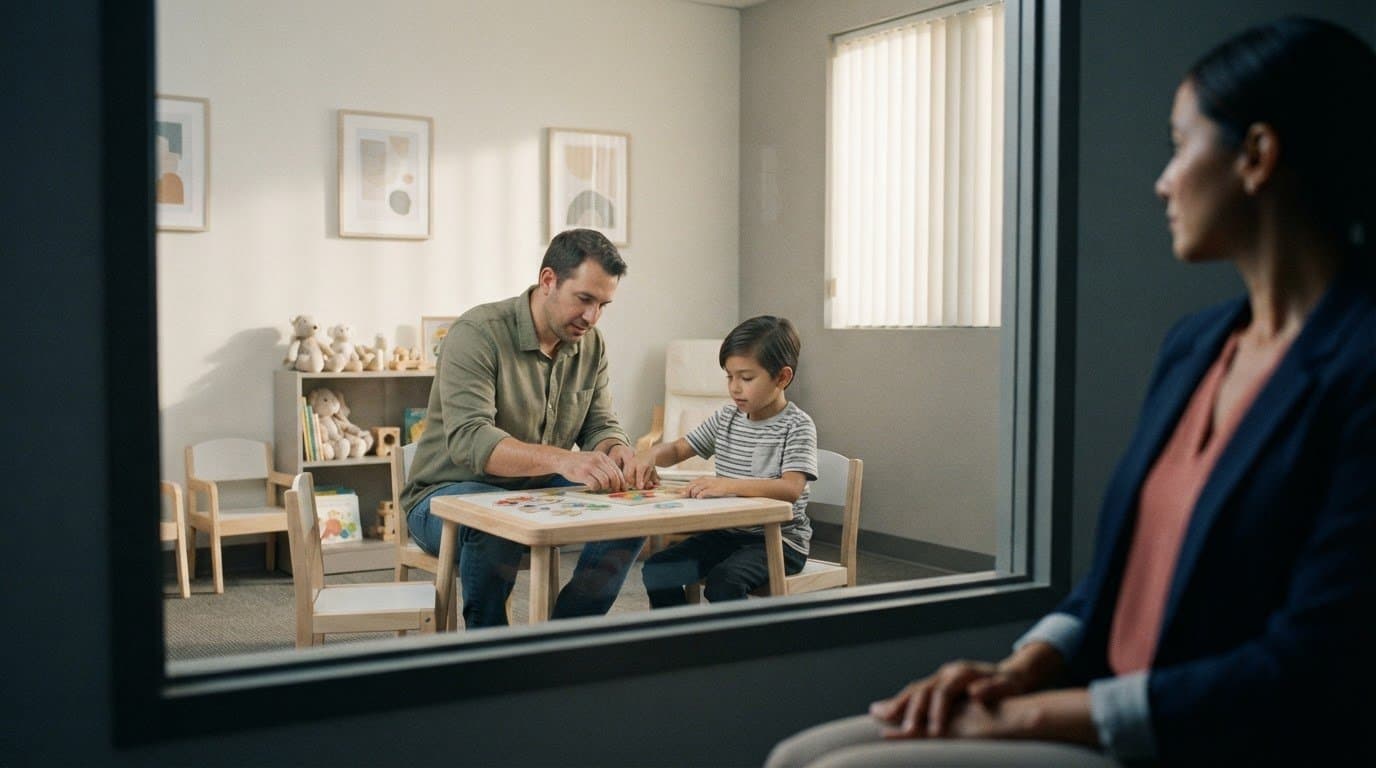
A 730 evaluation is not a ruling on which parent is right. If you’re asking what a 730 evaluation in California is, it’s a court-ordered psychological assessment in a custody dispute, authorized under California Evidence Code §730. The evaluator serves the court, not either parent, and provides an assessment that can help the judge consider the child’s needs.
It’s understandable to feel unsettled when an evaluation enters an already difficult custody case. Knowing its purpose and boundaries can make the process easier to understand, even when the outcome matters deeply to your family.
This article explains why a judge may order an evaluation, what its scope and process may involve, whether your child may be interviewed, and what can affect the evaluation’s cost and duration. It also explains how a report fits into the court’s decision, so you can approach the next steps with clearer expectations.
Key Takeaways
- A 730 evaluation gives the court a neutral professional assessment when custody questions need more than competing accounts from parents.
- The court’s order sets the evaluation’s purpose and scope, which may shape what the evaluator examines.
- Evaluations can take several weeks or months; the scope, interviews, and testing involved affect the timeline.
- Children may have age-appropriate interviews, while the evaluator considers their needs and relationships with both parents.
- Learn how evaluator qualifications, case complexity, and the court’s fee allocation can affect the process and its cost.
How Long Does a Court-Ordered Mental Health Evaluation Take?
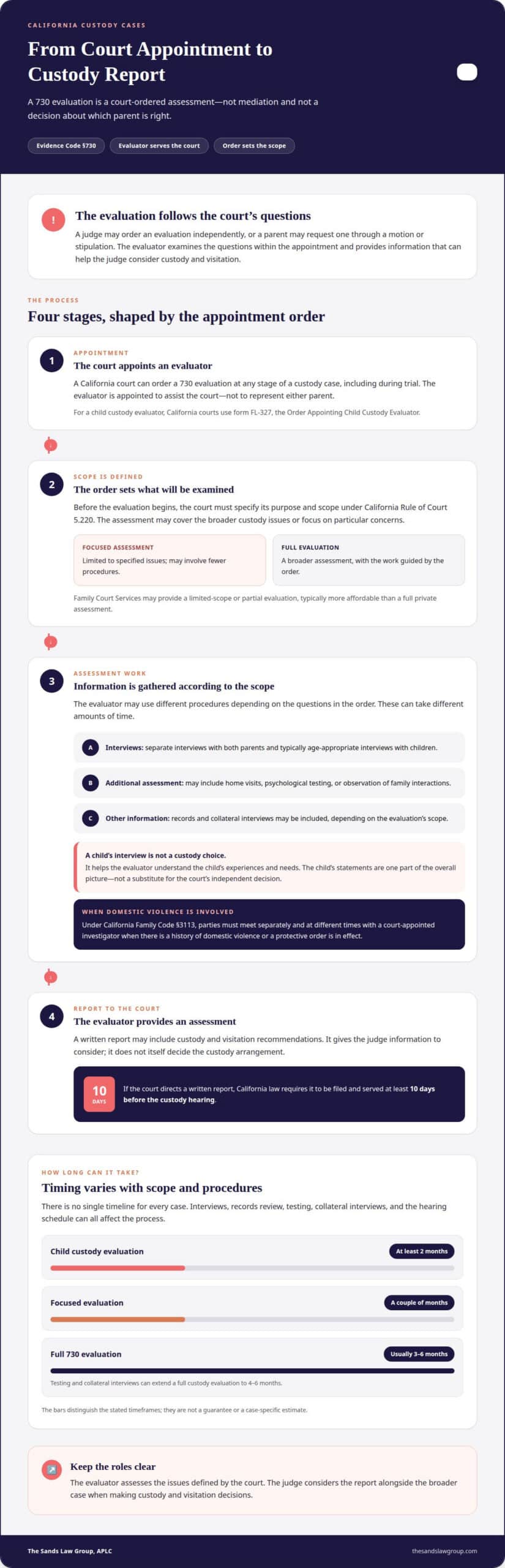
A California court may order a 730 evaluation at any stage of a custody case, including during trial. A judge can order one independently, or a parent can request one through a motion or stipulation. The court may consider an evaluation when conflicting accounts about parenting and a child’s needs call for a neutral professional assessment.
California Evidence Code section 730 authorizes courts to appoint experts to assist them. In a custody dispute, the appointed evaluator serves the court, not either parent. The evaluator assesses the questions within the appointment and provides information that can help the judge consider custody and visitation. This is not mediation: the evaluator analyzes relevant family circumstances rather than helping parents negotiate an agreement.
The appointment order shapes the work and helps define the timeline. California Rule of Court 5.220 requires the court to specify a custody evaluation’s purpose and scope before it begins. The court may direct a full evaluation or limit the assessment to particular issues. California courts use form FL-327, the Order Appointing Child Custody Evaluator, to appoint a child custody evaluator.
There is no single timeline for every case. A typical California 730 evaluation can take several weeks or even months. A child custody evaluation generally takes at least two months, while a full 730 evaluation usually takes three to six months. Testing and collateral interviews can extend a full custody evaluation to four to six months. A focused evaluation may take a couple of months.
Family Court Services differs from a full private evaluation. It may provide a limited-scope or partial evaluation, typically more affordable than a full private assessment. The court’s order defines the concerns under review, so a focused investigation may involve fewer issues and procedures than a comprehensive evaluation. That difference in scope can affect how long the assessment takes.
Timing depends on what the order asks the evaluator to examine and which procedures are needed. Parent and child interviews, records review, psychological testing, and collateral interviews can require different amounts of time. According to the California Legislature, when the court directs a written report, it must be filed and served at least 10 days before the custody hearing. The order’s scope and hearing schedule therefore matter alongside the evaluation itself.
Will My Child Be Interviewed?
Often, yes. A California 730 evaluation typically includes separate interviews with both parents and age-appropriate interviews with the children. The evaluator’s appointment order defines the questions and limits the assessment. A child’s interview gives the evaluator a chance to understand the child’s experiences and needs directly, rather than relying only on conflicting parental accounts. It does not make the child responsible for choosing a custody arrangement.
Depending on the scope, the evaluator may observe family interactions or gather information beyond interviews. A California child custody evaluation may include meetings with both parents and children, home visits, and a written report with custody and visitation recommendations. The evaluator may consider relevant records and other information about family circumstances, guided by the court’s order.
A child’s relationship with each parent may be relevant to the court’s analysis. In a California move-away custody case, a parent’s willingness to support the child’s relationship with the other parent is a factor the court considers. The evaluator may assess how each parent approaches that relationship and whether the child is being drawn into parental conflict. The child’s statements are one part of the overall picture, not a substitute for the court’s independent decision.
Domestic violence concerns can change how interviews are conducted. Under California Family Code 3113, parties must meet separately and at different times with a court-appointed investigator when there is a history of domestic violence or a protective order is in effect. California Rule of Court 5.230 specifies domestic violence training standards for court-appointed child custody investigators and evaluators. These safeguards address the risks of treating a family interview as ordinary joint discussion.
Serious allegations of child sexual abuse involve a distinct process. California Family Code section 3118 governs investigations involving those allegations in a 730 evaluation. The evaluation may include consultation with child welfare services or law enforcement, in addition to interviews with family members. A written report is restricted to specified people under California Family Code section 3025.5, including the parties, their attorneys, minor’s counsel, and the court.
California Family Code section 3042 governs how the court considers a child’s wishes and when the child may address the court. An evaluator’s interview and a child speaking to the court are different parts of the process. If the order includes an interview, its purpose and scope guide the evaluator’s work. Discuss how child interviews may affect a custody case as you consider the issues before the court.
How much does a 730 custody evaluation cost in California?
Full private custody evaluations in Southern California commonly cost a five-figure amount. This refers to evaluation expenses, not legal representation. The work involved matters: a focused assessment and a full evaluation involving testing or collateral interviews require different amounts of professional time.
Cost also depends on the evaluator’s qualifications and the appointment’s scope. California Family Code section 3110 and California Rules of Court Rule 5.220 establish qualification requirements for custody evaluators. Family Code Section 3110.5 outlines education, experience, and training requirements. California law permits licensed psychologists, psychiatrists, licensed clinical social workers, and licensed marriage and family therapists to conduct custody evaluations.
Specialized training is relevant because these assessments concern children and family relationships. Evaluators must complete training in child development, children’s psychological needs, parent-child relationships, and the effects of divorce and separation. California Rules of Court Rule 5.225 specifies appointment requirements, while Rule 5.230 sets domestic violence training standards for court-appointed child custody investigators and evaluators. Those requirements help establish whether an evaluator is appropriately prepared for the assignment.
Appointment records document qualifications, too. A private child custody evaluator appointed in California must file form FL-326, a declaration regarding qualifications, with the court. In Riverside County, evaluators must be qualified and appropriately licensed to administer, score, and interpret psychological tests to appear on the resource list. These criteria relate to evaluator selection and testing, not a fixed statewide fee schedule.
Impartiality is separate from professional qualifications. A court-appointed evaluator serves the court rather than either parent, and the assessment should address the custody questions assigned. In Leslie O. v. Superior Court, the California Court of Appeal held in 2014 that an evaluation by someone who did not meet statutory qualifications should not have been relied on. Under California Evidence Code section 732, either party may call the evaluator to testify and cross-examine them.
Payment allocation is another part of the cost question. California Family Code section 3112 allows the court to divide custody evaluation costs between the parties in any proportion it finds reasonable. The court must consider ability to pay when allocating court-appointed evaluation fees. As a result, the assigned share can depend on the court’s allocation, rather than defaulting automatically to equal payment.
Purpose and scope of a California 730 custody evaluation
A custody evaluation gives the court a professional assessment of family circumstances relevant to the child’s best interests. The appointment order defines what the evaluator examines. The evaluator may make recommendations, but the judge decides custody.
Custody and Parenting-Time Issues
Legal custody concerns decision-making for a child, while physical custody and parenting time address where the child lives and time with each parent. A 730 evaluation may examine these connected issues when conflict makes a workable arrangement difficult to assess. For example, the evaluator may consider each parent’s ability to meet the child’s needs and preserve the child’s relationship with the other parent.
Evaluation Scope and Recommendations
The appointment order defines whether the evaluation is full or limited to specific custody questions. California Rule of Court 5.220 allows either scope, and the evaluator’s recommendations should address the questions the court assigned. The assessment may consider family dynamics and relevant evidence. A California custody evaluation report must include findings about the best-interest factors in Family Code section 3011.
Effects on Custody Outcomes
A 730 evaluator prepares findings and recommendations for the court and both parties, but the report is not binding. The judge may consider it alongside testimony and other evidence before deciding custody and visitation. A recommendation can inform the court’s analysis, but it does not itself change an order or settle the dispute. Parents should prepare to address the evaluator’s conclusions through the case record.
Parents may call the evaluator to testify and cross-examine them under California Evidence Code section 732. Family Code section 217 gives parties the right to present live testimony, including questioning the custody evaluator. Under Evidence Code section 733, a party may hire an expert to review the evaluation and testify about problems with its methods or conclusions. Children’s wishes are addressed under Family Code section 3042, which governs when a child may address the court and how the court considers those wishes.
Important limits remain. California Rule of Court 5.220(f) requires evaluators to describe limitations and present relevant information that may not support their conclusions. Parties may challenge a report, request a rebuttal or supplemental evaluation, object to portions, or present other evidence. The appointment order also matters: in In re Marriage of Seagondollar, an evaluator assessed a proposed move to Virginia outside the issues in the order. Clear scope helps keep the evaluation focused, while the judge retains final authority over the custody decision.
Definition and legal basis of a California 730 evaluation
A 730 evaluation is a court-ordered expert assessment used in a California custody dispute. Its name refers to California Evidence Code section 730, which authorizes courts to appoint experts. The evaluation helps the court examine family circumstances relevant to child custody, rather than deciding the case or replacing the judge’s judgment.
Understanding what a 730 evaluation in California means requires distinguishing the appointment authority from custody-evaluation rules. Evidence Code section 730 provides for a court-appointed expert. Family Code section 3111 addresses child custody evaluations when custody or visitation arrangements raise questions about a child’s best interests. These provisions work within California family law, but address related, distinct parts of the process.
The appointment order provides the assessment’s boundaries. According to the Judicial Council of California, California Rules of Court Rule 5.220 specifies requirements for court-ordered child custody evaluations. That rule allows the court to order a full evaluation or limit it to particular issues. The distinction matters: an evaluator’s work should address the purpose and scope assigned, not become an open-ended review of every disagreement between parents.
A custody evaluation may examine family dynamics and the child’s circumstances to help the court assess an appropriate arrangement. For example, the order may focus on a disputed parenting issue rather than every custody question. The evaluator gathers and assesses relevant information and may offer recommendations. These recommendations are evidence for the court to consider; they do not establish legal or physical custody.
The court may order an evaluation on its own initiative, or a party may request one through a motion or stipulation. A judge may consider an evaluation when competing accounts about parenting and a child’s needs cannot be resolved through testimony alone. The key question is whether a neutral professional assessment would assist the court, not which parent wants it more.
That legal structure clarifies what an assessment can and cannot do. The evaluator is an expert appointed to assist the court, not a mediator tasked with negotiating an arrangement. A parent’s attorney can address the appointment’s purpose, the questions presented, and how the resulting evidence fits into the custody case. The judge retains authority to decide the dispute and is not bound by the evaluator’s recommendations.
If a proposed evaluation raises concerns about its purpose or scope, discuss your custody case and the court’s appointment order before the assessment proceeds.
The Sands Law Group, APLC
The Sands Law Group, APLC can help you understand how a 730 evaluation fits into your custody case and what the evaluator’s report may mean for the issues before the court. When the appointment order, recommendations, or next steps raise concerns, legal guidance can help you consider how to address them within your broader family law matter.
The Sands Law Group, APLC represents parents in child custody and visitation matters, as well as divorce proceedings involving related family issues. An attorney can discuss your circumstances and explain how representation may support your case strategy.
Contact The Sands Law Group, APLC to discuss your situation.
Move Forward With a Clear Plan
Understanding what a 730 evaluation in California means can help you approach the next stage of a custody dispute with greater clarity. The report is one part of a larger family law case, and your next steps may depend on the issues before the court, the evaluator’s findings, and your family’s priorities. Consider how you want to address those issues while keeping your child’s needs at the center.
The Sands Law Group, APLC represents clients in child custody and visitation, divorce, and spousal support matters. If an evaluation or its recommendations have raised questions about your case, an attorney can discuss how those concerns fit into your broader legal strategy.
Contact The Sands Law Group, APLC to discuss your situation. A thoughtful next step can help you move forward with greater confidence.
Frequently Asked Questions
What is a 730 Evaluation?
A 730 evaluation is an expert assessment a California court may use to examine custody questions. The name comes from Evidence Code section 730, which authorizes court-appointed experts. If you’re asking what a 730 evaluation in California is, the key point is that it informs the court rather than deciding custody. For example, an evaluator may assess family circumstances relevant to a disputed parenting arrangement.
Can You Refuse a Custody Evaluation or Choose Your Own Evaluator?
Don’t assume you can disregard a court order appointing an evaluator. Raise concerns through the court process. If the court orders an evaluation, the parties may select an evaluator they mutually agree on from the court’s resource list. If they cannot agree, follow the appointment order and the court’s direction. An attorney can help you understand how to raise an objection or address evaluator selection in your custody case.
How Is the Report Used at the Hearing or Trial?
The judge may consider the report alongside testimony and other evidence, but the evaluator’s recommendations do not decide the case. If the court directs a written report, California Legislature says it must be filed and served at least 10 days before the custody hearing. A party may call the evaluator to testify and cross-examine them under Evidence Code section 732, allowing questions about methods and conclusions.
Is the Custody Evaluation Report Confidential?
Yes, access to a custody evaluation report is limited under California Family Code section 3025.5. The specified people include the parties, their attorneys, minor’s counsel, and the court. The restriction means a report is not for unrestricted circulation among relatives, friends, or others outside the case. If you’re unsure whether someone may receive or review a copy, ask your attorney about the report’s permitted access.
What is a California Family Code section 730 evaluation?
There is no California Family Code section 730 that establishes this evaluation. The “730” refers to California Evidence Code section 730, which authorizes courts to appoint experts. Custody evaluations are also governed by applicable family-law statutes and court rules, including California Rules of Court Rule 5.220. Using the correct code name can help distinguish the court’s expert-appointment authority from rules governing custody assessments.
What Issues Can a 730 Evaluator Assess in California?
An evaluator can assess the custody questions within the court’s appointment order, such as parenting circumstances relevant to a child’s best interests. Depending on that scope, the assessment may consider parent-child relationships, family dynamics, and information from interviews or records. Serious concerns can involve additional procedures: Family Code section 3118 governs investigations involving allegations of child sexual abuse. The evaluator’s assignment does not extend beyond the issues ordered.
What Is the Difference Between a 730 Evaluation and a Child Custody Recommending Counseling Evaluation in California?
A 730 evaluation is an expert assessment, while child custody recommending counseling involves a mediator who can recommend a custodial arrangement to the judge under Family Code section 3183. The processes serve distinct roles. Most California custody disputes are resolved through mediation under Family Code section 3170 and a hearing on a Request for Order, without a custody evaluation. Whether a separate evaluation is appropriate depends on the court’s process and the issues presented.
What Is the Process for a 730 Evaluation in California, Including Interviews and Reports?
The process begins with a court appointment that defines the evaluation’s purpose and scope. The evaluator may interview each parent separately, conduct age-appropriate interviews with children, and review relevant information within that scope. The evaluator then prepares findings and recommendations for the court and parties. If the court directs a written report, it becomes part of the custody proceeding, where the parties may address its conclusions through evidence or testimony.

Article by
Thomas D. Sands, Esq.
Thomas D. Sands is the founder and CEO of The Sands Law Group, APLC. A California attorney with more than two decades of experience, he represents clients in divorce and family law matters as well as civil litigation and real property disputes. His approach emphasizes attentive, practical, and cost-conscious representation.
Sands is a 2023 Litigator of the Year honoree of the American Institute of Trial Lawyers and a 2023 Lawyer of the Year honoree of the American Institute of Legal Professionals. His firm has also received recognition among the 2025 Best Law Firms in America, a 2026 Benchmark Best of award, and a 2026 Law Firm of the Year honor.
Article reviewed by
Thomas D. Sands, Esq.
Thomas D. Sands is the founder and CEO of The Sands Law Group, APLC. A California attorney with more than two decades of experience, he represents clients in divorce and family law matters as well as civil litigation and real property disputes. His approach emphasizes attentive, practical, and cost-conscious representation.
Sands is a 2023 Litigator of the Year honoree of the American Institute of Trial Lawyers and a 2023 Lawyer of the Year honoree of the American Institute of Legal Professionals. His firm has also received recognition among the 2025 Best Law Firms in America, a 2026 Benchmark Best of award, and a 2026 Law Firm of the Year honor.
TOLL-FREE: 855-SANDS4U