

What if a fair divorce settlement depends less on splitting everything down the middle and more on understanding what each asset is worth and who owns it? In California, community property is generally divided equally, but that does not mean every home, account, business interest, or debt is automatically split in half. A california property division attorney can help you examine the details before agreeing to terms that affect your financial future.
It is understandable to worry that an asset could be misclassified or undervalued, or that missing records and disagreement could delay resolution. Property acquired during marriage is generally treated differently from property owned beforehand or received as a gift or inheritance. The distinction can become more complicated when assets have been combined or changed in value.
This guide explains California’s property division framework and the issues that can shape an outcome. Learn what to consider when classifying assets and debts, valuing a home, retirement account, or business interest, and organizing financial records. It also compares settlement options and explains how legal representation can help assess terms or prepare for court proceedings when agreement is not possible.
Key Takeaways
- California generally divides the community estate equally, but identifying what belongs in that estate is an essential first step.
- Tracing financial records can help clarify ownership when separate and community funds have been mixed.
- A california property division attorney can help assess disputed values and explain options for resolving them.
- Compare negotiated agreements, mediation, and court decisions based on cooperation, decision-making control, and how unresolved issues are handled.
- Prepare a list of assets, debts, and ownership questions, and preserve records without concealing or moving property.
California Property Division: What the Community Property Rule Actually Means
Separating finances during divorce can feel destabilizing, especially when a home, savings, retirement funds, or a business are tied to both spouses’ lives. Start by identifying what belongs to the community estate and how California law generally treats it. The central principle is equal division of the community estate, but determining what belongs in it requires attention to timing, the source of funds, and ownership history.
California generally presumes that property acquired by either spouse during marriage and before separation is community property. The court generally divides the community estate equally, subject to applicable law and any valid agreement between the spouses. This framework applies to assets and debts, though classification can be contested. A broad overview of community property in the United States can explain the general concept, but it does not replace analysis of California law or the facts of a particular divorce.
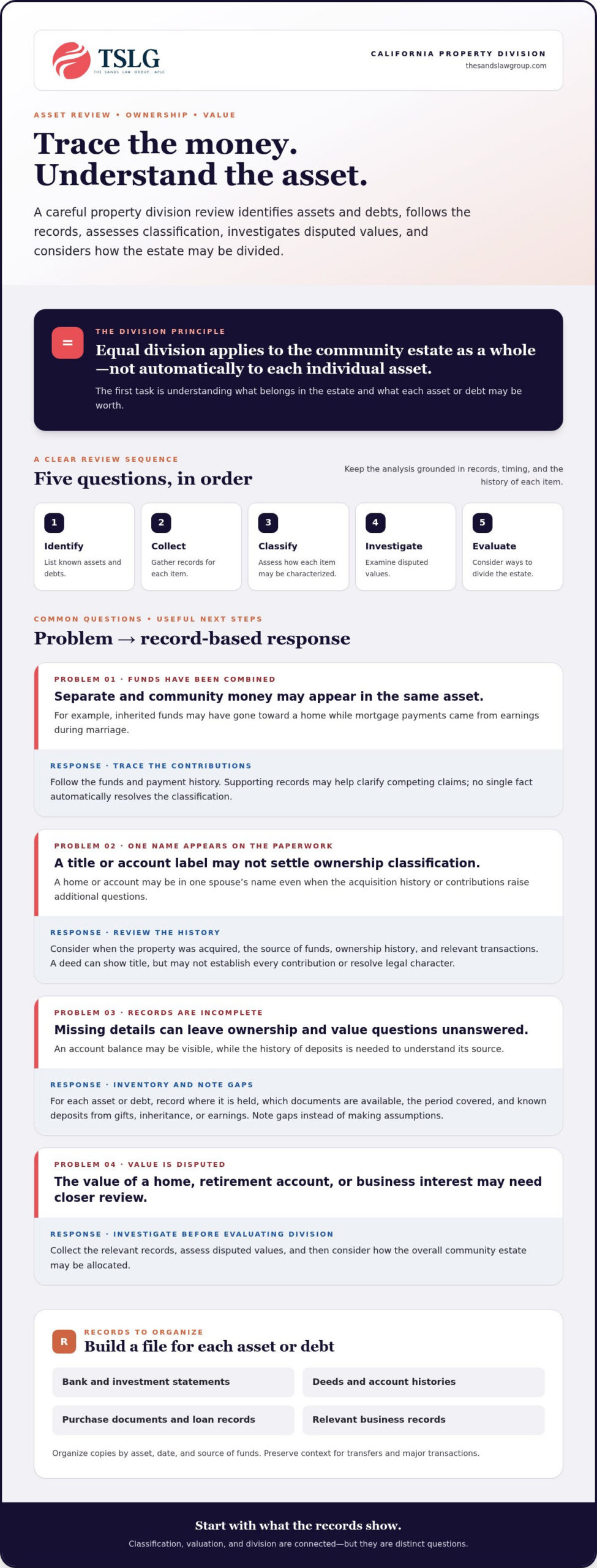
Equal division applies to the community estate as a whole, not necessarily to every individual asset. A court may allocate different assets to each spouse while seeking an equal division of the overall community value. For example, one spouse might keep a vehicle and some account funds while the other receives a different asset, with an adjustment considered to address a difference in value. The question is how the estate is allocated overall, not whether each asset can be physically divided in half.
What does California’s community property presumption cover?
The presumption can apply even when only one spouse’s name appears on a title or account. A name on paperwork is relevant, but does not by itself determine whether property is community or separate. Property owned before marriage, or received by one spouse as a gift or inheritance, may be separate; however, transactions, contributions, and records can complicate the analysis. Exceptions and fact-specific claims call for careful legal review.
Consider a home purchased during marriage but titled in one spouse’s name, or an account holding both inherited funds and marital earnings. The title or account label alone may not answer how the property should be characterized. The history of acquisition and contributions matters. A california property division attorney can help examine those details and distinguish the classification question from the later question of how to divide the community estate.
Why does the date of separation matter?
The separation date can affect whether later earnings or acquisitions are treated as community or separate property. Establishing that date may involve reviewing the spouses’ communications and conduct, including statements about ending the marriage, changes in living arrangements, or financial decisions that reflect a transition to separate lives. These are examples of potentially relevant facts, not a universal checklist or automatic legal test. The governing California standard and its application should be assessed under current law.
Disagreement about the date can have practical consequences when a spouse continues earning income, contributes to a retirement account, or acquires property during the disputed period. Keep relevant records and note significant events while details are fresh. Clarifying the date can help identify which assets and liabilities fall within the community estate before negotiations or court proceedings address their division.
How a California Property Division Attorney Traces, Classifies, and Values Assets
A sound property division analysis follows a sequence: identify assets and debts, collect records, assess how each item may be classified, investigate disputed values, and evaluate ways to divide the estate. Skipping a step can leave important questions unanswered. A bank balance, for example, may be easy to see, while the history of deposits may determine whether it includes separate contributions.
Tracing follows funds or contributions to evaluate a property claim. It can help distinguish separate funds from community money when they have been combined or used toward the same asset. Imagine one spouse used inherited funds toward a home while mortgage payments came from earnings during marriage. Payment history and supporting records may help clarify the competing claims, but no single fact automatically resolves the legal classification.
Which records help establish ownership and value?
Useful records may include bank and investment statements, deeds, account histories, purchase documents, loan records, and relevant business records. Organize copies by asset, date, and source of funds, and preserve context for transfers or major transactions. A deed may show how real estate is titled, for instance, but may not establish every contribution or resolve the property’s legal character.
Start an inventory that names each known asset and debt, where it is held, and which records you have. Note gaps instead of filling them with assumptions. For an account, record the institution, the approximate period covered by available statements, and any known deposits from gifts, inheritance, or earnings. This makes it easier to see what still needs investigation.
When can valuation or tracing require additional analysis?
Review becomes more involved when funds have been commingled, ownership is disputed, or an asset’s value has changed over time. Real estate, retirement accounts, and business interests may require records specific to how each was acquired, funded, or operated. For complex holdings, specialized financial analysis may help clarify the evidence and support a reasoned valuation. The appropriate approach depends on the asset and the questions in dispute.
Keep valuation separate from classification. A home may have a disputed market value, while the parties also disagree about the source of its down payment. A retirement account may include contributions from different periods, and a business interest may require examination of financial and ownership records. These are different questions, even when they concern the same property. Related guides on real estate, retirement accounts, business division, and hidden assets can help you explore those issues further.
A california property division attorney can organize the asset picture, identify unresolved classification or valuation questions, and assess how they affect division options. If records or ownership claims are complex, discussing your property division concerns can help you understand what needs review before you agree to terms.
Settlement, Mediation, or Court: Comparing California Property Division Paths
Choosing how to resolve property questions depends on more than whether you hope to avoid court. Consider how much cooperation is possible, which decisions you and your spouse can make together, and what should happen if a key issue remains unresolved. A negotiated agreement, mediation, and a court determination follow different processes, but none guarantees a particular financial result.
| Path | Cooperation required | Decision-making control | How unresolved issues are handled |
|---|---|---|---|
| Negotiated agreement | Both spouses need to exchange information and engage with proposed terms. | The spouses shape the terms, subject to legal requirements and review. | Disputes may be negotiated further or taken to mediation or court. |
| Mediation | Both spouses must participate in discussions, though they may disagree. | The spouses retain the choice to accept or reject proposals; a neutral facilitator helps guide discussion. | Issues that remain unresolved may proceed to court or another resolution effort. |
| Court determination | Cooperation may be limited, but each side must present its position through the legal process. | The judge decides disputed matters presented for determination. | The court resolves the issues before it based on the evidence and applicable law. |
When might negotiation or mediation help resolve property disputes?
Negotiation can be useful when spouses can exchange reliable financial information and discuss specific terms, even if they are not ready to resolve every issue at once. For instance, they may make progress on dividing certain accounts while continuing to assess a disputed business interest. Mediation offers a structured setting where a neutral facilitator helps the spouses explore options. The facilitator does not decide the outcome for them.
Before accepting proposed terms, understand what they mean in practice, which issues they resolve, and what uncertainty remains. A california property division attorney can advise you about the proposed division and identify terms that need clarification. That review can inform your choices, whether discussions continue or the dispute moves toward court.
What happens when spouses cannot agree on an asset?
If disagreement over classification or value persists, the issue may require a court decision. California Family Code section 2550 generally directs the court to divide the community estate equally, unless the spouses agree otherwise or another legal provision applies. The court considers the evidence and legal arguments presented. The result depends on the circumstances and applicable law, not simply on which spouse requests a particular asset.
Records supporting ownership, contributions, and value can help explain each party’s position. A judge may resolve the disputed issue as part of property division, but neither filing in court nor reaching a settlement guarantees a more favorable financial result. Legal representation can help present a claim and assess practical resolution options through settlement negotiations or trial proceedings.
Whether terms are reached through negotiation, mediation, or litigation, review the final agreement or proposed order for clarity, enforceability, and compliance with applicable law. Ambiguous language about who receives an asset, assumes a debt, or must take a particular step can create further disputes after divorce. Careful review helps ensure the written terms reflect the resolution reached.
What to Prepare Before Meeting a California Property Division Attorney
Preparing for a property division discussion can feel like one more demand during an already difficult transition. You do not need a perfect financial file to begin. A working inventory, the records you have, and a short list of concerns can help a california property division attorney identify questions about ownership, value, and possible resolution paths.
Which financial information should you organize first?
Gather what is available and group it by asset or debt. Do not delay a conversation because some documents are missing. Noting the gaps is useful in itself.
- Bank and investment accounts: Include available statements, account ownership details, and known deposits from earnings, gifts, or inheritance.
- Real estate: Collect deeds, purchase documents, loan statements, and records of major payments or improvements.
- Retirement assets: List each known plan or account and gather statements that show balances and account history.
- Business interests: Note the business name, ownership information, and available financial or purchase records.
- Debts: Record known loans, credit accounts, and other liabilities, including whose name appears on the account.
For each item, note an approximate acquisition date, whose name appears on the account or title, and any known separate-fund contribution. Keep source documents intact. If a value is disputed or records are unavailable, label it uncertain instead of estimating or editing the evidence. A title, statement, or receipt may help explain the history, but no single document necessarily answers every legal question.
What questions should you bring to the consultation?
Clear priorities help counsel focus on what needs attention first. Consider asking:
- Which assets or debts may require tracing, valuation, or additional documentation?
- What records could help clarify a disputed ownership or contribution claim?
- Which concerns are urgent, and what decisions should wait for more information?
- Where might settlement be possible, and which issues may remain contested?
- Based on the facts available, what are the likely next steps?
Be candid about immediate financial concerns, such as access to funds needed for ordinary expenses or uncertainty about an account or debt. Avoid concealing, transferring, or destroying property or records. Preserve materials lawfully, and do not access accounts or files without authorization. If you are unsure how to preserve information, raise that concern rather than taking a step that could complicate the dispute.
A focused discussion can distinguish known facts from open questions, set priorities for gathering records, and clarify what further analysis may be needed. The Sands Law Group represents clients in property division matters involving assets and liabilities, including real estate, retirement accounts, and business interests. Schedule a property division consultation to discuss your circumstances and the questions you would like addressed.
How The Sands Law Group Supports Property Division in Southern California
Property division decisions can shape your financial stability long after divorce is final. The Sands Law Group, APLC focuses exclusively on family law and represents clients in complex property division matters. For clients in Los Angeles, Riverside, San Bernardino, and Kern, representation can bring structure to questions about which property and debts exist, how they should be characterized, and what resolution options may be available.
A california property division attorney can help turn a complicated financial picture into issues that can be assessed and addressed. Counsel can review records, identify gaps, evaluate disputed asset values, and explain how different classification positions could affect negotiations or court proceedings. The aim is to support informed decisions, not promise a particular division or outcome.
What can counsel help clarify in a complex property matter?
Real estate, retirement accounts, business interests, and separate-property claims can involve different records and questions. A home may raise questions about ownership, contributions, or value; retirement assets may require attention to account history; and a business interest may involve financial and ownership information. Counsel can review available documentation, identify what remains disputed, and help determine whether additional valuation or tracing analysis is relevant.
Next steps depend on the facts, the records available, and the issues the spouses disagree about. Some matters can be addressed through settlement negotiations, while others require court proceedings. Legal representation can explain the strengths and uncertainties in a proposed position, organize issues for discussion, and assess whether proposed terms address relevant assets and liabilities. This review helps you weigh options without treating any particular route as a guarantee.
Clarity also means understanding what is not yet known. If a record is missing or an asset’s value is contested, counsel can help identify what information may be needed and how that question fits into the broader property division. This helps distinguish immediate decisions from issues that need more investigation, so choices are based on a fuller understanding rather than pressure to resolve every question at once.
How can you take the next step with The Sands Law Group?
Before a consultation, bring an overview of known assets and debts, any documents you have organized, and a short list of ownership or valuation questions. Include immediate financial concerns and note which issues you believe may be open to settlement. The overview does not need to be complete. Identifying uncertainties helps focus the conversation on what needs clarification.
A consultation is an opportunity to discuss your circumstances, raise concerns, and understand possible paths forward. The Sands Law Group handles property division matters from settlement negotiations through trial proceedings, with guidance shaped by the facts of each case. If you are ready to discuss questions affecting your financial future, schedule a consultation.
Take the Next Step Toward Financial Clarity
Divorce can make the future feel difficult to plan, especially when important financial questions remain unresolved. You do not need every document or answer in hand before seeking guidance. Start by identifying what feels most urgent, what decisions are approaching, and which uncertainties are making it hard to move forward.
A california property division attorney can help assess those concerns in light of your circumstances, clarify which questions need further attention, and consider a practical path forward. The goal is not to rush a decision, but to understand your options well enough to make choices with care.
A conversation with The Sands Law Group can be a first step toward clarity. Schedule a consultation with The Sands Law Group to discuss your concerns and explore your next steps. You can move forward one informed decision at a time.
Frequently Asked Questions
Does California automatically divide every asset in half?
No. California generally requires an equal division of the community estate, but that does not mean every item must be split physically or assigned half to each spouse. A proposed division may allocate particular assets and debts to different people. If a settlement spreadsheet assigns whole assets to each spouse, ask how it accounts for their values, related debts, and any separate-property claims before agreeing to the overall terms.
Can spouses agree to an unequal property division in California?
Yes, spouses may negotiate terms that allocate particular assets or debts differently, but a proposed agreement should be informed, clearly documented, and reviewed for legal requirements. Before signing, make sure you understand which issues the terms resolve and whether important details remain open. A california property division attorney can assess how the proposed arrangement fits your circumstances. Do not rely on informal discussions as a substitute for a reviewed final agreement.
Is an inheritance considered separate property in a California divorce?
An inheritance received by one spouse is generally treated as separate property, but its later use can raise questions about how to characterize it. For example, if inherited money was deposited into an account that also received shared income, records may be needed to trace the inheritance through later transactions. Preserve statements, transfer records, and documents showing where the funds came from. A lawyer can assess what those records establish.
Are debts divided in a California divorce too?
Yes. Debts should be reviewed alongside assets, since the date a balance arose, its purpose, and the circumstances of borrowing may matter. For example, a credit card in one spouse’s name could include charges from different periods or for different purposes. Gather statements and related records, and flag transactions you do not recognize or balances you dispute. Avoid agreeing to responsibility based only on whose name appears on the account.
Does a spouse’s name on a deed decide who owns the property after divorce?
Not necessarily. A deed is relevant, but may not settle how the property should be characterized under California law. The purchase history, source of funds, written agreements, and later transactions may also need review. If the deed and your understanding of the property’s history differ, gather purchase and payment records rather than relying on title alone to predict how a claim will be resolved.
Can a premarital agreement change how property is divided in California?
A valid premarital agreement may affect how certain property is characterized or divided, but whether particular terms apply depends on the document and circumstances. Bring the complete agreement, any amendments, and relevant records for legal review. Do not assume a provision controls automatically, or that an informal understanding changed its terms. Before signing a divorce settlement or transferring property based on the agreement, get advice about its potential effect.
What if spouses disagree about the value of a business or other asset?
A disputed value may need focused financial review before the spouses can evaluate settlement terms. For a business, useful materials may include financial statements, tax records, ownership documents, and information about changes in operations or income. Keep original records and distinguish documented figures from estimates. For property matters involving Los Angeles, Riverside, San Bernardino, or Kern, counsel can help assess what evidence may be relevant in negotiations or court proceedings without promising a particular valuation.

Article by
Thomas D. Sands, Esq.
Thomas D. Sands is the founder and CEO of The Sands Law Group, APLC. A California attorney with more than two decades of experience, he represents clients in divorce and family law matters as well as civil litigation and real property disputes. His approach emphasizes attentive, practical, and cost-conscious representation.
Sands is a 2023 Litigator of the Year honoree of the American Institute of Trial Lawyers and a 2023 Lawyer of the Year honoree of the American Institute of Legal Professionals. His firm has also received recognition among the 2025 Best Law Firms in America, a 2026 Benchmark Best of award, and a 2026 Law Firm of the Year honor.
Article reviewed by
Thomas D. Sands, Esq.
Thomas D. Sands is the founder and CEO of The Sands Law Group, APLC. A California attorney with more than two decades of experience, he represents clients in divorce and family law matters as well as civil litigation and real property disputes. His approach emphasizes attentive, practical, and cost-conscious representation.
Sands is a 2023 Litigator of the Year honoree of the American Institute of Trial Lawyers and a 2023 Lawyer of the Year honoree of the American Institute of Legal Professionals. His firm has also received recognition among the 2025 Best Law Firms in America, a 2026 Benchmark Best of award, and a 2026 Law Firm of the Year honor.
TOLL-FREE: 855-SANDS4U