
Your income has changed, your child now spends more time in your home, or the other parent is asking to reduce support, but the existing order still governs. People searching for a “child support modification attorney california” often have a practical question: do the facts support asking for a different amount? A clear timeline and records showing what changed can help connect your circumstances to the request. An informal arrangement or assumption about what the court will decide is not a substitute for evidence and an approved order.
California generally requires a material change in circumstances since the last order before child support can be modified. A verbal agreement between parents does not replace a court order. This article explains what kinds of changes may be relevant, how to organize financial and parenting-time records, and why procedure and timing matter. The Sands Law Group, APLC represents parents seeking changes to child support and those responding to a request, helping them organize the evidence and understand the process.
Key Takeaways
- Compare an agency review, a proposed agreement, and a court request to understand how each path may fit your case status and circumstances.
- California’s guideline formula informs support decisions. One factor alone cannot establish a new amount.
- Build a clear timeline by organizing the existing order, records, and information about what changed and when.
- If you’re searching “child support modification attorney california,” understand how counsel can help assess your position and represent you whether you’re seeking a change or responding to one.
- Changes in custody or parenting time may relate to support, but they do not automatically change the order.
When Should You Contact a California Child Support Modification Attorney?
An existing support order can become difficult to manage when income falls, parenting schedules shift, or a child’s needs change. The order does not adjust itself when family circumstances change. Either parent may ask the court to modify child support, but the request must be supported by relevant facts and approved through the applicable legal process. A child support modification attorney california can help assess whether the change may support a request or a response.
A changed circumstance may justify asking for a review, but only an approved modification changes the existing support order.
Which changes may justify reviewing a support order?
California courts generally look for a material change in circumstances since the last support order. A change in either parent’s income may affect the guideline calculation, but a raise, reduced work hours, job loss, or new employment does not guarantee a particular increase or decrease. The court considers the evidence and applies the relevant rules to the family’s circumstances.
Parenting time can also matter. If a child now spends substantially more or less time with one parent, that schedule may be relevant to support, but it does not determine the new amount by itself. Keep a calendar of actual overnights and exchanges, along with relevant written communications. This can help show whether the routine differs from the schedule stated in the order.
Changes involving childcare, health insurance, uninsured medical costs, or other child-related expenses may also be relevant under the applicable guidelines. For a general overview of how states approach support, see Child support in the United States. California applies its own guideline framework, so the effect of an expense depends on the order and facts of the case.
Why should parents address a possible change promptly?
Waiting can leave a family relying on an amount that no longer reflects its circumstances. It can also make it harder to assemble a clear record: pay statements may be misplaced, work arrangements may change, and informal parenting schedules can be difficult to reconstruct. Preserve the current order, income records, expense documentation, and a timeline showing when circumstances shifted.
A verbal agreement with the other parent may seem like a practical short-term solution, but it does not itself replace the court order. If the agreed amount differs from the ordered amount, relying on that arrangement can create uncertainty about what remains legally owed. Put any proposed change through the proper process rather than assuming a conversation has amended the order.
Timing can affect when a court-approved change applies. In general, a California modification may take effect retroactively to the date the request was filed, rather than the date circumstances first changed. The applicable rules and facts matter. A lawyer can help you understand filing requirements and timing for your case. If the other parent has requested a change, prompt review can also help you understand the request, gather records, and prepare a considered response.
How California Courts Evaluate a Child Support Modification Request
A modification is a formal change to an existing child support order, not simply a new estimate or an agreement between parents. The court must approve the change. It considers whether the legal basis for modification is met and how the relevant facts apply under California’s child support guideline. Evidence that circumstances changed is important, but it does not, by itself, establish what the new support amount should be.
Current income, parenting-time arrangements, and legally relevant child-related expenses inform a guideline review. The court’s decision depends on the evidence and applicable law.
How does the California child support guideline fit into modification?
California uses a statewide guideline framework to determine child support, subject to applicable law and the facts of each case. The calculation generally accounts for both parents’ financial circumstances and the amount of time each parent cares for the child. Eligible add-on expenses may also affect how support responsibilities are allocated. The guideline provides a structured basis for review, but it does not replace the court’s consideration of the request and supporting evidence.
Senate Bill 343 updated the statewide guideline formula effective September 1, 2024. Assess a request using current law and accurate information rather than relying on an old estimate or calculation. A calculator can provide an initial illustration, but it is not a court order or legal conclusion. Reported income, parenting time, and expenses can all affect the assessment.
What evidence helps explain the change?
A focused record makes it easier to understand what changed and how it relates to the requested outcome. Depending on the issues, useful documents may include:
- Recent pay statements, year-to-date earnings, and tax documents that show income over time.
- Records of eligible childcare or uninsured medical expenses, along with information about who pays them.
- Parenting schedules, calendars, and exchange records that help show the actual care arrangement.
- The existing order and prior financial information, which provide a point of comparison.
Consistency matters. If a work schedule changed, for example, explain when it changed and provide records that support the account. If the written parenting plan differs from the routine followed in practice, organize dates and communications so the difference is clear. Avoid relying on selected documents that omit context. Incomplete or inconsistent information can make it harder to evaluate the request fairly.
A child support modification attorney in California can help connect each record to the issue it supports, identify gaps, and prepare a coherent presentation. If you’re uncertain how the guideline may apply to your circumstances, you can schedule a consultation to discuss your support matter. A careful review can clarify which facts are relevant without treating an estimate as a guaranteed outcome.
Agency Review or Court Request: Comparing California Modification Paths
Parents may have more than one route to address a child support order, but the options are not interchangeable. An agency review may suit some cases managed by a local child support agency. A court request may be needed to resolve disputed facts or obtain judicial consideration. Parents may also reach a proposed agreement, but an agreement alone does not change the order. The right path depends on the existing order, case status, and circumstances.
| Path | How it may work | Key consideration |
|---|---|---|
| Agency review | A parent with a case managed by a local child support agency may request a review. Eligible cases receive a free review every three years. | The agency process may help assess updated information, but may not resolve every contested legal or factual issue. |
| Proposed agreement | Parents discuss and propose revised terms based on their circumstances. | The proposal must be formalized through the applicable legal process before it replaces the current order. |
| Court request | A parent asks the court to consider changing the existing order. | The parties can present their positions and supporting evidence; current filing and service requirements apply. |
When might an agency review be considered?
An agency review may be worth exploring when the case is handled by a local child support agency and updated income or other information could affect support. California’s agency review-and-adjustment option includes a free review every three years for qualifying agency cases. This is not a required first step for every parent seeking a change, and it may not address a disagreement involving contested evidence, parenting arrangements, or another issue requiring a judge’s decision. The agency’s role and available process depend on the case.
What changes when parents disagree?
If parents dispute income, parenting-time facts, expenses, or the appropriate support amount, a court request may provide a path for judicial consideration. Each parent can present a supported position, and the court evaluates the matter under current California law. A child support modification attorney california can help organize records around the disputed issues, explain what the evidence does and does not establish, and prepare a clear request or response.
Whatever path you consider, continue following the current order unless and until it is changed through the applicable process. A verbal understanding or signed proposal between parents should not be treated as a replacement for an approved order. Before filing, confirm the current forms, deadlines, service rules, and any requirements that apply to your case. Procedures can depend on the case and court. A consultation can help you assess whether agency review, a formal agreement, or a court request best fits your circumstances. You can schedule a consultation about your modification options for guidance on presenting or responding to a request.
How to Prepare for a California Child Support Modification Case
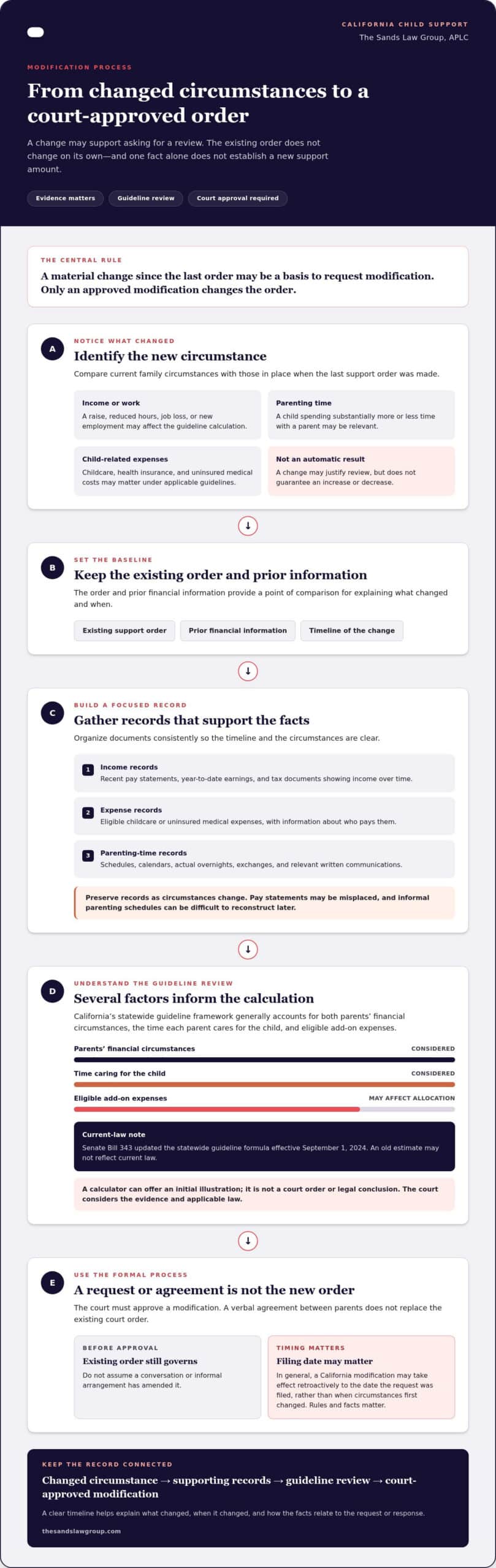
Preparation is not about submitting every document you can find. It is about making the connection between the existing order, what has changed, and the relief you are asking the court to consider. An organized record helps clarify that connection and makes it easier to spot missing information before preparing a request or response.
Use this sequence to build a focused file:
- Collect the current order. Include the signed order and any later orders that changed support or related arrangements.
- Identify the change. Note what shifted, when it began, and which part of the support picture it may affect.
- Gather records tied to that change. Choose documents that support the relevant income, expense, or parenting-time facts.
- Define the request. State what change you are seeking, or which part of the other parent’s request you dispute, and why.
Which documents should parents organize first?
Start with records that relate directly to the issues in your case. Depending on the circumstances, these may include recent pay statements, tax documents, proof of childcare or health-insurance costs, and the current support order. If parenting time is part of the change, calendars, written schedules, and relevant communications can help show the actual care pattern. Keep documents complete and legible, and avoid collecting private material that has no clear connection to the request.
How can a parent make the request easier to evaluate?
Create a dated chronology that links each important development to a supporting record. For example, note when a work or care schedule changed, then identify the documents that help establish the timing. Separate confirmed facts from estimates, disputed details, and assumptions. This helps the reader understand not only what you believe happened, but what evidence supports it.
Next, prepare a concise explanation of the change you are requesting and its connection to the child’s circumstances. Avoid framing the request only as a reaction to conflict or financial pressure. Explain the relevant facts and their practical effect on support information. If you are responding to a request, identify each point you agree with, dispute, or cannot verify, then gather records that address those specific claims.
A child support modification attorney in California can review the file, identify evidentiary gaps, address documents or claims from the other parent, and help refine the relief you seek. Filing requirements and Judicial Council forms can change, and the correct process may depend on the case and court. Confirm the current forms, instructions, and service requirements before filing rather than relying on an outdated copy or general checklist.
If you want guidance turning your records into a clear request or response, schedule a consultation to discuss your child support modification case.
Work With a Child Support Modification Attorney in Southern California
A support dispute can affect a family’s finances and daily routines, particularly when an existing order no longer reflects current circumstances. A child support modification attorney California parents work with should help bring clarity to the facts and process, not promise a particular result. The Sands Law Group, APLC represents parents seeking a modification and those responding to one in Los Angeles, Riverside, San Bernardino, and Kern counties.
The firm’s family law attorneys can review the current order alongside updated financial and parenting information, then help assess whether the evidence supports the requested change or raises issues to address in a response. This review can help you make informed decisions, identify procedural questions, and prepare for the next step with a clearer understanding of your position.
What can a child support attorney help you assess?
A lawyer can examine how the existing order relates to changes in income, parenting time, or relevant child-related expenses. They can also look for gaps between the facts presented and the documents available, consider potential weaknesses or unanswered questions in the other parent’s position, and explain procedural options in light of your case. If custody or visitation arrangements have shifted, counsel can consider how those facts intersect with support without assuming they dictate a specific amount.
Representation can be valuable on either side of a request. If you’re seeking a change, counsel can help frame the relief you want around relevant evidence and applicable law. If you’re responding, counsel can help evaluate the claims, organize supporting records, and present concerns clearly. The aim is a well-prepared position, not a guaranteed court outcome.
What should you bring to an initial legal consultation?
Useful preparation gives the discussion a practical starting point. Gather documents and notes related to the change and the outcome you’re seeking, rather than trying to bring every record you have. Consider organizing:
- The existing child support order and any recent court or agency notices.
- Current income information, tax documents, and records of relevant expenses.
- Childcare and health-insurance information that may relate to support.
- Parenting-time schedules or calendars showing the current arrangement, if relevant.
- A brief timeline stating what changed, when it changed, and how it affects your request or response.
Bring questions, too. You may want to discuss which facts need stronger documentation, what issues the other parent may contest, or what procedural choices are available in your circumstances. An initial review can help separate established facts from unresolved questions and clarify how to proceed without relying on assumptions.
If you’re ready to discuss your circumstances and records with counsel, schedule a confidential consultation. A focused conversation can help you understand your options and prepare for a modification request or response with informed guidance.
Choose a Clear Next Step for Your Family
A possible change in support can feel like one more uncertainty in an already demanding season. You don’t have to decide what to file or how to respond based on guesswork. A tailored legal review can help you identify the questions that matter, understand what remains uncertain, and consider a practical path forward for your family.
If you’re looking for a child support modification attorney california, a focused conversation can help you assess your situation, whether you’re seeking a change or preparing to respond. Bring your questions and the information you have. You can begin clarifying your options before every detail is settled.
Schedule a confidential consultation with The Sands Law Group, APLC to discuss your child support matter in Los Angeles, Riverside, San Bernardino, or Kern County.
Frequently Asked Questions
Can I modify child support in California if the other parent and I agree?
Yes. You can propose different support terms together, but a private agreement should not be treated as changing the court order. The proposed terms generally must go through the applicable legal process and receive any required approval before replacing the existing order. For example, agreeing by text to pay a lower amount may not protect either parent if circumstances later become disputed. Have the proposed terms reviewed before relying on them.
Does losing my job automatically change my California child support order?
No. Losing a job may be important, but the support order does not change automatically, and an amount can remain due under the current order. Keep documentation of when employment ended, any income received afterward, and relevant communications about the change. Don’t stop or reduce payments based solely on a job loss. Seek legal guidance promptly about the appropriate process while continuing to follow the existing order unless it is formally changed.
Can child support be modified if the other parent’s income increases?
It may be relevant, but an increase does not automatically establish that support should change or determine the new amount. The effect depends on current financial information and California’s guideline framework. Avoid relying on assumptions, rumors, or a change in lifestyle alone as proof of income. A child support modification attorney California parents consult can help assess which information is relevant and how to address it through the proper process.
How often can a California child support order be modified?
There isn’t a fixed schedule that guarantees a modification at a particular interval. Whether another request makes sense depends on the new facts, the existing order, and applicable legal requirements. If a prior request was denied or an order changed recently, compare the current circumstances with those considered at that time. Repeating the same arguments may not address what has changed. Have counsel review the order history and new information before deciding whether to proceed.
Can a change in custody or parenting time affect child support in California?
It can affect information considered in a support determination, but a revised schedule does not automatically change the amount due. For instance, if the written plan says one thing but the child has regularly been staying elsewhere, the difference may need to be explained with reliable records. Keep a calendar and relevant written communications, and distinguish a temporary deviation from an ongoing arrangement. Legal advice can help assess whether the facts support a formal request.
What happens to unpaid child support when a modification is requested?
Requesting a review or modification does not, by itself, erase unpaid support or suspend the current order. Past-due amounts and the effective date of any new order may depend on the facts and current law. Don’t assume a later change will eliminate arrears, and avoid making payment decisions based on that expectation. Because filing timing may affect when a modification applies, ask counsel to review the payment history and explain the options relevant to your situation.

Article by
Thomas D. Sands, Esq.
Thomas D. Sands is the founder and CEO of The Sands Law Group, APLC. A California attorney with more than two decades of experience, he represents clients in divorce and family law matters as well as civil litigation and real property disputes. His approach emphasizes attentive, practical, and cost-conscious representation.
Sands is a 2023 Litigator of the Year honoree of the American Institute of Trial Lawyers and a 2023 Lawyer of the Year honoree of the American Institute of Legal Professionals. His firm has also received recognition among the 2025 Best Law Firms in America, a 2026 Benchmark Best of award, and a 2026 Law Firm of the Year honor.

Article reviewed by
Thomas D. Sands, Esq.
Thomas D. Sands is the founder and CEO of The Sands Law Group, APLC. A California attorney with more than two decades of experience, he represents clients in divorce and family law matters as well as civil litigation and real property disputes. His approach emphasizes attentive, practical, and cost-conscious representation.
Sands is a 2023 Litigator of the Year honoree of the American Institute of Trial Lawyers and a 2023 Lawyer of the Year honoree of the American Institute of Legal Professionals. His firm has also received recognition among the 2025 Best Law Firms in America, a 2026 Benchmark Best of award, and a 2026 Law Firm of the Year honor.
TOLL-FREE: 855-SANDS4U