
A collaborative divorce can give spouses a more active role in shaping their agreement, but it does not remove California’s required timeline. A collaborative divorce attorney in Riverside can guide a spouse through negotiations and legal decisions. According to the California Legislature, a divorce is subject to a six-month waiting period that begins when the petition is served on the other party.
It is understandable to want a process that protects your interests without turning every disagreement into a courtroom dispute. Collaborative divorce may offer a structured way to work toward resolution, but it depends on both spouses’ willingness to participate and access clear legal guidance throughout.
This article explains what a collaborative divorce lawyer does, what California requires, how the waiting period works, and how each spouse’s representation fits into negotiations. It also covers what can happen if the process breaks down, helping you assess whether this approach fits your circumstances and what legal support may help you move forward.
Key Takeaways
- Understand how collaborative divorce differs from mediation, including who guides negotiations and who makes the final decisions.
- Learn how legal guidance can help address property, debts, real estate, custody, and support within a negotiated settlement.
- See what a written agreement and structured meetings contribute to the collaborative process, and where its limitations matter.
- Know how each spouse’s attorney represents that spouse’s interests while settlement terms are negotiated and documented.
- Prepare for what may change if either spouse ends the collaborative process, including the lawyers’ role if negotiations fail.
Do Collaborative Divorces Have a Waiting Period?
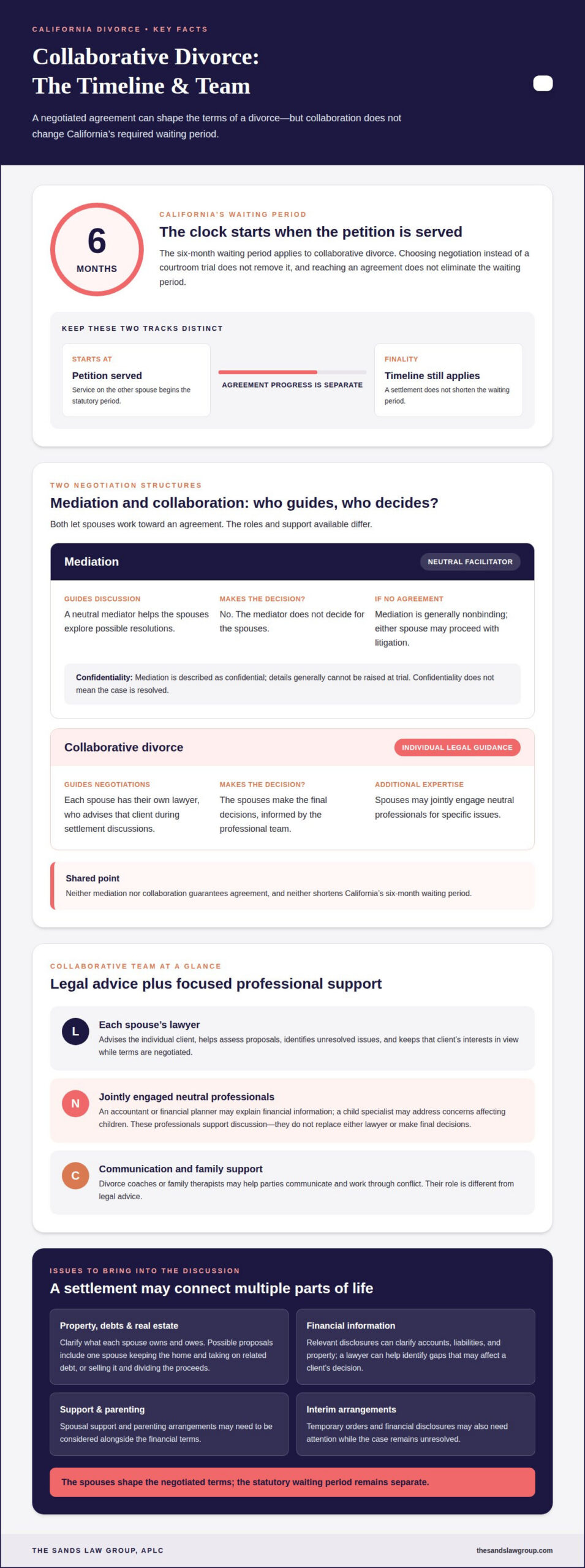
Yes. California’s six-month waiting period applies to a collaborative divorce, according to the California Legislature. The period begins when the divorce petition is served on the other spouse. Choosing collaboration rather than a courtroom trial does not remove this statutory timeline, so spouses should distinguish progress toward agreement from when the divorce can become final.
The waiting period and the negotiation process serve different purposes. Spouses may discuss property division, parenting arrangements, or spousal support, but reaching an agreement does not eliminate the waiting period. The California Legislature states that the six-month waiting period begins when the divorce petition is served on the other party.
How Collaborative Divorce Differs From Mediation
In mediation, a neutral third-party mediator facilitates discussion and helps the parties explore possible resolutions. The mediator does not make decisions for the spouses. Mediation is generally nonbinding, so either spouse may proceed with litigation if negotiations do not produce an acceptable agreement.
Collaborative divorce also centers on negotiation, but each spouse has their own lawyer. The attorneys advise their respective clients as the spouses work toward a settlement. If useful, the parties may jointly engage neutral professionals, such as an accountant or child specialist, to address specific issues. The spouses make the final decisions, informed by the professional team.
That difference can matter when a difficult issue involves several moving parts. In mediation, a neutral mediator may help spouses discuss a home and its value. In a collaborative process, each spouse’s lawyer can provide individual legal guidance about a proposed resolution. Neither format guarantees agreement; each offers a different structure for negotiation.
Confidentiality in Mediation
Mediation is described as confidential, and details from mediation generally cannot be raised at trial. This can give parties room to discuss settlement options without treating every proposal as a final position. Confidentiality does not mean the case is resolved: mediation remains generally nonbinding, and unresolved issues may proceed to litigation.
Both mediation and collaboration let spouses shape their agreement rather than leaving every detail to a judge. The right process depends on the issues, the parties’ ability to negotiate, and how much individual legal guidance they need. Neither method shortens California’s six-month waiting period, which begins when the petition is served. Understanding this distinction helps spouses plan negotiations around the legal timeline.
Why Hire a Collaborative Divorce Lawyer?
A collaborative lawyer helps a client assess proposals, identify unresolved issues, and protect individual interests during settlement discussions. This guidance can bring financial, parenting, and legal questions into a coordinated process rather than leaving difficult details to emerge during litigation.
Financial Assets, Debts, and Real Estate
Dividing a home, savings, investments, and debts requires a clear picture of what each spouse owns and owes. A lawyer can help a client assess proposed terms, such as one spouse keeping the home and taking on related debt, or selling the property and dividing the proceeds.
Relevant financial information matters before either party evaluates a settlement. In a collaborative process, the parties agree to disclose relevant information, which can clarify questions about accounts, liabilities, and property. A lawyer can identify gaps that may affect a client’s decision and help frame financial issues for discussion.
Neutral Financial and Mental Health Professionals
The spouses may jointly hire neutral professionals when a question calls for focused expertise. An accountant or financial planner can help explain financial information, while a child specialist can address concerns affecting children. These professionals support discussion; they do not replace either spouse’s lawyer or make the final decisions.
Emotional strain can also make negotiations difficult. Divorce coaches or family therapists may help parties communicate and work through conflict. Their role differs from legal advice: a lawyer advises the client about legal interests, while a neutral professional helps the spouses address communication or family concerns.
Financial, Parenting, and Legal Issues
A settlement may need to address property, debts, spousal support, parenting arrangements, and legal terms together. For example, a proposed parenting schedule may affect each parent’s practical needs, while a proposal involving the home may shape the financial options available to both parties.
Temporary orders and financial disclosures also require attention while a case is unresolved. A lawyer can help a client understand how interim arrangements relate to the broader settlement and what financial information matters to a proposal. Clear organization helps keep each issue focused instead of letting it obstruct the entire negotiation.
In Riverside County, a collaborative divorce lawyer can help organize these questions, explain proposed terms, and keep the client’s interests visible throughout negotiations. If you’re weighing legal guidance for property, support, or parenting issues, discuss collaborative divorce representation as a possible next step.
Is there a strict procedure for the process of collaborative divorce?
California provides a collaborative law process for family court matters through a written agreement, a framework established in 2013. The process has recognizable steps, but negotiations address the spouses’ specific disputes rather than following one fixed script.
Typically, the spouses and their lawyers begin working together before court paperwork is filed. They agree to negotiate in good faith, share relevant information, and use neutral professionals when needed. This structure lets the parties discuss settlement terms outside court while each spouse has access to legal advice.
Meetings commonly bring both spouses and both lawyers together for a four-party discussion. The group can identify unresolved issues, set an agenda, and decide what information or expertise would help next. Meetings may take place weekly or every two weeks, depending on the discussions and participants’ needs.
This structure can keep a family law case focused on solutions rather than a series of contested court hearings. For example, spouses can discuss parenting schedules and practical concerns directly, while their lawyers clarify legal implications. Collaborative divorce and mediation may save time and money, but the result depends on the issues and the parties’ ability to reach agreement.
Privacy is another potential benefit. The collaborative process is described as out of court and confidential, giving spouses a setting for candid settlement discussions. Confidentiality does not resolve every issue: spouses still need to settle disputed terms and complete the necessary legal process.
There are important limits. Collaboration depends on both parties participating constructively and disclosing relevant information. If one spouse refuses meaningful negotiation or the parties cannot agree on a central issue, the process may not produce a settlement. It is also not well suited to circumstances involving domestic violence, safety risks, or a substantial power imbalance. Because the process relies on direct negotiation, it may not provide a safe or balanced framework in those situations.
A divorce lawyer can help assess whether the process fits the disputes involved, including contested finances or parenting terms. The key question is whether both spouses can participate safely, exchange information, and negotiate in good faith. Those conditions matter more than simply preferring an out-of-court process.
For spouses who can meet those conditions, a written agreement and scheduled meetings provide a defined path toward settlement. If safety concerns or a serious imbalance affect the family law case, those limits should guide the choice of process before negotiations begin.
Legal representation in collaborative divorce
Collaborative divorce changes how spouses negotiate, not whom each lawyer represents. Each attorney has an absolute duty to represent solely that attorney’s client’s interests. A shared goal of settlement does not make the lawyers neutral advisers. This distinction matters when spouses disagree about property, parenting, or support: each client needs independent legal advice before making decisions.
At a consultation, a lawyer can learn which issues are settled, which remain disputed, and what information could affect a proposal. For example, if one spouse proposes keeping the family home, the other spouse’s lawyer can assess the legal and financial terms from that client’s perspective. The lawyer can explain tradeoffs, identify unanswered questions, and help the client decide whether to accept, revise, or reject the proposed terms.
During meetings, each attorney advises their own client while the parties negotiate together. A lawyer can clarify the possible implications of a proposed provision, help a client express concerns, and keep discussion focused on specific decisions. The client, not the lawyer or neutral professional, makes the final choices. This division of roles supports direct negotiation without requiring either spouse to give up independent legal representation.
Once the parties reach a settlement, their lawyers draft the agreement. Both spouses then review and edit it until they are satisfied with its terms. The document turns discussions into written provisions that may cover property, debts, support, or parenting arrangements. Careful review matters: a verbal understanding about a home or schedule may not capture all the details the spouses intended to resolve.
The process also has a meaningful limit. If a spouse ends collaborative negotiations, the collaborative lawyers must withdraw and cannot represent either party against the other in court. A client should understand this consequence before starting, especially when the situation involves serious conflict or uncertainty about continuing negotiations. The attorneys’ role is tied to the collaborative process, not later courtroom representation between those spouses.
Collaborative lawyers generally charge by the hour, and jointly engaged professionals may add costs. The number and type of professionals involved, along with the work needed to resolve disputed issues, affect the overall financial commitment. Before agreeing to participate, a client can use an initial consultation to discuss the process, responsibilities, and potential need for outside expertise.
Whether you live in Riverside or San Bernardino, the central point is the same: collaborative representation means independent legal advice within a joint negotiation framework. Each lawyer protects one client’s interests, while the spouses make settlement decisions. Understanding that balance can help you decide whether this form of representation fits your situation.
What happens if collaborative divorce negotiations fail or a spouse withdraws
If a spouse ends collaborative negotiations, the collaborative lawyers must withdraw and cannot represent either spouse against the other in court. That consequence is central to the process: the attorneys’ participation is tied to settlement negotiations, not later courtroom advocacy between these parties.
For example, a couple may agree on parenting arrangements but remain divided over the family home. If one spouse withdraws before resolving that dispute, the collaborative lawyers cannot continue as courtroom counsel in the conflict between them. The spouses must consider another way to resolve the remaining issues, with legal representation suited to that next stage.
Withdrawal does not settle unresolved questions. A proposed property division, support term, or parenting plan remains a proposal unless the parties reach an agreement and document it. Before ending negotiations, each spouse can identify which terms are settled, which remain open, and what information or discussion might help resolve the disagreement.
A practical review can help clarify the decision:
- List the issues already resolved, such as an agreed parenting schedule.
- Identify disputed terms, such as the division of a home or spousal support.
- Determine whether missing financial information or a neutral professional could help clarify a specific disagreement.
- Consider whether both spouses remain willing and able to negotiate constructively.
These steps do not require a spouse to stay in a process that no longer works. They help distinguish a difficult but negotiable issue from a breakdown in participation. If a spouse refuses to disclose relevant information or negotiate in good faith, continued meetings may not move the case toward a workable settlement.
Once the collaborative lawyers withdraw, a spouse should not assume those attorneys can switch roles and represent them in court against the other party. The withdrawal rule applies to both collaborative lawyers, so each spouse may need new legal representation for litigation or other next steps. A lawyer can assess unresolved issues and explain how they may be addressed after collaboration ends.
For a Riverside divorce, understand this transition before signing a collaborative agreement. Ask how the withdrawal requirement affects your representation, what happens to unresolved issues, and how you will make decisions if negotiations stop. These questions are especially important when property division, parenting, or support remains contested.
If negotiations have stalled or a spouse is considering withdrawal, schedule a discussion about divorce representation and the legal steps that may follow.
The Sands Law Group, APLC: Divorce Legal Representation
The Sands Law Group, APLC provides divorce legal representation for people navigating contested and uncontested divorce matters. When questions involve parenting arrangements, financial support, or property division, legal guidance can clarify the issues and help inform decisions about next steps.
Representation may include child custody and visitation, spousal support, and property division. These issues can shape a settlement and affect daily life after divorce, so it helps to understand the legal questions before agreeing to terms. If negotiations have stalled or you need guidance about your options, The Sands Law Group, APLC can discuss your circumstances and the representation you may need.
Contact The Sands Law Group, APLC to discuss your divorce and legal concerns.
Choose a Clear Next Step
Consider what you need from legal representation: a careful review of proposed terms, guidance through a difficult disagreement, or help deciding how to proceed. A collaborative divorce attorney in Riverside can help you assess your priorities and understand how they fit the process, keeping decisions grounded in your circumstances.
The Sands Law Group, APLC provides divorce legal representation, along with child custody and visitation representation and spousal support representation. A conversation can help you explain the issues affecting your family and discuss what legal support may address them.
Contact The Sands Law Group, APLC to discuss your situation and possible next steps. You can move forward with greater clarity, one decision at a time.
Frequently Asked Questions
What Is Collaborative Law?
Collaborative law is a way for spouses to address family-law disputes through negotiated agreements with separate legal counsel. The spouses and their lawyers work toward resolving matters such as parenting arrangements or property terms outside a contested court process. For example, a couple might discuss a parenting schedule with individual legal advice available to each spouse. The approach relies on both parties participating in the negotiation process.
What Is the Difference Between Collaborative and Mediated Divorce?
Collaborative divorce includes a lawyer for each spouse, while mediation centers on a neutral mediator facilitating discussion. In mediation, a spouse may also have separate legal advice, but the mediator is not either party’s lawyer. This distinction matters if one spouse needs individual guidance on a proposed term, such as how a support arrangement affects their financial position.
What Should I Look for When Hiring a Riverside Divorce Lawyer?
Look for representation that fits the issues affecting your case, such as parenting, support, or property questions. In an initial discussion, describe the decisions you face and ask how the lawyer would explain options, communicate proposals, and prepare written terms. For example, if you share a business or own a home, raise that early so the legal discussion can address those concerns rather than focus only on routine paperwork.
What’s the advantage of choosing alternative dispute resolution for my divorce?
Alternative dispute resolution can give spouses more direct involvement in shaping settlement terms than leaving each disputed detail to a judge. It may also make room to address practical arrangements, such as coordinating a child’s school schedule with parenting time. The tradeoff is that negotiation requires both spouses to participate. If communication is unsafe or one party cannot negotiate freely, a negotiated process may not fit the situation.
What is collaborative divorce and how does the process work in Riverside, California?
Collaborative divorce is a negotiated process in which each spouse has independent legal representation while working toward a settlement. In Riverside, spouses can discuss issues such as parenting plans or property arrangements through this process. A collaborative divorce attorney in Riverside can explain how legal advice fits into meetings and how proposed terms become written agreements, helping you understand the process before deciding whether to participate.
Which Riverside, CA divorce attorneys specialize in collaborative divorce?
The Sands Law Group, APLC provides divorce legal representation for contested and uncontested divorce matters in Riverside. In a collaborative case, understand the attorney’s role, including whether the process involves separate counsel and negotiated settlement work. The firm also handles family law matters such as custody, visitation, and spousal support, which may arise alongside divorce issues.
How can I verify a Riverside collaborative divorce attorney’s credentials and experience?
Ask for the attorney’s full name and review the qualifications and relevant family law experience they describe. Discuss how they approach collaborative negotiations, protect an individual client’s interests, and document proposed terms. The Sands Law Group, APLC focuses on family law representation, including divorce matters. This website content is for general informational purposes only and does not constitute legal advice.
How does collaborative divorce compare with mediation and litigation in California?
Collaborative divorce provides each spouse with a lawyer during negotiations; mediation uses a neutral facilitator, and litigation asks the court to resolve disputed issues. The right comparison depends on the conflict, safety, and the spouses’ ability to negotiate. For instance, spouses who need individual legal guidance may value separate counsel, while disputes that cannot be negotiated may require a court-based path.

Article by
Thomas D. Sands, Esq.
Thomas D. Sands is the founder and CEO of The Sands Law Group, APLC. A California attorney with more than two decades of experience, he represents clients in divorce and family law matters as well as civil litigation and real property disputes. His approach emphasizes attentive, practical, and cost-conscious representation.
Sands is a 2023 Litigator of the Year honoree of the American Institute of Trial Lawyers and a 2023 Lawyer of the Year honoree of the American Institute of Legal Professionals. His firm has also received recognition among the 2025 Best Law Firms in America, a 2026 Benchmark Best of award, and a 2026 Law Firm of the Year honor.

Article reviewed by
Thomas D. Sands, Esq.
Thomas D. Sands is the founder and CEO of The Sands Law Group, APLC. A California attorney with more than two decades of experience, he represents clients in divorce and family law matters as well as civil litigation and real property disputes. His approach emphasizes attentive, practical, and cost-conscious representation.
Sands is a 2023 Litigator of the Year honoree of the American Institute of Trial Lawyers and a 2023 Lawyer of the Year honoree of the American Institute of Legal Professionals. His firm has also received recognition among the 2025 Best Law Firms in America, a 2026 Benchmark Best of award, and a 2026 Law Firm of the Year honor.
TOLL-FREE: 855-SANDS4U