
A DNA result alone does not always settle who California recognizes as a legal parent. Contesting paternity in California may mean challenging a parentage petition, a signed voluntary declaration, or an existing judgment. The court may consider more than genetic evidence, and the available process depends on how parentage was established and whether a court case or support order is already in progress.
It is understandable to expect biology to provide a clear answer, especially when parentage affects a child’s stability and a parent’s legal responsibilities. But signing a declaration or being named a legal parent can have consequences that are not undone simply by disputing a biological connection. Some declarations may be rescinded within a limited period; challenges after that period may require a court case.
This article explains how California parentage disputes proceed, when genetic testing may matter, and how a challenge can affect child support, custody, and visitation. It also describes the court procedures and records that may be involved, helping you understand the issues and whether legal representation could help protect your position.
Key Takeaways
- The right way to challenge parentage depends on whether it was established through a court petition, a voluntary declaration, or an existing judgment.
- Genetic testing can inform a dispute, but biology alone may not resolve who California recognizes as a legal parent.
- Rescinding a declaration and setting aside a judgment follow different rules, and strict deadlines can affect your options.
- Parentage status can shape child support responsibilities and who may seek custody or visitation orders.
- Learn which court forms and procedures may apply, and when legal representation can help you protect your position.
Disputing a Petition to Establish Parental Relationship
In California, biology and legal parentage do not always match. A judge may recognize someone as a legal parent without a genetic relationship to the child. That distinction matters when a petition asks the court to establish parentage. The decision can affect who may seek custody or visitation orders and who has legal parental responsibilities.
California Family Code section 7611(a) or (d) may create a presumption that a man is the child’s legal father. The court considers the circumstances described by the applicable presumption, not DNA results alone. Under section 7612(c), a section 7611(d) presumption may be rebutted by a judgment establishing another man’s paternity. That means competing claims require attention to both legal status and evidence of biological parentage.
A parentage case can begin with a Petition to Determine a Parental Relationship, filed on form FL-200. If you receive a petition, read it carefully and identify the parentage finding it asks the court to make. A person responding to a petition may challenge the requested parentage finding and present their position to the court. The court process gives each side an opportunity to present its position before parentage is determined.
Genetic testing can address whether an alleged father is biologically related to a child. A judge may order testing when genetic parentage is disputed. At a hearing, a result showing that an alleged father is not the biological father may support a ruling in that person’s favor. Still, a test does not automatically resolve every legal issue, particularly when a statutory presumption or prior parentage finding is involved.
Parents can also establish legal parentage outside court by signing and filing a Voluntary Declaration of Parentage with the state. This can establish the parent-child relationship without a petition or hearing. Because a signed declaration affects legal status, anyone disputing parentage should determine whether one was signed and filed. A declaration and a court petition are different records, so the challenge depends on how parentage was established.
After parentage is established, the legal relationship provides the basis for court orders concerning the child. A dispute is therefore not simply a request to compare DNA samples. It asks the court to assess the petition, any applicable presumption, the parties’ intent, and genetic evidence. For example, a person named in an FL-200 petition may challenge the requested finding while the court considers whether the evidence supports that position.
Rescinding a voluntary declaration or parentage judgment
California allows different challenges depending on whether parentage was established through a voluntary declaration or a court judgment. A case may be reopened to seek relief from a paternity finding, but an existing child support order does not disappear automatically.
Rescinding Parentage Declarations
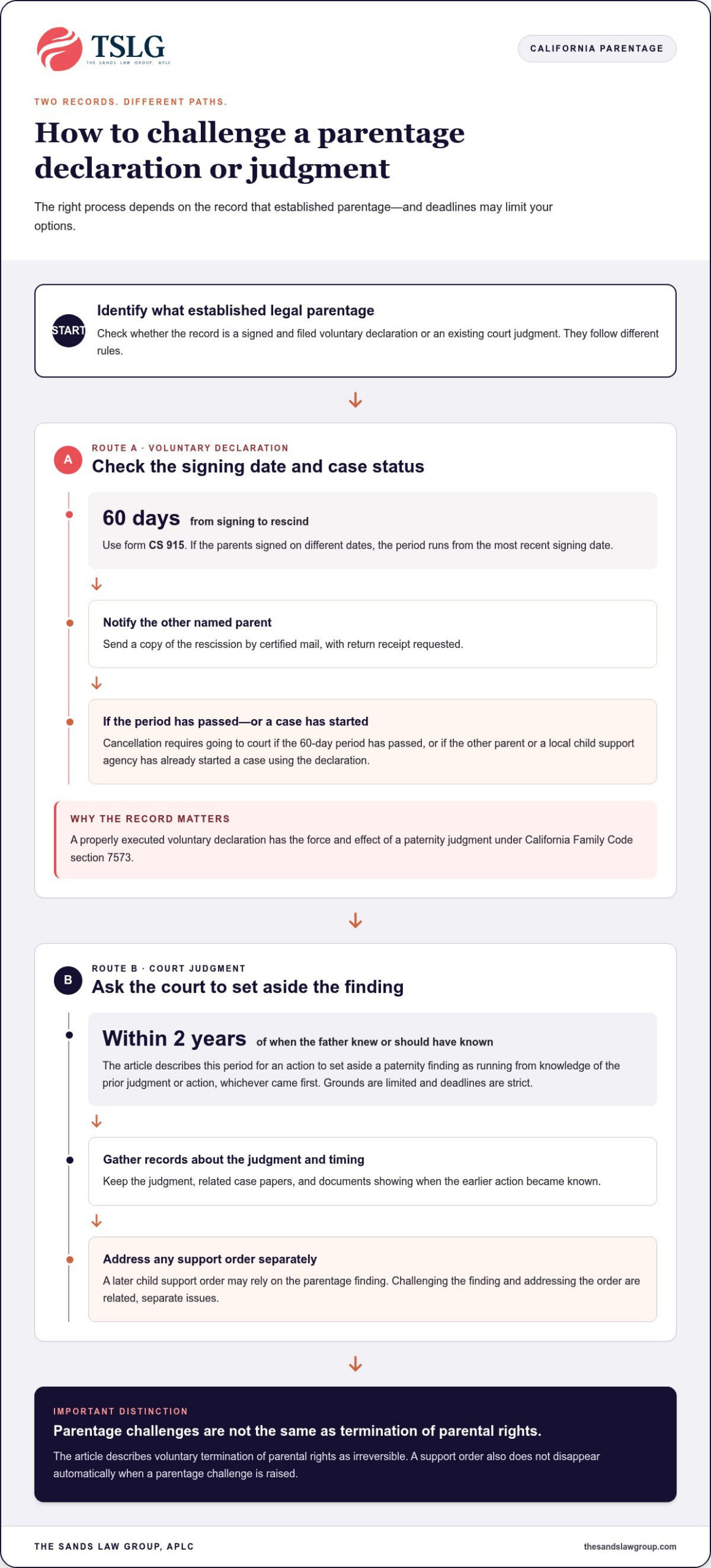
A voluntary Declaration of Paternity or Parentage is a signed record that can establish legal parentage without a court hearing. Under California Family Code section 7573, a properly executed Voluntary Declaration of Paternity has the force and effect of a paternity judgment. That legal effect makes the document consequential, even when a parent later questions the biological relationship or intended responsibilities.
California permits a parent to rescind the declaration within 60 days after signing, using form CS 915. If the parents signed on different dates, the 60-day period runs from the most recent signing date. The person rescinding must send a copy to the other named parent by certified mail, with return receipt requested.
After that 60-day period, cancellation requires going to court. Court action is also required if the other parent or a local child support agency has already started a case using the declaration. A voluntary acknowledgment of paternity is not interchangeable with a casual agreement; the signed and filed record can establish parentage and legal responsibilities. A married spouse’s parentage may follow a separate presumption, which a genetic test may not disprove.
Reopening a Parentage Judgment
Reopening a parentage judgment means asking a court to set aside an earlier paternity finding, rather than rescinding a declaration within its initial cancellation period. California parentage judgments can be difficult to set aside because the grounds are limited and deadlines are strict. California Legislative Information states that an action to set aside a paternity finding should be brought within 2 years of when the father knew or should have known of the prior judgment or action, whichever came first.
Because a deadline may apply, records showing when the father learned about the judgment can be important. Gather the judgment, related case papers, and documents showing when the earlier action became known. A later child support order may rely on the parentage finding, so challenging that finding and addressing the order are related but separate issues.
Voluntary termination of parental rights is different from rescinding a declaration or setting aside a paternity judgment; termination is described as irreversible. Before taking a step that could affect parentage or support, identify which legal record established the relationship. If a declaration or judgment is already affecting your family’s responsibilities, a discussion about parentage options can help you consider the appropriate court process.
Child support, custody, and visitation consequences
Parentage connects a child’s legal relationship with a parent to support and parenting decisions. In California, legal parents must financially support their child and may ask the court for custody and visitation orders. A biological connection alone does not automatically give a father custody. The court must address parentage before making orders about custody, visitation, child support, a name change, or restraining orders.
That sequence can matter when a parent disputes paternity while the child needs stable support or parenting arrangements. Denying parentage can complicate and prolong child support and custody proceedings. It may also delay financial support for the child and create uncertainty while the case remains unresolved. For a father, the dispute can affect legal standing and potentially lead to less favorable outcomes in later custody proceedings.
A biological father determined to be a child’s father does not automatically receive custody. Parentage establishes legal status; custody and visitation orders address parenting arrangements. A father who establishes parentage may ask the court for those orders, but the parentage finding does not grant a particular schedule. A parentage finding does not by itself determine custody or contact arrangements.
Child support obligations can also reach backward. A father whose genetic relationship is established after he denied paternity may face fines and retroactive child support payments. A challenge does not, by itself, remove existing responsibilities or prevent later support consequences. Keep court papers, support notices, and parentage records together, and distinguish a dispute about legal parentage from a request to change support or parenting orders.
If a California local child support agency serves a summons, respond promptly: a person disputing it has 30 days to take a paternity test. The agency summons uses form FL-600, while a parentage case summons uses form FL-210. These documents signal different proceedings, so identify who filed the case and what response or testing the summons requires. Missing the stated testing period can affect how the dispute proceeds.
An attorney can help organize a response when parentage, support, and custody overlap. Relevant records include the summons, any existing support or custody orders, and documents related to parentage. These materials help clarify whether the court has already established legal parentage and which orders are in effect. An organized record can also distinguish immediate support obligations from the process of resolving parentage and parenting arrangements.
Who has access to information in a parentage case?
California courts may recognize a legal parent without a genetic connection. A genetic test does not automatically erase an established parent-child relationship; the court also considers any applicable legal presumption, signed declaration, or prior judgment.
Court filing fees are separate from testing costs and depend on the filing and case circumstances.
In a parentage case, relevant records may include the petition, response, signed parentage declaration, prior judgment, and genetic test results. Each answers a different question: what legal status is requested, how parentage may have been established, and what biological evidence exists. For example, a declaration signed by both parents may matter even if a later test raises questions about genetic parentage.
Keep the records together and note what each one shows. A petition identifies the requested court finding; a response states the opposing position. A signed declaration documents a voluntary acknowledgment, while a judgment records a court’s prior decision. Genetic test results address biological connection, but they do not by themselves explain how an existing legal relationship arose.
When genetic results conflict with an established relationship, California’s parentage rules matter alongside the test. Family Code section 7611(a) or (d) may create a presumption of fatherhood, and section 7612(c) allows a section 7611(d) presumption to be rebutted by a judgment establishing another man’s paternity. The court must consider the legal basis for parentage, not simply treat DNA as the only evidence.
A useful record review starts with identifying who signed each document and whether a court later issued an order. Compare the names and dates on the declaration, petition, and judgment with the genetic report. If a mother or father disputes the information, identify the specific issue: biology, intent to assume parenthood, or an earlier legal finding.
For a filing that challenges parentage, organize the evidence around the issue in dispute. A genetic report may support a claim about biological parentage; a signed declaration may show how legal parentage was established. A prior judgment can change what the court is being asked to reconsider. Keeping these distinctions clear helps the court assess the records in context.
Information is most useful when each item is tied to a specific question. A DNA result addresses genetic relationship, while a declaration or judgment addresses legal status. Separating these categories helps prevent a test result from being mistaken for a complete account of parentage.
Court procedures for contesting paternity
In California, a child is generally presumed to have legal parents if the parents were married or registered domestic partners when the child was born or conceived. A marital presumption can affect how a parentage dispute is handled, and genetic evidence may not resolve the legal question on its own. In that situation, a person disputing parentage must address the legal status through the court process, not rely on genetic evidence alone.
A parentage case may begin with a Petition to Determine a Parental Relationship, form FL-200. The case summons uses form FL-210. A response should clearly identify which requested parentage finding is disputed and the basis for the challenge, such as lack of intent to become the child’s parent. The court considers the filing and supporting evidence when deciding parentage.
The court process depends partly on who started the case. A mother, father, child’s personal representative, or county Department of Child Support Services may initiate a parentage action where the child lives or can be found. If the county agency files, its summons and complaint regarding parental obligations use form FL-600. Identify the issuing party and form, since they indicate the type of case and requested action.
Genetic testing can be evidence when biological parentage is disputed. A judge may order testing when there is a question about the genetic father. The test addresses biological connection, while a court order determines the legal result. Keep test results with the petition, response, signed parentage records, and any prior judgment so the court can consider the evidence in context.
A summons from a local child support agency requires prompt attention. A person disputing that summons has 30 days to take a paternity test. Review the summons for the agency’s instructions and deadlines, then preserve a copy with related notices. A missed testing window can affect how the agency’s case proceeds, so the date and type of document matter.
California court Self-Help Centers, also called Family Law Facilitators, can answer questions about forms and where to file them. They can clarify procedural questions, while you identify the parentage decision being challenged. A dispute about a biological result, for example, differs from one involving a signed declaration or the marital presumption.
When marriage, a child support agency filing, or a genetic test complicates the case, discuss your parentage case with an attorney to understand the court process and how to present the relevant records.
The Sands Law Group, APLC: Divorce Legal Representation
The Sands Law Group, APLC represents clients when a parentage dispute overlaps with divorce, custody, or visitation concerns. A paternity challenge may affect family decisions in a broader separation, making it important to consider how court proceedings and parenting arrangements intersect.
The firm provides Divorce Legal Representation and Child Custody and Visitation Representation. When a parentage case raises questions about parenting time or related family law matters, these services can address the connected issues. The firm also represents clients in spousal support and property division matters as part of divorce proceedings.
For guidance on how divorce or parenting concerns relate to your circumstances, contact The Sands Law Group, APLC.
Choose a Clear Path Forward
A parentage dispute can shape how your family moves forward, but resolving it involves more than revisiting the past. Consider what clarity means for your child and your role in the family, and bring that goal into legal discussions. When contesting paternity in California, keeping the focus on a workable future can help guide decisions through a difficult, personal process.
The Sands Law Group, APLC can help you consider family-law concerns connected to your circumstances. If you’re weighing what to do next, a conversation can help you explain the situation and understand the legal questions that need attention. You can schedule a conversation with The Sands Law Group, APLC when you’re ready.
Seeking legal guidance is a measured step toward informed decisions. Move forward with care, clarity, and your family’s well-being in view.
Frequently Asked Questions
Can I Solve This on My Own or Do I Need an Attorney?
You can handle basic filing tasks yourself, but disputes involving a signed declaration, marriage presumption, or existing judgment can raise several legal issues at once. California court Self-Help Centers can answer questions about forms and filing locations. A case involving both a genetic test and a prior parentage order, for example, requires attention to each record. The approach depends on what established parentage and what the court is being asked to decide.
Need Legal Help Challenging Paternity?
The Sands Law Group, APLC represents mothers and fathers in court actions to establish or challenge legal parentage. The firm serves clients in Los Angeles, Riverside, San Bernardino, and Kern. This website’s content is for general informational purposes only and does not constitute legal advice. Contacting the firm does not create an attorney-client relationship; that relationship begins only after a formal agreement is signed.
Who is a legal parent?
A legal parent is someone recognized as a parent under California law, which may include a person without a genetic connection to the child. For example, a person may gain legal status through a court judgment or a filed voluntary declaration. Marriage or registered domestic partnership at the child’s birth or conception can also establish legal parentage. In limited circumstances, California courts may recognize more than two legal parents.
Who can contest paternity in California, and what are the deadlines?
A person named in a parentage petition may dispute the requested finding by responding in court. A mother, father, child’s personal representative, or county Department of Child Support Services may start a parentage case. A declaration may generally be rescinded within 60 days of signing. For a judgment, California Legislative Information says an action to set aside a paternity finding should be brought within 2 years of when the father knew or should have known, whichever came first.
How do you challenge a voluntary declaration of parentage in California?
A parent can rescind a voluntary declaration within 60 days by submitting form CS 915. If parents signed on different dates, the period runs from the later signing date; the rescinding parent must send the other parent a copy by certified mail, return receipt requested. After the deadline, or once the other parent or a local child support agency has started a case using the declaration, cancellation requires court action.
How do you contest a presumed parent’s paternity under California law?
Begin by identifying the legal basis for the presumption, because a genetic result may not resolve every parentage issue. Family Code section 7611(a) or (d) may support a presumption of fatherhood; a section 7611(d) presumption may be rebutted under section 7612(c) by a judgment establishing another man’s paternity. The marital presumption described for spouses married when the child was born is conclusive, so DNA alone cannot disprove it.
What California court forms and filing steps are required to dispute parentage?
A court parentage case uses form FL-200, the Petition to Determine a Parental Relationship, and form FL-210 for the summons. A responding person disputes the requested finding by filing a response. If a county child support agency files, its summons and complaint regarding parental obligations use form FL-600. A person disputing that agency summons has 30 days to take a paternity test. County Self-Help Centers can answer form and filing-location questions.
When will a California court order genetic testing in a paternity case?
A judge may order genetic testing when parentage proceedings raise a question about the genetic father. Testing can address biological relationship, but the court must also consider the legal basis for parentage, such as a presumption, signed declaration, or existing judgment. A test may show that an alleged father is not biologically related, while a separate legal record still requires the court’s attention.

Article by
Thomas D. Sands, Esq.
Thomas D. Sands is the founder and CEO of The Sands Law Group, APLC. A California attorney with more than two decades of experience, he represents clients in divorce and family law matters as well as civil litigation and real property disputes. His approach emphasizes attentive, practical, and cost-conscious representation.
Sands is a 2023 Litigator of the Year honoree of the American Institute of Trial Lawyers and a 2023 Lawyer of the Year honoree of the American Institute of Legal Professionals. His firm has also received recognition among the 2025 Best Law Firms in America, a 2026 Benchmark Best of award, and a 2026 Law Firm of the Year honor.
Article reviewed by
Thomas D. Sands, Esq.
Thomas D. Sands is the founder and CEO of The Sands Law Group, APLC. A California attorney with more than two decades of experience, he represents clients in divorce and family law matters as well as civil litigation and real property disputes. His approach emphasizes attentive, practical, and cost-conscious representation.
Sands is a 2023 Litigator of the Year honoree of the American Institute of Trial Lawyers and a 2023 Lawyer of the Year honoree of the American Institute of Legal Professionals. His firm has also received recognition among the 2025 Best Law Firms in America, a 2026 Benchmark Best of award, and a 2026 Law Firm of the Year honor.
TOLL-FREE: 855-SANDS4U