

What if a DNA result doesn’t, by itself, change who California law recognizes as a parent? If you’re considering disputing paternity in california, the answer may depend on how legal parentage was established, not only on biology. A signed declaration, marital presumption, or existing court order can each affect the available path.
It’s understandable to feel unsettled, especially if you’re concerned about custody, parenting time, or child support. The rules and deadlines vary with the circumstances, so identifying the legal basis for parentage and acting promptly may matter.
This article explains how parentage may be established, why timing and court procedure can shape your options, and what to consider before taking the next step. It also outlines which records and dates to gather before discussing your situation with a family-law attorney.
Key Takeaways
- For disputing paternity in california, first identify whether legal parentage arose from a signed declaration, presumed-parent status, or a court determination.
- Biological evidence and legal parentage are related but distinct; genetic test results alone may not change a person’s legal status.
- Deadlines and available procedures depend on how parentage was established and the specific facts, so don’t assume one time limit applies to every case.
- Gather declarations, court papers, and key dates. If you’ve been served with documents, note any response deadline.
- A family-law attorney can assess possible next steps and how a parentage dispute may relate to custody, visitation, or support.
What Does Disputing Paternity in California Actually Mean?
Questioning whether you are a child’s parent can bring painful uncertainty. The consequences may also reach beyond family relationships to court orders and financial responsibilities. Start by separating two questions that can feel inseparable: whether someone is biologically related to a child, and whether California law recognizes that person as a parent.
Biological parentage concerns genetic connection; legal parentage is the relationship the law recognizes, with rights and responsibilities that may exist independently of a genetic result. That distinction is central to disputing paternity in california. A DNA test may address biology, but it doesn’t necessarily determine the legal effect of a challenge. The applicable route depends on how parentage was established and the family’s circumstances.
How can someone become a legal parent in California?
California Courts identifies several ways parentage may be established: through birth, marriage, a voluntary declaration of parentage, or a court decision. These pathways don’t operate identically in every family. For example, a person may be recognized as a parent based on marital status, while another may have signed a declaration or been named in a judgment.
Those differences matter when someone wants to challenge legal status. The document or event that established parentage can point to a specific procedure, and a challenge involving a declaration may not follow the same steps as one involving a court determination. Before focusing on test results, locate the relevant birth, declaration, or court records. They can help clarify which questions need legal review.
Why does legal parentage matter beyond a DNA result?
Legal parentage can affect who may ask the court for custody or parenting-time orders, as well as who may have child-support responsibilities. These issues can be closely connected: challenging legal status may raise questions about existing arrangements, but the result depends on the facts and applicable process. A biological finding alone doesn’t automatically resolve those legal questions.
This distinction can be difficult when someone has acted as a parent for years, or when new information raises questions about a child’s biological history. Discussions of paternity fraud may describe one reason someone seeks answers, but a label or allegation doesn’t determine the legal outcome of a particular case. The focus remains on the basis for legal parentage and the rules that apply to challenging it.
The practical question is not simply, “What would a genetic test show?” It is also, “What established this legal relationship, and what consequences could follow from challenging it?” Keeping those questions separate can help you preserve relevant records and understand why the next step should be tailored to your circumstances.
Which Legal Route Applies to Disputing Paternity in California?
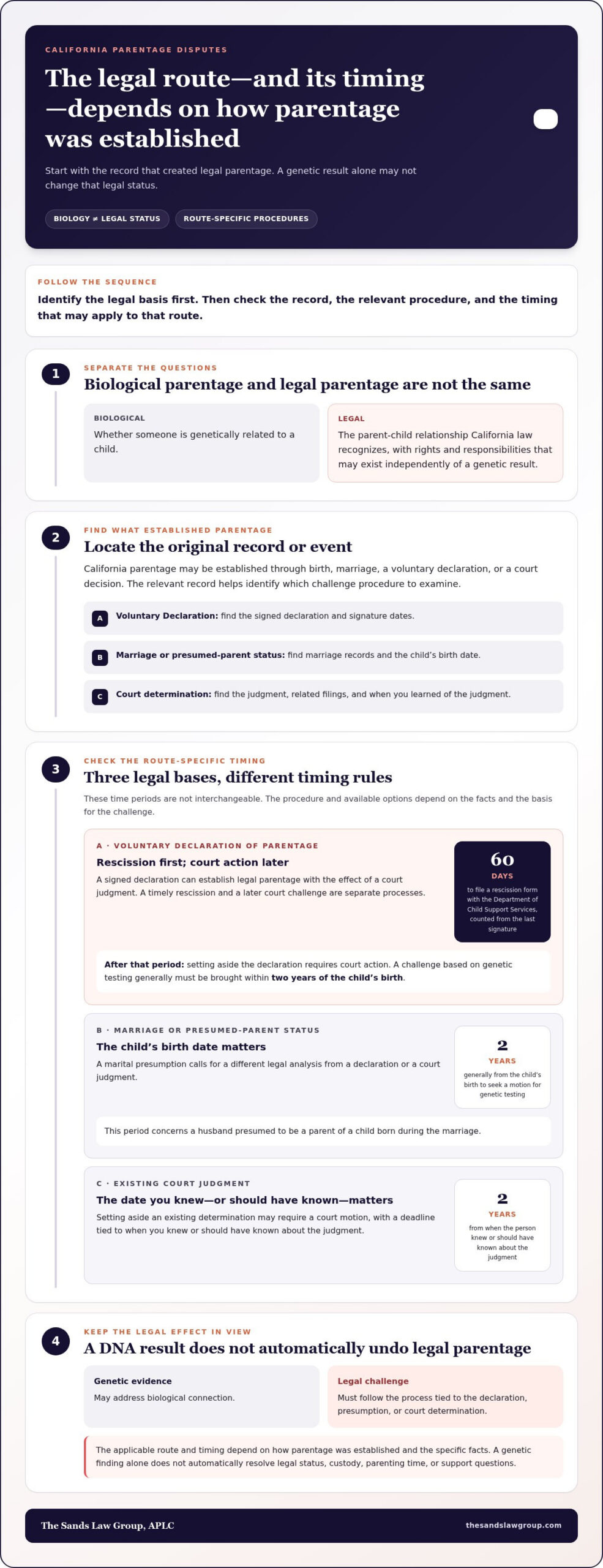
Once you know legal parentage has been established, identify how it happened. A signed declaration, a marital presumption, and a court judgment are different legal bases, and the procedure for challenging one may not fit another. Locating the original record can help you focus on the relevant documents, deadlines, and legal questions instead of assuming a DNA test alone resolves the matter.
The original legal basis for parentage guides which challenge procedure and deadline may apply. Use this comparison as an initial framework, not as a prediction of what a court will do:
| How status may have been established | Record or event to locate | Why the route matters |
|---|---|---|
| Voluntary Declaration of Parentage | The signed declaration and its signature dates | Rescission and a later court challenge are separate processes with different timing. |
| Marriage or presumed-parent status | Marriage records and the child’s birth date | A challenge may involve rules tied to the marital presumption and the child’s age. |
| Court determination | The judgment, related filings, and when you learned of the judgment | Setting aside an existing determination may require a court motion and a deadline tied to when you knew or should have known about it. |
What if parentage began with a voluntary declaration?
A signed Voluntary Declaration of Parentage can establish legal parentage with the effect of a court judgment. California’s process distinguishes a timely rescission from a later court challenge. A signer may file a rescission form with the Department of Child Support Services within 60 days of the last signature. After that period, setting aside the declaration requires court action; a challenge based on genetic testing generally must be brought within two years of the child’s birth. The procedure available depends on the facts and the basis for the challenge.
What if parentage rests on marriage or a court order?
A marital presumption and a judgment each call for a different legal analysis. A husband presumed to be a parent of a child born during the marriage generally has two years from the child’s birth to seek a motion for genetic testing. For an existing judgment, the stated period to seek to set it aside is two years from when the person knew or should have known about it. These time limits are not interchangeable, and the underlying facts can matter.
Gather the marriage record, birth information, declaration, and complete court file, including the judgment and filing dates. A genetic result may be relevant, but it doesn’t automatically undo a declaration, presumption, or court order. Because a missed deadline can affect available options, a family-law attorney can help clarify which route may apply. Discuss your parentage circumstances in a consultation.
Can You Dispute Paternity in California After Time Has Passed?
Time passing doesn’t make the biological question disappear, but it can affect which legal procedures remain available. A genetic result and legal parentage are related, yet they aren’t interchangeable: evidence about biology does not automatically cancel a declaration, presumption, or court order. If you’re disputing paternity in california, focus on how parentage was established, when the relevant legal clock began, and what action may still be available.
Prompt legal review matters when parentage is being challenged. This is especially true if you’ve discovered a declaration or judgment you didn’t know existed, or if years have passed since a child’s birth. Delay may affect your options, but it doesn’t by itself answer what can happen next. The legal basis and case facts matter.
Why might the deadline depend on how parentage was established?
California’s time limits are tied to different legal pathways and triggering events. A declaration challenge based on genetic testing may be measured from the child’s birth, while a challenge to a judgment may be measured from when the person knew or should have known about it. A marital presumption has its own timing considerations. The date on a document, the child’s birth date, and the date you learned of an order may all be important.
For example, learning about an old judgment today may raise a different timing question from discovering that a declaration was signed years ago. The relevant date and available procedure need to be assessed together.
- Declaration: A signer may have a short rescission period; a later court challenge has separate requirements and timing.
- Marital presumption: The child’s birth date and the circumstances of the marriage may be central to assessing whether a challenge can proceed.
- Prior judgment: The judgment and when you learned of it may affect the deadline analysis.
These examples aren’t interchangeable rules, and a missed deadline may limit available procedures without automatically resolving every issue. Preserve the declaration, court papers, and key dates, then seek advice based on the specific history.
What can genetic testing establish, and what can it not decide alone?
Genetic testing can provide evidence relevant to biological parentage. A court may order testing as part of a parentage dispute, but a test result is not itself a ruling that changes an existing legal status. Someone seeking to set aside a declaration or judgment may need to use the proper court procedure, and the applicable deadline may still matter.
A privately obtained test also shouldn’t be treated as a substitute for court procedure. Before relying on a result, consider how it was obtained, what legal status is already in place, and whether a court action or order is involved. Those details can shape how the evidence is considered.
Gather relevant records and make a timeline of signatures, births, court filings, judgments, and when you learned of them. A family-law attorney can review those facts and discuss possible procedural routes without assuming genetic evidence alone determines the outcome.
What Should You Do First When You Question Legal Paternity?
Uncertainty can make it tempting to act quickly, particularly if a custody schedule or support order is already in place. Start by organizing what established legal parentage and what has happened since. This gives you and your attorney a clearer picture without risking a missed court response or an unintended change to existing arrangements.
- Identify the legal basis. Look for a signed Voluntary Declaration of Parentage, records suggesting parentage was based on marriage, or a court judgment. If you’re unsure, note what you remember and which documents may exist.
- Collect relevant records. Gather the declaration, birth records, court orders, parentage-related correspondence, and any genetic-testing records. Keep complete copies, including pages that may seem routine.
- Make a timeline. Record when documents were signed, received, or filed, when you learned of a court order, and key dates connected to the child’s birth. Mark dates as estimates if you’re uncertain.
- Review every court paper. Note case numbers, hearing information, and any stated response date. If you’ve been served, seek case-specific legal advice promptly and don’t assume a parentage dispute pauses another deadline.
Which documents and dates should you gather?
Place records in one folder, in date order if possible. Include declarations, birth records, court orders and filed papers, letters or messages about parentage, and any testing records. Write down when each item was signed, received, or filed, and who sent or filed it when known. A simple timeline can help separate what is documented from what you recall.
How should you respond to a pending court case?
Read the papers carefully, including the hearing date and any deadline to respond. Filing forms and procedures depend on the type of case and the county, so general instructions may not resolve what applies to your situation. The California Courts parentage self-help materials provide general information to use alongside case-specific advice.
If custody, parenting time, or child support is also at issue, include those concerns in the same factual review. A challenge doesn’t automatically change an existing order. Don’t ignore an order or make unilateral changes based only on a test result or a belief about biology. Preserve the current paperwork and get advice about addressing related issues through the proper process.
Organize your records and timeline before discussing your circumstances with a family-law attorney. Schedule a consultation about your paternity concerns to review the legal basis for parentage, relevant deadlines, and possible next steps.
How Can a California Family-Law Attorney Help With a Paternity Dispute?
A paternity dispute can involve more than biological connection. The legal basis for parentage, dates attached to declarations or court orders, and existing custody, visitation, or support arrangements may all affect what steps are available. A family-law attorney can review these details together, explain possible procedural routes, and help you plan a careful response without assuming a genetic test will change legal status on its own.
For people disputing paternity in California, an individualized review can be especially important when more than one issue is active. You may, for example, be questioning a declaration while also facing a hearing about parenting time. Those matters can be related, but one doesn’t automatically decide the other. A paternity lawyer in California can help assess how the parentage question interacts with the family-law issues in your case.
What can a legal consultation help you clarify?
A consultation gives you an opportunity to explain the history and ask focused questions. Bring the records you have and note what you don’t know. You might ask:
- What document or event appears to have established legal parentage?
- Which dates may affect the available procedure or deadline?
- How should an existing judgment, declaration, or pending hearing be addressed?
- Could custody, visitation, or child-support matters require attention alongside the parentage dispute?
Counsel can review relevant documents and timing, identify procedural choices for your circumstances, and discuss potential family-law implications. This assessment is not a promise of an extension, dismissal, or particular ruling. It can help you understand the issues and make decisions with a clearer picture of the process.
Where does The Sands Law Group, APLC handle family-law matters?
The Sands Law Group, APLC represents mothers and fathers in formal paternity actions and related family-law matters, including custody, visitation, and child support. The firm serves Los Angeles, Riverside, San Bernardino, and Kern. When parentage questions intersect with existing family arrangements, its attorneys can review the legal basis, records, and case history alongside those related concerns.
Before a discussion, organize declarations, court papers, relevant dates, and any pending hearing information. Write down your immediate questions, such as whether a judgment can be challenged or how an existing order relates to the dispute. This preparation helps focus the conversation on your circumstances and the records available.
To discuss your facts and possible next steps, speak with The Sands Law Group, APLC family-law team about your paternity concerns.
Take a Careful Next Step Toward Clarity
Uncertainty about parentage can make it difficult to know what to do next, especially when family relationships and existing responsibilities are involved. You don’t have to resolve every question before seeking guidance. A focused conversation can help you organize what you know, identify what remains unclear, and consider a measured path forward based on your circumstances.
If you’re disputing paternity in california, bring your questions and relevant records to a consultation with The Sands Law Group. The discussion can focus on your priorities, including how to approach the legal process while keeping related family-law issues in view. No consultation can promise a particular court result, but informed guidance can help you make decisions with greater clarity.
Schedule a consultation about your paternity concerns with The Sands Law Group, APLC in Los Angeles, Riverside, San Bernardino, or Kern.
Frequently Asked Questions
Can a home DNA test change the legal father listed on a California birth certificate?
No. A home DNA test may provide information about biological relationships, but it doesn’t itself change legal parentage or amend a birth record. In a case involving disputing paternity in California, the result is evidence, not a court order. Before acting on the test, locate any signed declaration or parentage order and review current California requirements for challenging legal status and correcting birth records.
Can I challenge paternity if I signed a Voluntary Declaration of Parentage at the hospital?
Possibly, but the available route depends on the circumstances, dates, and whether a court has since issued an order. California’s current process allows a signer to seek rescission within 60 days of the last signature by filing the appropriate form with the Department of Child Support Services; later challenges require court action. Keep your copy and note when and how it was signed, then seek prompt, case-specific advice.
Does disputing paternity automatically stop an existing child support order?
No. Questioning parentage doesn’t itself change or suspend a child support order. If a support payment date arrives while a challenge is being considered, don’t assume the filing or a DNA result changes what the order requires. Review the order’s terms and get legal guidance about the proper court process before changing payments or responding to a support notice.
Can a mother challenge the legal paternity of a person already named as a parent?
A mother may be involved in a parentage challenge, but the available procedure depends on the basis for the existing status and the case history. The role of a person who signed a declaration may differ from that of someone seeking relief from a judgment. Gather the declaration, court file, and any later orders before assuming the same options or deadlines apply to every party.
What if the child was born while the parents were married?
A child’s birth during a marriage may affect how legal parentage is assessed, but that fact alone doesn’t determine the outcome of an individual case. The dates of the marriage and birth, any separation circumstances, and later court orders may all be relevant. Collect those records and have a family-law attorney review them under current California law before deciding whether or how to challenge parentage.
Will disputing paternity end my custody or visitation rights immediately?
Not necessarily. Filing a challenge doesn’t by itself answer what happens to existing custody or visitation arrangements; the effect depends on the legal status, any current orders, and further court action. If an order sets a schedule, don’t assume it has ended or changed because you questioned parentage. Keep following the order unless it is changed through the appropriate legal process, and seek advice promptly if a hearing is approaching.
Can a parentage case be handled in a California county different from where I live?
Possibly, but there isn’t one county rule that fits every case. The appropriate court location can depend on the child’s circumstances, the history of related cases, and applicable venue requirements. Before filing, review current court instructions and discuss the case location with counsel, particularly if another parentage or custody matter is already pending. A firm’s service area doesn’t determine which county court has authority over a case.

Article by
Thomas D. Sands, Esq.
Thomas D. Sands is the founder and CEO of The Sands Law Group, APLC. A California attorney with more than two decades of experience, he represents clients in divorce and family law matters as well as civil litigation and real property disputes. His approach emphasizes attentive, practical, and cost-conscious representation.
Sands is a 2023 Litigator of the Year honoree of the American Institute of Trial Lawyers and a 2023 Lawyer of the Year honoree of the American Institute of Legal Professionals. His firm has also received recognition among the 2025 Best Law Firms in America, a 2026 Benchmark Best of award, and a 2026 Law Firm of the Year honor.
Article reviewed by
Thomas D. Sands, Esq.
Thomas D. Sands is the founder and CEO of The Sands Law Group, APLC. A California attorney with more than two decades of experience, he represents clients in divorce and family law matters as well as civil litigation and real property disputes. His approach emphasizes attentive, practical, and cost-conscious representation.
Sands is a 2023 Litigator of the Year honoree of the American Institute of Trial Lawyers and a 2023 Lawyer of the Year honoree of the American Institute of Legal Professionals. His firm has also received recognition among the 2025 Best Law Firms in America, a 2026 Benchmark Best of award, and a 2026 Law Firm of the Year honor.
TOLL-FREE: 855-SANDS4U