
A label won’t decide custody; evidence about parenting can. In a divorce with a narcissistic spouse in San Bernardino, California courts apply the child’s best-interests standard under Family Code § 3011 and focus on relevant conduct, not a diagnosis. Family courts don’t diagnose personality disorders, but behavior that affects a child’s well-being may matter.
When your spouse’s conduct feels manipulative or controlling, it can be hard to separate painful behavior from what matters legally. This article explains how California law approaches these concerns, which records may help show a pattern, and how to respond to common conflict tactics without diagnosing your spouse.
It also covers high-conflict co-parenting, including structured communication and parallel parenting. The goal is practical clarity: focus on documented events, your child’s needs, and decisions that can help you move through the divorce with greater stability.
Key Takeaways
- Learn which parenting behaviors may matter in a custody dispute and why focusing on evidence is more useful than applying a diagnosis.
- Recognize common conflict tactics and ways to keep necessary communication brief, factual, and centered on the children.
- See what messages, financial records, and incident notes can help establish a clear account of events.
- Explore how attorneys can help structure co-parenting communication and assess whether parallel parenting may fit your circumstances.
- Understand how legal representation can help address contested divorce, custody, support, and property division issues.
1. Does California Divorce Law Recognize Narcissism?
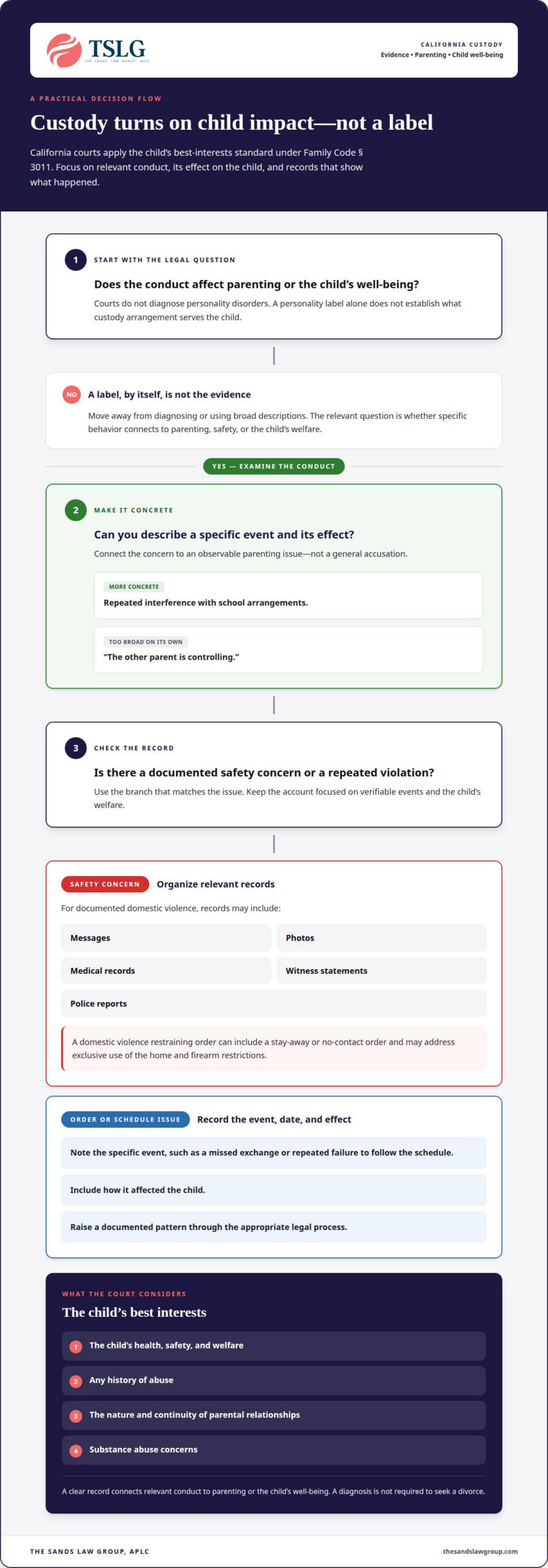
California family courts don’t decide custody by labeling a parent a narcissist. Under Family Code § 3011, the court applies the child’s best-interests standard and considers evidence about parenting, safety, and the child’s welfare. A parent’s behavior may be relevant when it affects the children, but a personality label alone does not establish what arrangement serves them.
If you’re starting a case, a San Bernardino divorce attorney can help prepare and file the required forms, organize supporting documents, and track response deadlines. According to California Courts, you generally have 30 days to respond to Form FL-100, which can start a divorce case. The attorney can also explain which filing steps apply to your circumstances and help keep the case moving through required procedures.
Custody decisions consider a child’s health, safety, and welfare, any history of abuse, the nature and continuity of parental relationships, and substance abuse concerns. Manipulative conduct is relevant when evidence connects it to parenting or the child’s well-being. For example, repeated interference with school arrangements is more concrete than a general claim that the other parent is controlling.
Documented domestic violence is a significant factor in California custody decisions. Relevant records may include messages, photos, medical records, witness statements, or police reports. A domestic violence restraining order can include a stay-away or no-contact order, and may address exclusive use of the home and firearm restrictions. When safety is at issue, an attorney can help organize the facts and prepare a request for court protection.
If a parent violates a custody agreement or order, record the event, date, and effect on the child, then raise the pattern through the appropriate legal process. Note, for example, a missed exchange or repeated failure to follow the schedule. A clear record distinguishes a documented violation from a broad accusation and can support a request to address ongoing problems.
Property, debts, and spousal support are resolved through financial disclosure, negotiation, or court decisions, depending on the issues in dispute. Financial records help identify assets, obligations, and support needs. Filing fees and legal costs vary with the case and the work involved. Attorney fees depend on the case and are provided after a quote request; factors include contested custody, property disputes, and the amount of legal work required.
A California divorce involves legal forms and decisions about finances, support, and, when children are involved, custody. A spouse’s controlling behavior does not create a separate divorce process, and you do not need to prove a diagnosis to seek a divorce. Focus on meeting court deadlines, presenting relevant evidence, and addressing the issues the court must decide.
2. What are common narcissist divorce tactics?
High-conflict behavior can turn routine divorce discussions into struggles over control. A spouse may shift positions, make broad accusations, or provoke an emotional response, then cite that reaction as proof of unreasonable conduct. In a divorce with a narcissistic spouse in San Bernardino, keep discussions focused on a specific decision, such as a parenting exchange or settlement proposal, rather than reopening arguments about the marriage. An attorney can help identify which issues need a response and which distractions do not advance your case.
Set boundaries around necessary communication. Keep messages brief, factual, and limited to topics such as parenting schedules, financial disclosures, or settlement terms. In response to a missed pickup, for example, confirm the agreed time and ask about the next arrangement without trading personal accusations. Counsel can advise whether structured written exchanges fit your circumstances and help preserve relevant messages without prolonging conflict.
Do not put children in the middle of adult disputes. A parent may disparage the other parent or pressure children to take sides, conduct sometimes described as parental alienation. Avoid responding through the children or posting about the marriage on social media. An attorney can keep custody discussions centered on the children’s needs and address claims through appropriate legal channels, rather than turning a child’s conversation into evidence-gathering or a public dispute.
Settlement discussions benefit from clear priorities. Counsel can help distinguish urgent decisions, such as temporary parenting arrangements, from longer-term questions about property or support. When a spouse makes a demand or accusation, an attorney can review relevant documents, explain the legal issue, and prepare a measured response. You need not accept an inaccurate claim; you can acknowledge any valid point while calmly addressing disputed facts.
Before responding to a provocative message, pause and consider its practical purpose. An attorney can review communications, identify questions that require an answer, and handle appropriate exchanges with opposing counsel. For a divorce with a narcissistic spouse in San Bernardino, this support can reduce direct contact without preventing necessary decisions about children, finances, or settlement. If you need help setting a communication strategy, discuss high-conflict divorce communication with a family law attorney.
3. Documenting messages, finances, and incidents
A family law attorney can organize scattered messages and financial records into a clear account of events. Context matters in a high-conflict divorce: one angry message may say little on its own, while repeated threats tied to money or parenting may show a pattern. Counsel can sort records by topic and date, identify what supports a specific issue, and distinguish documented conduct from conclusions about personality or a personality disorder.
For coercive control, harassment, or financial abuse, an attorney can organize relevant communications, records, and incident details for the case. Messages, photos, medical records, witness statements, police reports, and journal entries may document domestic violence. The attorney can assess how each item relates to a specific event, the children’s interests, or a financial dispute, then prepare evidence for the appropriate family court process.
Financial disclosure is mandatory in California divorce. A family law attorney can review records of income, assets, debts, and support, then identify gaps or inconsistencies for follow-up. Useful materials may include bank and investment statements, tax returns, pay records, loan documents, and records showing ownership or transfers. For example, a transfer missing from later account records may warrant closer examination.
California Legislative Information states that a spouse who conceals a marital asset may face an award to the other spouse of up to 100% of that hidden asset. When disclosures appear incomplete, discovery, motions to compel, and sanctions can address noncompliance. Counsel can use these procedures to seek relevant information and build a clearer financial picture, rather than relying on suspicion alone.
Evidence for family court should connect an event to its date, source, and effect. An attorney can build a chronology from preserved emails and texts, compare it with school or medical reports, and identify witnesses with direct knowledge. If a parent repeatedly changes an exchange plan, for example, records can show the message, the scheduled arrangement, and what happened afterward. This structure helps the court assess conduct in context.
For financial and personal records, counsel can identify which documents relate to the disputed issue and organize them in a usable sequence. You can provide available records while the attorney determines what needs clarification, what further evidence may be sought, and how to present it. This keeps the focus on verifiable actions and their consequences, not on diagnosing a spouse or assigning a personality label.
A dated account can preserve details that may be difficult to recall later. Record the incident, who was present, what was said or done, and any supporting message or report. Share the account with your attorney, who can assess its relevance, organize corroborating evidence, and determine how it fits the legal strategy for divorce, custody, or support issues.
4. Co-parenting apps and parallel parenting
When direct conversations repeatedly turn into arguments, a co-parenting app can keep practical exchanges in one written channel. Parents may use it for school pickup, medical appointments, schedule changes, or a child’s supplies. An attorney can help assess whether app-based communication fits the custody orders and your family’s circumstances. The tool supports communication; it does not replace a court order or resolve disagreements on its own.
For example, a message about a school event can state the date, location, and transportation plan without revisiting marital conflict. Keeping exchanges focused on parenting helps limit personal disputes. An attorney can help shape a communication approach that addresses necessary decisions, preserves relevant messages, and avoids using children as messengers. If a proposed exchange conflicts with an existing order, counsel can clarify the issue before it becomes another dispute.
Parallel parenting may be an option when cooperative decision-making remains difficult. Rather than expecting frequent discussion, parents can follow clear arrangements and limit direct interaction to matters requiring coordination. Each parent might manage daily routines during their own parenting time while following the custody schedule for transitions and shared decisions. An attorney can help assess how this approach fits existing orders and the children’s needs.
Legal guidance can help distinguish a communication problem from a disagreement about parental rights. A parent’s position may be strongly worded, but the next step should address the practical issue: a missed exchange, a schedule-change request, or a school-related decision. Counsel can review the message, explain relevant terms in the order, and help prepare a calm response. This structure keeps emotional exchanges from obscuring what needs to be resolved.
Apps do not make every interaction safe or appropriate. If messages contain threats, harassment, or pressure involving the children, preserve them and discuss the situation with an attorney. Counsel can help assess whether to limit communication, route it through attorneys, or address it through court. The appropriate strategy depends on the conduct, existing orders, and any effect on the children’s health, safety, or welfare.
You do not need a diagnosis of narcissistic personality disorder to set practical communication limits. Focus on observable behavior, such as repeated schedule changes or messages that shift from logistics to personal attacks. An attorney can help turn those patterns into specific requests about exchanges and communication. Clear arrangements can protect children from adult conflict while allowing each parent to maintain a relationship with them.
Before adopting an app or parallel parenting approach, counsel can review custody terms, identify decisions that still require coordination, and clarify how each parent should communicate. This connects the plan to the family’s actual positions and obligations, rather than assumptions about personality. For example, an arrangement may cover school updates while limiting discussion to child-related matters.
5. Recognizing narcissistic traits without diagnosing a spouse
In a difficult divorce, the word “narcissist” can feel like a useful explanation for repeated conflict. But a label doesn’t prove what happened or establish what a court should decide. The DSM-5 identifies criteria for narcissistic personality disorder; recognizing a few traits in a spouse isn’t the same as applying a diagnosis. Keep the distinction clear: describe specific conduct and its effect, rather than presenting a clinical conclusion.
Focus on observable actions over time. For example, note when a spouse blames you for the marriage ending, refuses to discuss a child’s schedule, or changes an agreement after you rely on it. These examples establish behavior, date, and context. By contrast, writing “my spouse is a narcissist” identifies no specific event for a lawyer, evaluator, or court to assess.
Consider whether the conduct affects parenting or the children’s welfare. A parent might repeatedly undermine agreed rules about screen time, socializing, or food. A child may also adopt one parent’s negative account of the divorce. Describe what you observed, what the child said or did, and how it affected a specific parenting arrangement, without assigning a motive or disorder.
Patterns matter more than a single tense exchange, but context matters too. One hostile message does not, by itself, establish a personality disorder or a pattern of harmful behavior. Compare it with earlier communications and the relevant event. For instance, distinguish a disputed schedule change from repeated conduct that disrupts school attendance or a child’s relationship with a parent.
Separate facts from interpretations in your notes. “The exchange was scheduled after school; the other parent arrived later and sent a message” is more useful than “they wanted to punish me.” If a child repeats an accusation, record the words as accurately as possible and note the circumstances. Avoid questioning children for details or asking them to take sides in adult disputes.
This approach also helps you discuss concerns with counsel. Bring concrete examples related to custody, communication, or another disputed issue, and explain the outcome you seek. An attorney can assess which facts are legally relevant and present them without treating a personality label as proof. The same discipline applies if you are concerned about your own reactions: acknowledge specific actions and address them directly.
Keep the central distinction in view: you can identify difficult traits and describe their effects without diagnosing your spouse. That precision supports a more focused legal strategy and keeps attention on decisions affecting your family. Discuss your divorce concerns with an attorney and prepare to explain the conduct and disputes that matter most.
The Sands Law Group, APLC: Divorce Legal Representation
The Sands Law Group, APLC represents clients when conflict over parenting, finances, or communication makes divorce decisions difficult to manage alone. Its divorce representation can address contested proceedings, while its child custody and visitation, spousal support, and property division representation address those specific disputes.
Consider seeking legal guidance when you need to respond to divorce papers, address repeated custody-order violations, organize financial issues, or prepare evidence about conduct affecting your children. An attorney can help focus the case on relevant facts and the decisions before the court, without relying on a diagnosis of your spouse.
Contact The Sands Law Group, APLC to discuss your divorce concerns and the representation you may need.
Move Toward a Clear, Practical Next Step
A difficult divorce can make every decision feel tied to the past. Your next step can focus instead on the future you need to build: a workable parenting structure, a fair resolution of financial issues, and communication that keeps conflict from defining family life. If you are facing a divorce with a narcissistic spouse in San Bernardino, legal guidance can help turn immediate concerns into a focused plan without making a diagnosis the center of the case.
The Sands Law Group, APLC provides divorce legal representation, child custody and visitation representation, and spousal support representation. If you’re ready to discuss how those issues apply to your circumstances, contact The Sands Law Group, APLC. You can take the next step with care, clarity, and a steadier path forward.
Frequently Asked Questions
Does California Divorce Law Recognize Narcissism?
California courts don’t treat “narcissist” as a legal finding that decides a divorce or custody dispute. The useful question is whether specific conduct relates to an issue the court must resolve. For example, explain how a repeated parenting conflict affects a child or an existing arrangement. Keep clinical labels separate from observable facts, and focus your legal presentation on the requested decision.
Can I get a diagnosis of my spouse into evidence?
A diagnosis is not automatically decisive simply because it exists. If a mental health professional has made an assessment, discuss with your attorney whether it relates to a disputed issue and how it may be presented. In custody matters, the court focuses on the child’s best interests and relevant parenting conduct. Do not rely on a diagnosis instead of evidence about its practical effect.
Can a narcissist affect custody decisions?
A parent’s behavior can affect custody decisions when it bears on the child’s health, safety, or welfare. Evidence that a parent repeatedly disrupts school attendance, for instance, may be more relevant than a general claim about personality. A court evaluates the circumstances and the child’s needs, not a label alone. Keep examples specific to parenting and explain their effect on the child.
Can mediation fail in a high-conflict case, and what happens next?
Yes. Mediation may not resolve every disputed issue, particularly when spouses cannot agree on parenting arrangements, support, or property. Unresolved matters may continue through the court process, where each side presents evidence and requests decisions on the remaining issues. An attorney can identify what was settled, define what remains contested, and prepare a focused position for further negotiations or court proceedings.
Should I try to co-parent directly or only through an attorney?
Use the communication method that fits the conflict, safety concerns, and existing court orders. Routine logistics, such as confirming a school pickup, may be handled through brief written messages when workable. If contact leads to threats, harassment, or escalating disputes, discuss limits with counsel. An attorney can distinguish necessary parenting exchanges from legal issues that should be addressed through representatives.
What are common narcissist divorce tactics?
People sometimes describe shifting demands, blame, provocation, or attempts to draw children into adult disputes as high-conflict tactics. The label matters less than the event and its effect. For example, preserve a message changing a previously discussed exchange plan, then note the practical consequence. Address the issue, not the insult, and avoid arguing about the marriage through children or social media.
What happens if my spouse ignores a custody agreement?
A missed exchange or ignored parenting term does not, by itself, change the custody arrangement. Keep a clear record of what the agreement required, what happened, and any relevant communication. Then discuss the pattern with your attorney, who can assess whether to seek enforcement or another court response. Avoid changing the schedule on your own out of frustration; focus on the order and the child’s needs.
What are the grounds for divorce in California, and does narcissistic behavior affect the outcome?
You do not have to prove narcissistic behavior or a diagnosis to seek a divorce. Issues may include parenting, financial disclosure, support, and property division, with evidence tied to each dispute. A label alone does not determine the outcome. This information is for general informational purposes only and does not constitute legal advice; case-specific guidance should address the facts and requests in your matter.

Article by
Thomas D. Sands, Esq.
Thomas D. Sands is the founder and CEO of The Sands Law Group, APLC. A California attorney with more than two decades of experience, he represents clients in divorce and family law matters as well as civil litigation and real property disputes. His approach emphasizes attentive, practical, and cost-conscious representation.
Sands is a 2023 Litigator of the Year honoree of the American Institute of Trial Lawyers and a 2023 Lawyer of the Year honoree of the American Institute of Legal Professionals. His firm has also received recognition among the 2025 Best Law Firms in America, a 2026 Benchmark Best of award, and a 2026 Law Firm of the Year honor.

Article reviewed by
Thomas D. Sands, Esq.
Thomas D. Sands is the founder and CEO of The Sands Law Group, APLC. A California attorney with more than two decades of experience, he represents clients in divorce and family law matters as well as civil litigation and real property disputes. His approach emphasizes attentive, practical, and cost-conscious representation.
Sands is a 2023 Litigator of the Year honoree of the American Institute of Trial Lawyers and a 2023 Lawyer of the Year honoree of the American Institute of Legal Professionals. His firm has also received recognition among the 2025 Best Law Firms in America, a 2026 Benchmark Best of award, and a 2026 Law Firm of the Year honor.
TOLL-FREE: 855-SANDS4U