
To understand how to financially prepare for a divorce, start by organizing your finances. Gather tax returns for the prior three years, checking and savings statements for the past year, and records of income, assets, debts, property, and insurance. Build a clear picture of what you own, what you owe, and the costs of living separately before making major financial decisions.
It’s understandable to focus first on where you’ll live or how you’ll pay the bills. But the marital home, retirement accounts, support, and taxes can all shape your finances after divorce. Clear records and careful planning can help you approach decisions with greater confidence.
This guide covers planning for changed income and expenses, organizing individual accounts, and reviewing estate documents. It also addresses property, keeping the home, retirement assets, and taxes, helping you better understand the financial choices ahead.
Key Takeaways
- Build a realistic post-divorce budget that accounts for changed income, housing costs, support, and future savings needs.
- Separate day-to-day finances carefully, protect account access, and track shared expenses as financial arrangements change.
- Review beneficiaries and estate documents so they reflect your current wishes and any obligations in court orders.
- Compare the costs and tax effects of keeping the home with other property-division options before making a decision.
- Understand how retirement assets, support, and filing status may affect your financial picture after divorce.
1. How Do I Financially Prepare to Leave My Spouse?
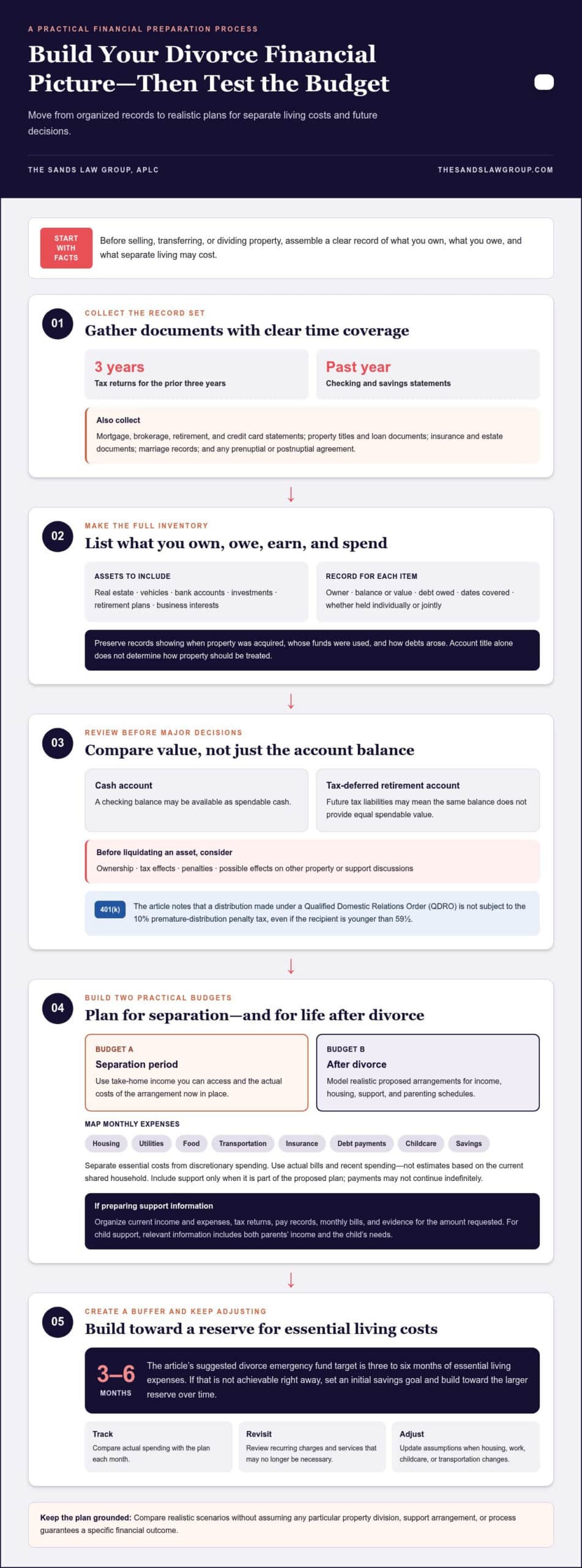
Start with a complete inventory before selling, transferring, or dividing anything. Gather tax returns for the prior three years and checking and savings statements for the past year. Collect mortgage, brokerage, retirement, and credit card statements, along with property titles, loan documents, insurance policies, and estate documents. Include assets held individually and jointly. Record account owners, balances, debts, and the dates covered by each document.
List income, spending, assets, and liabilities, and note who owns or owes each item. Include real estate, vehicles, bank accounts, investments, retirement plans, and business interests. Gather marriage documents and any prenuptial or postnuptial agreement. Once divorce proceedings begin, both spouses are typically required to disclose assets and liabilities. Complete records help you compare proposals and spot missing statements. Avoid large purchases or long-term financial commitments while key decisions remain unresolved.
California property division depends on the rules that apply to your case, and property laws differ across states. Preserve records showing when property was acquired, whose funds were used to purchase it, and how debts arose. An account’s title alone does not determine how it should be treated. Before liquidating an asset, consider ownership, tax effects, penalties, and whether a sale could affect other property or support discussions. A financial advisor can explain financial consequences, while legal representation can address how property division applies.
Compare assets by after-tax value, not just account balance. A tax-deferred retirement account may carry future tax liabilities that a cash account doesn’t. For example, equal balances in a checking account and retirement account may not provide equal spendable value. A pension earned during marriage should also be considered in the marital asset picture. According to the Internal Revenue Service, a 401(k) distribution made under a Qualified Domestic Relations Order is not subject to the 10% premature-distribution penalty tax, even if the recipient is younger than 59 1/2.
For temporary support requests, organize current income and expense information, tax returns, pay records, monthly bills, and evidence supporting the amount requested. Filing and service must follow the court’s procedures and deadlines. For child support, relevant information includes both parents’ income and the child’s needs.
Before filing, gather tax returns, bank and credit statements, mortgage and loan records, retirement statements, property titles, insurance documents, and marriage agreements. For a home or business, assemble ownership records, purchase documents, debt statements, and reliable valuation information; compare appraisals or financial records when available. California Courts’ self-help resources, county family law facilitators, legal aid organizations, and public law libraries can offer free or low-cost information about forms and procedures.
2. Budgeting for changed income and expenses
Build separate budgets for the separation period and life after divorce. Start with take-home income you can access, then list housing, utilities, food, transportation, insurance, debt payments, and childcare. Separate essential expenses from discretionary spending. Replacing one shared household with two homes, for example, changes housing costs, utility bills, and commuting needs. Use actual bills and recent spending records rather than estimates based on your current household.
Then model income and expenses under several realistic arrangements. Include wages, support payments, and other income only when they form part of the proposed plan. Treat support separately from permanent income because payments may not continue indefinitely. If a parenting schedule changes, recalculate childcare, school transportation, and health-related expenses. A financial advisor can help compare scenarios; an attorney can explain how proposed support arrangements fit into divorce negotiations.
Set aside a reserve for transition costs and unexpected bills. A divorce emergency fund can cover three to six months of essential living expenses. If that target isn’t achievable right away, choose an initial savings goal and build toward the larger reserve over time. Review recurring charges and decide which services, subscriptions, and insurance policies remain necessary. Update your plan when housing, work, childcare, or transportation arrangements change.
Make the post-divorce budget flexible rather than treating the first version as permanent. Track actual spending each month, compare it with planned amounts, and adjust savings goals when income or expenses shift. A person changing careers or moving into a separate home may need different assumptions than someone keeping existing work and housing. A 32-year-old with young children and limited resources may face different priorities from a 55-year-old with a career and pension. The particular situation matters; use the example to test your own assumptions, not as a template.
How does mediation compare financially with hiring separate divorce attorneys? Mediation can be one way for spouses to discuss shared decisions, while each may seek advice about their individual circumstances. The financial trade-off depends on the work involved, the issues in dispute, and whether negotiations resolve them. Budget for the process you choose without assuming either approach guarantees lower costs.
Bring your draft budget and income assumptions to a discussion about support, housing, and other contested decisions. A clear monthly picture can help identify which proposals are workable and where further discussion is needed. For guidance on how divorce decisions relate to your financial plans, you can schedule a divorce planning conversation.
3. Opening individual bank accounts and managing expenses
A separate checking account can make personal income and household spending easier to track during separation. Choose an account in your name, use a secure email address, and update passwords for individual financial accounts. Create credentials that aren’t shared or easy to guess. Keep access details private and save statements showing deposits, transfers, and recurring payments. These records can clarify which funds paid household expenses.
Before changing how shared money is handled, list every joint account, account holder, current balance, automatic payment, and linked card. Note which bills support the home or children, such as utilities, insurance, and childcare. Keep copies of statements before making changes, and document transfers between accounts. Don’t assume a joint balance is automatically available for personal spending. Clear records can explain necessary expenses and reduce confusion during financial discussions.
Open an individual account for new income and necessary personal expenses, then update direct deposit and payment details where appropriate. Keep enough money available for essential bills, while tracking which payments remain shared. If setting aside savings feels difficult, even $10 or $20 a week in a separate account can begin a modest financial safety net. Add deposits to your budget so the amount is sustainable alongside rent, food, transportation, and insurance.
Review your credit history and accounts in your own name. In the United States, Equifax, Experian, and TransUnion provide a free credit report every 12 months. Review each report for accounts, balances, and payment details you don’t recognize, then keep a copy for your records. If you have little individual credit history, make a plan for regular, affordable payments on accounts held in your name. Avoid taking on new debt without considering your income and monthly obligations.
Make a separate list of joint credit cards, loans, and other debts, including the lender, balance, minimum payment, and names on each account. Track payments while financial arrangements are discussed, and save confirmations. Consider proposed debt division alongside account access and household needs, not in isolation. Include expected child or spousal support in your cash-flow plan as the arrangement takes shape. Keep retirement accounts in a separate inventory rather than treating them as everyday spending funds.
If access to a shared account changes, use your own records to identify urgent bills and plan short-term payments. Document communication about necessary expenses for children and the household. If parenting schedules affect childcare or transportation costs, record those changes alongside the related expenses.
4. Updating beneficiaries and estate planning documents
Divorce can change who may inherit, make medical decisions, or receive insurance proceeds. Review each beneficiary designation separately; a will or trust may not control every account or policy. List life insurance, retirement plans, pensions, payable-on-death accounts, wills, trusts, powers of attorney, and medical directives. Note each current beneficiary and the change you want, then update documents when legally appropriate.
Coordinate changes with court orders and settlement terms. If a court order requires an existing life-insurance policy to retain a former spouse as beneficiary, the policyholder cannot change that beneficiary. Keep the order with the policy records and identify any required coverage in the settlement. For other policies and accounts, review the governing documents and update designations when permitted. Save confirmations and copies of revised forms.
Retirement benefits need careful attention during settlement discussions. Include the portion of a pension earned during marriage in the marital asset picture, and compare its value with other property. A pension may begin paying benefits in 15 years, which can leave a spouse without funds for current bills if the settlement overlooks timing. Consider both when payments start and how the award affects each spouse’s present and future income.
Social Security may also affect long-term planning. According to the Social Security Administration, a divorced person may qualify for Social Security spousal benefits based on an ex-spouse’s earnings if the marriage lasted at least 10 years. The person must have been divorced for at least two years and remain unmarried. If both former spouses have reached full retirement age, the spousal benefit equals one-half of the ex-spouse’s benefit. Include these conditions in retirement projections.
Review wills, trusts, powers of attorney, and medical directives created during marriage to ensure they reflect your current wishes. Review the people named to manage finances or make health decisions, including alternate choices. These documents address different situations, so changing one does not automatically revise the others. Keep signed copies accessible and tell appropriate people where current documents are stored.
There is no single divorce cost across the United States. Court expenses and attorney fees depend on location, case complexity, contested issues, and the work required; legal fees are provided after a quote request.
For each document, record its date, the institution holding it, the requested change, and any related order or settlement term. This record helps prevent outdated beneficiary details from conflicting with final arrangements. If support or retirement terms are still being negotiated, account for their effect on your financial plan before finalizing related decisions.
5. Mortgage, property, and capital gains taxes
Keeping the marital home takes more than agreeing on who stays. Compare its estimated value with the mortgage payoff, liens, and expected selling expenses to understand the equity available for division. Then assess whether one person can manage the mortgage, property taxes, insurance, maintenance, and household bills on their own income. A home that looks valuable on paper may still strain a post-divorce budget.
If you plan to keep the home, consider whether you can qualify for a mortgage before the divorce is final. A lender’s review can show how your income, credit history, existing debts, and proposed support arrangements fit the available financing. Also clarify how the current mortgage will be handled. A settlement assigning payments to one spouse does not itself change the mortgage agreement with the lender.
Compare three practical options: one spouse keeps the home and addresses the other’s share, both sell and divide the proceeds, or both retain an interest under agreed terms. For each, estimate proceeds after the mortgage payoff and selling expenses, then account for other property and debts in the settlement. Factor in the home’s condition, needed repairs, and maintenance costs. Don’t base the decision only on emotional attachment or estimated market value.
Consider capital gains taxes before a sale or transfer. Gather purchase documents, records of major improvements, ownership information, and prior tax records related to the property. These details can help establish the home’s tax basis and the financial result of a future sale. Compare that result with the proceeds you expect to receive rather than treating the sale price as spendable cash. Tax effects depend on the transaction and the property’s history.
Apply the same careful approach to other shared property. Assess a business, investment, or vehicle alongside associated debts, ownership records, and potential tax consequences. Distinguish an asset’s estimated value from the amount either spouse could receive after obligations. If a credit card or loan funded renovations, include that liability in the home analysis rather than counting the improvement alone. California property division should reflect the full financial picture of the marriage.
Before signing settlement terms, consult a tax professional about the proposed home disposition and its tax treatment. Ask for a comparison of keeping the home and selling it, using consistent assumptions for mortgage debt, repairs, and sale proceeds. Then consider how each option affects housing costs, other assets, and estate plans. A clear written comparison can make trade-offs easier to discuss and document.
If the home or other property is a central point of disagreement, schedule a conversation about property division to discuss the legal issues affecting your options.
The Sands Law Group, APLC: Divorce Legal Representation
The Sands Law Group, APLC provides Divorce Legal Representation for people addressing financial and family decisions during divorce. When property division, support, or parenting arrangements become difficult to resolve, legal guidance can help you understand the issues and prepare for discussions or court proceedings.
The firm also represents clients in property division, spousal support, and child custody and visitation matters. These issues can affect one another: a parenting schedule may shape childcare expenses, while a property agreement may affect housing choices and future financial stability. Bringing your financial records and priorities to the discussion can help identify the decisions that need attention.
If you’re ready to discuss your divorce matter, contact The Sands Law Group, APLC or visit thesandslawgroup.com.
Take Your Next Step With Clarity
Knowing how to financially prepare for a divorce doesn’t mean solving every question at once. It means approaching each decision carefully, preserving your ability to make informed choices, and recognizing which matters require legal guidance. As new information emerges, keep a brief record of unresolved questions and the decisions that depend on them. This helps distinguish urgent needs from issues that can wait, rather than letting uncertainty drive every move.
Before making a significant financial or legal decision, consider how it may affect your stability after divorce, not just what seems manageable today. A focused discussion of your circumstances can help identify relevant issues and a practical path forward. You deserve clear information and thoughtful support during a difficult transition.
Schedule a conversation with The Sands Law Group, APLC to discuss your situation and next steps. You can move forward with care, one considered decision at a time.
Frequently Asked Questions
How Do I Financially Prepare to Leave My Spouse?
Knowing how to financially prepare for a divorce starts with a clear baseline: compare accessible income with recurring and irregular expenses, and flag disputed assets or payments. The Sands Law Group, APLC represents clients in contested and uncontested divorce matters in Los Angeles, Riverside, San Bernardino, and Kern. Website information is for general informational purposes only and does not constitute legal advice. Contacting the firm does not create an attorney-client relationship until a formal agreement is signed.
How can I make a post-divorce budget and estimate living expenses?
Estimate living costs for the household arrangement you expect, not your current shared setup. Include housing, utilities, food, transportation, insurance, childcare, debt payments, medical costs, and irregular annual bills converted into monthly estimates. Create separate scenarios for changes in employment, parenting time, housing, or support terms. If income varies, use a conservative baseline and reserve variable earnings for savings or occasional expenses. Revise estimates as new bills clarify your costs.
How are assets and debts divided in equitable-distribution and community-property states?
Equitable-distribution states divide marital property according to fairness, considering factors such as each spouse’s contributions; the shares aren’t automatically equal. Community-property states generally divide qualifying marital property equally, though separate-property classifications and exceptions can affect what is included. California follows community-property principles. A home’s purchase date, funding records, and any marital agreement, for example, may help establish its classification. Debts also require classification rather than assumptions based only on account title.
How are retirement accounts, pensions, and 401(k)s divided in divorce, and what is a QDRO?
A Qualified Domestic Relations Order, or QDRO, is a court order used to assign eligible benefits from an employer retirement plan to a spouse or former spouse. The plan administrator processes benefits under the plan’s terms, so account statements alone don’t complete the division. An IRA is handled differently: the QDRO penalty exception does not apply, and a withdrawal may create income tax unless funds are rolled into a qualified retirement account. Compare timing and after-tax value.
How does divorce affect taxes, filing status, and child or spousal support?
Divorce can change tax filing status during proceedings and after finalization. For divorces finalized in 2019 or later, spousal support isn’t deductible by the payer or treated as income for the recipient; earlier instruments follow different federal tax treatment. Child-support payments generally aren’t taxable income to the recipient or deductible by the payer. Consider how support and filing choices affect projected take-home income, rather than treating a proposed payment as spendable income without tax context.
Should I open separate bank accounts or credit cards before divorce, and what are the risks?
An individual account can help separate personal income and expenses, but transfers from joint accounts may lead to disputes or complicate records. A new credit card creates an individual payment obligation, and its balance may affect available monthly cash. Before changing payment arrangements, identify automatic payments for shared bills such as utilities or insurance. Record transfers and expenses, and distinguish account access from proof that funds belong solely to one spouse.
How can I protect my credit and monitor joint debts during divorce?
Keep a debt log listing each lender, account holders, balance, due date, and payment source. Compare statements with reports from Equifax, Experian, and TransUnion; differences can help identify reporting errors or unfamiliar activity. Save payment confirmations and note changes to balances or account status. If an entry appears inaccurate, document the discrepancy and follow up with the reporting bureau or creditor. This creates a clearer record of joint obligations during negotiations.

Article by
Thomas D. Sands, Esq.
Thomas D. Sands is the founder and CEO of The Sands Law Group, APLC. A California attorney with more than two decades of experience, he represents clients in divorce and family law matters as well as civil litigation and real property disputes. His approach emphasizes attentive, practical, and cost-conscious representation.
Sands is a 2023 Litigator of the Year honoree of the American Institute of Trial Lawyers and a 2023 Lawyer of the Year honoree of the American Institute of Legal Professionals. His firm has also received recognition among the 2025 Best Law Firms in America, a 2026 Benchmark Best of award, and a 2026 Law Firm of the Year honor.
Article reviewed by
Thomas D. Sands, Esq.
Thomas D. Sands is the founder and CEO of The Sands Law Group, APLC. A California attorney with more than two decades of experience, he represents clients in divorce and family law matters as well as civil litigation and real property disputes. His approach emphasizes attentive, practical, and cost-conscious representation.
Sands is a 2023 Litigator of the Year honoree of the American Institute of Trial Lawyers and a 2023 Lawyer of the Year honoree of the American Institute of Legal Professionals. His firm has also received recognition among the 2025 Best Law Firms in America, a 2026 Benchmark Best of award, and a 2026 Law Firm of the Year honor.
TOLL-FREE: 855-SANDS4U