A court cannot enforce a custody schedule that has not been made into an order. When enforcing a custody order in San Bernardino, a parent generally needs a court order that clearly sets out the custody or visitation arrangement; without one, the first step is to seek an order from the court. If an existing order is being ignored, a parent may ask the court to address the violation.
Being denied time with your child can be deeply upsetting, especially when you are unsure what to do next. For enforcing a custody order in San Bernardino, the available response depends on whether an order exists, what it requires, and how it was violated.
This article explains what may happen when a parent willfully disobeys a custody order, how court enforcement may work, and what options may be available when there is no order yet. It also covers safety concerns and repeated violations that may call for a different court response.
Key Takeaways
- Courts may respond to willful custody-order violations with remedies that address missed parenting time and future compliance.
- A contempt request depends on showing that the other parent knowingly disobeyed a clear court order.
- Police involvement is not automatic; the circumstances, including whether there is an urgent safety concern, matter.
- San Bernardino County’s compliance declaration can help present information about each parent’s adherence to custody orders.
- Without a court order, enforcement options are limited, so establishing a formal custody arrangement may be the necessary next step.
Court sanctions for violating a custody order
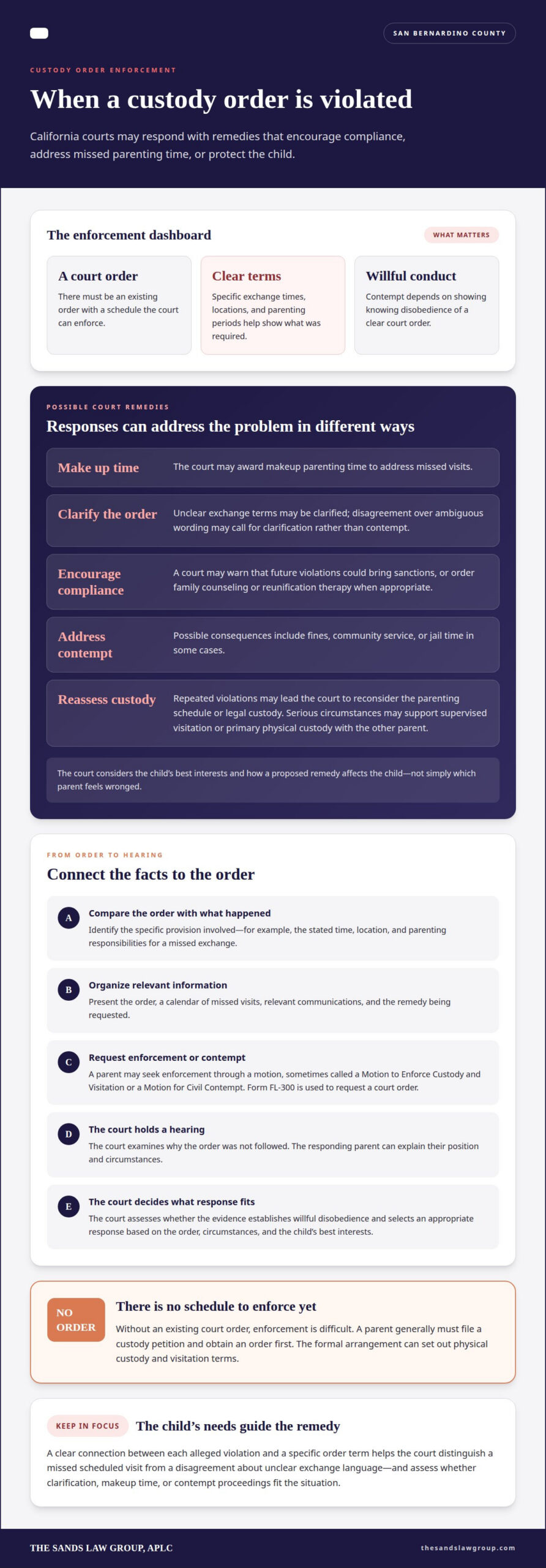
California courts can address custody-order violations with remedies intended to encourage compliance, make up missed parenting time, or protect the child. The response depends on the order’s terms and the conduct presented to the court.
Available Court Remedies
A court may award makeup parenting time, clarify unclear exchange terms, or warn that future violations could bring sanctions. When appropriate, it may also order family counseling or reunification therapy. In contempt matters, possible consequences include fines, community service, or jail time in some cases.
Repeated violations may lead a court to reconsider the parenting schedule or legal custody. Serious circumstances may support supervised visitation or primary physical custody with the other parent. California custody decisions focus on the child’s best interests, so the court considers how a proposed remedy affects the child, not simply which parent feels wronged.
Filing a Contempt Case
A parent may seek enforcement through a motion, sometimes called a Motion to Enforce Custody and Visitation or a Motion for Civil Contempt. The central question is whether the other parent willfully disobeyed the court order. After a filing, the court schedules a hearing to examine why the order was not followed and how to proceed.
A family law attorney can assess whether the order clearly required the missed exchange or visit, then prepare the filing and supporting materials. This may include organizing the relevant order, identifying the alleged violation, and presenting the remedy sought. The court decides whether the evidence establishes willful disobedience and what response is appropriate.
Preparation means connecting each allegation to a specific order term. A filing, for example, can distinguish a missed scheduled visit from a disagreement about an unclear exchange provision. This helps the court assess whether clarification, makeup time, or contempt proceedings address the problem. When applicable, an attorney can prepare the required forms, including a Request for Order, and ensure the requested relief fits the custody issue.
Without an existing court order, enforcement is difficult because there is no court-ordered schedule to enforce. A parent generally must file a custody petition and obtain an order first. An attorney can help prepare the petition and proposed arrangements, including terms for physical custody and visitation. Once a judge issues an order, its specific requirements give parents and the court a defined schedule to address if violations occur.
In San Bernardino, review whether the order clearly addresses exchange times, locations, and parenting periods. Specific terms help establish what each parent was required to do. If the order is unclear, a request for clarification may be more useful than treating every disagreement as contempt. The court can then assess the conduct and choose a remedy based on the order, the circumstances, and the child’s best interests.
Civil contempt proceedings
A contempt action asks the court to address an alleged willful violation of an existing custody order. A family law attorney can assess whether contempt fits the situation or whether another enforcement request better serves the child’s interests. When enforcing a custody order in San Bernardino, the key is how the alleged conduct relates to the order’s specific terms.
How a Family Law Attorney Starts a Contempt Action
An attorney starts by comparing the custody order with the specific conduct at issue. For example, a missed exchange can be assessed against the order’s stated time, location, and parenting responsibilities. Counsel can organize relevant records, identify the provision allegedly violated, and frame the request around facts rather than broader conflict between parents.
Having a Family Law Attorney Request an Enforcement Order
How can an attorney help file a Request for Order to enforce a custody or visitation order in San Bernardino County? Counsel can prepare the request, describe the violation and requested relief, and present the issue for a court hearing. California form FL-300 is used to request a court order; the San Bernardino County Department of Child Support Services lists it for that purpose.
An enforcement request and a contempt action are related, but they address different questions. An attorney can clarify whether the parent seeks compliance with an existing order, makeup parenting time, or a finding of willful disobedience. The filing should connect each requested remedy to the order and events involved. In an enforcing custody order San Bernardino matter, matching the request to the dispute helps keep the court’s focus clear.
The Contempt Process
After a contempt motion is filed, the court schedules a hearing to examine why the order was not followed and how to proceed. An attorney can organize the order, a calendar of missed visits, and relevant communications for the court’s consideration. The parent responding to the motion can explain their position and circumstances.
Willfulness matters. A disagreement over unclear wording may call for clarification, while evidence that a parent knowingly disregarded a specific requirement may support a contempt finding. The court assesses the facts and decides whether contempt is established. Possible consequences can include fines, community service, or jail time in some cases.
Preparation also keeps the child’s needs central. Counsel can distinguish a repeated pattern from a single disruption and explain how each affected the parenting schedule. The court may consider remedies such as makeup time, counseling, or a warning about future violations. In an enforcing custody order San Bernardino action, the child’s best interests remain central to the court’s response.
If you need help evaluating an enforcement request or contempt action, discuss your custody order concerns.
When a Family Law Attorney May Recommend Contacting Police or the County District Attorney
A custody dispute can make police involvement seem like the only immediate option, but officers may or may not enforce a family court order. California police tend to avoid involvement unless the situation involves a criminal act, such as kidnapping. A family law attorney can help assess whether contacting law enforcement fits the facts or whether court enforcement is more appropriate.
For an ordinary missed exchange, an attorney may first review the order’s exact terms and what happened. A clear exchange time and location can establish what the order requires, while unclear wording may be difficult for police to resolve. The attorney can also consider the child’s experience, since a police response during a handoff may be upsetting.
If a parent believes the other parent has abducted the child, California offers another route: requesting help from the child abduction unit of the county district attorney’s office. An attorney can help assess whether the facts point to abduction and organize information for the request. If the child faces immediate danger or a parent threatens to leave California without permission, urgent court attention may be needed.
An attorney may also use a written letter to address a specific compliance problem before it escalates. The letter can identify the relevant order provision, describe the missed exchange or denied visit, and request that the parent follow the schedule. It should keep the focus on the child’s routine and the parents’ responsibilities, rather than personal accusations that could deepen conflict.
Written communication can be difficult when the relationship between parents has become hostile. Counsel can help keep a request factual, preserve a record of the communication, and distinguish a custody issue from a support issue. An attorney’s letter may prompt a person to bring overdue support payments current, but that concerns support, not enforcement of parenting time.
Before recommending police or district attorney involvement, an attorney can consider the order, the child’s location, the urgency, and whether an alleged criminal act is involved. A parent refusing a scheduled visit presents a different situation from a parent believed to have taken the child unlawfully. An attorney can explain the available paths and help the parent choose a response that protects the child while addressing the violation.
Declaration regarding compliance with custody orders
When custody enforcement is disputed, the court needs a clear account of each parent’s conduct. San Bernardino County lists the local family law form “Declaration Re: Compliance with Custody Orders” as form 13-11300-360, according to the Superior Court of California, County of San Bernardino. The form gives parents a county-specific way to address compliance with custody orders.
A declaration can organize the history behind an enforcement request, but it should distinguish observed events from conclusions. Identify the scheduled exchange, whether it occurred, and what communication followed. Describe a missed visit by its date and the relevant order term, rather than making broad claims that the other parent is never cooperative.
California parents are advised to continue meeting their own obligations under an existing custody order while documenting the other parent’s alleged violations. This matters when seeking contempt relief, since the court may need to assess both the claimed breach and the declarant’s own conduct. A lawyer can present the parent’s position without obscuring facts that may complicate the request.
Useful supporting information can include a calendar of scheduled parenting time, records of missed visits, and communications about exchanges. Connect each event to a specific responsibility in the order. If one parent was ready at the stated location but the child was not brought, that detail is more useful than a general claim of noncompliance.
The form is not a substitute for the underlying custody order or a court decision. Its role is to present information about compliance in a structured declaration. A lawyer can review whether the account is consistent with the order, identify gaps in the chronology, and determine how the declaration fits the requested court action. The local form’s listed revision date is August 21, 2013.
Keep the focus on the child’s schedule and the court’s existing directions. Mixing custody facts with unrelated disputes may make the central issue harder to understand. For instance, describe a canceled visitation period separately from a disagreement about property or support. Clear organization helps the court see which responsibilities are at issue.
Before filing, counsel can check that the declaration names the relevant order provisions and explains events in sequence. If the parent has also missed exchanges or changed arrangements, those facts should be addressed honestly. A complete account can help the court evaluate whether enforcement, clarification, or another response is appropriate, with the child’s interests at the center.
Enforcing Child Custody in San Bernardino County, CA
Enforcing a custody order in San Bernardino County starts with determining whether a court order already exists. If it does, a parent may ask the court to address the other parent’s refusal to follow its terms. Without an order, there is no court-ordered schedule to enforce, so a parent generally must file a custody petition and obtain an order establishing custody and visitation.
For parents developing an arrangement, California form FL-311, the Child Custody and Visitation (Parenting Time) Attachment, can help set out an agreement or submit it to a judge. A proposed schedule can specify parenting periods, exchange locations, and exchange times. These details make each parent’s responsibilities clearer and give the court a practical arrangement to consider.
When enforcing a custody order in San Bernardino, match the requested court action to the problem. A parent may ask the court to address an existing violation, including by awarding makeup parenting time for missed visitation. After a motion is filed, the court schedules a hearing to consider why the order was not followed and how to proceed. Connect the relevant order terms to the conduct and remedy sought.
Specific terms can make a difference. An order naming the exchange time and location helps clarify each parent’s responsibilities. If a provision is ambiguous, requesting clarification may address the disagreement more directly than alleging deliberate disobedience. Keeping a certified copy of the order can also help relevant people, such as the child’s school or daycare, understand the arrangement.
A changed situation may call for modification rather than enforcement alone. Parents in San Bernardino may modify a custody order by agreement; if they cannot agree, they can seek a change through a judicial proceeding. California courts may modify an order when a significant change affects the child’s best interests. A parent whose access has been blocked may ask the court to change the order, though modification and enforcement address different issues.
If a child’s safety is at issue, California courts can issue emergency custody orders when appropriate to protect the child’s health, safety, and welfare. Supervised visitation may also be ordered when safety concerns warrant it. Mediation can help parents develop practical solutions while reducing conflict, and family courts often encourage it. The court’s response depends on the order, the conduct, and the child’s needs. Discuss your custody enforcement options when you need help assessing the next court step.
The Sands Law Group, APLC: Child Custody and Visitation Representation
The Sands Law Group, APLC provides Child Custody and Visitation Representation for parents facing denied parenting time, repeated order violations, or the need to establish a court-approved arrangement. When an existing order is not being followed, legal counsel can assess its terms, the events at issue, and possible court remedies. If no order exists, counsel can help with the steps to seek one.
These disputes affect a child’s routine as well as a parent’s relationship with their child. A focused legal approach can clarify the issue, prepare the court request, and present facts relevant to the child’s best interests.
Contact The Sands Law Group, APLC to discuss your custody and visitation matter.
Choose a Clear Next Step for Your Family
Deciding what to do can feel difficult when a custody dispute begins shaping your child’s daily life. For enforcing a custody order in San Bernardino, a focused legal assessment can help turn the immediate conflict into a plan that considers your child’s needs and your family’s longer-term circumstances.
The Sands Law Group, APLC offers Child Custody and Visitation Representation, as well as Divorce Legal Representation and Spousal Support Representation. If your custody concerns intersect with separation or support issues, addressing them within a considered family-law strategy may help you make informed decisions about what comes next.
You do not have to resolve every question before seeking guidance. A conversation can help clarify the issue you want addressed and the next step to consider. Contact The Sands Law Group, APLC to discuss your circumstances and move toward a more stable path for your family.
Frequently Asked Questions
Can I request supervised visitation in a high conflict case?
Yes, you can ask the court to order supervised visitation when safety concerns affect the child. A high-conflict relationship alone does not establish that supervision is needed; explain the specific safety issue and how supervision would protect the child. For example, describe conduct or circumstances affecting safe visits, rather than relying only on disagreements between parents. The court considers the child’s best interests.
What Constitutes a Violation of a Custody Order?
A violation occurs when a parent fails to follow a requirement in the court’s custody or visitation order. Examples include withholding the child during the other parent’s scheduled time or failing to follow an ordered exchange arrangement. The exact wording matters: a disagreement about an unclear provision may differ from disregarding a specific direction. The court considers the order and the circumstances surrounding the alleged breach.
What if the Child Doesn’t Want to Go?
A child’s reluctance does not automatically cancel a court-ordered visit. California courts may consider the child’s wishes depending on age and maturity, but a parent should generally seek court intervention rather than abandon the schedule. If a child repeatedly resists transitions, explain the pattern and its context in a court request. The judge can consider the child’s circumstances and whether the existing arrangement needs attention.
What if the other parent refuses to follow the custody order?
You may ask the court to address the refusal; the appropriate request depends on the order’s terms and the conduct involved. A parent seeking enforcement can identify the provision at issue and its practical effect, such as a missed holiday visit. Continue meeting your own obligations under the order while documenting violations. This helps the court assess the dispute without creating additional compliance disagreements.
What forms and documents are required to enforce a California custody order?
The forms depend on the request. California form FL-300 is used to request a court order, while FL-320 is used to respond to a request. San Bernardino County also lists form 13-11300-360, “Declaration Re: Compliance with Custody Orders.” The relevant custody order and information supporting the request help explain the dispute. The website content is for general informational purposes only and does not constitute legal advice.
Can police enforce a custody order in San Bernardino County, and when should I call them?
Police may or may not become involved in enforcing a custody order, and officers tend to avoid involvement without a criminal act, such as kidnapping. A parent who believes the child has been abducted can request help from the county district attorney’s child abduction unit. For a disputed exchange without an apparent criminal act, a court request may be a more suitable way to address the order.
What happens if a parent violates a custody or visitation order in California?
The court can examine why the order was not followed and determine an appropriate response. If the judge finds willful disobedience, consequences may include fines, community service, or jail time in some cases. The court may also consider remedies related to the parenting arrangement, such as counseling or makeup time. A violation alone does not determine the outcome; the order and circumstances matter.
Can I request make-up parenting time, attorney fees, sanctions, or a custody change for violations?
You may ask the court for makeup parenting time after missed visitation, and sanctions may be considered for willful disobedience. Repeated violations may support a request to change the parenting schedule or legal custody, depending on the child’s best interests. Attorney fees are a separate issue and are not automatic based solely on a violation. Explain the specific relief you seek and how the alleged conduct affected the child.

Article by
Thomas D. Sands, Esq.
Thomas D. Sands is the founder and CEO of The Sands Law Group, APLC. A California attorney with more than two decades of experience, he represents clients in divorce and family law matters as well as civil litigation and real property disputes. His approach emphasizes attentive, practical, and cost-conscious representation.
Sands is a 2023 Litigator of the Year honoree of the American Institute of Trial Lawyers and a 2023 Lawyer of the Year honoree of the American Institute of Legal Professionals. His firm has also received recognition among the 2025 Best Law Firms in America, a 2026 Benchmark Best of award, and a 2026 Law Firm of the Year honor.
Article reviewed by
Thomas D. Sands, Esq.
Thomas D. Sands is the founder and CEO of The Sands Law Group, APLC. A California attorney with more than two decades of experience, he represents clients in divorce and family law matters as well as civil litigation and real property disputes. His approach emphasizes attentive, practical, and cost-conscious representation.
Sands is a 2023 Litigator of the Year honoree of the American Institute of Trial Lawyers and a 2023 Lawyer of the Year honoree of the American Institute of Legal Professionals. His firm has also received recognition among the 2025 Best Law Firms in America, a 2026 Benchmark Best of award, and a 2026 Law Firm of the Year honor.
TOLL-FREE: 855-SANDS4U