

When child support stops arriving, a useful first step is to organize the records showing what is due and what remains unpaid. The strain can quickly affect a child’s daily needs, and it’s understandable to want a clear path forward. For parents searching “enforcing child support orders california,” matching documented arrears to an appropriate enforcement option can help clarify where to start.
Begin with the current support order, payment history, and relevant communications. Then consider how California’s agency enforcement process differs from remedies pursued through the court. This guide explains how to identify a practical starting point, what to do when the payment record or other facts are disputed, and when legal guidance may help. The Sands Law Group, APLC handles child support matters alongside related family law issues, including custody and paternity, so those circumstances can be considered together.
Key Takeaways
- When enforcing child support orders california, separate missed or partial payments from amounts that are genuinely disputed.
- Compare county child support agency assistance, income withholding, and court-based options to identify a route suited to your circumstances.
- Gather the support order, payment ledger, bank statements, agency notices, and relevant communications to build a clear record.
- An inability-to-pay claim doesn’t change an existing order on its own. A formal modification may be needed, so avoid adjusting payments informally.
- Statewide rules apply across the region, but agency procedures and court filing logistics can vary in Los Angeles, Riverside, San Bernardino, and Kern counties.
Enforcing a Child Support Order in California: What Counts as Nonpayment?
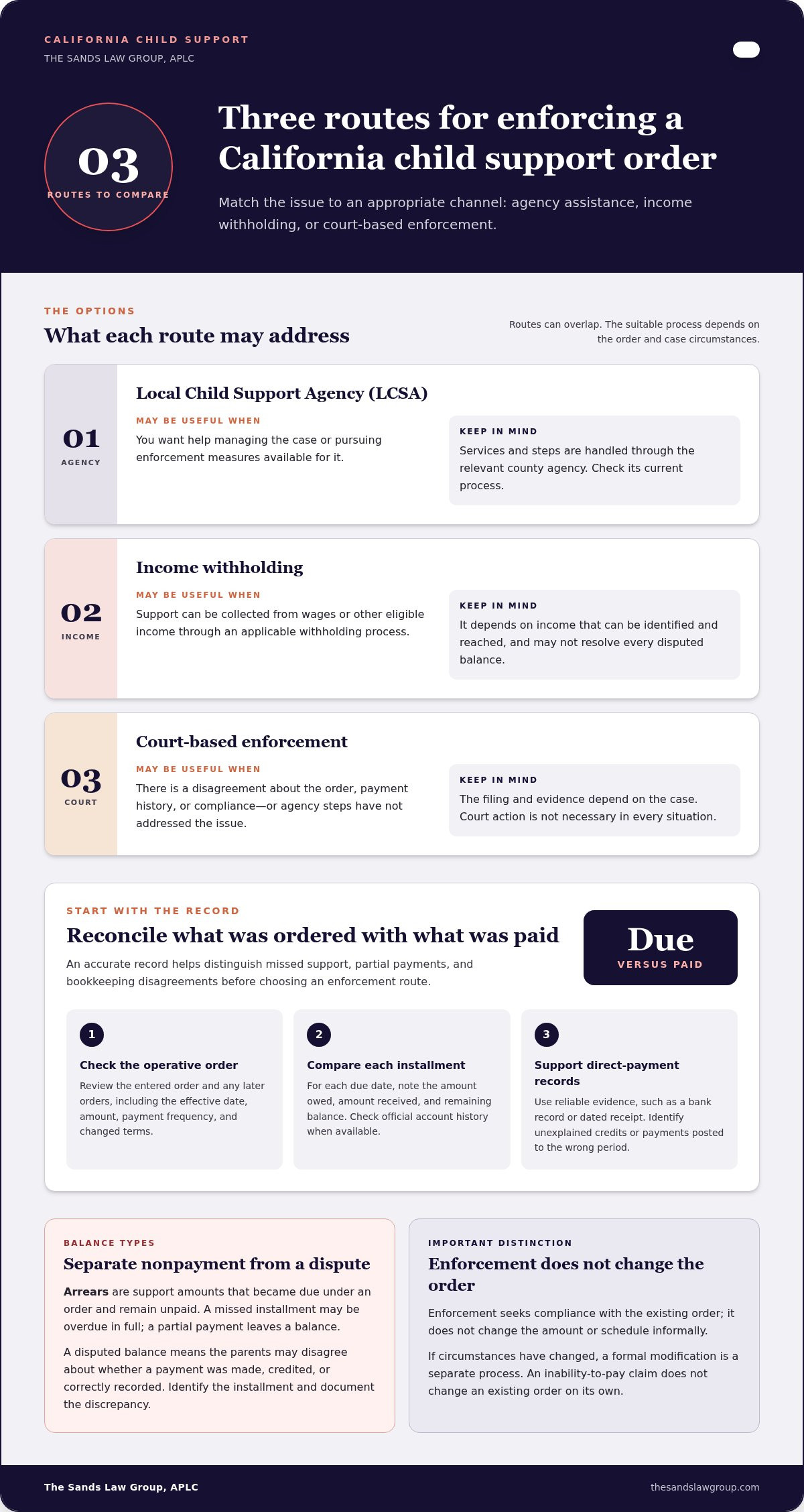
When expected support does not arrive, meeting a child’s needs may be the immediate concern. Before taking enforcement steps, check what the current order requires and compare it with the payment history. Enforcement seeks compliance with an existing order; it does not change the amount or schedule informally. If the order no longer reflects a parent’s circumstances, requesting a formal modification is a separate process.
Child support arrears are unpaid support amounts that became due under a child support order and remain unpaid. A missed installment may leave the full amount overdue, while a partial payment leaves a balance. A disputed balance is different: the parents may disagree about whether a payment was made, credited, or correctly recorded. Keep these situations distinct when describing the claimed arrears. For broad context on how state and federal rules shape support systems, see Child support laws in the U.S.
Which child support order can be enforced?
The operative court order sets the support obligation and payment terms. An order may have been established through a child support agency process, but an informal agreement between parents is not a substitute for an entered order when seeking court enforcement. Review the entered order and any later orders. Check the effective date, payment frequency, amount, and any terms that changed, so you don’t rely on an outdated figure or overlook a later adjustment.
How can you tell whether payments are actually overdue?
Compare each installment required by the order with the payment records, including official account history when available. For each due date, note the amount owed, the amount received, and the remaining balance. If support was paid directly, record it only when you have reliable evidence of the amount and date, such as a bank record or dated receipt. Recollection may help identify a transaction, but documentation makes it easier to reconcile.
Look for credits, payments posted to the wrong period, and differences between your records and an agency account. Don’t treat an unexplained discrepancy as settled. Identify the installment in question and document what you believe was paid or remains due. Careful reconciliation is a practical first step in enforcing child support orders california, especially when the balance is disputed. Accurate records help distinguish missed support, partial payment, and a bookkeeping disagreement before you choose an enforcement route.
California Child Support Enforcement Options: How the Main Routes Compare
Once you’ve identified a possible unpaid balance, consider which enforcement channel fits the issue. California child support agencies can assist with case management and enforcement. Income withholding may collect support through the paying parent’s income when applicable. Court-based remedies may be relevant when facts or compliance are contested. These options can overlap, and the available process depends on the order and case circumstances.
| Route | May be useful when | Key consideration |
|---|---|---|
| Local child support agency | You want agency assistance with managing the case or pursuing available enforcement measures. | Services and steps are handled through the relevant county agency; review its current process. |
| Income withholding | Support can be collected from wages or other eligible income under an applicable withholding process. | It relies on income that can be identified and reached, and may not resolve every disputed balance. |
| Court-based enforcement | There is a disagreement about the order, payment history, or compliance, or agency steps have not addressed the issue. | The appropriate filing and evidence depend on the case; court action isn’t necessary in every situation. |
When may a local child support agency help?
A Local Child Support Agency (LCSA) may assist with case management and pursue enforcement measures available for the case. California’s statewide agency, the California Department of Child Support Services, provides information about child support services and connects parents with local resources. In Los Angeles County, the Child Support Services Department (CSSD) is a local resource. Agency processes and contact details differ by county, so use the current instructions for the county handling your case.
Agency assistance may be a practical starting point when the order and payment record are relatively clear and you want help using the administrative process. It doesn’t prevent you from seeking legal advice if a more complicated issue arises.
When might a court-based remedy or attorney be relevant?
Court involvement may be worth considering if the parents disagree about what the order requires, whether payments were credited, or whether the paying parent is complying. Potential remedies depend on the facts and applicable procedures; no particular result or timeline is assured. A family law attorney can review the evidence, explain procedural choices, and identify related issues, such as a change in custody or a request to modify support, that may affect the next step.
Agency involvement and private representation serve different needs, and one doesn’t automatically replace the other. If you’re weighing options for enforcing child support orders california, counsel can help evaluate the records and whether an agency route, court process, or coordinated approach fits your circumstances. You can discuss your child support circumstances to consider an informed next step.
What If the Other Parent Disputes Arrears or Cannot Pay?
A disagreement about unpaid support can be stressful, particularly when the child’s needs continue during the dispute. Keep two questions separate: what amount, if any, is already overdue, and whether future support should change. A claim that a parent cannot afford the ordered amount does not, by itself, change the order or erase amounts that have already become due.
Does a change in income automatically stop support obligations?
No. An existing order generally remains in effect unless it is changed through the proper legal process. If income, custody arrangements, or a child’s needs have materially changed, the paying parent may seek a formal modification. That request is separate from resolving arrears under the current order. California modifications generally aren’t retroactive, so a parent shouldn’t assume a later change will automatically eliminate unpaid amounts that accrued earlier.
Neither parent should unilaterally reduce, pause, or redirect court-ordered payments based on a private understanding or financial hardship. Doing so can create a new payment dispute. If enforcement is being considered, the court process must allow the parties to address the evidence and respond to the issues raised. Serious remedies shouldn’t be treated as automatic consequences of an allegation. The result depends on the facts and applicable procedure.
What if the payment history or arrears amount is disputed?
Start by comparing the order with the available payment records. Review official account history, receipts, and bank statements, then prepare a chronology showing each due date, amount owed, payment date, payment method, and any credit either parent claims. For example, if one parent says a direct transfer covered an installment but the account shows no credit, record the transfer date and amount and keep the supporting statement or receipt.
Mark unexplained differences rather than assuming they prove either parent’s position. A payment may have been credited to a different period, recorded late, or omitted from one party’s records. An agency or court may need to resolve factual disagreements before addressing the balance or an enforcement request. Los Angeles County CSSD describes local enforcement tools in its guide to enforcing child support in Los Angeles. Procedures and available steps may differ by county and case.
Clear records help distinguish an accounting dispute from a request to change future support. If the facts are contested, a family law attorney can assess the documentation, explain procedural options, and consider whether related custody or post-judgment issues affect the analysis. This evidence-based approach to enforcing child support orders california helps keep the child’s interests in view while giving disputed issues a fair review.
Enforcing Child Support in California: A Checklist
A clear record makes it easier to explain what you believe is unpaid and decide how to proceed. Before choosing an enforcement route, work through these steps:
- Obtain the controlling order. Gather the entered support order and any later modification or enforcement-related court documents. Check which terms applied during the period you’re reviewing.
- Calculate the claimed arrears. List each installment due, the amount required, and any amount you believe remains outstanding. Separate confirmed payments from disputed payments or credits.
- Organize supporting records. Match payment entries to receipts, bank statements, agency account histories, notices, and relevant written communications.
- Choose a next step. Consider agency assistance for payment tracking or available administrative enforcement pathways. If the amount, order terms, parentage, or compliance is contested, legal guidance can help assess the evidence and procedural options.
Filing requirements, forms, and agency procedures depend on the route and current county practice. Review the applicable instructions before submitting documents, especially for a court filing.
What records should you gather before taking action?
Collect the order, later modifications, and court documents related to enforcement. Add a payment ledger, receipts, bank statements, official agency history, agency notices, and relevant communications about payments or claimed credits. Organize them by date so each amount can be traced to a record. Protect sensitive financial and personal information, share documents through appropriate channels, and avoid circulating unnecessary account details.
A dated chronology can make gaps easier to spot. For each installment, note the due date and amount, then record the payment date, method, and amount if paid. Label entries as confirmed, partially paid, or disputed, and note the document supporting each entry. This helps prevent an uncertain credit from being mistaken for a verified payment or an unpaid balance.
Which first step fits your situation?
If the order and account history are straightforward, the relevant county child support agency may help with payment tracking and available administrative pathways. If the record conflicts, the order is unclear, or parentage or compliance is in question, an attorney can evaluate the documentation and explain whether a court process may be appropriate. The right approach depends on the facts, not simply on how long payments have been missing.
Organized records support a more informed discussion about enforcing child support orders california. You can discuss your child support concerns in a consultation and consider a next step suited to your circumstances.
Enforcing Child Support Orders Across Los Angeles, Riverside, San Bernardino, and Kern
California’s statewide rules provide the legal framework for child support, but practical steps for agency services and court filings can vary by county. The local office, submission process, and filing logistics may depend on where the case is handled and what orders or proceedings already exist. Don’t assume a process used in one county applies in another.
Where can Southern California parents begin?
The Sands Law Group serves clients in Los Angeles, Riverside, San Bernardino, and Kern. Start by reviewing the support order and identifying which county agency or court is connected to your case. Los Angeles County’s Child Support Services Department (CSSD) is a local resource for parents seeking information about agency enforcement. In Riverside, San Bernardino, and Kern, use the relevant county’s current official resources to identify its agency and procedures.
Before submitting forms or traveling to an office, review the current agency name, contact details, service options, and filing instructions through the appropriate county source. Requirements may depend on the type of request and the case history. If you’re considering a court filing, confirm which court handles the matter and follow its current instructions rather than relying on a process from a neighboring county.
When can family law counsel help with enforcement?
Legal guidance can be useful when the order’s terms are unclear, the payment history conflicts with the other parent’s account, or claimed arrears are disputed. Counsel can review the order and available records, assess procedural choices, and clarify how an agency process and court remedies may fit the circumstances. Court action isn’t always required; the appropriate route depends on the facts and the relief sought.
Related family law issues may also matter. A custody change, unresolved parentage question, or divorce-related order could affect how support obligations are understood or what steps are available. These issues don’t automatically decide an enforcement question, but considering them together may help avoid overlooking the broader case history.
For parents considering enforcing child support orders california, a location-aware strategy can distinguish statewide legal principles from county procedures and keep the next step grounded in the record. To discuss your order, payment history, and available choices with The Sands Law Group, schedule a consultation with The Sands Law Group.
Take a Clear, Informed Next Step
Unpaid support can create immediate pressure, but a careful response starts with a reliable record. Review the current order, reconcile payments and claimed arrears, then consider whether county agency assistance or a court-based step better fits the facts. If the other parent says they can’t pay, the existing order generally remains in place unless formally changed. A request to modify future support is separate from addressing amounts already due.
Choosing among the options for enforcing child support orders california can become more complex when payment credits are disputed or related family law orders affect the situation. The Sands Law Group focuses exclusively on family law and handles child support matters alongside custody, visitation, divorce, and paternity issues. The firm serves clients in Los Angeles, Riverside, San Bernardino, and Kern, where local agency and court procedures may differ.
You don’t have to sort through conflicting records or procedural choices alone. Schedule a consultation with The Sands Law Group to discuss your circumstances and consider a practical path forward. An informed next step can help you approach your child’s financial stability with greater confidence.
Frequently Asked Questions
Can child support arrears be enforced in California?
Yes. Unpaid amounts due under a valid child support order may be subject to enforcement. First, compare the order with reliable payment records to establish what was due and what remains unpaid or disputed. You can explore assistance through your local child support agency or an appropriate court process. The suitable route depends on the order, case details, and current procedures, so review the applicable requirements before taking action.
How do I enforce a child support order in California?
Start by obtaining the current order and organizing a payment history that separates amounts due, confirmed payments, and disputed entries. Then consider whether local agency assistance or a court-based step fits the circumstances. County procedures and case facts can affect what to do next. If the balance is contested, the order is unclear, or compliance is complicated, legal counsel can assess the evidence and explain procedural options.
Can I enforce child support without a lawyer in California?
Some parents begin through their local child support agency or handle procedural steps themselves, while others seek counsel for a contested or complex matter. Whether self-representation is practical depends on the process, the order, and the facts. Keep complete records and follow current agency or court instructions. If the balance, compliance, or potential consequences are disputed, consider legal advice before choosing a course of action.
What happens if a parent cannot afford to pay court-ordered child support?
Financial hardship doesn’t automatically change an existing support order. A parent who can’t meet the ordered amount generally needs to request a formal modification rather than unilaterally paying less. That request concerns future support, while enforcement of amounts already overdue is a separate issue. The court evaluates the evidence and circumstances under current law, so a parent shouldn’t assume that a later modification will resolve past-due amounts.
Can child support enforcement affect a parent’s driver’s license in California?
License-related enforcement consequences may be available in eligible cases, but they aren’t automatic in every situation. The outcome can depend on the case status, notices, and applicable agency procedures. If you receive a notice involving a driver’s license, review it promptly and note any response instructions or deadlines stated in the notice. Because requirements can change, review current California law and agency rules, and consider legal guidance about your options.
How can I dispute the amount of child support arrears?
Compare the controlling order and later modifications with official account history, bank statements, receipts, and agency notices. Create a dated chronology showing each payment’s amount, date, and method, and identify any credit you believe is missing or misapplied. Keep supporting records. If the difference remains unresolved, use the applicable agency or court process to raise the dispute. An informal disagreement alone doesn’t change the recorded balance or support order.
Which county handles child support enforcement in Southern California?
The appropriate agency or court depends on the case and where relevant parties or proceedings are located. Los Angeles County CSSD provides local child support services in Los Angeles County. Riverside, San Bernardino, and Kern have their own local resources and procedures, which may differ. Identify the correct county pathway, agency contact details, and current filing or service instructions through official sources before submitting documents or starting a process.

Article by
Thomas D. Sands, Esq.
Thomas D. Sands is the founder and CEO of The Sands Law Group, APLC. A California attorney with more than two decades of experience, he represents clients in divorce and family law matters as well as civil litigation and real property disputes. His approach emphasizes attentive, practical, and cost-conscious representation.
Sands is a 2023 Litigator of the Year honoree of the American Institute of Trial Lawyers and a 2023 Lawyer of the Year honoree of the American Institute of Legal Professionals. His firm has also received recognition among the 2025 Best Law Firms in America, a 2026 Benchmark Best of award, and a 2026 Law Firm of the Year honor.
Article reviewed by
Thomas D. Sands, Esq.
Thomas D. Sands is the founder and CEO of The Sands Law Group, APLC. A California attorney with more than two decades of experience, he represents clients in divorce and family law matters as well as civil litigation and real property disputes. His approach emphasizes attentive, practical, and cost-conscious representation.
Sands is a 2023 Litigator of the Year honoree of the American Institute of Trial Lawyers and a 2023 Lawyer of the Year honoree of the American Institute of Legal Professionals. His firm has also received recognition among the 2025 Best Law Firms in America, a 2026 Benchmark Best of award, and a 2026 Law Firm of the Year honor.
TOLL-FREE: 855-SANDS4U