

Does a name on a birth certificate or a signed form automatically establish legal parentage? The answer depends on the circumstances. For parents establishing paternity in california, the difference between a biological connection and legal parentage can affect parental rights, custody, visitation, and support.
It’s understandable to feel uncertain about whether parentage has been formally established, especially if the other parent disagrees or the paperwork seems difficult to navigate. A properly completed and filed Voluntary Declaration of Parentage can establish legal parentage, but it isn’t the only route. Marriage-related presumptions and court orders may also apply.
This guide explains how California establishes legal parentage, how to compare the available pathways, and what to prepare before filing or seeking legal guidance. You’ll learn how biological and legal parentage differ, when a voluntary declaration may apply, and what to expect if a court case is needed. If parentage is disputed, identifying the documents you already have and the question you need resolved can help you prepare for next steps, including related questions about custody, visitation, and child support.
Key Takeaways
- Biological connection and legal parentage are different; determine what California recognizes in your circumstances before taking action.
- Establishing paternity in california may involve birth-parent status, a marital or registered-partner presumption, a voluntary declaration, or a court process, depending on the family’s situation.
- Compare your current legal status, whether both parents agree, and any special circumstances to understand which pathway may apply.
- If a court case is needed, identify the appropriate county court and gather relevant records and forms before filing.
- Establishing parentage doesn’t automatically resolve custody, parenting time, or child support. Those issues may need separate requests or orders.
What establishing paternity in California means for a parent and child
Parentage questions can carry real emotional weight. A person may have a biological connection to a child but be unsure whether California law recognizes them as a legal parent. Another person may assume that a birth certificate or family arrangement settles the issue. The distinction matters because legal status can affect what orders a parent may seek and what responsibilities may follow.
Legal parentage in California is the status of being recognized under the law as a child’s parent, with rights and responsibilities that may include seeking custody or parenting-time orders and addressing financial support.
Biological parentage concerns a genetic relationship. Legal parentage is the relationship recognized under California law. The two may coincide, but a biological connection alone doesn’t necessarily establish legal parental status. The law may also recognize parentage through a route that does not depend solely on biological proof. The applicable facts and legal pathway matter.
This distinction has practical consequences. A person’s legal status can affect their ability to ask a court to decide where a child lives, how parenting time is arranged, or whether support should be ordered. It can also clarify who has parental responsibilities. These are separate questions from whether someone is biologically related to the child, and the answers can affect a family’s planning.
What does legal parentage establish in California?
Legal parentage establishes who the law recognizes as a child’s parent. Depending on the circumstances and the issues involved, that status may provide a basis to seek parental-rights orders and may carry responsibilities, including financial support. California families can establish legal parentage through different pathways, so one family’s documents or history may not determine another family’s status.
Recognition of parentage doesn’t necessarily settle day-to-day arrangements. If parents need enforceable decisions about custody, parenting time, or support, they may need additional court orders. Which orders are appropriate depends on the issues raised and the circumstances before the court.
Does establishing paternity automatically decide custody or support?
No. Establishing paternity in california addresses legal parentage. It doesn’t, by itself, decide a parenting schedule, determine where a child will live, or set a support amount. A court may consider those matters separately when they’re part of the case. The result depends on the issues presented and the relevant facts, not simply on the fact that parentage has been established.
For example, parents may still disagree about parenting time or financial support after legal parentage is established. They may need to request orders addressing those specific issues. Keeping the questions distinct helps parents identify what has been resolved and what remains open, rather than assuming that recognition as a legal parent settles every part of family life.
Four ways legal parentage may be established in California
Once you understand that biological connection and legal parentage are not always the same, the next question is which legal pathway may fit your family. California recognizes several routes, but not every route applies to every parent or child. Existing legal status, the parents’ relationship, whether they agree, and how the child was conceived can all matter.
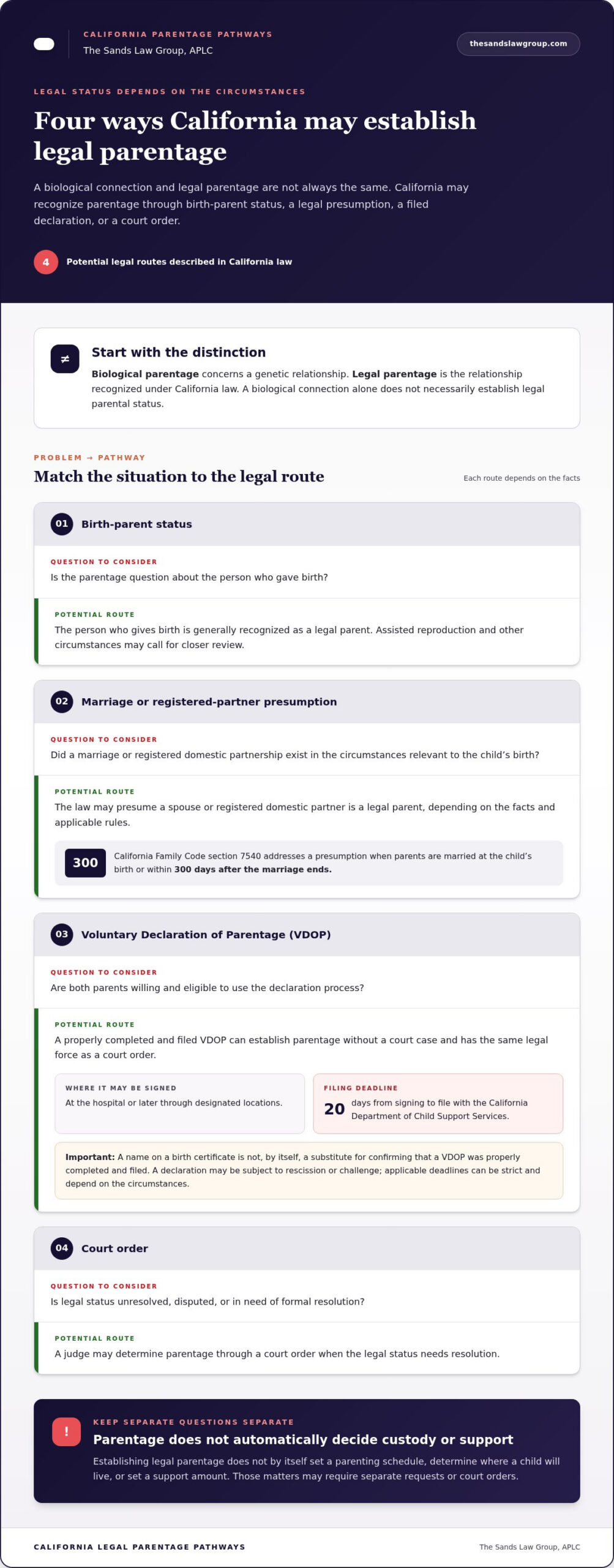
In California, legal parentage may arise through birth-parent status, a legal presumption such as marriage or registered-partner status, a properly completed Voluntary Declaration of Parentage, or a court order.
- Birth-parent status: The person who gives birth is generally recognized as a legal parent. Other circumstances, including assisted reproduction, may call for closer review.
- Marriage or registered-partner status: The law may presume a spouse or registered domestic partner is a legal parent, depending on the facts and applicable rules. California Family Code section 7540, for example, addresses a presumption when parents are married at the child’s birth or within 300 days after the marriage ends.
- Voluntary Declaration of Parentage: When both parents complete and file the required declaration, it can establish parentage without a court case.
- Court order: A judge may determine parentage when legal status is unresolved, disputed, or needs formal resolution.
When can a Voluntary Declaration of Parentage apply?
A Voluntary Declaration of Parentage, or VDOP, may be an option when both parents are willing and eligible to use the declaration process. A properly completed and filed form has the same legal force as a court order. It may be signed at the hospital or later through designated locations, and it must be filed with the California Department of Child Support Services within 20 days of signing to establish parentage through this route.
A name on a birth certificate is not, by itself, a substitute for confirming that a VDOP was properly completed and filed. A declaration may also be subject to rescission or challenge, and applicable deadlines can be strict and depend on the circumstances. If someone disputes the declaration or believes it was signed under improper conditions, prompt legal guidance can help clarify the available options.
When might a court determine parentage?
A parentage case may be necessary if one parent disputes the claim, the parents cannot complete a voluntary declaration, or existing documents leave legal status uncertain. Genetic testing may be considered in some cases, but it is not the only factor a court may examine. Assisted reproduction, surrogacy, and an existing parentage order can raise distinct legal questions, so the appropriate approach depends on the family’s history and records.
If the facts are disputed or involve an existing order, reviewing the history and documents can help identify the court pathway and issues that may need resolution. Discussing a California parentage case with counsel may help you prepare before taking that step.
How to choose the right California parentage process for your situation
The right next step depends less on what a family calls its relationship and more on what legal status already exists, whether both parents agree, and whether unusual facts affect the analysis. Before starting a case, gather any parentage declaration, court order, marriage or registered-partner records, and relevant birth records. Reviewing these documents can help clarify whether a court needs to decide parentage or whether a different issue remains unresolved.
| What you know about your situation | What to consider next |
|---|---|
| Legal parentage may already be established | Review existing declarations, orders, and circumstances that may create a legal presumption. A new parentage case may not be needed just to establish a status that already exists. |
| Both parents agree | A voluntary declaration may be an option if the parents are eligible and complete the required steps. Understand its legal effect before signing. |
| One parent disputes parentage | A court case may be needed to resolve the disagreement and determine legal status. |
| There are special circumstances | Assisted reproduction, surrogacy, prior orders, or competing parentage claims may call for individualized legal analysis before choosing a route. |
This is a general decision framework, not legal advice. First clarify whether the issue is parentage itself or a related matter, such as custody or support. If a valid declaration or court order already establishes parentage, filing another case may be unnecessary for that purpose, though a parent might still need orders on other issues. Reviewing the documents and facts can help avoid taking a path that does not address the actual concern.
What if both parents agree about parentage?
Agreement may make a voluntary legal route relevant, provided the circumstances meet the requirements for using it. Before signing, both parents should understand the declaration’s legal consequences and complete the required filing steps. Agreement about parentage does not automatically settle custody, parenting time, or support. Depending on the family’s needs, those matters may require separate agreements or court orders.
What if parentage is disputed or the family situation is complex?
If a parent contests legal status or the record is unclear, a court may need to determine parentage. Assisted reproduction, surrogacy, an existing order, or another person’s competing claim can make the analysis more fact-specific. These circumstances don’t predetermine the outcome, but they can change which documents and legal issues matter. Individualized review can help identify an appropriate next step.
In short: If legal parentage is already established, identify what remains unresolved. If both parents agree, consider whether a voluntary route fits. If parentage is disputed or the circumstances are complex, a court process or case-specific legal analysis may be appropriate. For parents establishing paternity in california, matching the process to the existing legal status and the actual dispute is a practical starting point.
How to start a California parentage case in your county
Starting a court case can feel daunting, particularly when you’re also trying to understand what the other parent may do next. A clear sequence can help you organize the work. The steps below are a general overview. Filing procedures, local requirements, and forms can change, so review the current instructions from the Superior Court handling the case.
- Identify what needs a court decision. Clarify whether parentage itself is unresolved or disputed, or whether you need orders about a related issue such as custody, parenting time, or support.
- Locate the proper court. Parentage cases are generally filed in the county where the child lives or can be found. Review the Superior Court’s current guidance for its filing location and procedures.
- Gather information and prepare forms. Collect the child’s and parents’ identifying details, relevant parentage records, and information about any related court cases. California Courts guidance lists FL-200, Petition to Determine Parental Relationship; FL-210, Summons (Uniform Parentage, Petition for Custody and Support); and FL-105/GC-120, Declaration Under Uniform Child Custody Jurisdiction and Enforcement Act (UCCJEA). Verify current form versions and instructions before completing them.
- File the documents. Follow the court’s current filing instructions, including requirements for submitting documents and addressing filing fees or fee waivers.
- Follow the court’s next-step instructions. After filing, review what the court requires for serving the other parent and responding to any directions or deadlines. Keep copies of filed papers and proof of important steps.
What information and forms should you prepare?
Before filling out paperwork, assemble accurate information about the child and both parents, along with copies of any declaration, parentage order, or related family-court papers. Note any other cases involving the child, since that history may affect what the court needs to know. The three forms named above are a starting point, not a complete checklist for every case. Requested orders and local court rules may require additional documents.
Do not rely on an old form packet or assume the filing process is identical in every county. Review the court’s current parentage instructions, confirm the forms are the latest versions, and note whether the court requires local forms or specific filing methods. If the matter involves disputed facts, existing orders, or multiple related requests, legal guidance can help you prepare the case coherently.
What happens after you file the parentage petition?
Filing begins the court process, but what follows depends on proper service, the other parent’s response, and whether parentage or related issues are contested. The court may give case-specific directions, so don’t assume every case follows the same hearing schedule or timeline. Read notices carefully, keep copies of filed and served documents, and record any deadlines or instructions you receive.
The Sands Law Group, APLC represents parents in paternity actions and related custody, visitation, and child support matters in Los Angeles, Riverside, San Bernardino, and Kern counties. If you’re preparing to file or responding to a parentage dispute, schedule a discussion about your parentage case to review the issues and prepare for court.
What establishing parentage can mean next, and when legal guidance helps
Establishing legal parentage can answer an important question, but it may not resolve the practical arrangements a family needs. Parents may still need clear decisions about where a child lives, how parenting time is shared, or how financial support will be addressed. Identifying which issues remain open helps focus the next step instead of assuming one legal determination settles every matter.
Which family-law issues may need separate orders?
A parentage determination and a custody decision serve different purposes. Parentage addresses legal status; custody and parenting-time orders address arrangements for the child. If parents disagree about a schedule or decision-making, those issues may need to be presented separately for resolution. Establishing parentage does not automatically decide the facts relevant to those arrangements.
Child support also involves its own legal considerations. The amount and terms of any support order depend on the issues before the court and the applicable circumstances. A parentage outcome does not, by itself, set a support amount or resolve every financial question. Identifying the specific orders you need can help keep the process focused and clarify what has been decided and what still needs attention.
How can a California paternity attorney help you prepare?
Legal guidance can help you assess existing parentage documents, court history, and the precise points in dispute before deciding how to proceed. The Sands Law Group, APLC represents mothers and fathers in formal California paternity actions, including cases to establish or challenge legal parentage. Counsel can help organize relevant records, prepare court filings, and consider how parentage questions relate to custody, visitation, or child support concerns.
Preparation matters when the history is complicated or parents disagree. A review may include identifying prior orders, clarifying what each parent is asking the court to decide, and considering whether related parental-rights issues should be addressed. This process doesn’t guarantee a particular result, but it can help you understand the issues and approach the next step with a clearer plan. Learn more about California paternity lawyer guidance for contested or uncertain situations.
The firm represents clients in Los Angeles, Riverside, San Bernardino, and Kern counties. If you’re establishing paternity in california and need to determine what remains unresolved, a case-specific discussion can help you consider your options and prepare.
Move forward with a clearer plan
Uncertainty about parentage can make it difficult to plan for your child’s future, especially when communication is strained or important decisions remain unresolved. You don’t need to resolve every family-law issue at once. Start by identifying the specific question that needs attention now and the outcome you hope to work toward.
Before discussing your circumstances with counsel, gather any parentage paperwork or prior court orders you have and write down what remains unclear. You may need to determine whether legal status is already established, whether a disputed issue requires court review, or whether separate arrangements still need to be addressed. This preparation can help keep the conversation focused on your family’s needs.
Establishing paternity in california can involve more than completing a form or filing a petition. The appropriate approach depends on your history, records, and current concerns. The Sands Law Group, APLC represents parents in paternity actions and related family-law matters in Los Angeles, Riverside, San Bernardino, and Kern counties. Schedule a consultation with The Sands Law Group, APLC to discuss your circumstances and possible next steps.
Frequently Asked Questions
Does signing a Voluntary Declaration of Parentage establish paternity in California?
Yes, a properly completed and filed Voluntary Declaration of Parentage can establish legal parentage when California’s requirements are met. Simply signing a document or seeing someone’s name on a birth certificate isn’t necessarily enough to confirm that the declaration process was completed. Because a declaration can have significant legal consequences, and options to rescind or challenge it may be subject to strict deadlines, review current official guidance or seek legal advice if you’re uncertain before signing.
Is a DNA test required to establish paternity in California?
No. Genetic testing isn’t automatically required in every parentage matter. An existing legal status or a valid voluntary process may address parentage without a DNA test. If a parent disputes the claim, testing may become relevant as part of the court process. The court determines what evidence matters in the circumstances, and a test result alone may not resolve related legal questions or replace review of existing orders and documents.
Can paternity be established if the other parent does not agree?
Yes. A parent can ask a California court to determine legal parentage even if the other parent objects. The case may involve filing the required papers, giving the other parent formal notice, and presenting evidence relevant to the disagreement. Depending on the case, the court may address requests for genetic testing or other evidence. The appropriate steps and outcome depend on the facts, so follow current court instructions and consider individualized legal guidance.
Does being named on a California birth certificate establish legal paternity?
Not necessarily in every situation. A birth certificate is an important record, but it shouldn’t be treated as interchangeable with every legal basis for parentage. Relevant documents may include a properly completed Voluntary Declaration of Parentage, a court order, or records connected to a legal presumption. If the other parent disputes status, gather the birth record and any signed declarations or orders, then review how they apply to your circumstances.
Where do I file a parentage case in California?
California Courts guidance generally directs parents to file in the county where the child lives or can be found, but the proper venue may depend on the case, and a judge may move it in some circumstances. Review the current family-law information from the relevant county Superior Court for its filing location, procedures, and local requirements. Filing details may differ by county.
Does establishing paternity automatically give a father custody or parenting time?
No. Establishing legal parentage and obtaining custody or parenting-time orders are related but separate matters. A parentage case may include requests for custody or a parenting schedule, but those arrangements aren’t automatically determined by parentage alone. The court’s process depends on the requests made and the circumstances before it. If you need both parentage recognition and a clear parenting plan, identify each issue so it can be addressed appropriately.

Article by
Thomas D. Sands, Esq.
Thomas D. Sands is the founder and CEO of The Sands Law Group, APLC. A California attorney with more than two decades of experience, he represents clients in divorce and family law matters as well as civil litigation and real property disputes. His approach emphasizes attentive, practical, and cost-conscious representation.
Sands is a 2023 Litigator of the Year honoree of the American Institute of Trial Lawyers and a 2023 Lawyer of the Year honoree of the American Institute of Legal Professionals. His firm has also received recognition among the 2025 Best Law Firms in America, a 2026 Benchmark Best of award, and a 2026 Law Firm of the Year honor.
Article reviewed by
Thomas D. Sands, Esq.
Thomas D. Sands is the founder and CEO of The Sands Law Group, APLC. A California attorney with more than two decades of experience, he represents clients in divorce and family law matters as well as civil litigation and real property disputes. His approach emphasizes attentive, practical, and cost-conscious representation.
Sands is a 2023 Litigator of the Year honoree of the American Institute of Trial Lawyers and a 2023 Lawyer of the Year honoree of the American Institute of Legal Professionals. His firm has also received recognition among the 2025 Best Law Firms in America, a 2026 Benchmark Best of award, and a 2026 Law Firm of the Year honor.
TOLL-FREE: 855-SANDS4U