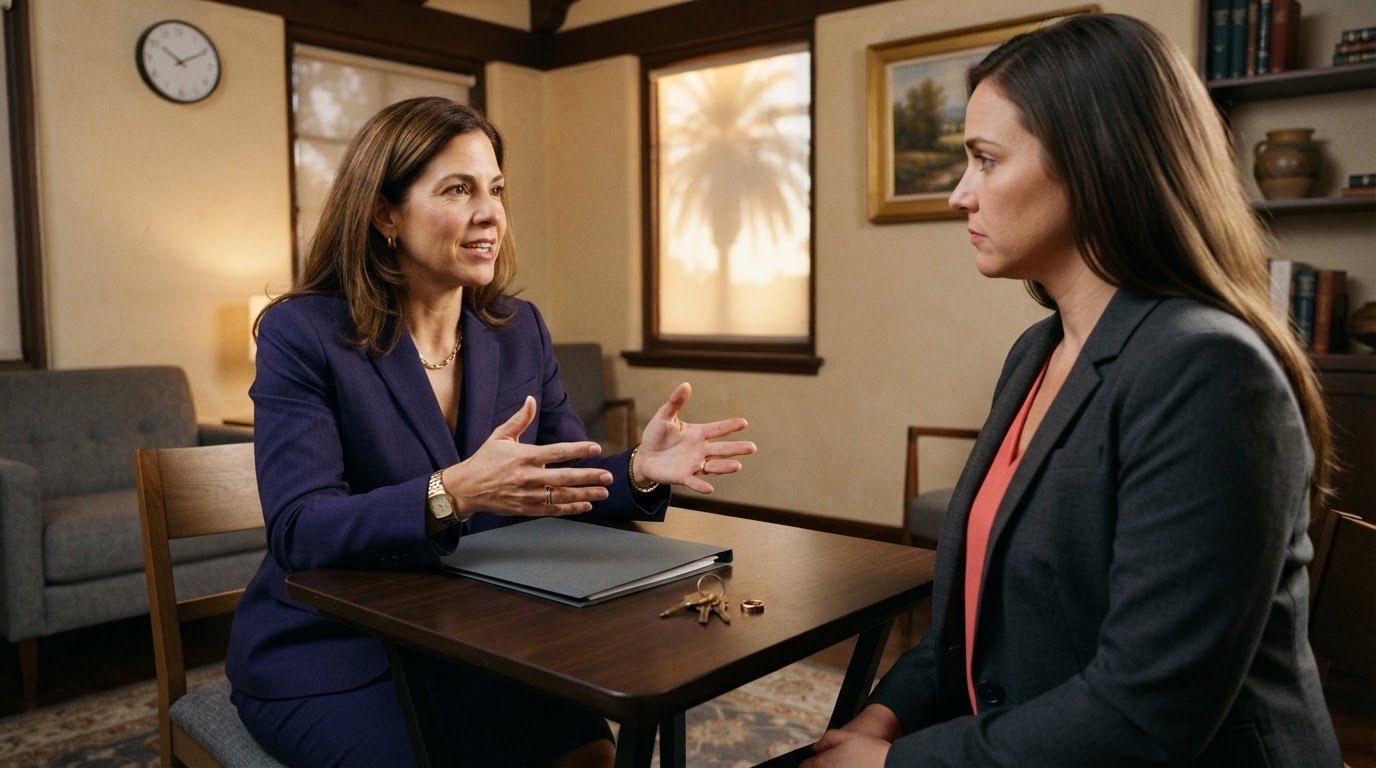
A “free consultation” is not the same as free legal representation. If you’re looking for a free divorce consultation in Riverside, confirm whether the initial meeting has a charge and what it covers. Legal representation is separate, and the work involved depends on the issues in your case.
It’s understandable to want clear cost information before discussing a difficult decision. This guide explains what to clarify about a consultation, what can affect the cost of divorce representation, and how to prepare for a first conversation so you can use the time effectively.
You’ll also learn what next steps may involve when divorce raises questions about property, support, or parenting arrangements. Understanding the process can help you decide what guidance you need and approach the conversation with greater confidence.
Key Takeaways
- Clarify what an initial divorce consultation covers and how it differs from the cost of legal representation.
- Identify the business, real estate, retirement accounts, and other property issues that may shape division discussions.
- Understand why complete financial disclosure matters when working through property division in a Riverside County divorce.
- Use the first conversation to outline your priorities, questions, and the next steps relevant to your circumstances.
- Consider legal representation when divorce involves contested issues about property, parenting arrangements, or spousal support.
Dividing businesses, real estate, retirement accounts, and separate property
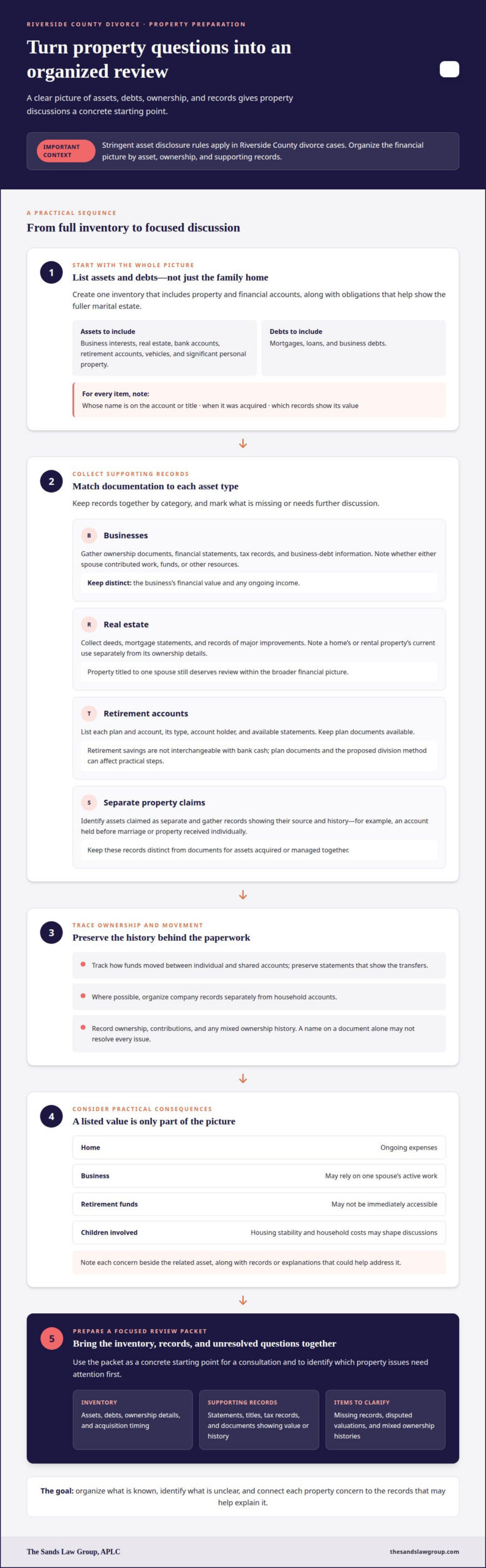
Property discussions become more manageable when the financial picture is organized by asset, ownership, and supporting records. In Riverside County, stringent asset disclosure rules apply in divorce cases. A clear inventory helps identify what needs documentation, valuation, or further discussion before decisions are made.
Start with a complete list of assets and debts, not just the family home. Include business interests, real estate, bank accounts, retirement accounts, vehicles, and significant personal property. For each item, note whose name appears on the account or title, when it was acquired, and which records show its value. Include mortgages, loans, and business debts to give a fuller picture of the marital estate.
- Businesses: Gather ownership documents, financial statements, tax records, and information about business debts. Note whether either spouse contributed work, funds, or other resources. A business may involve both financial value and ongoing income, so those issues should be identified separately.
- Real estate: Collect deeds, mortgage statements, and records of major improvements. For a home or rental property, distinguish its current use from its ownership details. A property titled to one spouse still deserves careful review within the broader financial picture.
- Retirement accounts: List each plan and account, its type, account holder, and available statements. Avoid treating retirement savings as interchangeable with cash in a bank account. The plan documents and the proposed division method can affect the practical steps involved.
- Separate property: Identify assets claimed as separate and gather records showing their source and history. Examples might include an account held before marriage or property received individually. Keep those records distinct from documents for assets acquired or managed together.
Keep track of how funds moved between individual and shared accounts, and preserve statements showing the transfers. For a business, organize company records separately from household accounts where possible. These details can help clarify questions about ownership and contributions. A name on a document alone may not resolve every issue.
Consider practical consequences as well as listed values. A home has ongoing expenses, a business may rely on one spouse’s active work, and retirement funds may not be immediately accessible. If children are involved, housing stability and household costs may also shape discussions. Note each concern beside the related asset, along with the records or explanations that could help address it.
For a focused consultation, assemble the inventory, supporting documents, and unresolved questions into one review packet. Mark missing records, disputed valuations, and assets with mixed ownership histories. This gives the discussion a concrete starting point and helps identify which property issues need attention first.
Family law consultations at Riverside and Indio offices
A consultation can help identify which family law concerns need attention. Before an appointment, clarify its location or format, scope, and cost.
Consultation Locations and Lawyer Availability
Riverside is a primary meeting location, but an office location doesn’t establish that a consultation is free. For a free divorce consultation in Riverside, look for appointment terms that expressly state the meeting has no charge. Location alone also doesn’t identify which lawyer will meet with you or what matters the conversation can cover.
Before scheduling, clarify whether the meeting is in person or remote, who will participate, and whether you can discuss your main concern. For example, a parent may want to discuss parenting arrangements alongside the divorce. Choose a location and format that work for your practical needs.
Consultation Format and Length
A free divorce consultation can give you time to describe your situation, identify legal questions, and discuss possible next steps. Bring a short timeline and prioritize concerns about separation, finances, or children. The scope depends on the appointment’s stated purpose, so distinguish an introductory discussion from document review or ongoing representation.
Don’t assume every free divorce lawyer consultation in Riverside has the same length. Ask how much time is reserved and which issues fit within the meeting. If you’ve recently received divorce papers or have an urgent parenting concern, raise it first so the discussion can focus on immediate priorities.
An initial conversation may identify issues without resolving disputed facts, valuing assets, or developing a complete case strategy. Treat it as a starting point, not a substitute for detailed review or ongoing legal representation.
Questions to Ask
Ask what the consultation covers, which issues the lawyer can discuss, and what information would help explain your circumstances. If a family business or home is involved, ask how those subjects may shape the conversation. These questions define the meeting’s purpose and help you prepare.
Clarify whether the consultation itself is free, what it includes, and whether later legal work is separate. Ask who would handle your matter and how contested parenting or property issues are approached. The answers can help you distinguish an introductory conversation from representation and understand the next decision.
Free and Low-Cost Legal Assistance
Riverside County Superior Court Self-Help Legal Services provides family law assistance and other legal help, with limited assistance in specified case types. This may help residents understand court processes, but it isn’t the same as full representation in a divorce dispute.
For any program, clarify what kind of help it provides and whether it fits your procedural need. Help understanding forms differs from representation in a contested matter. A free or low-cost resource may address a specific task, while complex disputes can require a broader legal strategy.
When you’re ready to discuss divorce representation, schedule a conversation with The Sands Law Group, APLC to discuss the issues shaping your next steps.
Choosing a Riverside divorce lawyer
Choose a lawyer whose experience fits the issues affecting your family. In Riverside County, distinguish private representation from limited court self-help assistance.
Lawyer Selection
Look for a lawyer whose work addresses the decisions you face, such as contested parenting arrangements, support, or complex finances. Ask how the lawyer handles negotiation, court proceedings, and updates about your case. A dispute involving a family business, for example, may raise different questions from an uncontested divorce with few shared assets.
During an initial conversation, clarify who will work on your matter, what the consultation covers, and what next steps may follow. Ask how fees for representation are explained and what factors may affect them. A free consultation does not make ongoing legal work free, so distinguish the introductory meeting from any proposed representation.
How do you file for divorce in Riverside County, California, and what are the filing fees? Riverside County Superior Court provides information about divorce, separation, and child custody through its Families & Children resources. Filing steps depend on the forms and circumstances involved. Filing fees are separate from attorney fees, and an applicable waiver process can affect what a person pays.
If you’ve been served with divorce papers in California, the first 30 days after service are critical. Treat that period as a prompt to understand the papers and identify a response plan, rather than delaying while choosing representation. A consultation can help you frame questions, but it doesn’t itself file documents or resolve the case.
Eligibility for Free Legal Help
Are there income limits or eligibility requirements for free divorce legal help in Riverside County? Requirements vary among programs and the assistance they provide, so don’t assume one threshold applies to every service. Ask about the rules for the specific help you’re considering.
Riverside County Superior Court Self-Help Legal Services provides assistance in family law and other areas, with limited help in specified case types. This is different from full representation by a lawyer. Before relying on a self-help service, identify whether you need help with forms, procedural information, or advocacy in a contested dispute.
When evaluating free or low-cost help, clarify whether the service covers your case type and what assistance it includes. Guidance on completing paperwork, for example, may not cover negotiation over parenting time or property. Ask what documents or information are needed, how appointments work, and what options remain if the service cannot address every issue.
Compare the answers with your immediate priorities, such as responding to served papers, resolving a parenting question, or addressing a financial disagreement. This can help you choose a practical next step without assuming a free consultation includes ongoing representation.
Divorce and dissolution services
In California, divorce, or dissolution, involves ending a marriage and resolving related family issues. Riverside County Superior Court provides information about divorce, separation, and child custody through its Families & Children resources.
Start by identifying which decisions remain open. Some couples agree on major terms, while others need help addressing disputed issues. Listing the unresolved questions can clarify whether the next step involves paperwork, negotiation, or court proceedings.
Common issues include parenting arrangements, financial support, and property division. Riverside County family law courts require mediation for custody disputes. Mediation addresses disagreements about children, while financial or other legal issues may need separate attention. Beyond the legal process, managing the personal stress and emotional transitions of a separation often benefits from professional guidance and coaching, such as the support offered at leapsinc.com.
- Parenting: Write down the decisions needed about children’s schedules, exchanges, and communication. In Riverside County, custody disputes require mediation.
- Support: Identify questions about household income, recurring expenses, and the support arrangement being considered.
- Property: Separate questions about real estate, accounts, business interests, and debts. Riverside County divorce cases have stringent asset disclosure rules.
- Court documents: Note which forms or procedural steps remain unclear, then use Riverside County Superior Court’s family resources to locate relevant information.
In a contested matter, the parties may disagree about one issue or several. They might agree about ending the marriage but disagree about parenting time or property, for example. Identify the specific disagreements to focus discussions and separate unresolved decisions from those already settled.
In an uncontested matter, spouses may agree on the terms they want to resolve. Agreement can simplify discussions, but documents and proposed terms still need careful review. A written list can show where you agree and where clarification remains necessary.
Riverside County Superior Court Self-Help Legal Services offers limited assistance in specified case types. This may help with certain procedural needs, but it differs from representation in a contested case. The distinction matters when a dispute involves mediation, financial disclosure, or proposed court orders.
Prepare for the next step by ordering your questions by urgency. Put immediate parenting concerns first, then list financial disagreements and document questions. Keep a separate record of agreements and unresolved matters. This gives each discussion a clear purpose, whether you need court information, mediation, or resolution of outstanding terms.
Start with Riverside County Superior Court’s family resources for relevant forms and procedural information. Its Self-Help Legal Services provides limited assistance in specified case types.
Which divorce lawyers in Riverside, California offer a free consultation?
A free consultation is a law firm’s policy, not a countywide service. Look for appointment information that expressly describes the first meeting as free, then confirm what it covers. An office location or the word “consultation” alone doesn’t establish that the meeting has no charge.
When comparing Riverside law practices, review each firm’s stated consultation terms rather than assuming all first meetings work alike. Clarify whether you’ll speak with a lawyer, which divorce issues the meeting can cover, and whether later legal work is separate. A short introductory meeting, for example, may help frame a property question without including document review or ongoing representation.
Use the same questions when reviewing an advertised offer:
- Does the practice describe the initial consultation as free?
- What topics can the meeting address, such as divorce, parenting, or support?
- How much time is allocated, and what information should be available?
- Does the meeting include advice about next steps, or only an initial discussion?
- What would representation involve after the consultation?
Those distinctions matter because “free consultation” doesn’t mean free legal representation. A consultation can help you explain your situation, identify questions, and understand possible next steps. It may not include a complete review of financial records, preparation of court documents, or continued advocacy. Ask for the scope in plain language before the meeting begins.
Riverside County Superior Court Self-Help Legal Services provides legal assistance in family law and other areas, with limited assistance in specified case types. This may help with a defined court-related task, but it differs from a private lawyer’s consultation and from full representation. Match the type of help to your immediate need.
Riverside Legal Aid was founded in 1982 by the Riverside County Bar Association. If you’re considering legal aid, clarify the assistance available for your circumstances and whether it addresses your particular divorce issue. A program’s existence doesn’t establish that every applicant or case qualifies for every form of help.
Before an appointment, prepare a brief timeline, identify your main concern, and bring your questions. If you’ve been served with divorce papers, mention that when describing your situation. A focused summary can help you use the meeting effectively, whether you’re asking about parenting arrangements, finances, or the process ahead.
If you’re ready to discuss divorce representation, schedule a consultation and outline the questions you want addressed.
The Sands Law Group, APLC: Divorce Legal Representation
The Sands Law Group, APLC provides Divorce Legal Representation for people navigating contested and uncontested divorce proceedings. When decisions involve parenting arrangements, support, or property, legal guidance can help clarify the issues and the steps ahead.
Depending on the issues involved, representation may address Child Custody and Visitation, Spousal Support, or Property Division. Bring your priorities and key questions so the matters requiring attention can be identified. A consultation is a starting point for understanding your situation, not a promise of a particular outcome.
If you’re ready to discuss your circumstances and possible next steps, contact The Sands Law Group, APLC.
Take the Next Step With a Clear Priority
Before arranging a free divorce consultation in Riverside, decide what you most need from the conversation: a clearer path through a contested issue, guidance about possible representation, or help identifying your next decision. Confirm the consultation’s terms and scope, then bring that priority to the discussion. A focused first step can help you move from uncertainty toward a considered plan.
The Sands Law Group, APLC offers Divorce Legal Representation, Child Custody and Visitation Representation, and Spousal Support Representation. If one of these matters is shaping your next decision, a conversation can help you explain your concern and discuss how to proceed. You don’t need every detail resolved before seeking guidance.
Schedule a conversation with The Sands Law Group, APLC when you’re ready to discuss your circumstances. Taking that step can help bring greater direction to a difficult transition.
Frequently Asked Questions
How Do I Get Started?
Start by writing down your immediate concern and the decision you need help making. The Sands Law Group, APLC offers a free case evaluation. Its website content is for general informational purposes only and does not constitute legal advice, and the website should be used only for lawful purposes. Contacting the firm doesn’t create an attorney-client relationship until a formal agreement is executed. Call 855-SANDS4U; text STOP to +1 425-292-2421 to cancel SMS communications. Reply HELP for assistance with the SMS program.
What Should I Consider Before Filing for Divorce in Riverside County?
Consider how separation could affect your household routine, financial responsibilities, and children’s day-to-day needs. Alongside legal and practical planning, seeking counseling support from practices like Benessere Marriage and Family Therapy, Inc can help individuals and families navigate the emotional strain of major life transitions. Think through where each person may live and how essential expenses would be managed during the transition. Make a private list of urgent decisions and questions that can wait. Separating immediate practical concerns from longer-term issues can help you discuss possible next steps more clearly.
What Should I Look for When Hiring a Riverside Divorce Lawyer?
Look for a lawyer whose family law work fits the issues you need addressed, whether you expect agreement or anticipate contested decisions. Ask how the lawyer approaches negotiation and court proceedings, who will communicate with you, and how you’ll receive updates. Clarify the proposed scope of representation and how fees are explained before deciding. A useful conversation should leave you understanding the next step, without assuming a particular result.
How do I prepare for a divorce lawyer consultation in Riverside?
Prepare a concise timeline of major events, note upcoming court dates, and identify your most important questions. Keep any court papers together so you can explain what they concern. You might also write down the outcome you want to discuss, such as a workable parenting schedule or a way to resolve a disputed issue. A focused agenda helps keep the meeting centered on your circumstances.
How do I file for divorce in Riverside County, California, and what are the filing fees?
Riverside County Superior Court provides divorce information through its Families & Children resources. Filing steps depend on the forms and your circumstances. Filing fees are separate from attorney fees, and an applicable fee waiver process can affect what you pay.

Article by
Thomas D. Sands, Esq.
Thomas D. Sands is the founder and CEO of The Sands Law Group, APLC. A California attorney with more than two decades of experience, he represents clients in divorce and family law matters as well as civil litigation and real property disputes. His approach emphasizes attentive, practical, and cost-conscious representation.
Sands is a 2023 Litigator of the Year honoree of the American Institute of Trial Lawyers and a 2023 Lawyer of the Year honoree of the American Institute of Legal Professionals. His firm has also received recognition among the 2025 Best Law Firms in America, a 2026 Benchmark Best of award, and a 2026 Law Firm of the Year honor.
Article reviewed by
Thomas D. Sands, Esq.
Thomas D. Sands is the founder and CEO of The Sands Law Group, APLC. A California attorney with more than two decades of experience, he represents clients in divorce and family law matters as well as civil litigation and real property disputes. His approach emphasizes attentive, practical, and cost-conscious representation.
Sands is a 2023 Litigator of the Year honoree of the American Institute of Trial Lawyers and a 2023 Lawyer of the Year honoree of the American Institute of Legal Professionals. His firm has also received recognition among the 2025 Best Law Firms in America, a 2026 Benchmark Best of award, and a 2026 Law Firm of the Year honor.
TOLL-FREE: 855-SANDS4U