
What if a custody decision isn’t about which parent can make the strongest case against the other, but which parenting arrangement best supports your child? If you’re asking how is custody determined in california, it’s understandable to worry about what a judge will consider and whether a change could unsettle your child’s routine. California courts focus on the child’s best interests, not on rewarding one parent or punishing the other.
This guide explains the child-centered standard and the kinds of information a court may weigh, including your child’s safety, well-being, and relationships with each parent. It covers custody disputes between parents, not child dependency proceedings, which follow a different legal process. The Sands Law Group, APLC represents parents in custody matters in Los Angeles, Riverside, San Bernardino, and Kern.
You’ll learn how legal and physical custody differ, how agreements and mediation can shape a parenting plan, and when a court order may be needed. You’ll also find practical ways to organize child-focused information, whether you’re seeking an initial arrangement or asking to modify an existing order. The aim is to help you approach the process with clarity and keep your child’s needs at the center.
Key Takeaways
- To understand how is custody determined in california, focus on the child’s best interests and the facts that explain their needs and routine.
- Legal custody concerns decision-making; physical custody concerns where the child lives and how parenting time is arranged.
- Organize specific, child-focused information. Generalized accusations and speculation may distract from the issues the court needs to assess.
- For a contested case, identify your child’s needs, consider workable schedules, and prepare for mediation.
- Follow the terms of an entered custody order. Changed circumstances may provide a reason to seek a modification, depending on the facts and applicable legal standard.
How California Courts Approach Child Custody Decisions
Custody questions feel personal because they affect where your child wakes up, how time is shared, and who makes important decisions. But the court’s task isn’t to decide which parent deserves a child more. California custody decisions center on the child’s best interests, not parental entitlement. That distinction keeps the focus on the parenting arrangement rather than a judgment about either parent’s worth.
A custody order sets out parental decision-making and the child’s living arrangements. Parents may agree on a plan and ask the court to make it an order. If they cannot resolve important terms, a judge may decide them. Clear terms can reduce uncertainty about daily care and help both parents understand what the arrangement requires.
What does a custody decision determine?
A custody decision may address legal custody, which concerns authority to make decisions about a child’s upbringing, and physical custody, which concerns where the child lives and how parenting time is arranged. An order can also set schedules, exchanges, and other practical details. For example, it may specify how school-day transitions or handoffs work. The terms depend on the family’s circumstances.
This guide concerns custody disputes handled in family court, such as disagreements between parents about a parenting plan. It isn’t a guide to juvenile dependency proceedings, a separate court process involving state intervention to protect a child. Child safety matters in both settings, but the cases, participants, and procedures differ. An explanation written for a dependency case should not automatically be treated as a complete account of a private family-court custody dispute.
When does a judge become involved?
Parents can try to work out a parenting plan together. If they agree, they may seek to have its terms entered as a court order, giving the arrangement formal legal force. An informal agreement may help parents coordinate, but it isn’t the same as an entered court order. If parents disagree about decision-making, the schedule, or another central term, family court may need to resolve the issue.
For unmarried parents, establishing legal parentage may be an important step in addressing parental rights and custody. The relevant steps depend on the family’s circumstances. Learn more about California paternity actions and parental rights in relation to a custody question.
So, how is custody determined in california? Parents may shape a plan together, but a court can decide disputed terms when they cannot reach agreement. The central question remains how the proposed arrangement serves the child. Clear, workable terms turn that focus into a practical plan for everyday parenting.
Which California Custody Factors Can Shape the Decision?
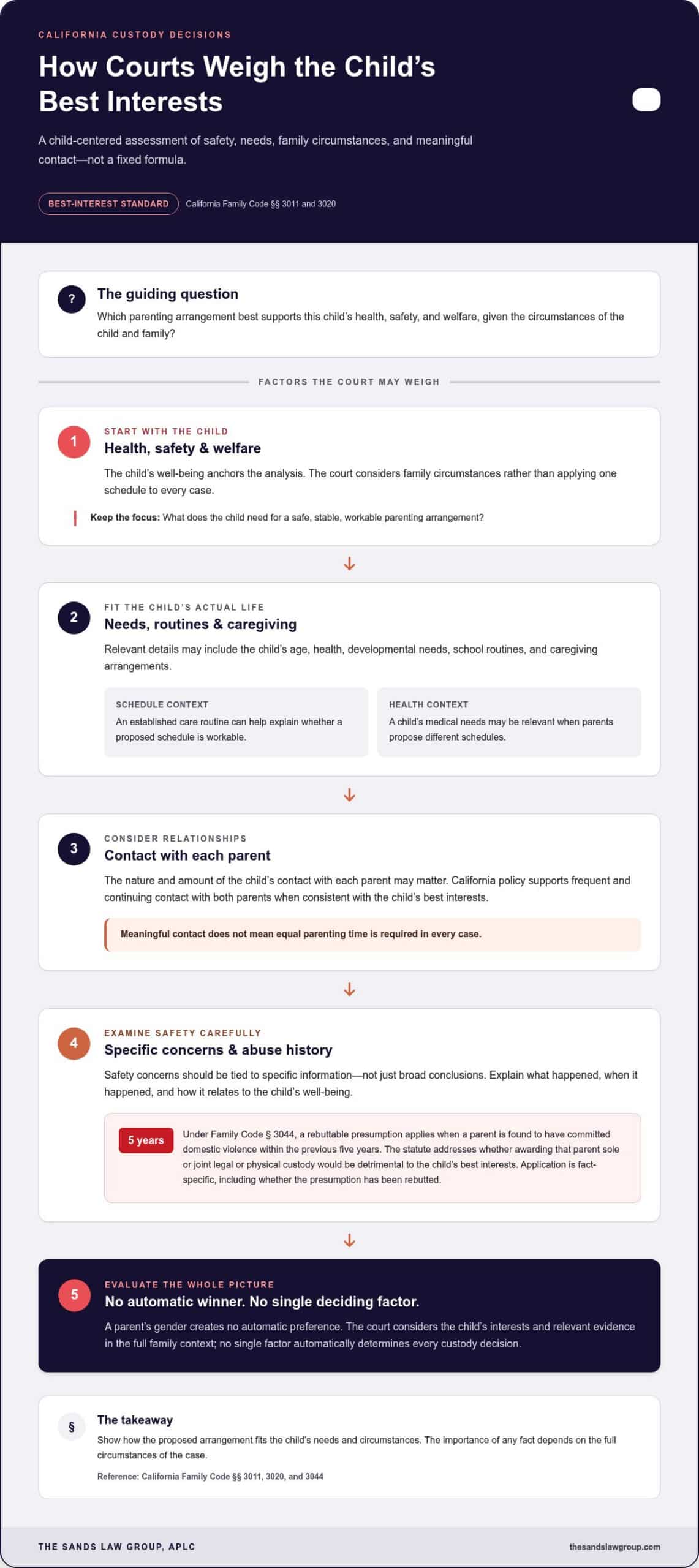
California courts apply the child’s best-interest standard. They consider the circumstances of the child and family rather than using a formula that produces the same schedule in every case. Family Code sections 3011 and 3020 address the child’s health, safety, and welfare, along with the policy of frequent and continuing contact with both parents when that contact is consistent with the child’s best interests. Section 3011 also identifies relevant considerations such as a history of abuse and the nature and amount of the child’s contact with each parent.
Under California Family Code sections 3011 and 3020, courts consider a child’s health, safety, and welfare, as well as meaningful contact with both parents when appropriate. No single factor automatically determines every custody decision. The California Courts on Child Custody also describes the best-interest standard and factors judges may consider.
How do safety and a child’s needs matter?
A parenting plan should fit the child’s actual life, not just look equal on paper. Age, health, developmental needs, school routines, and caregiving arrangements may help show whether a schedule is workable. For example, an established care routine or a child’s medical needs may be relevant when parents propose different schedules. The importance of each fact depends on the full circumstances.
Safety concerns call for careful, specific attention. A parent raising a concern should be prepared to explain what happened, when it happened, and how it relates to the child’s well-being, rather than relying only on broad conclusions. California Family Code section 3044 provides a rebuttable presumption that awarding sole or joint legal or physical custody to a parent found to have committed domestic violence within the previous five years is detrimental to the child’s best interests. Its application is fact-specific, and the court considers whether the presumption has been rebutted under the statute.
Does California automatically favor one parent?
No. A parent’s gender doesn’t create an automatic preference, and custody isn’t a reward for either parent. The court assesses the child’s interests and the evidence relevant to those interests. Preserving relationships with both parents doesn’t mean equal parenting time is required in every case. The child’s needs, safety, and family circumstances guide the analysis.
The court may need to weigh competing information. A documented pattern of reliable caregiving, for example, may help explain how a proposed schedule would work. A serious safety allegation may call for a different kind of scrutiny. Neither an accusation nor a preferred schedule settles the issue by itself. How is custody determined in california ultimately depends on the relevant facts and how they relate to the statutory considerations, not on one parent’s assertion that an arrangement is fair.
When requesting or responding to a custody arrangement, legal guidance can help organize the facts around your child’s needs and the applicable standards. You can discuss your California custody concerns with counsel without assuming a particular outcome.
How Do Judges Weigh Evidence in a Custody Dispute?
For parents asking, “how is custody determined in california,” evidence can help the court understand the child’s circumstances beyond each parent’s account. Relevant, reliable information may clarify daily routines, caregiving responsibilities, communication, and specific concerns. A document or message doesn’t decide a case on its own. Its meaning depends on context and how it relates to the parenting arrangement being considered.
What information may help explain a child’s routine?
Organize information that relates to your child and the issue in dispute. Depending on the circumstances, useful records may include:
- School calendars, attendance information, and schedules showing recurring commitments.
- Notes about caregiving arrangements, such as who handles regular pickups or appointments.
- Relevant health or developmental information that helps explain care needs.
- Communication records about scheduling, exchanges, or decisions affecting the child.
Specific dates and factual descriptions are generally clearer than character judgments. “On Tuesday, the exchange took place two hours later than agreed” describes an event the court can assess. “The other parent is always irresponsible” is a broad conclusion that may not explain what happened or how it affected the child. Keep original records where possible, and don’t alter messages or add commentary that blurs what was actually said.
Child-focused documentation: A dated schedule showing school pickups and which parent completed them may help illustrate how a proposed routine would work.
Generalized accusations or speculation: Saying a parent “never cooperates” without particular examples or supporting context may not help explain the child’s actual needs.
This is a practical distinction, not a scoring system. A judge may consider credibility, context, and consistency, including whether an account aligns with other relevant information. A record may need explanation, and a collection of records doesn’t guarantee a particular result. Keep the focus on what the information clarifies about the child.
How should parents handle disputed allegations?
When accounts differ, make calm, accurate notes about what happened, when it occurred, and any relevant follow-up. Separate what you directly observed from what someone else told you or what you believe an event means. If a concern involves safety, raise it responsibly and organize information relevant to that concern. Avoid inflammatory messages or repeated confrontations that may intensify conflict instead of clarifying facts.
Documentation isn’t a reason to surveil, harass, or intrude on the other parent. Don’t involve your child in gathering evidence, coach them on what to say, or pressure them to take sides. Protect sensitive information about your child and share only what is relevant and appropriate for the proceeding. Thoughtful preparation can help you present a clearer account while keeping your child out of adult conflict.
How Can Parents Prepare for California Custody Proceedings?
Preparing for mediation or a hearing can feel daunting, especially when the facts involve daily family life. A steady approach can keep attention on what the child needs rather than every disagreement between adults. If you’re wondering how is custody determined in california, preparation can help you explain your child’s routine and your proposed arrangements clearly. No single document or schedule guarantees an outcome.
Work through these steps:
- Identify the child’s needs. Consider school, health, developmental needs, regular activities, and the care that supports stability.
- Organize relevant facts. Create a concise timeline of caregiving, schedule changes, and significant child-related events.
- Consider workable schedules. Account for travel, each parent’s availability, school days, weekends, and transitions.
- Prepare questions. Note which terms remain unresolved and what information you need to understand the options.
In contested custody matters, California courts generally require parents to attend mediation before a judge hears the dispute. California Family Code section 3170 addresses mediation when custody or visitation is contested. Mediation gives parents an opportunity to discuss arrangements with a mediator, but it doesn’t guarantee agreement. Local procedures can vary, so prepare for the process that applies to your county and case.
What should parents organize before mediation or a hearing?
Keep a clear timeline that distinguishes dates and direct observations from assumptions. Gather relevant school, health, caregiving, and communication records, while protecting sensitive child information and avoiding private details unrelated to the issues. A concise, organized set of materials is easier to explain than an unsorted collection. Legal counsel can help you assess what is relevant and how to present it.
How can a parenting proposal stay child-focused?
Write a schedule that addresses school days, weekends, holidays, exchanges, and practical communication between parents. Consider travel time, the child’s existing routine, and how the plan would work during an ordinary week. Explain how the proposal supports stability and the child’s ongoing needs. A preferred schedule is a proposal, not a legal entitlement, and a judge may not approve it as written.
Before mediation or a hearing, review your timeline and proposed plan for clarity. Can another person understand what happens, when it happens, and how the arrangement responds to the child’s needs? A focused presentation keeps the discussion grounded in practical choices, even when parents disagree.
For an initial parenting plan or a contested matter, you can discuss your custody circumstances with counsel.
What Happens After a California Custody Decision?
Once a family court enters a custody order, its terms provide the framework for parenting time and decision-making. Read the order carefully, follow its requirements, and keep an accessible copy so you can refer to the exact schedule and directions. If a term seems unclear or difficult to follow, seek guidance rather than relying on assumptions or treating a disagreement as permission to disregard it.
Keep practical records of how the arrangement is working, including schedule changes and relevant developments in your child’s needs. If parents agree to a temporary adjustment, remember that an informal understanding isn’t necessarily a change to the court order. Get case-specific advice before relying on a different arrangement.
When might a parent seek a custody modification?
A parent may ask the court to modify an order when circumstances have changed in a way that may warrant a different arrangement. A substantial change in a child’s needs or family circumstances could be relevant, but whether it supports a modification depends on the facts and applicable legal standard. Disagreeing with the original decision, by itself, isn’t the same as showing a basis for changing it.
For example, a child’s changing educational or health needs may affect what schedule is workable, but that alone doesn’t predict what a court will decide. Before changing an existing arrangement unilaterally, get legal guidance about your order and the appropriate next steps. If there is an urgent safety concern, seek prompt, case-specific advice about available legal options.
When can legal guidance help clarify next steps?
Custody and visitation counsel can help organize relevant facts, assess how a proposed parenting arrangement addresses your child’s needs, and prepare court filings for an initial plan or a post-judgment modification request. That support may be useful when the other parent disputes a proposed change, the current schedule has become difficult to carry out, or you’re unsure which facts matter. The Sands Law Group, APLC represents parents in custody and visitation matters in Los Angeles, Riverside, San Bernardino, and Kern.
Legal guidance can also help distinguish between a practical problem parents may be able to resolve and a change that calls for a court request. The right approach depends on the existing order, the circumstances behind the disagreement, and the child’s needs. No modification is automatic, and representation can help present the relevant facts without promising a particular result.
If you’re weighing whether to seek a change or need help understanding an existing order, discuss your custody circumstances. A tailored discussion can help clarify possible next steps and how to protect a workable parenting arrangement.
Take the Next Step Toward a Workable Parenting Plan
A custody decision can shape everyday life, but it doesn’t have to define every future conversation between parents. As your child grows and circumstances shift, a thoughtful approach can help address concerns without losing sight of stability and your child’s needs. If you’re still asking “how is custody determined in california,” consider how the law applies to your family’s specific facts.
When the way forward feels uncertain, tailored legal guidance can help you understand your options and prepare for decisions ahead. The Sands Law Group, APLC represents parents in California custody matters, from developing an initial parenting plan to seeking a post-judgment modification. No particular result can be promised, but clear advice can help you approach the process with greater confidence.
Schedule a consultation with The Sands Law Group, APLC to discuss your circumstances and possible next steps. You can move forward with care, clarity, and your child’s well-being at the center.
Frequently Asked Questions
Does California favor mothers or fathers in custody decisions?
No. California custody decisions don’t automatically favor a parent based on gender. The court considers the child’s needs, each parent’s role, safety issues, and the practicality of the proposed arrangement. For example, a parent’s work hours may matter when assessing how a suggested school-day schedule would function, but that fact alone doesn’t determine the result. Each case turns on its own circumstances, and no particular schedule is guaranteed.
At what age can a child choose which parent to live with in California?
A child doesn’t gain an automatic right to choose a custodial parent at a fixed age. The court may consider a child’s preference if the child is old enough and has sufficient capacity to form an intelligent opinion. In general, a child aged 14 or older may address the court unless doing so isn’t in the child’s best interests. The judge still makes the custody decision; the child’s wishes don’t control it.
Can a California judge order supervised visitation?
Yes. A judge may order supervised visitation if the evidence and circumstances support that arrangement to protect a child’s safety or welfare. Supervision isn’t an automatic response to parental conflict. Depending on the case, the court may consider the nature of the concern and whether a less restrictive arrangement can address it. If you’re worried about a visit, keep a factual record of relevant incidents and get advice before taking action.
Do parents have to attend mediation before a California custody hearing?
Generally, parents must participate in mediation when custody or visitation is contested before the court holds a hearing, subject to applicable rules and procedures. The process varies by county, so instructions in one courthouse may not describe another county’s process. Before mediation, identify which decisions remain unresolved, such as holiday arrangements or how parents will share important updates. Mediation can help clarify options, but it doesn’t require parents to reach an agreement.
Can custody be changed after a California court has issued an order?
Yes. A parent may ask the court to modify an existing custody order if the applicable legal requirements are met. A disagreement with the other parent, by itself, doesn’t necessarily justify a change. For example, a proposed adjustment to accommodate a new school schedule should be considered in light of the order and the child’s circumstances. Don’t assume you can disregard an existing schedule while a request is pending; get advice about your specific order first.
Does an unmarried parent have custody rights in California?
An unmarried parent’s ability to seek custody can depend on whether legal parentage has been established and on the family’s circumstances. Once parentage is legally established, a parent may pursue appropriate custody and visitation orders. An informal parenting arrangement may not resolve questions about legal status or provide the clarity of a court order. If parentage is uncertain, understand the available legal process before relying on an assumed right or changing the child’s arrangements.
Can parents agree on custody without a judge deciding every detail?
Yes. Parents can develop proposed terms together and submit their agreement through the appropriate court process, rather than asking a judge to resolve every disputed detail. For clarity, they may address decision-making, regular parenting time, holidays, and how schedule changes will be communicated. The court must still review the proposed arrangement under applicable requirements. If a key term remains disputed, that issue may require mediation or a court decision.

Article by
Thomas D. Sands, Esq.
Thomas D. Sands is the founder and CEO of The Sands Law Group, APLC. A California attorney with more than two decades of experience, he represents clients in divorce and family law matters as well as civil litigation and real property disputes. His approach emphasizes attentive, practical, and cost-conscious representation.
Sands is a 2023 Litigator of the Year honoree of the American Institute of Trial Lawyers and a 2023 Lawyer of the Year honoree of the American Institute of Legal Professionals. His firm has also received recognition among the 2025 Best Law Firms in America, a 2026 Benchmark Best of award, and a 2026 Law Firm of the Year honor.
Article reviewed by
Thomas D. Sands, Esq.
Thomas D. Sands is the founder and CEO of The Sands Law Group, APLC. A California attorney with more than two decades of experience, he represents clients in divorce and family law matters as well as civil litigation and real property disputes. His approach emphasizes attentive, practical, and cost-conscious representation.
Sands is a 2023 Litigator of the Year honoree of the American Institute of Trial Lawyers and a 2023 Lawyer of the Year honoree of the American Institute of Legal Professionals. His firm has also received recognition among the 2025 Best Law Firms in America, a 2026 Benchmark Best of award, and a 2026 Law Firm of the Year honor.
TOLL-FREE: 855-SANDS4U