

A missed custody exchange, unpaid support, or failure to transfer property may violate a court order, not simply reflect a disagreement between former spouses. If you’re deciding what to do if an ex-spouse violates a court order, preserve the order and records of what happened, then consider legal help with enforcement. Don’t retaliate by withholding parenting time or stopping support payments.
It’s understandable to feel unsettled when an order meant to create stability is ignored. A clear, factual record can help show what happened and support a request for the court to address the specific violation.
This article explains common family court order violations, how to document them, and how enforcement may proceed. It also covers ways to reduce future conflict while keeping the focus on the order and your family’s needs.
Key Takeaways
- Record each alleged violation with clear dates, times, locations, and supporting messages or other evidence.
- Compare what happened with the exact terms of the order, since specific requirements help clarify what may need enforcement.
- Recognize that violations can involve parenting time, support, or property obligations, and that the appropriate response depends on the issue.
- Use calm, written communication for manageable disputes, while seeking legal guidance when violations are serious or recurring.
- Learn how family-law representation can help present the documented facts and pursue an appropriate path forward.
What to do if your Ex refuses to follow a court order?
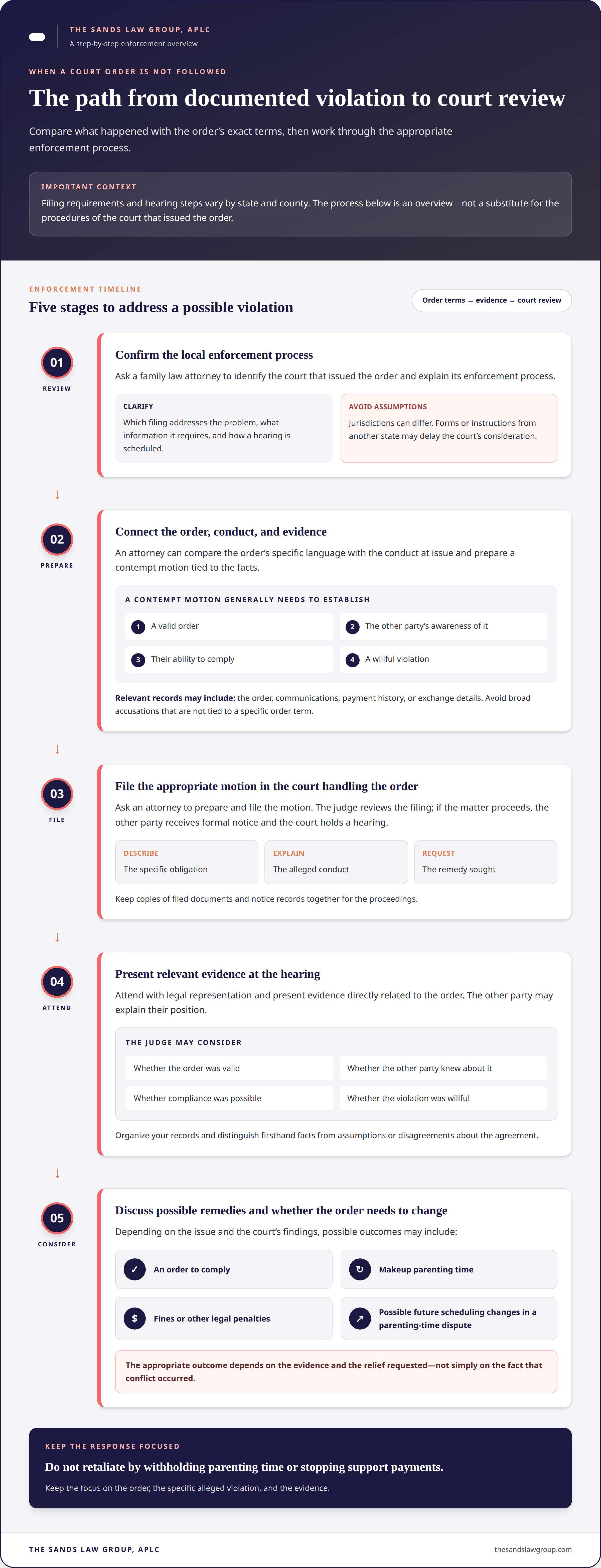
Compare the conduct with the order’s exact terms, then consider whether enforcement or a request to change the order is appropriate. Court procedures vary by state and county, including filing requirements and hearing steps, so don’t assume one jurisdiction’s process applies everywhere.
-
Review Family Court Enforcement Procedures With an Attorney
Ask a family law attorney to identify the court that issued the order and explain its enforcement process. Find out which filing addresses the problem, what information it requires, and how a hearing is scheduled. Procedures can differ between jurisdictions, even in similar parenting-time disputes. Using forms or instructions from another state may delay the court’s consideration.
-
Have an Attorney Prepare a Contempt Motion and Evidence
Have an attorney compare the order’s specific language with the conduct at issue. A contempt motion generally needs to establish a valid order, the other party’s awareness of it, their ability to comply, and a willful violation. Gather records relevant to each point, such as the order, communications, payment history, or exchange details. Avoid broad accusations that aren’t tied to a specific order term.
-
Have an Attorney File a Motion for Contempt
Ask an attorney to prepare and file the appropriate motion in the court handling the order. The judge reviews the filing. If the matter proceeds, the other party receives formal notice and the court holds a hearing. Describe the specific obligation, the alleged conduct, and the remedy requested. Keep copies of filed documents and notice records together for the proceedings.
-
Attend the Contempt Hearing With Legal Representation
Attend the hearing with your attorney and present evidence directly related to the order. The judge may consider whether the order was valid, whether the other party knew about it, whether compliance was possible, and whether the violation was willful. The other party may explain their position. Organize your records and distinguish firsthand facts from assumptions or disagreements about the agreement.
- Discuss possible remedies and whether the order needs to be modified with your attorney. Depending on the issue and the court’s findings, the court may order compliance, makeup parenting time, fines, or other legal penalties. A parenting-time dispute may also lead to changes in future scheduling. The appropriate outcome depends on the evidence and relief requested, not simply on the fact that conflict occurred.
Documenting violations
Create a factual record linking each event to a specific term in the order. Dates, times, locations, and preserved communications can make later review clearer.
-
Preserve Evidence of Violations With Legal Guidance
Save a copy of the current court order and preserve relevant messages, voicemails, and social media communications. Keep original files when possible and store copies securely. Note when you received each item and which order term it relates to. Don’t edit messages or rely only on memory. An attorney can assess whether the records support an enforcement request.
-
Document Parenting-Time Violations With Legal Guidance
For each missed exchange, record the scheduled date and time, the location, and what happened. Note whether the child was unavailable, returned late, or kept beyond the time specified in the parenting schedule. Preserve related texts and voicemails, including messages about delays or proposed changes. Record each incident separately so recurring conduct is clear rather than blended into one account.
-
Document Custody-Order Violations With Legal Guidance
Compare the custody order’s language with the decision or action at issue. If the order assigns responsibility for a school or medical decision, record what was decided, when it happened, and any related communications. Save the relevant order page with supporting messages. Avoid guessing about motive. Document observable facts so an attorney can distinguish a possible breach from a disagreement about interpretation.
- Organize financial and property records separately from parenting evidence. For missed child or spousal support payments, keep payment records and compare each missed or partial payment with the order’s terms. If an awarded property transfer did not happen, keep the relevant provision with transfer documents or messages showing its status. Separate records make clear which obligation needs attention and help prevent unrelated disputes from obscuring the issue.
- Prepare a concise incident log with one entry for each event. Include the date, time, location, order provision, what happened, and the evidence saved. For example, distinguish a missed exchange from a disagreement over a proposed schedule change. Before presenting the log, have an attorney review whether each item supports the issue. You can discuss organizing custody-violation evidence with legal counsel.
What Does “Violating A Custody Order” Mean Specifically?
A violation occurs when a parent fails to follow a requirement in a divorce or family court order. There is no single nationwide filing deadline. The time to act depends on the issue and applicable California procedures, so seek legal advice promptly from professionals like The Sands Law Group, APLC.
-
Identify the Type of Order Violation
Compare the conduct with the order’s exact terms and identify the obligation involved. Examples include denied visitation, unpaid child or spousal support, or failure to transfer property awarded in a divorce. Record the provision and the action that conflicts with it. Don’t treat every tense exchange as a violation. The order must address the disputed obligation.
-
Determine What Counts as a Custody Violation
Review whether the order clearly states the parent’s rights and responsibilities. A missed exchange or refusing to return a child at the agreed time may breach parenting-time terms. A parent making a major decision assigned to the other parent may raise a legal-custody issue. Under California law, clear mandatory language in your custody order can support enforcement.
-
Consult Legal Counsel on Enforcement Options
Ask an attorney at The Sands Law Group, APLC to assess whether enforcement or clarification is the appropriate next action. In California family courts, a Request for Order regarding domestic violence or custody contempt may seek compliance. For a filing, identify the exact term, the conduct at issue, and the remedy sought.
-
Consider Modification Versus Enforcement
Consider whether the order needs to change, rather than simply be enforced. A court may modify custody arrangements after a violation, and parenting-time changes can depend on the circumstances and governing California law. A parenting-time modification generally requires showing that a change serves the best interests of the child. An attorney can explain whether the facts support a motion or another approach.
-
Address Immediate Safety Concerns
Take immediate safety concerns seriously and distinguish them from ordinary scheduling disputes. When an ex-spouse fails to follow custody or visitation orders, or when reasonable cause exists to believe the child is in danger, California law allows for expedited relief. If you believe a child is in immediate danger or don’t know the child’s whereabouts, contact local law enforcement promptly and consult your attorney.
-
Plan Your Next Steps with a Consultation
Use a consultation to plan your next step when the order’s meaning, enforcement process, or requested change is unclear. Bring the relevant order and records tied to the disputed term. For example, a parenting-time request should distinguish missed exchanges from disagreements over legal decision-making. That distinction keeps the request focused on the rights and issue before the court.
Preventing future violations through communication and recordkeeping
Clear communication may resolve a minor misunderstanding, while consistent records help show whether an order is being followed. Keep the court’s written terms central, especially when parenting schedules or payments are involved.
-
Get Legal Guidance on Communicating About Noncompliance
Consider the nature of the violation before contacting your ex-spouse. If a minor, one-time issue arises and communication is safe, send a written request that identifies the order term and asks for a practical remedy. For repeated or serious conduct, consult an attorney before responding. Avoid threats or arguments about penalties, which can distract from the specific obligation.
-
Keep Communication in Writing With Legal Guidance
Use a written message to address a concrete issue, such as confirming an exchange time or requesting a missed payment. State the relevant date, the order requirement, and the action needed, without accusations or unrelated grievances. Save the message and any reply with the related order records. If your ex refuses to communicate safely or the situation feels threatening, don’t approach them alone.
- Keep problem-solving separate from the record of what happened. For example, if a parent misses a scheduled pickup, keep the message about that missed exchange distinct from a later proposal to adjust the schedule. This helps show whether you reached an agreement or whether the original order still governs. Don’t assume a casual conversation changes written court terms.
- Keep each request specific and limited to the issue. For a late support payment, identify the payment and ask when it will be made. For a missed exchange, state the date and the parenting-time term involved. Avoid broad statements such as “you never comply.” A precise message is easier to understand and preserves a useful record if enforcement becomes necessary.
- Track whether the proposed remedy resolves the problem. Note when your ex responds, any agreed action, and whether it happens. If an agreement restores a missed exchange or addresses a delayed payment, retain written confirmation. If the same problem continues, the record can help an attorney distinguish a resolved misunderstanding from an ongoing pattern.
- Choose communication that protects the children from adult conflict. Keep scheduling messages focused on their exchange, school, or care needs, rather than asking them to deliver messages between parents. When cooperation is safe and realistic, a calm written request may help the parties comply without court action. If you need guidance on a recurring custody or support dispute, arrange a legal discussion.
Common family court order violations
Family court orders can address parenting, support, insurance, property, and use of a home. To understand what to do if an ex-spouse violates a court order, identify the specific obligation first, then consider whether enforcement or modification is appropriate.
- Compare the concern with the order’s actual terms. Common examples include missed parenting time, unpaid child or spousal support, failure to provide required health insurance, and failure to transfer property awarded in the divorce. A disagreement alone may not establish noncompliance. Focus on what the order requires and what happened instead.
- Separate parenting-time issues from legal-custody decisions. A parent who refuses an ordered exchange may interfere with visitation, while making a major decision assigned to the other parent may raise a different concern. Check whether the order gives one parent decision-making authority about education or health care, then compare that language with the decision made.
- Review financial and property obligations separately. A missed support payment, failure to sell marital property as ordered, or refusal to leave the marital home may involve different provisions and evidence. A job loss or other financial change may affect a person’s ability to pay support. An attorney can assess the circumstances alongside the payment record and order language.
- Ask a family law attorney to assess whether enforcement or modification better addresses the problem. Enforcement seeks compliance with an existing order; modification asks the family court to change its terms. Recurring exchange problems may call for reviewing the parenting schedule, while an unpaid amount may require a request focused on payment. The facts and desired outcome shape the legal approach.
- Consider whether the conduct affects a child’s stability or safety. Repeatedly disrupting exchanges, withholding a child, or making unilateral decisions can create problems beyond a single missed appointment. Keep the focus on the order and the child’s needs, not on using parenting time to retaliate over unpaid support. A lawyer can help evaluate the evidence and appropriate next step.
- For a dispute involving parentage or unclear legal rights, a paternity action may help establish the legal framework for custody and support issues. Understanding what to do if an ex-spouse violates a court order also means choosing a response suited to the specific obligation. For other family law concerns, discuss your court-order enforcement options with a family law attorney. A focused review can clarify whether enforcement, modification, or another family court request fits the facts.
The Sands Law Group, APLC
The Sands Law Group, APLC helps people address family court order disputes through legal representation focused on the order, the documented conduct, and the relief sought. When a violation involves parenting time, custody, support, or property division, an attorney can assess whether enforcement or a request to modify the order fits the circumstances. This guidance can help you present the issue clearly and understand the legal steps ahead, without escalating conflict with your former spouse.
If you’re ready to discuss your situation, contact The Sands Law Group, APLC.
Choose a Clear Path Forward
Deciding what to do if your ex-spouse violates a court order is not only about responding to past conduct. It can also mean seeking a workable path that supports your family’s stability and clarifies expectations. Consider which outcome matters most, such as consistent parenting time, compliance with support obligations, or resolution of a divorce-related dispute. A focused legal strategy can keep that priority central rather than letting conflict drive each decision.
The Sands Law Group, APLC provides divorce, child custody and visitation, and spousal support legal representation. If you want counsel to assess your circumstances and explain possible next steps, schedule a conversation with The Sands Law Group, APLC.
A thoughtful next move can help replace uncertainty with a clearer plan. You deserve guidance that treats your family’s concerns with care and seriousness.
Frequently Asked Questions
What is a Rule to Show Cause?
A Rule to Show Cause asks a court to examine alleged noncompliance with an order. In an Illinois family law case, it is filed with the court and sent to the other spouse, followed by a hearing about compliance and possible remedies. The filing should identify the specific order terms at issue. This information is for general informational purposes only and does not constitute legal advice.
How Will the Court Decide?
The court considers the order’s terms, the evidence of noncompliance, and the responding party’s explanation. In Illinois, the person raising the issue must show that an order existed and was not followed; the judge also considers whether there was a reason for refusing compliance. Messages, payment records, or exchange details may help explain the events. A hearing gives the other party an opportunity to respond.
What Are Common Violations?
Common violations include missed parenting time, unpaid child or spousal support, failure to provide health insurance, and failure to transfer property as ordered. A parent may also interfere with the other parent’s decision-making authority, such as making a child-related decision assigned to the other parent. The key question is whether the conduct conflicts with a specific requirement, not simply whether former spouses disagree.
What Can I Do if My Ex-Spouse Refuses to Pay Child Support?
Keep a record of missed or partial payments and compare them with the support order. You can seek enforcement through the court rather than withholding parenting time in response; support and visitation obligations should be addressed separately. In Illinois, child support orders can be enforced through wage withholding, and additional tools may apply when delinquency is substantial. A change in financial circumstances may support seeking a modification.
What Happens if My Spouse Violates the Divorce Decree?
A court may be asked to enforce the decree or address an alleged violation at a hearing. The appropriate process depends on the provision involved, such as support, parenting time, or property transfer. The judge may consider the order’s wording, evidence of noncompliance, and the other spouse’s explanation. For a property obligation, precise language describing what must be transferred can matter when seeking contempt enforcement.
What Is Indirect Civil Contempt in Illinois Family Law?
Indirect civil contempt in Illinois concerns conduct outside the courtroom and is intended to obtain compliance with a court order. A person held in contempt may purge the contempt by completing the required action. For example, the court may require compliance with an order rather than impose a fixed punishment. This differs from indirect criminal contempt, which involves a fixed jail term intended to punish a violation.
What Remedies Can the Court Implement?
Depending on the issue and applicable law, a court may order compliance, makeup parenting time, a schedule adjustment, fines, attorney fees, or other sanctions. In some circumstances, contempt can involve jail time. Illinois courts may also use wage garnishment or property liens to address noncompliance. The remedy relates to the obligation at issue, so a support dispute and a denied-visitation dispute may require different requests.
What Should I Do if My Ex Is Interfering With My Parenting Time?
Put the child’s safety first, then identify the parenting-time provision affected and preserve relevant communications. If you believe your child is in danger or don’t know the child’s whereabouts, contact police immediately. Otherwise, consider asking the court to address repeated interference, which may include makeup time or changes to future arrangements. The Sands Law Group, APLC represents clients in Los Angeles, Riverside, San Bernardino, and Kern in family law matters. This information is for general informational purposes only and does not constitute legal advice.

Article by
Thomas D. Sands, Esq.
Thomas D. Sands is the founder and CEO of The Sands Law Group, APLC. A California attorney with more than two decades of experience, he represents clients in divorce and family law matters as well as civil litigation and real property disputes. His approach emphasizes attentive, practical, and cost-conscious representation.
Sands is a 2023 Litigator of the Year honoree of the American Institute of Trial Lawyers and a 2023 Lawyer of the Year honoree of the American Institute of Legal Professionals. His firm has also received recognition among the 2025 Best Law Firms in America, a 2026 Benchmark Best of award, and a 2026 Law Firm of the Year honor.

Article reviewed by
Thomas D. Sands, Esq.
Thomas D. Sands is the founder and CEO of The Sands Law Group, APLC. A California attorney with more than two decades of experience, he represents clients in divorce and family law matters as well as civil litigation and real property disputes. His approach emphasizes attentive, practical, and cost-conscious representation.
Sands is a 2023 Litigator of the Year honoree of the American Institute of Trial Lawyers and a 2023 Lawyer of the Year honoree of the American Institute of Legal Professionals. His firm has also received recognition among the 2025 Best Law Firms in America, a 2026 Benchmark Best of award, and a 2026 Law Firm of the Year honor.
TOLL-FREE: 855-SANDS4U