
You can file for divorce in Kern County without hiring a lawyer, but you must complete the required court forms, serve your spouse, and follow the court process. If you’re learning how to file for divorce in Kern County, know that the petition filing fee is $435, and eligible people may request a fee waiver. The right path depends in part on whether you and your spouse agree and whether you have children or need decisions about property or support.
It’s understandable to wonder whether you can handle the paperwork yourself. This guide explains the steps, forms, costs, and process for filing for divorce in Kern County without a lawyer, including where careful preparation matters. It also covers when contested issues may call for legal representation, so you can better understand what lies ahead.
Key Takeaways
- Map the filing process from choosing the right petition to serving your spouse and submitting the required paperwork.
- Budget for the $435 petition filing fee, and learn when a court fee waiver may be an option.
- Identify the California and Kern County forms that apply to your situation, including cases involving children or an agreed filing.
- Understand the financial disclosures required in divorce and what self-representation involves.
- Check the residency requirement with California Courts and consider how custody, support, or property disputes may affect your next steps.
Can I get the Kern County filing fee waived?
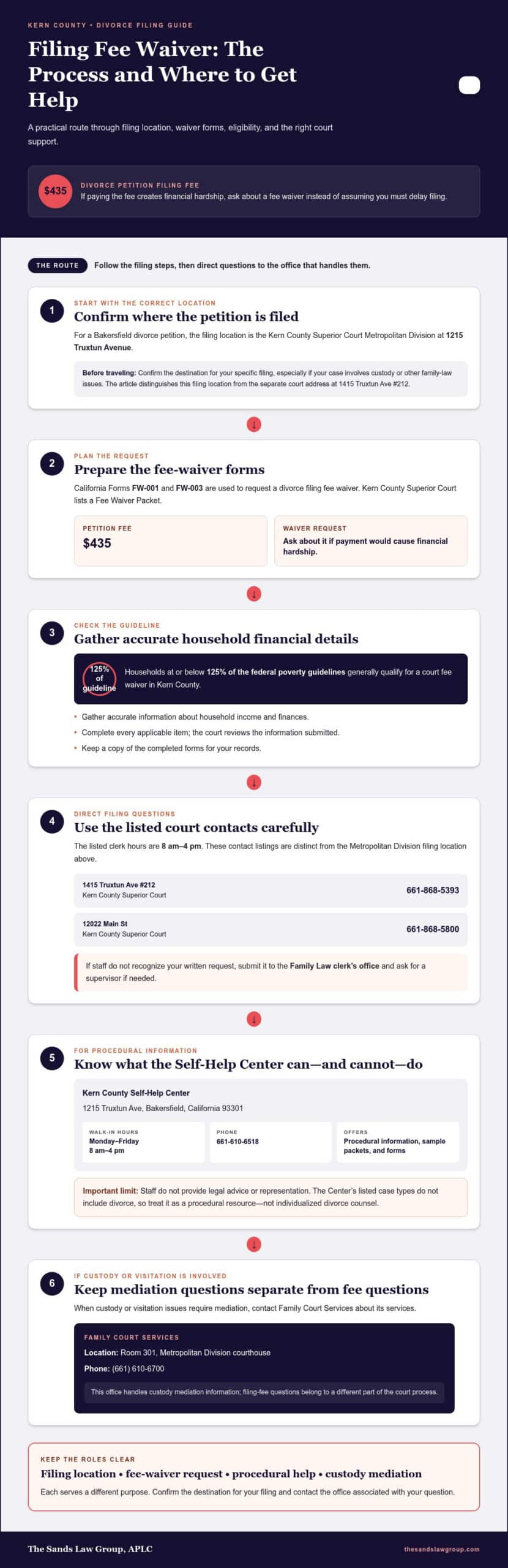
- Identify the correct filing location. For a Bakersfield divorce petition, use the Kern County Superior Court Metropolitan Division at 1215 Truxtun Avenue. This is the courthouse location for filing, not the separate address listed for the court at 1415 Truxtun Ave #212. Confirm the destination for your specific filing before traveling, especially if your case involves custody or other family-law issues.
- Plan how you’ll submit the petition and fee-waiver request. The divorce petition filing fee is $435. If paying it creates financial hardship, ask about a fee waiver rather than assuming you must delay filing. The Kern County Superior Court lists a Fee Waiver Packet revised July 27, 2026. California forms FW-001 and FW-003 are used to request a divorce filing fee waiver.
- Review the financial eligibility guideline. Households at or below 125% of the federal poverty guidelines generally qualify for a court fee waiver in Kern County. Gather accurate information about household income and finances before completing the request. The court reviews the submitted information, so complete every applicable item and keep a copy of your forms for your records.
- Use the right court contact for filing questions. The listed clerk hours are 8am-4pm. The Kern County Superior Court at 1415 Truxtun Ave #212 can be reached at 661-868-5393; the court at 12022 Main St can be reached at 661-868-5800. If staff don’t recognize your written request, submit it to the Family Law clerk’s office and ask for a supervisor if needed.
- Use self-help services for procedural information. The Kern County Self-Help Center is at 1215 Truxtun Ave, Bakersfield, California 93301. It offers walk-in help Monday through Friday from 8 am to 4 pm and can be reached at 661-610-6518. Staff provide procedural information, sample packets, and forms, but not legal advice or representation. Its listed case types do not include divorce, so treat it as a procedural resource, not individualized divorce counsel.
- Contact Family Court Services about custody mediation. When custody or visitation issues require mediation, Family Court Services is in Room 301 at the Metropolitan Division courthouse. Call (661) 610-6700 for information about its services. Keep mediation questions separate from filing-fee questions; these offices handle different parts of the family-court process.
How much does a divorce cost in Kern County?
Start by separating the court filing fee from other expenses, then identify the forms your case requires. California Family Code § 2550 requires courts to divide community property equally; debts, custody, and support need separate consideration.
-
Review Filing Fees and Costs
Confirm the court fee before filing: a Kern County divorce petition costs $435. California’s 2026 Joint Petition option lets agreeing spouses file together for a single $435 fee under Senate Bill 1427. Account for the filing fee separately from other expenses, such as preparing documents or serving papers. A fee waiver may be available if you qualify, as explained above.
-
Consider Property, Custody, and Support Rules
List property and debts before deciding what terms to request. Under California Family Code § 2550, courts divide community property equally. Don’t assume this rule automatically resolves every debt, custody question, or support issue. Identify each concern separately, including parenting arrangements and financial needs, so your petition and proposed resolution address the issues actually affecting your family.
- Prepare the petition and summons. Use California Form FL-100, the Petition for Dissolution, to begin a divorce case. Prepare Form FL-110, the Family Law Summons, as part of the initial filing. Check that names, case details, and requested orders are consistent across the forms. Missing or conflicting information can require corrections and delay progress.
- Address service and response. After filing, arrange proper service of the papers on your spouse and retain proof. Form FL-115 is the Proof of Service filed after service. If your spouse filed the petition, prepare a response rather than leaving it unanswered. Kern County lists a Response to Dissolution Packet, which can help identify the forms involved.
- Check form instructions and filing readiness. Compare your completed documents with Kern County Superior Court’s current packets and filing instructions. Confirm that every required signature, attachment, and supporting document is included before submission. The court’s Self-Help Center offers procedural information and sample packets, but it doesn’t provide legal advice or representation. For complicated property or parenting questions, consider discussing your divorce filing questions with an attorney.
California divorce forms and Kern County local forms
Use California forms for the core divorce case, then add any Kern County forms that apply to your circumstances. Check each form’s revision date and case type before filing.
-
Complete California Divorce Forms
Start with Form FL-100, the Petition for Dissolution, and Form FL-110, the Family Law Summons. Together, they identify the marriage and open the divorce case. If property details need a separate schedule, Form FL-142 lists assets and debts. Read each form’s instructions, answer every applicable question, and keep names consistent throughout the packet.
- Prepare financial disclosure forms. Financial disclosures help document income, expenses, assets, and debts. California Form FL-140 is the Declaration of Disclosure, while Form FL-150 is the Income & Expense Declaration. Form FL-160 is the Property Declaration. Kern County lists its Declaration of Disclosures Packet, revised January 15, 2025, and a sample packet revised March 20, 2025.
-
Use Kern County Local Forms
Select the local packet that matches your case rather than relying on a generic set. Kern County lists a Dissolution of Marriage with Minors Form, revised July 27, 2026, and a Dissolution of Marriage without Minors Packet, revised January 15, 2025. It also lists a Joint Petition for Dissolution or Legal Separation, revised July 27, 2026. Check the packet’s title and revision date before completing it.
-
Prepare Proof of Service Forms
After your spouse receives the filed papers, complete Form FL-115, the Proof of Service. Kern County also lists an Information Sheet for Proof of Personal Service, revised January 16, 2025. Match the proof to the way service occurred, and make sure the completed document identifies the papers served. Keep copies of the filed petition, summons, and proof together for your records.
- Choose the correct response or default packet. If you received a petition, Kern County lists a Response to Dissolution Packet, revised July 27, 2026. If the case proceeds without a response, the court lists a Dissolution Default Packet with the same revision date. Use the packet that fits the case’s status; default paperwork is not a substitute for responding when you intend to contest requested terms.
- Prepare the final judgment documents. Form FL-180 is the Judgment used to finalize a California divorce, and Form FL-190 is the Notice of Entry of Judgment. Kern County lists its Judgment form, revised January 16, 2025. If you have reached a settlement, ensure the judgment documents reflect the terms you want the court to approve and include the required supporting paperwork.
Can You Really Divorce Without a Lawyer in Bakersfield, CA?
Yes, you can represent yourself, but the paperwork requires careful attention. Common risks include incomplete financial disclosures, missed procedural steps, and settlement terms that overlook important rights.
-
Prepare Mandatory Financial Disclosures
Gather accurate records before completing your disclosures. Kern County divorcing spouses must exchange preliminary financial disclosures, including Forms FL-140, FL-142, and FL-150. Form FL-140 is the Declaration of Disclosure, FL-142 lists assets and debts, and FL-150 reports income and expenses. Compare each entry against your records, and correct inconsistencies before exchanging the paperwork.
- Match each form to the financial information it requests. Use FL-142 to organize property and debts, then review FL-150 for income and expenses. Form FL-160 is the Property Declaration and may also be relevant to the financial information in your case. Kern County lists a Declaration of Disclosures Packet revised January 15, 2025, plus a sample packet revised March 20, 2025.
- Complete and exchange disclosures carefully. Treat financial disclosure as a separate task from filing the petition. Review the schedules for omissions, inconsistent amounts, and property held in different names. A proposed agreement should reflect the financial information exchanged, rather than assumptions or incomplete paperwork. Keep copies of the forms and supporting records in an organized file.
-
Avoid Common Filing Mistakes and Risks
Check every form against the current Kern County packet, and confirm that your proposed agreement addresses the issues you intend to resolve. Incomplete disclosures or unclear settlement language can leave property, debt, or support questions unsettled. For legal separation, use forms and terms suited to that proceeding rather than assuming every divorce document applies unchanged.
- Assess whether self-representation fits the dispute. A straightforward case with complete financial records and agreement on key terms may be easier to manage than one involving contested property, support, or parenting issues. If you and your spouse disagree about custody or financial rights, identify each disputed issue before signing anything. Unclear terms can have consequences beyond the initial filing.
- Use self-help resources for procedure, not legal advice. The Kern County Superior Court Self-Help Center provides procedural information, sample packets, and forms for various cases. Its staff don’t provide legal advice or representation, and communications with staff aren’t privileged. Use these resources to understand paperwork and filing steps, while treating decisions about your rights and settlement terms as separate legal questions.
Kern County divorce procedures
To understand how to file for divorce in Kern County, start by checking residency requirements and following the court’s filing sequence. Local procedures also affect how you submit paperwork, serve your spouse, and complete the case.
- Confirm residency before filing. To file for divorce in California, either spouse must have lived in their current California county for the past 3 months, according to California Courts. Either spouse must also have lived in California for the past 6 months. A practical first step in how to file for divorce in Kern County is confirming that the county requirement is met. If not, legal separation has no residency requirement.
- Choose the appropriate filing route. Kern County distinguishes between represented parties and people representing themselves. Self-represented litigants aren’t required to e-file. Follow the court’s filing instructions for your case, and prepare legible, complete documents. Before submitting, make sure each attachment belongs with the petition and protect personal identifiers in filed paperwork.
- File the petition and summons. Submit the divorce petition and summons to open your case. Keep copies of the filed documents and note the case number for later submissions. If filing electronically, Kern County guidance states an e-filing envelope has a 50 megabyte size limit. Under CCP 1010.6, a filing received on a non-court day is deemed received on the next court day.
- Arrange proper service on your spouse. The filing spouse must arrange service of the filed papers and retain proof for the court. A friend or family member serving divorce papers must be over 18. Don’t serve the papers yourself. After delivery, complete and file proof of service so the court can document that the other spouse received notice.
- Address children and safety concerns in the paperwork. If your case involves minor children, include the UCCJEA declaration and child custody and visitation application attachment. These documents identify child-related issues for the court. If domestic violence affects safety or communication, consider the risks before arranging service or discussing terms directly with your spouse.
- Track responses, settlement, and timing. A spouse who receives the petition can file a response; failure to respond may lead to a default judgment. California has a mandatory six-month waiting period, according to the California Legislature. A settlement agreement must meet court requirements for approval, and Kern County requires specific documents rather than a default-with-agreement procedure. Knowing how to file for divorce in Kern County means tracking each required stage, not just submitting the initial petition.
- Prepare the case for final judgment. Review the proposed judgment against the petition, financial disclosures, and settlement terms. Confirm that custody, support, and property division requests are addressed clearly, then submit the required final documents. If you need guidance about Kern County procedures or disputed terms, schedule a discussion about your divorce case.
The Sands Law Group, APLC: Divorce Legal Representation
The Sands Law Group, APLC provides divorce representation in contested and uncontested proceedings. If decisions about parenting, financial support, or property division remain unresolved, an attorney can help you understand the issues and prepare for the next steps. The firm also represents clients in child custody and visitation, spousal support, and property division matters.
Consider seeking representation when you and your spouse disagree about a settlement, need to address custody or support, or feel uncertain about protecting your rights during the case. You can contact The Sands Law Group, APLC or visit thesandslawgroup.com to discuss your situation.
Choose the Next Step That Protects Your Priorities
Once you understand how to file for divorce in Kern County, focus on decisions that will shape life after the case: parenting arrangements, financial support, and a workable division of property. You don’t have to resolve every concern at once. Write down your questions, the outcomes that matter most, and any points where you and your spouse disagree. This can help you prepare for a focused conversation and make your next decision with greater clarity.
The Sands Law Group, APLC offers Divorce Legal Representation, along with Child Custody and Visitation Representation and Spousal Support Representation. If you would like guidance on how those issues apply to your circumstances, contact The Sands Law Group, APLC to discuss your situation. Taking a considered next step can help you approach this transition with greater confidence.
Frequently Asked Questions
How long will it take?
An uncontested divorce in Bakersfield typically takes 6-8 months, while litigated cases may take a few years. California also has a mandatory six-month waiting period, according to the California Legislature. The actual timeline depends on whether the spouses agree, how quickly required documents are completed, and whether the court must resolve disputed issues. A cooperative settlement can reduce disputes, but it doesn’t remove the statutory waiting period.
What Happens if You Don’t File a Response?
If you don’t respond to a divorce petition, your spouse may seek a default judgment. The case may proceed without your participation, and the court may decide based on the requests in the petition and documents filed. For example, you could lose the opportunity to formally contest proposed terms about property or support. Read the papers you were served and note any response deadline stated in them.
What are the residency requirements to file in Kern County?
For a Kern County divorce, either spouse must have lived in California for the past 6 months and in the current California county for the past 3 months. The county requirement matters if you recently moved within California. For example, a person who moved to Kern County may need to wait until meeting the county residency period before filing for divorce there. Legal separation has no residency requirement.
What are the residency requirements to file for divorce in Kern County, California?
California requires one spouse to meet both residency periods: 6 months in the state and 3 months in the county where the case is filed. The requirement concerns the filing spouse’s residence, not necessarily both spouses’ addresses. If neither spouse meets the California residency rule, a legal separation case may be filed instead, then later amended to request divorce after residency requirements are met.
Which Kern County court handles divorce filings, and where is the family law courthouse?
Bakersfield divorce petitions are filed at the Kern County Superior Court Metropolitan Division, 1215 Truxtun Avenue. Family Court Services, which handles mediation related to custody and visitation, is in Room 301 at that courthouse. For mediation information, call (661) 610-6700. The court lists clerk hours as 8am-4pm, so plan courthouse visits around those hours and bring your case information when asking about a filing.
What forms are required to start a divorce in California, and where can I get them?
Start with Form FL-100, the Petition for Dissolution, and Form FL-110, the Family Law Summons. Kern County Superior Court publishes local dissolution packets and sample forms, which can help identify documents for cases with or without children. This article provides general information only, not legal advice. The Sands Law Group, APLC serves Kern, Los Angeles, Riverside, and San Bernardino counties; contacting the firm doesn’t create an attorney-client relationship until a formal agreement is signed.
How do I file and serve divorce papers in Kern County?
File the completed petition and summons with Kern County Superior Court, then have someone else serve the filed papers on your spouse. A friend or family member who serves papers must be over 18. After service, file the proof of service with the court. Represented parties in Kern County Family Law cases must e-file, while self-represented litigants aren’t required to use e-filing.
What is the divorce filing fee in Kern County, and how can I request a fee waiver?
The divorce petition filing fee is $435. To request a waiver, use California Forms FW-001 and FW-003 and provide the required financial information. Households at or below 125% of the federal poverty guidelines generally qualify for a waiver in Kern County. The Kern County Superior Court lists a Fee Waiver Packet revised July 27, 2026. Keep copies of your request and supporting documents for your records.

Article by
Thomas D. Sands, Esq.
Thomas D. Sands is the founder and CEO of The Sands Law Group, APLC. A California attorney with more than two decades of experience, he represents clients in divorce and family law matters as well as civil litigation and real property disputes. His approach emphasizes attentive, practical, and cost-conscious representation.
Sands is a 2023 Litigator of the Year honoree of the American Institute of Trial Lawyers and a 2023 Lawyer of the Year honoree of the American Institute of Legal Professionals. His firm has also received recognition among the 2025 Best Law Firms in America, a 2026 Benchmark Best of award, and a 2026 Law Firm of the Year honor.
Article reviewed by
Thomas D. Sands, Esq.
Thomas D. Sands is the founder and CEO of The Sands Law Group, APLC. A California attorney with more than two decades of experience, he represents clients in divorce and family law matters as well as civil litigation and real property disputes. His approach emphasizes attentive, practical, and cost-conscious representation.
Sands is a 2023 Litigator of the Year honoree of the American Institute of Trial Lawyers and a 2023 Lawyer of the Year honoree of the American Institute of Legal Professionals. His firm has also received recognition among the 2025 Best Law Firms in America, a 2026 Benchmark Best of award, and a 2026 Law Firm of the Year honor.
TOLL-FREE: 855-SANDS4U