
A divorce doesn’t erase the years you spent caring for your family. Stay-at-home mom divorce rights in California include a claim to marital property and consideration of caregiving’s effect on a spouse’s career when support is decided. Under community property law, debt is usually divided 50/50, and for marriages lasting less than 10 years, spousal support often lasts half the length of the marriage, according to California Courts.
It’s understandable to worry about supporting yourself and your children when your income has been limited or paused. In California, courts consider factors such as each spouse’s earning capacity, the marital standard of living, and how caring for children affected a spouse’s work prospects. Custody decisions focus on the child’s best interests, and a stay-at-home parent awarded custody is generally eligible for child support.
This guide explains how to organize information about property and debts, prepare for custody discussions, and understand spousal support and financial self-sufficiency. It also describes records that can help you clarify the issues involved in a divorce and plan for greater stability afterward.
Key Takeaways
- Gather records of assets, debts, and when they were acquired to prepare for property division.
- If you’re seeking custody, organize a proposed parenting plan, activity calendar, expense log, and relevant messages.
- A parent awarded custody is generally eligible for child support; custody decisions focus on the child’s best interests.
- Spousal support depends on factors such as each spouse’s income, earning capacity, marital standard of living, and caregiving responsibilities. According to California Courts, for marriages lasting less than 10 years, support often lasts half the length of the marriage.
- Plan for financial independence by considering employment, education, or training, and keeping a clear picture of your income, expenses, and resources.
What property is a SAHM entitled to?
Moving out can disrupt a child’s routine and complicate discussions about parenting time. Relocating with children may also prompt disagreement about schedules, school, and continued contact. Before making plans, document the proposed arrangements and the practical effect on the child’s routine.
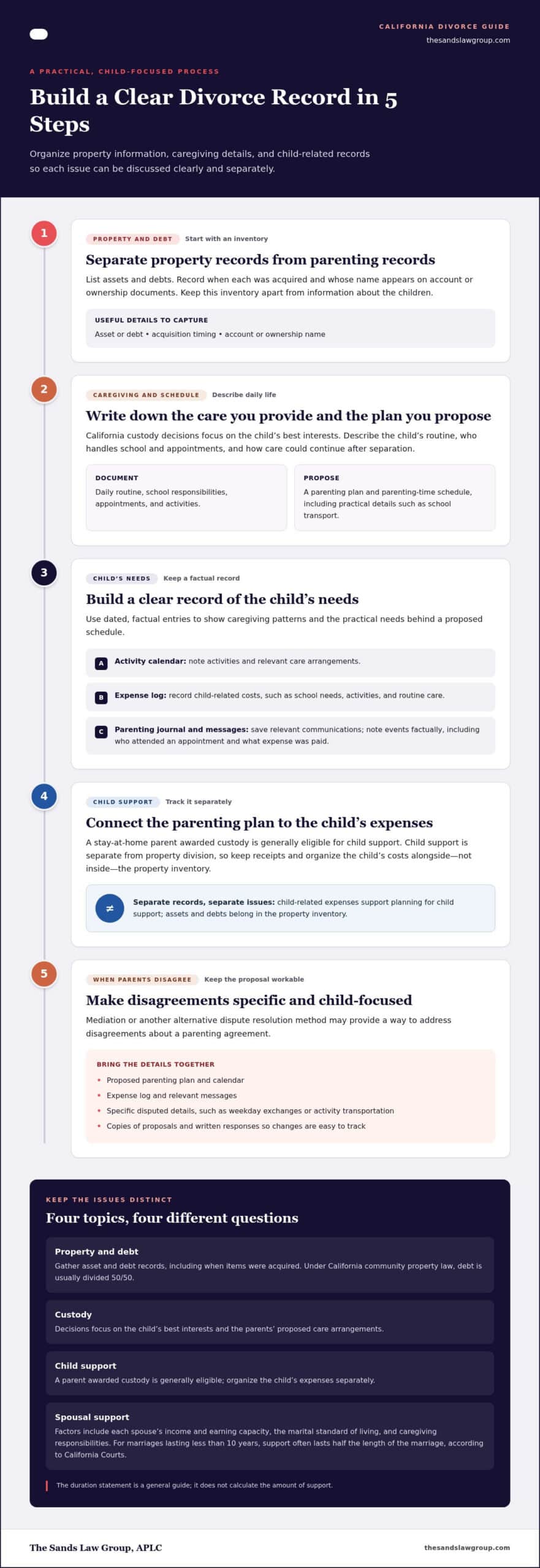
- Separate the property question from parenting and support. A stay-at-home parent’s role does not determine every aspect of property division. Inventory assets and debts, recording when each was acquired and whose name appears on account or ownership documents. Keep this list separate from records about the children. That makes it easier to prepare for property discussions while also tracking custody and support needs.
- Write down the care you provide and the schedule you propose. California courts prioritize the child’s best interests when considering custody. Describe the child’s daily routine, who handles school and appointments, and how care could continue after separation. Set out a proposed parenting plan and parenting-time schedule. For example, identify who would take the child to school and manage an existing activity.
- Build a clear record of the child’s needs. Keep an activity calendar, a log of child-related expenses, and a parenting journal. Save relevant messages with the other parent, including discussions about care arrangements. Use dated, factual entries rather than conclusions. For example, note an appointment, who attended, and the expense paid. These records can help describe caregiving patterns and the proposed schedule.
- Understand how custody connects to child support. A stay-at-home parent awarded custody is generally eligible for child support. Child support is separate from property division, so include the child’s expenses in your planning. Keep receipts and organize costs such as school needs, activities, and routine care. A clear expense log provides a practical record to discuss alongside the parenting schedule.
- Address disagreements with a workable proposal. If you and the other parent disagree about a parenting agreement, mediation or another alternative dispute resolution method may provide a way to address the disagreement. Organize your proposed plan, calendar, expense log, and relevant messages. Identify disputed details, such as weekday exchanges or activity transportation, and set out a child-focused proposal. Keep copies of proposals and written responses so changes are easy to track.
What type of custody will a stay-at-home mom get?
California custody decisions focus on the child’s best interests, not a parent’s job title. A mother who was the primary caregiver and can show a stable, nurturing home may have relevant caregiving history when seeking primary physical custody. The court considers the child’s needs and each parent’s proposed care arrangement.
- Prepare a child-focused custody proposal. Describe how the child’s daily needs will be met, including school, health appointments, and activities. Explain how each parent can maintain a meaningful relationship with the child. Specific plans are more useful than broad claims about which parent deserves custody.
- Document caregiving and career contributions. Record how your care enabled your spouse to pursue education, training, or career advancement. Include practical examples, such as managing childcare while your spouse attended classes or took on work responsibilities. California courts may consider how childcare affected either parent’s career and how returning to work could affect the children when assessing spousal support.
- Keep child support and spousal support distinct. Child support addresses children’s financial needs, while spousal support addresses a spouse’s transition after divorce. A parent awarded custody is generally eligible for child support. Spousal support depends on factors including each spouse’s income, earning capacity, and the marital standard of living.
- Account for the marriage’s duration. For marriages lasting less than 10 years, spousal support often lasts half the length of the marriage, according to California Courts. This is a general duration guide, not a calculation of the support amount. Document caregiving and career sacrifices when explaining the financial transition.
- Respond to difficult or controlling conduct with records. “Narcissistic spouse” is not a custody category. Focus on specific behavior affecting the child or parenting, such as missed exchanges, threatening messages, or failure to follow an agreed schedule. Preserve dated communications and keep descriptions factual. A consistent record distinguishes documented events from labels or accusations.
- Ask about temporary financial and parenting arrangements. A stay-at-home parent can request temporary orders addressing custody, parenting time, child support, or spousal support while a divorce proceeds. Identify the immediate need and organize relevant financial and caregiving records. A spouse can also request attorney fees and court costs. Income, expenses, and available financial resources are relevant to that request.
- Understand the starting steps and available assistance. A California divorce generally begins with preparing and filing divorce papers and ensuring the other spouse receives them. Filing costs depend on the court and circumstances; fee waiver options may be available through the court when costs create hardship. Legal aid organizations and court self-help centers may also provide assistance to low-income spouses.
If custody, support, or fee requests are disputed, discussing your custody and support concerns can help you organize the issues and records that matter.
Expectations of financial self-sufficiency
- Map a realistic path toward independence. California courts generally expect a spouse receiving support to make a good-faith effort toward financial independence. That effort may involve employment, education, or training. List practical steps, such as updating a résumé or researching a course that fits childcare responsibilities. Note how each step builds on your experience and current schedule.
- Describe caregiving’s effect on your work history. Write down periods when caring for children limited your ability to work, study, or advance professionally. Include examples, such as leaving a position to manage school pickups or postponing training while caring for an infant. Then record your current skills, past roles, and realistic work interests. This context explains the transition without overstating employment prospects.
- Gather income records for both spouses. Collect recent pay statements, tax returns, and documents showing other income, if available. Keep copies of bank statements and records showing recurring deposits. If your spouse handled household finances, list the employers, accounts, and income sources you know about. Organize these materials by category and date, so changes in household income are easier to identify.
- Make a clear record of monthly expenses and debts. Gather housing bills, utility statements, insurance costs, childcare expenses, and loan or credit card statements. Create a budget that separates essential costs from flexible spending. For example, list rent or mortgage payments separately from activities or subscriptions. Match each expense with a statement or receipt when possible, and record whose account or name appears on it.
- Prepare financial information in a usable format. A court may require a financial disclosure form or net worth statement to understand your finances. Keep an asset list, debt list, income records, and monthly budget together. Check that figures in your summary match the supporting statements. If a balance changes, save the newer statement and update your working copy rather than relying on memory.
- Plan for employment or training around family responsibilities. Compare possible work schedules with school hours, childcare, transportation, and the children’s routines. Record whether a training program requires attendance at set times or offers flexible study. These details help clarify which steps toward self-sufficiency are workable. California courts may consider how caring for children affects a spouse’s work prospects.
- Build a post-divorce reserve into your plan. The guide recommends saving three to six months of living expenses in an emergency fund after divorce. Use your budget to estimate essential costs, then identify a manageable savings approach. Include recurring expenses such as housing, food, and childcare. Review the plan as income, support, or work arrangements change so the reserve reflects your household’s actual needs.
Dividing marital property and debts
- Make a complete inventory before discussing a split. List each asset and debt acquired during the marriage, including bank accounts, vehicles, retirement accounts, loans, and credit cards. Add the account holder, current balance, and any available statement date. For example, record a vehicle loan separately from the vehicle’s estimated value. An organized inventory helps identify what needs valuation, clarification, or discussion during property division.
- Track when each item was acquired. Note the purchase date and source of funds for major assets, and save related records. A home purchase document, account statement, or loan record can help explain an item’s history. Keep records of property owned before marriage separate from documents for assets acquired during marriage. Clear timelines help identify questions about ownership and the source of funds.
- Account for caregiving and homemaking contributions. Your contribution to the household was not limited to wages. Homemaking and caregiving may be considered when a court divides marital assets and debts. Write down the responsibilities you handled and how they supported the household, such as caring for children while your spouse pursued work or training. Pair those examples with relevant records, such as calendars, messages, or employment documents.
- Review debts alongside assets. Make a separate list of credit cards, loans, and other obligations acquired during marriage. Under community-property rules, debt is usually divided equally, or 50/50. Record each creditor, balance, account holder, and the purchases or expenses connected to the debt. For example, distinguish a household expense from a charge that appears unrelated to shared family needs.
- Compare possible division proposals carefully. For each asset, note its value, associated debt, and proposed division or other treatment. A proposal involving a home, for example, should account for both its value and mortgage obligation. Assess each asset in the context of the full list. Compare the proposed allocation of assets and debts together, and mark unresolved valuation or ownership questions.
- Keep copies and update your working records. Save statements, purchase documents, loan records, and written proposals in clearly labeled folders. Add new statements when balances or valuations change, and note the date of each update. Keep every version of a proposed division so you can identify what changed. Property division representation can help address disputed classifications, valuations, and allocation proposals.
Spousal support for stay-at-home parents
- Compare each spouse’s financial position. List both spouses’ income, available resources, and earning capacity. A stay-at-home parent may have little current income, while the other spouse may have established employment. California courts consider each spouse’s income and the marital standard of living when assessing support. Gather records showing household income and the expenses the family regularly maintained during marriage.
- Explain the effect of caregiving on your career. Describe how childcare responsibilities affected your work history, education, or career advancement. Give specific examples, such as reducing work hours to care for a child or postponing training. California courts consider how caring for children affected either parent’s career and how working now may affect the children.
- Assess your realistic earning capacity. Identify your education, skills, past work, and current employment opportunities. California courts consider skills, education, and the job market when evaluating earning capacity for spousal support. For example, previous office experience may point to a different employment plan than training for a new field. Include relevant limits, such as childcare needs, that affect available work.
- Consider support that helps you rebuild earning capacity. California courts may award rehabilitative spousal support to help a stay-at-home parent gain skills and education for self-sufficiency. Outline a practical transition plan, such as completing training before seeking work in a new field. Age and health can also affect a spouse’s ability to return to work and become self-supporting.
- Connect the request to the marital standard of living. Record the household’s regular expenses and the lifestyle supported during marriage. Courts frequently grant support when spouses have notably different earning capacities or financial resources. Spousal support is temporary financial assistance intended to help a supported spouse transition after divorce and develop skills for financial independence. The amount and duration depend on the relevant circumstances.
- Understand circumstances that may affect eligibility. Support may be denied when the lower-income spouse can earn enough to maintain the marital standard of living, has enough separate property, or receives sufficient support through community property division. Other stated grounds include the recipient making no effort toward self-sufficiency, abuse by the lower-income spouse, or the higher-income spouse’s inability to pay because of other obligations. Custody and a co-parent’s full support of the children may also matter.
- Prepare a focused support position. Organize income information, work history, caregiving details, and a realistic education or employment plan. Explain how each fact relates to your needs and future earning capacity. If you need help presenting these factors, discuss your spousal support options with a family law attorney.
The Sands Law Group, APLC: Divorce Legal Representation
The Sands Law Group, APLC represents clients in divorce matters involving property, parenting, or support issues. If you’re uncertain how caregiving, income, and household contributions relate to your divorce, organized financial and parenting records can help clarify the issues to discuss.
The firm also represents clients in child custody and visitation, spousal support, and property division matters. These issues can overlap. Legal representation can help address questions as you prepare a parenting proposal, assess support needs, or review a proposed division of assets and debts. The focus is on understanding your circumstances and addressing the family law issues affecting your next steps.
To discuss your divorce concerns, contact The Sands Law Group, APLC or visit thesandslawgroup.com.
Choose Your Next Step With Care
Your next chapter deserves decisions made with a clear view of your priorities. Before taking action, identify what stability means for you and your children: a workable routine, a sustainable financial plan, or a thoughtful path back to employment. That focus can help you consider your options without letting immediate pressure determine every choice.
A stay-at-home mom’s divorce rights in California must be understood in the context of the family’s circumstances. You can bring your questions, priorities, and relevant records to a focused legal discussion, then consider which decisions need attention first. The Sands Law Group, APLC represents clients in divorce, child custody and visitation, and spousal support matters.
If you’re ready to discuss your situation, contact The Sands Law Group, APLC. A deliberate next step can help you move forward with greater clarity and purpose.
Frequently Asked Questions
When Should You Hire a Divorce Lawyer?
Consider legal representation when you and your spouse disagree about parenting, support, or property. Representation can also help you understand issues involved in a contested or uncontested divorce. Families with matters in Los Angeles, Riverside, San Bernardino, or Kern can seek counsel familiar with local family law practice. This page provides general information only, not legal advice. Contacting the firm does not create an attorney-client relationship until a formal agreement is signed.
What are a stay-at-home mother’s rights in a California divorce?
A stay-at-home mother can address property division, custody, child support, and spousal support during a California divorce. Her lack of current earnings does not erase her contributions to the household or children’s care. Caregiving responsibilities, for example, can be relevant to parenting arrangements and a spouse’s career history. Keep the issues distinct: property division concerns assets and debts, while support and custody address different family needs.
How does California divide marital property and debt in divorce?
California’s community property framework generally addresses assets and debts acquired during marriage, while separate property claims require attention to ownership history and records. Debt under community property law is usually divided equally, or 50/50. For example, an account statement can show a balance, while purchase or ownership documents may help explain an asset’s history. Make a list that identifies each item and flags disputed classification or valuation questions.
Can a stay-at-home spouse receive spousal support in California, and how is it calculated?
Yes, a stay-at-home spouse can receive spousal support in California. The assessment considers factors including each spouse’s income, the marital standard of living, earning capacity, education, skills, and the job market. A spouse’s age and health can affect their ability to return to work. For example, a documented caregiving-related career interruption can help explain current earning capacity. Caregiving status alone does not determine support.
How long can temporary and long-term spousal support last in California?
Temporary support can apply while divorce proceedings are underway, while support after divorce follows a separate assessment. For marriages lasting less than 10 years, spousal support often lasts half the length of the marriage, according to California Courts. Duration also relates to the marriage and the supported spouse’s transition toward financial independence. Prepare a realistic work or training plan, since courts generally expect good-faith efforts toward self-sufficiency.
How is child custody determined in California, and does being a stay-at-home parent matter?
California courts prioritize the child’s best interests when determining custody. A parent’s stay-at-home role is part of the caregiving history, especially when records show who consistently handled daily needs. School communications or appointment records, for example, can help illustrate established routines. Courts also consider whether a proposed arrangement supports a stable, nurturing home and meaningful parenting relationships, rather than relying on a parent’s employment status alone.
How is child support calculated in California when one parent has little or no income?
A parent awarded custody is generally eligible for child support, even with little or no income. Child support is separate from spousal support and focuses on the child’s financial needs. Keep a clear record of child-related expenses, such as school costs, activities, and routine care, so those needs are visible during discussions. The parents’ financial circumstances and parenting arrangements shape the support assessment.
What financial records should a stay-at-home spouse gather before filing for divorce?
Gather records showing household income, assets, debts, and recurring expenses. Examples include tax returns, pay statements, bank and credit card statements, loan records, insurance bills, and housing costs. Save copies in dated folders and note which account or person each document relates to. If a statement is missing, record the account name and institution in your inventory, then keep the rest of the financial file organized.

Article by
Thomas D. Sands, Esq.
Thomas D. Sands is the founder and CEO of The Sands Law Group, APLC. A California attorney with more than two decades of experience, he represents clients in divorce and family law matters as well as civil litigation and real property disputes. His approach emphasizes attentive, practical, and cost-conscious representation.
Sands is a 2023 Litigator of the Year honoree of the American Institute of Trial Lawyers and a 2023 Lawyer of the Year honoree of the American Institute of Legal Professionals. His firm has also received recognition among the 2025 Best Law Firms in America, a 2026 Benchmark Best of award, and a 2026 Law Firm of the Year honor.
Article reviewed by
Thomas D. Sands, Esq.
Thomas D. Sands is the founder and CEO of The Sands Law Group, APLC. A California attorney with more than two decades of experience, he represents clients in divorce and family law matters as well as civil litigation and real property disputes. His approach emphasizes attentive, practical, and cost-conscious representation.
Sands is a 2023 Litigator of the Year honoree of the American Institute of Trial Lawyers and a 2023 Lawyer of the Year honoree of the American Institute of Legal Professionals. His firm has also received recognition among the 2025 Best Law Firms in America, a 2026 Benchmark Best of award, and a 2026 Law Firm of the Year honor.
TOLL-FREE: 855-SANDS4U