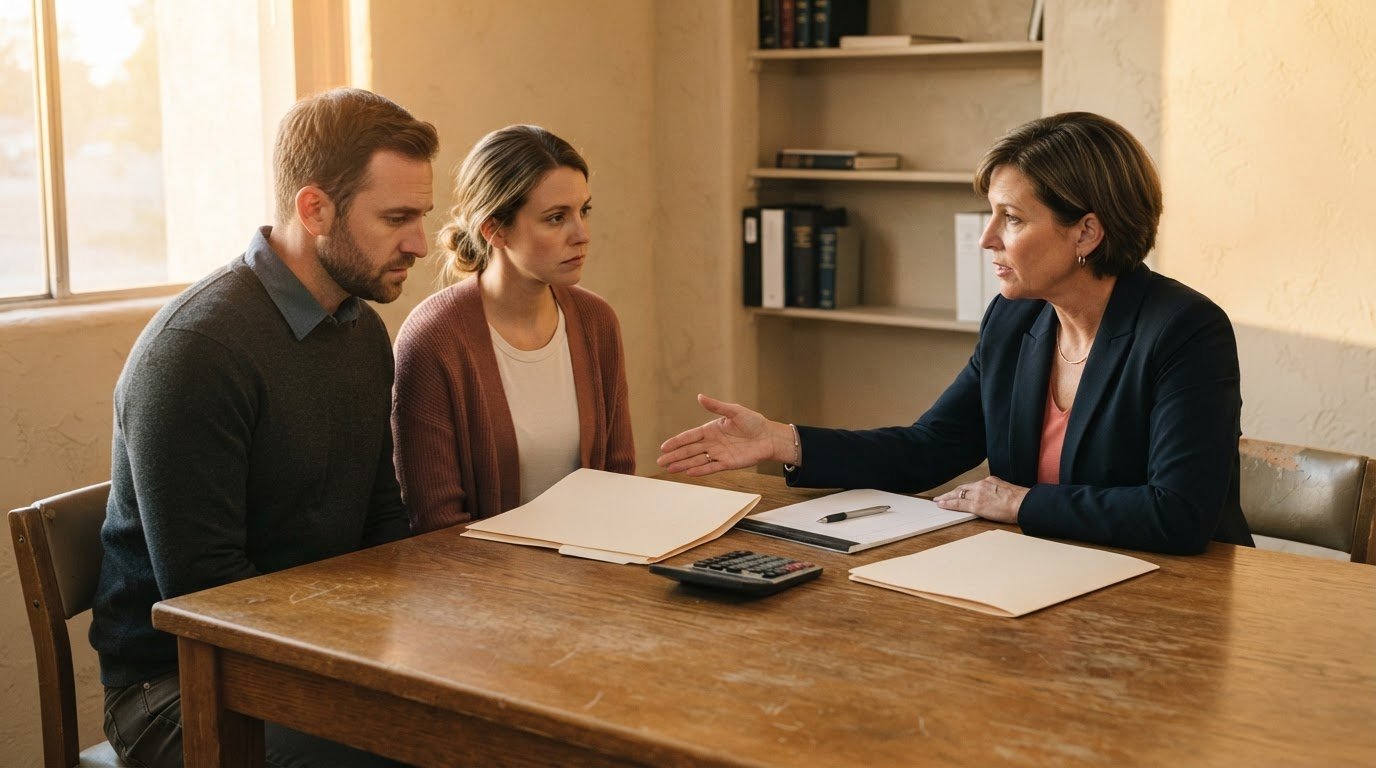
In California, temporary spousal support is typically estimated using a computer program while a divorce or legal separation is pending. Long-term support is not set by a fixed mathematical formula. A Kern County spousal support attorney can explain how that distinction may affect your case. When deciding longer-term support, courts consider factors such as each spouse’s earning capacity, the marital standard of living, and the length of the marriage.
It’s understandable to want a clear figure when separation has unsettled household finances. But temporary support and a final order serve different purposes and are assessed differently. This article explains how temporary amounts are estimated, what California courts consider when setting long-term support, and how an order’s duration may depend on the marriage and financial circumstances. You’ll also learn where spousal support matters are handled in Kern County and when legal representation may help you understand your options.
Key Takeaways
- Temporary support and long-term support are assessed differently, so an early estimate may not predict the final order.
- Understand which financial and relationship factors can shape a long-term support decision, including earning capacity and the marital standard of living.
- Learn how marriage length can affect the expected duration of support and why a simple rule may not answer every question.
- Find out what help the Kern County Family Law Facilitator provides and how its assistance differs from representation by a private attorney.
- See when legal representation can help clarify support issues alongside divorce, property division, or child custody matters.
Factors California courts consider when setting spousal support
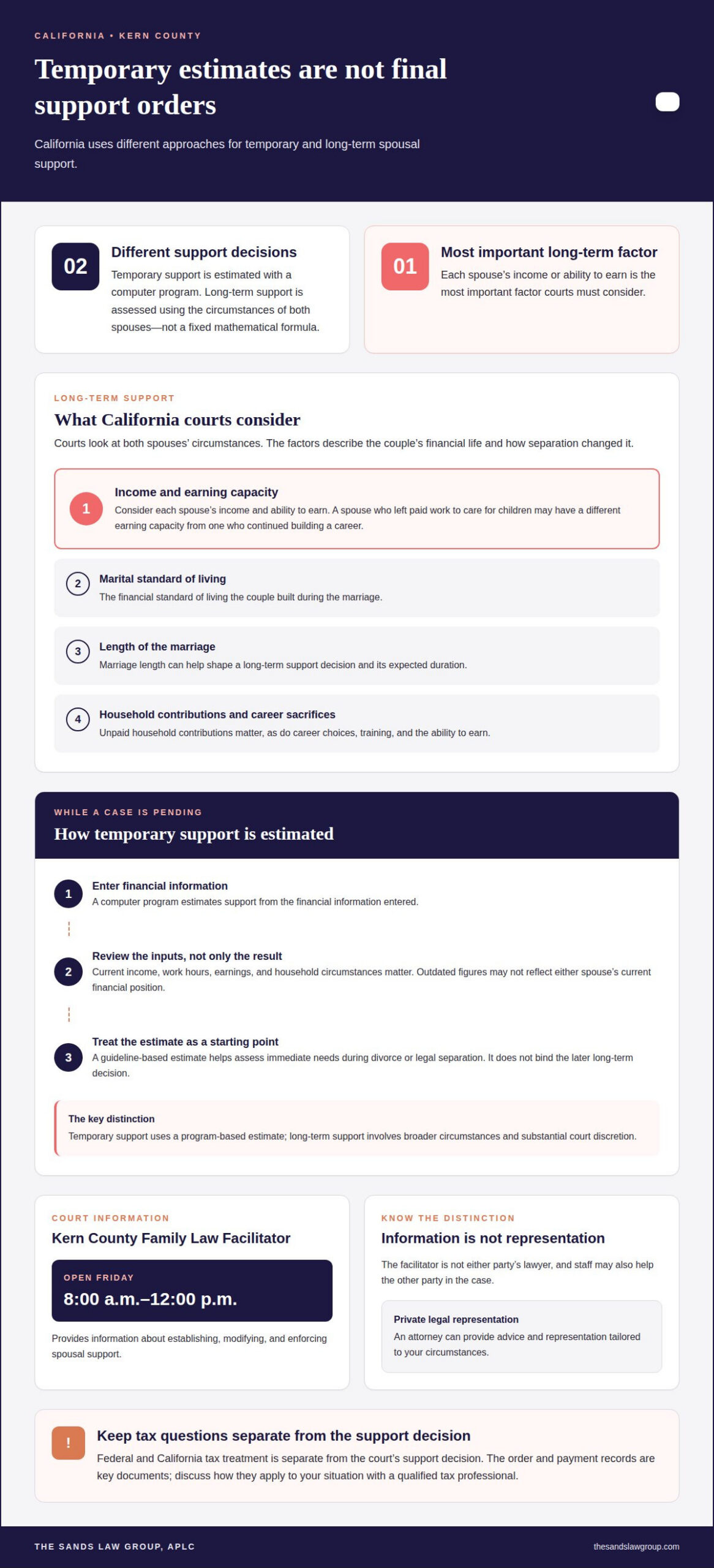
California courts assess both spouses’ circumstances rather than applying one fixed calculation to long-term support. Permanent spousal support cannot be based on a computer program or a particular mathematical formula. Courts have substantial discretion, and each spouse’s income or ability to earn is the most important factor they must consider. A spouse who left paid work to care for children, for example, may have a different earning capacity from one who continued building a career.
The court also considers the marital standard of living, the length of the marriage, and each spouse’s household contributions or career sacrifices. These factors help describe the financial life the couple built and how separation changed each person’s circumstances. Household contributions matter even when they did not produce wages. Career choices, training, and ability to earn can also help show what financial independence may look like after separation.
The Kern County Family Law Facilitator provides information about establishing, modifying, and enforcing spousal support. According to the Superior Court of California, County of Kern, the facilitator is open Friday from 8:00am to 12:00pm. The facilitator can offer information and assistance, but is not a party’s lawyer; its staff may also help the other party in a case. That distinction matters when you need personalized advice or court representation.
When comparing spousal support attorneys in Kern County, consider whether each can explain how income, earning capacity, marriage length, and household contributions apply to your circumstances. Ask how the attorney would assess the financial information and present your position in court. Compare the clarity and relevance of the explanations, not simply whether an estimate sounds favorable.
Federal and California tax treatment is separate from the court’s support decision. The order and payment records are key documents for understanding how support is treated for tax purposes. Discuss how they apply to your situation with a qualified tax professional. The court’s support factors alone don’t determine how payments should be reported.
For a consultation, organize the current support order, income records, expense information, and documents showing relevant changes in work or household responsibilities. Include a concise timeline of separation and court events so the attorney can connect your financial picture to the case history. An organized record can make the discussion more focused.
To request, change, or end an order, identify the relief you seek and the financial circumstances behind it, then make the request through the Kern County family court process. A change in circumstances may support a request for a new order. The Family Law Facilitator provides information about the process, while an attorney can offer advice and representation tailored to your case.
If court-ordered support goes unpaid, keep a clear record of missed payments and the order’s terms. Then seek enforcement information through the Kern County Family Law Facilitator or legal representation. The facilitator provides information about enforcing support but does not represent either party. This distinction helps you understand what assistance is available without mistaking general court information for legal advice.
Guideline-based temporary support calculations
During a pending California divorce, temporary spousal support is typically calculated using a computer program similar to one used for child support. The program estimates support based on the financial information entered. It gives the parties and the court a practical starting point while the case proceeds. A Kern County spousal support attorney can explain how the inputs shape the estimate.
Accuracy matters because an estimate reflects its inputs. Using outdated income instead of current figures can change the calculation. If work hours, earnings, or household circumstances have shifted, those details can affect the financial picture presented to the court. For example, income from an earlier job may not reflect a spouse’s current financial position.
Review the information behind a calculation, not just the result on screen. Consider whether the financial records describe both spouses’ current circumstances and whether the figures match the period being evaluated. Finances often change during family law disputes, so dated information can obscure what each household can manage while the case is pending.
Temporary support addresses the period while divorce or legal separation proceedings are pending. That purpose helps explain why a guideline-based estimate may differ from a later decision. The temporary calculation offers a structured way to assess immediate support needs. A final order considers the broader circumstances relevant to longer-term support, rather than treating the temporary estimate as a binding formula.
For example, one spouse’s employment may change after separation. A calculation based on earlier earnings may not reflect the current situation. Make sure the relevant financial details are clear when reviewing the estimate. The court can then consider the circumstances presented instead of relying on a figure detached from its underlying information.
The program is a tool, not a substitute for understanding how the figures were assembled. Review income information alongside supporting records. If the estimate seems inconsistent with current circumstances, identify which input may explain the difference. A Kern County spousal support attorney can help assess how disputed financial details relate to a temporary support request.
Temporary support can help address expenses during a difficult transition, but an estimate should be understood in context. The parties’ financial circumstances, the timing of the request, and the stage of the family law case all affect how it is used. Keep the distinction clear: an estimate informs consideration of temporary support; it does not resolve every question about a final order.
If you need help understanding how financial information affects a temporary estimate, a discussion of temporary support calculations can help clarify the issues to consider in your case.
Service locations and remote assistance
The Kern County Family Law Facilitator serves people across Kern County through several court locations. Its Bakersfield office is at 1215 Truxtun Avenue, 1st Floor, Bakersfield, California 93301. Knowing the office location helps you plan an in-person visit and identify which court site is relevant to your matter. If you live outside Bakersfield, the other listed locations may make court-related assistance more accessible.
The facilitator provides assistance at four court sites: Delano, Metro Justice Building, Mojave, and Shafter. These locations give people in different parts of Kern County options beyond the Bakersfield office. Before traveling, identify the location connected to the help you need. The facilitator provides information about establishing, modifying, and enforcing spousal support, and can assist with court forms and support calculations.
Phone and email are useful starting points for contacting the Bakersfield facilitator. The listed phone number is 661-610-6400, and its listed email address is WMFacil@kern.courts.ca.gov. Someone in Mojave, for example, could use these contact details to ask about available facilitator information before planning travel. Phone or email contact should not be mistaken for private legal advice or representation.
Location matters when transportation or work schedules make an in-person visit difficult. Note the court site you plan to visit, the purpose of your visit, and the documents or forms involved. If your question concerns a support calculation, identify the relevant income information. A focused inquiry can help staff understand what family law information you need.
Remote contact has limits. The listed phone number and email provide ways to reach the facilitator, but that does not mean every service or court appearance is available remotely. Use these contact methods to seek information, not as a substitute for confirming court procedures. The facilitator may assist either party in a case, so it is not a confidential channel for discussing strategy.
For personalized advice or court representation, a private attorney has a different role from the Kern County Family Law Facilitator. The facilitator provides information and assistance to unrepresented parties; it does not act as your lawyer. This distinction matters if you need someone to assess your circumstances, develop a case strategy, or advocate for you in court.
A practical location plan starts with three details: your nearest listed court site, the support issue you need help understanding, and whether you need general information or legal representation. Someone near Shafter may consider that site, while a person with a case-related question can contact the Bakersfield facilitator by phone or email. These steps help clarify where to seek information and what type of assistance fits your needs.
Temporary spousal support during divorce or legal separation
Separation can disrupt household finances before a California divorce is complete. Temporary spousal support is a court-ordered payment from one spouse to help cover the other spouse’s monthly expenses. It helps address living costs and maintain the status quo while proceedings are pending. Support can provide structure during an unsettled period, but it does not guarantee that both households can preserve their former lifestyle.
California Family Code section 3600 concerns temporary spousal support while a divorce or legal separation case is pending. A judge can award temporary support as soon as a divorce case is filed. Support is not automatic, however. The court may consider it during the case, while the parties address financial issues and work toward resolution. The timing matters because an order can address expenses before the final judgment.
Temporary and long-term support serve different roles. A temporary order concerns the period before the case concludes; a final judgment may address longer-term support when appropriate. Understand a temporary amount in context rather than treating it as a prediction of the final decision. For example, an amount intended to help with monthly housing expenses during proceedings does not, by itself, establish the terms of a later order.
California divorce proceedings involve filing a dissolution petition, serving the other spouse, exchanging mandatory financial disclosures, negotiating or attending court hearings, and obtaining a final judgment. Support questions can arise along the way. Financial disclosures help frame the parties’ circumstances, while negotiations or hearings provide a setting to address disputed issues. The court may consider temporary support before the case reaches final judgment.
Separation also changes what “maintaining the status quo” means in practice. Once households divide, there is almost never enough money for both parties to maintain the marital standard of living. Temporary support can help cover living expenses, but it cannot necessarily recreate one shared household’s financial arrangements across separate homes. That limitation matters when considering what interim support is meant to accomplish.
To understand a temporary order, consider its purpose, timing, and effect. Its purpose is to provide interim help with expenses. Its timing is during a pending divorce or legal separation. Its effect is limited to the order and circumstances it addresses; it does not automatically resolve long-term support. This distinction helps prevent an early estimate or order from being mistaken for the final outcome.
For someone facing immediate uncertainty, the central question is how to address expenses while the California case proceeds. The court can consider a temporary support request after the divorce case is filed, but its decision depends on the matter presented. Any order made applies during the pending proceedings; the final judgment may address longer-term support separately.
How long can spousal support last in Kern County?
Support duration depends partly on the length of the marriage, but California does not use one timeline for every order. Temporary support applies while divorce proceedings are pending. Long-term support may be set for a defined period or remain modifiable as the parties’ financial situations change. Identifying which kind of order applies is the first step toward understanding its duration.
For marriages lasting less than 10 years, courts generally order support for a period equal to one-half the marriage’s length, according to California Courts. For example, a marriage lasting eight years would generally point to a four-year support period under that guideline. This is a general rule for marriages under 10 years, not a universal calculation for every case.
Marriages lasting more than 10 years are treated differently. Courts typically order support for life or until remarriage. That description does not mean every long-term order must remain unchanged. California long-term support may be set for a defined period or remain modifiable, depending on future changes in the parties’ financial situations.
The duration question differs from the amount question. California courts consider factors such as each spouse’s earning capacity, the marital standard of living, and the length of the marriage. These factors frame the support decision, while a marriage-duration guideline provides only one reference point. For instance, marriages of the same length may involve different financial circumstances and earning capacities.
Read the order carefully to see whether it sets an end date or allows future modification. A defined period gives the order a specific duration; a modifiable order may be revisited if financial circumstances change. A change in circumstances may be grounds to seek a new support order in court. The existing order remains important until the court changes it.
For a marriage near the 10-year threshold, the distinction between “less than” and “more than” matters when reading these general guidelines. The rule supplied by California Courts addresses marriages lasting less than 10 years; longer marriages are commonly associated with support for life or until remarriage. The marriage length is only one part of the broader support picture.
If you are evaluating an order’s duration, organize the marriage timeline, the order’s wording, and relevant changes in financial circumstances. These details help clarify whether the order states a set period or may be modified. For guidance about how duration applies to your circumstances, schedule a spousal support discussion.
The Sands Law Group, APLC: Spousal Support Representation
The Sands Law Group, APLC provides spousal support representation for people addressing temporary requests, longer-term orders, or changes to existing support. This may be useful when financial circumstances have shifted, the proposed terms are disputed, or you need representation in a divorce proceeding. The firm also handles divorce legal representation, property division, and child custody and visitation matters, which can arise alongside support issues.
Legal guidance can connect your case’s financial details with the support issues before the court. If you need help understanding your options or presenting your position, contact The Sands Law Group, APLC to discuss your circumstances.
Take the Next Step With a Clear Plan
Support decisions can shape practical choices after separation, from managing household expenses to planning for financial independence. Before taking your next step, identify the outcome you need guidance on and the questions that remain unresolved. Clear priorities can make a legal discussion more focused, especially when support concerns intersect with broader family changes.
A Kern County spousal support attorney can help you assess your position, understand the issues that need attention, and prepare for decisions ahead. The Sands Law Group, APLC represents clients in spousal support matters, with related family law representation available when divorce or child custody issues also affect your circumstances. Advice tailored to your situation can help turn uncertainty into a considered plan.
Arrange a conversation with The Sands Law Group, APLC to discuss your support concerns and possible next steps. You can move forward with greater clarity, one decision at a time.
Frequently Asked Questions
How is spousal support calculated in Kern County, California?
Temporary support is typically estimated with a computer program using financial information, while long-term support has no fixed mathematical formula. The estimate is not a guaranteed amount or a substitute for the court’s assessment. For example, disagreement over the income information entered can affect the estimate and should be addressed as part of the case. The distinction between an interim estimate and a final order matters.
What factors do Kern County judges consider when deciding spousal support?
California courts consider each spouse’s earning capacity, the marital standard of living, marriage length, and household contributions or career sacrifices. Income and ability to earn are especially important. For example, a spouse who stepped away from employment to support the household may have a different earning capacity from one who continued working. The court has discretion, so it evaluates these circumstances together rather than reducing the decision to one factor.
What is the difference between temporary and long-term spousal support in California?
Temporary support addresses expenses while a divorce or legal separation case is pending; long-term support may be addressed in the final judgment. The distinction affects both timing and purpose. For example, an interim order covers the period before the case concludes, while a final order may account for broader circumstances, including earning capacity and the marital standard of living. Long-term support may be set for a defined period or remain modifiable.
What happens if someone fails to pay court-ordered spousal support in California?
Keep a clear record of missed payments and the support order’s terms, then seek enforcement information from the Kern County Family Law Facilitator or legal representation. The facilitator provides information but does not represent either party.

Article by
Thomas D. Sands, Esq.
Thomas D. Sands is the founder and CEO of The Sands Law Group, APLC. A California attorney with more than two decades of experience, he represents clients in divorce and family law matters as well as civil litigation and real property disputes. His approach emphasizes attentive, practical, and cost-conscious representation.
Sands is a 2023 Litigator of the Year honoree of the American Institute of Trial Lawyers and a 2023 Lawyer of the Year honoree of the American Institute of Legal Professionals. His firm has also received recognition among the 2025 Best Law Firms in America, a 2026 Benchmark Best of award, and a 2026 Law Firm of the Year honor.
Article reviewed by
Thomas D. Sands, Esq.
Thomas D. Sands is the founder and CEO of The Sands Law Group, APLC. A California attorney with more than two decades of experience, he represents clients in divorce and family law matters as well as civil litigation and real property disputes. His approach emphasizes attentive, practical, and cost-conscious representation.
Sands is a 2023 Litigator of the Year honoree of the American Institute of Trial Lawyers and a 2023 Lawyer of the Year honoree of the American Institute of Legal Professionals. His firm has also received recognition among the 2025 Best Law Firms in America, a 2026 Benchmark Best of award, and a 2026 Law Firm of the Year honor.
TOLL-FREE: 855-SANDS4U