

What if the settlement that ends today’s conflict creates a financial or parenting problem you’ll live with for years? Mistakes to avoid in a Los Angeles divorce include rushing to agree, failing to disclose financial information fully, and letting communication break down, especially when custody is disputed. Clear, respectful written communication can preserve a record of discussions and agreements, while angry messages or vague verbal understandings can fuel further conflict.
It’s understandable to want the process over when emotions are high, but speed alone doesn’t make a settlement fair or workable. This article explains how mediation, financial disclosure, custody communication, and long-term planning can affect your decisions, and why it’s important to understand the terms before agreeing to them. You’ll also learn when unresolved issues may need a judge’s decision, so you can approach each step with greater clarity and protect the stability you’re working toward.
Key Takeaways
- If mediation does not resolve a disputed issue, it may ultimately be decided in court; understanding the options can help you prepare for the next step.
- Consider whether a proposed property or support arrangement will remain workable for your housing, income, and retirement needs over time.
- Disclose assets and debts fully. According to the California Legislature, a spouse who willfully or fraudulently fails to disclose a community asset risks losing 100% of that asset’s community value.
- Keep co-parenting communication respectful and focused on practical arrangements, since written messages can become part of the record in a custody dispute.
- Before accepting a settlement, make sure you understand its terms and the long-term consequences of the decisions it makes difficult to change.
1. Q: What Happens if My Spouse and I Can’t Agree During Mediation?
If mediation ends without agreement, unresolved issues may proceed to court, where a judge can decide custody and child-support terms. Before filing, confirm that California’s residency requirement is met: according to California Courts, at least one spouse must have lived in California for 6 months and in the filing county for 3 months immediately before filing. A mediation impasse does not resolve disputed parenting arrangements, support, or other divorce issues by itself.
For child custody, California identifies children’s health, safety, and welfare as the primary concern. Courts may also consider each parent’s involvement in a child’s education, healthcare, and activities. Keep a practical record of parenting responsibilities, such as school pickups, medical appointments, and activity schedules. These details can show how each parent participates in the children’s daily lives and what arrangements may support their needs.
Children benefit when parents keep them out of adult conflict. Don’t use a child to deliver messages, seek information about your spouse, or provide emotional support during disputes. For example, discuss a schedule change directly with the other parent rather than asking a child to negotiate it. California law supports children having frequent and continuing contact with both parents, so communication and cooperation around visitation can matter.
Badmouthing a former spouse in front of children, using children as leverage, or unreasonably refusing to cooperate with visitation schedules can jeopardize custody or visitation rights. The same concern applies when relatives or significant others criticize the other parent around a child. Set a clear boundary with involved adults: disagreements about the other parent should stay away from children. A child should not have to choose sides or carry hostile messages between households.
Moving out can also affect the caregiving pattern. If a parent leaves the family home and the other parent becomes the children’s primary caregiver, that status quo may be difficult to change later. Before making a major change, consider who will handle school, healthcare, and regular routines, and how the children will maintain contact with both parents. Follow existing court orders and parenting plans. Frustration with an arrangement is not a reason to disregard it.
If domestic violence raises an immediate safety concern, emergency court orders may address protection and temporary arrangements; the relief sought depends on the circumstances. For support disputes, mediation may resolve spousal-support terms, but unresolved issues can be presented to a judge. A focused proposal should identify the disputed issue, the children’s needs where relevant, and a workable alternative, rather than using mediation to punish a spouse.
2. Considering long-term financial and retirement impacts
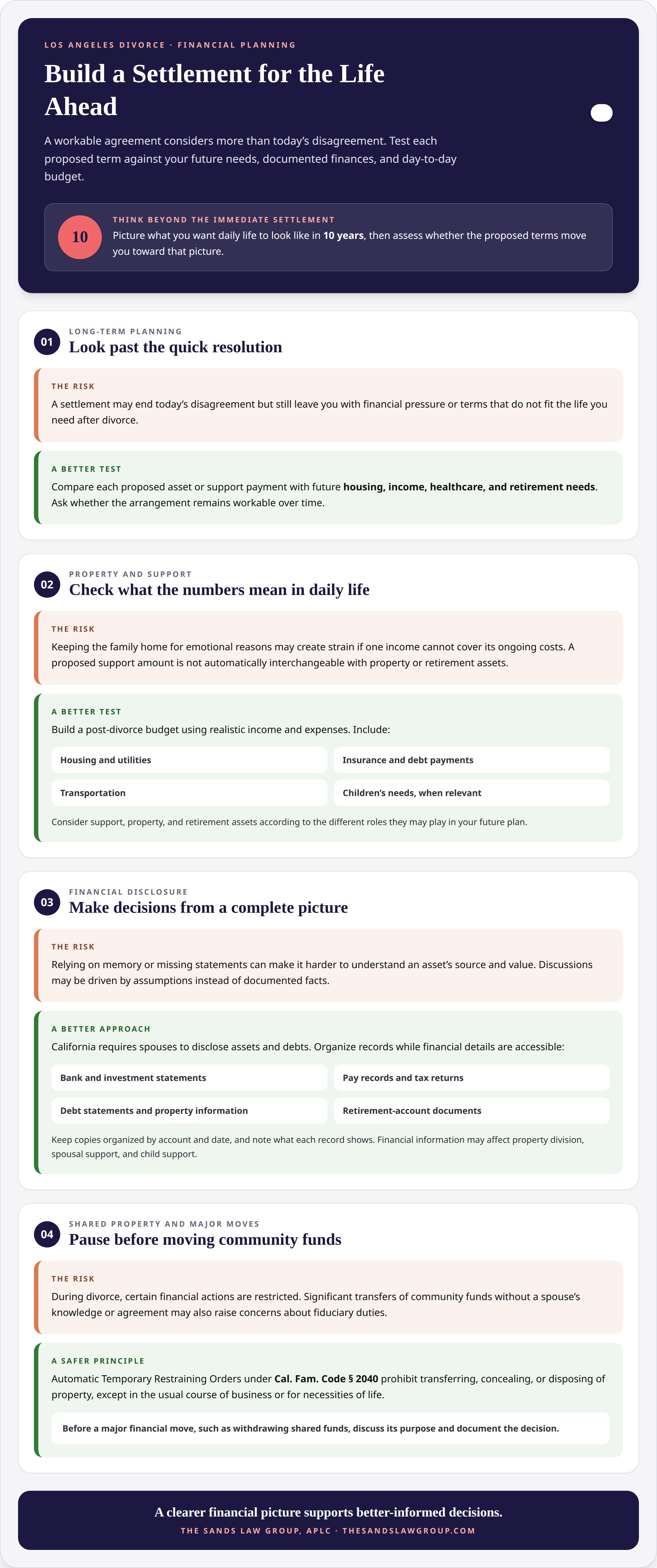
A settlement should support the life you’ll need after divorce, not only resolve today’s disagreement. Compare each proposed asset or support payment with future housing, income, healthcare, and retirement needs. Keeping the family home for emotional reasons, for example, may create strain if one income cannot cover its ongoing costs. Consider what you want daily life to look like in 10 years, then assess whether the proposed terms move you toward that picture.
Build a post-divorce budget around realistic income and expenses. Include housing, utilities, insurance, debt payments, transportation, and children’s needs if custody arrangements involve regular care. Spousal support may affect the budget, but don’t treat a proposed amount as interchangeable with property or retirement assets. Money available now and an asset intended for retirement can play different roles in your future plan.
California also restricts certain financial actions during a divorce. Automatic Temporary Restraining Orders under Cal. Fam. Code § 2040 prohibit transferring, concealing, or disposing of property, except in the usual course of business or for necessities of life. Significant community-fund transfers without a spouse’s knowledge or agreement may also raise concerns about fiduciary duties. Before a major financial move, such as withdrawing shared funds, discuss its purpose and document the decision.
Preserve records while financial details are still accessible. Gather bank and investment statements, pay records, tax returns, debt statements, property information, and retirement-account documents. Keep copies organized by account and date, and note what each record shows. For example, a statement may help distinguish a routine household payment from a substantial transfer that needs explanation. Orderly records can help your divorce attorney assess the financial picture and identify questions before negotiations advance.
California requires spouses to disclose assets and debts, and financial information may affect property division, spousal support, and child support. Don’t rely on memory alone when accounts, loans, or retirement benefits span several years. A missing statement can make it harder to understand an asset’s source and value. Clear records keep discussions grounded in documented facts rather than assumptions or emotionally charged estimates.
For an uncontested divorce, California’s six-month waiting period runs from the date the respondent is served, according to California Courts. Contested cases may take longer; the reported median for contested California divorces is 12 to 18 months. To file in Los Angeles County, according to California Courts, at least one spouse must have lived in California for 6 months and in the filing county for 3 months immediately before filing.
A Response filing costs $435 as of April 2026. Court filing charges are separate from attorney, mediation, and other case costs, which depend on the disputed issues and work involved. A fee waiver may address qualifying court charges, while it doesn’t create a post-divorce budget or resolve support and property questions. If you’re weighing an agreement’s financial effects, discuss your divorce planning with counsel before accepting terms.
3. Disclosing marital assets and obligations
Complete financial disclosure gives both spouses a clearer basis for negotiating property division and support. California is a community property state: most assets acquired during marriage are generally subject to division, while premarital assets are generally separate. Some property can have both separate and community components. For example, a home owned before marriage may require closer analysis if marital funds later paid its mortgage or improvements.
List assets and debts together, rather than focusing only on accounts held in your own name. Include income, real estate, bank and investment accounts, retirement accounts, loans, and other obligations. California requires spouses to provide a Preliminary Declaration of Disclosure, including two years of tax returns. Preliminary and final declarations must be completed, and parties certify under penalty of perjury that supporting documents are complete and true.
Deadlines matter. The petitioner must serve preliminary disclosures within 30 days after the response is filed, and the respondent must serve them within 60 days. Organize records by account and date, then compare statements with tax returns and debt documents. If a statement shows a transfer or account balance that doesn’t match other records, identify the difference and preserve the documents needed to explain it.
Hiding an asset can change the outcome dramatically. In a California divorce, a spouse who willfully or fraudulently fails to disclose a community asset risks losing 100% of that asset’s community value, according to the California Legislature. A court may also impose sanctions for hidden assets or set aside a final judgment. Concealment is not a sound way to protect property; it can undermine the agreement and create further disputes.
Accurate values matter as much as complete lists. A retirement account statement, property valuation, or business record can provide a starting point, but the relevant value and any separate-property component may require careful assessment. Don’t assume that an emotional attachment establishes an asset’s financial worth. Trying to keep a home, business, or treasured item at any cost can obscure the debts, taxes, or other property involved in the proposed terms.
Emotions can make disclosure feel like a contest, particularly when one spouse controlled household finances. A calm consultation can help identify missing categories and distinguish suspicion from evidence. If an account, debt, or transfer raises questions, record what is known and seek an explanation through the appropriate legal process. A complete picture helps each spouse assess whether an agreement reflects the actual assets and obligations, rather than assumptions that may later prove costly.
4. How Can Poor Communication With My Ex During A Custody Case Cause Harm?
During a California divorce, a message sent in anger can outlast the emotion that prompted it. Angry texts, emotional emails, and negative social media posts may become evidence in a divorce case. Before replying, pause, identify the practical issue, and write a brief response focused on the children or the pending decision. A message about a missed school pickup, for example, should clarify the next handoff rather than revive an argument about the relationship.
When negotiating child custody and visitation in Los Angeles, avoid badmouthing the other parent, using children as messengers, or refusing reasonable schedule discussions. Keep proposals focused on the child’s routine, school, healthcare, and activities. California courts may consider a parent’s involvement in these areas, so a clear, workable proposal is more useful than accusations about who is the better parent.
Silence can also create problems. If the other parent asks about a school event or medical appointment, respond promptly and respectfully when possible, even if the answer is simply that you’ll provide details later. Keep a record of important exchanges and agreements, including dates and schedule changes. Written records can help establish what was discussed if memories differ during later negotiations or court proceedings.
Social media deserves similar care. A post criticizing your spouse, describing private negotiations, or showing a conflict may be used against you during the case. Avoid using public posts to vent or recruit support, and don’t assume a private message stays private. Keep communications about the divorce and children measured, factual, and directed to the people who need the information.
Emotions can make every disagreement feel urgent, yet decisions made to punish a spouse may increase litigation, legal fees, and stress for children. California is a no-fault divorce state, so courts do not financially punish a spouse for conduct such as cheating. A family law attorney can help separate emotional injury from the legal issue, then focus negotiations on practical outcomes and the family’s future needs.
Financial communication also matters. Transferring significant community funds without a spouse’s knowledge or agreement may be viewed as a breach of fiduciary duty. Before moving shared money, document the purpose and discuss the proposed action through an appropriate channel. Preserve relevant account records and messages. Don’t use financial access to pressure the other parent or gain leverage in a custody discussion.
If you’re going through a difficult divorce, choose a consistent method for essential co-parenting updates and keep each exchange focused on one issue. For example, send a concise message about a visitation adjustment, confirm the response, and retain the record. This approach reduces misunderstandings while keeping the divorce case centered on decisions that support stable parenting arrangements over time.
5. Avoiding rushed settlement decisions
A settlement can end negotiations quickly and still create problems that last. One mistake to avoid in a Los Angeles divorce is treating immediate relief as proof that an agreement is fair. Fear, guilt, heartbreak, or exhaustion may make signing feel like the simplest path forward. Before accepting, separate the urgency of ending conflict from the terms that will shape daily life. A parent, for example, might agree to a visitation schedule without considering school pickups, holiday routines, or future changes.
Review each decision as part of the whole agreement. A house, retirement account, debt, and support arrangement should not be assessed in isolation. Keeping the family home may mean taking on expenses that a single income cannot comfortably manage. A settlement that appears balanced today may have different consequences after considering housing costs, taxes, debts, and ongoing support.
Use a deliberate review process before signing. First, identify every issue the agreement resolves, including property division, spousal support, and child-related arrangements when applicable. Next, compare the written terms with financial disclosures and any current parenting plan. Then, mark unclear language and unanswered questions for discussion. If a clause says one parent will cover a recurring expense, clarify what it means and how payment will work.
Another mistake to avoid in a Los Angeles divorce is overlooking what the agreement leaves unresolved. Vague provisions about future decisions or payments can invite disagreement, even when both spouses intend to cooperate. Ask how each term will work in an ordinary month, during a school break, or after an income change. This practical test can reveal gaps that emotional negotiations or rushed reading might miss.
California divorce terms can be very difficult, and potentially impossible, to change after a court finalizes them. Careful review therefore matters before approval, not after regret sets in. An experienced family law attorney can explain how proposed language affects your rights and identify unresolved issues. Friends’ experiences or social media advice may not fit your family, finances, or proposed agreement.
Compromise does not require accepting unclear or unworkable terms. It means distinguishing issues that matter to long-term stability from disagreements that mainly prolong conflict. For example, parents might prioritize a reliable school-week schedule while negotiating flexibility around occasional activities. A focused discussion can keep attention on meaningful decisions without turning every detail into a contest.
If pressure to sign makes it difficult to assess the consequences, pause and seek a focused review. Bring the proposed agreement, financial records, and a written list of questions to a settlement review consultation. Understanding each provision before approval can help you make a considered choice about the future it creates.
The Sands Law Group, APLC: Divorce Legal Representation
The Sands Law Group, APLC provides divorce legal representation when financial disclosure, property division, support, or custody issues make decisions difficult. Representation can help you assess proposed terms, address unresolved disputes, and understand how an agreement may affect your next steps. The firm also represents clients in child custody and visitation, spousal support, and property division matters.
Consider seeking legal guidance before signing a settlement, when you and your spouse cannot resolve a disputed issue, or when parenting arrangements need careful attention. A clear review can bring the financial and family questions into focus without minimizing the personal weight of divorce.
Contact The Sands Law Group, APLC to discuss your divorce and the issues you need to address.
Move Forward With a Clear Plan
The choices made during divorce shape more than the legal outcome; they influence how you rebuild routines, manage responsibilities, and make future decisions. As you consider mistakes to avoid in a Los Angeles divorce, focus on the life you need to create after the case ends. A thoughtful next step is to identify the questions that still feel unresolved, then address them before they become part of a lasting agreement.
Prepare for that conversation by writing down your priorities, the decisions still ahead, and any practical concerns affecting your family or finances. This can help turn a difficult transition into a series of deliberate choices, rather than decisions made only to escape immediate pressure. You deserve to understand the path ahead and move at a pace that allows for careful consideration.
If you’re ready to discuss your circumstances and possible next steps, schedule a conversation with The Sands Law Group, APLC. A clearer plan can help you move forward with greater confidence.
Frequently Asked Questions
How Can Failing To Document Communication And Agreements Affect My Chances In A Custody Battle?
Without written records, it may be harder to establish what was agreed or how parenting arrangements worked. For example, if a parent repeatedly handles school pickups but the other disputes that history, dated messages and calendars can help clarify the pattern. Keep records factual and complete, including schedule changes and responses. Avoid editing messages or creating notes that exaggerate events, since accuracy matters when explaining a disagreement.
How Can Poor Communication With My Ex During A Custody Case Cause Harm?
Poor communication can turn routine parenting decisions into new disputes. If a child needs a school uniform or a medication refill, unclear messages may leave each parent assuming the other will handle it. Use brief, civil messages that identify the issue, the requested action, and any relevant date. Keep the discussion centered on the child’s needs rather than past relationship conflicts, and preserve important exchanges in an organized record.
How Does Badmouthing A Co-Parent Affect My Custody Case And My Child’s Well-Being?
Criticizing a co-parent where a child can hear may place the child in the middle and intensify loyalty conflicts. For instance, asking a child to report on the other parent or repeat adult accusations makes the child carry a dispute they cannot resolve. Keep complaints away from children, and ask relatives or household members to do the same. Focus conversations with children on practical reassurance and their routines.
Q: What Are the Main Divorce Issues to Work Through in California?
California divorce cases commonly involve property division, spousal support, and, when relevant, child custody and child support. Consider how connected decisions may affect one another: a proposed parenting schedule can influence childcare arrangements, while a property settlement can shape each spouse’s housing options. Make a written list of unresolved topics, such as debts, retirement accounts, or school-week schedules, so negotiations address the full picture rather than one isolated dispute.
Q: What Happens if My Spouse and I Can’t Agree During Mediation?
If mediation does not resolve an issue, the dispute may proceed to court for a judge to decide. Before that step, identify the exact point of disagreement and the evidence or practical concern behind each position. For example, parents who disagree about school-week exchanges can define the pickup location, transportation responsibility, and proposed schedule. Narrowing the issue may support further negotiation, even if the broader case remains contested.
Why Is Ignoring Court-Ordered Parenting Plans Risky During A Child Custody Dispute?
Ignoring a court-ordered parenting plan can lead to enforcement proceedings and may undermine a parent’s position in later custody discussions. If an order sets a specific exchange time, follow it unless the parents agree to a change or the court modifies the order. Keep a record of any missed exchange or requested adjustment, and use the proper legal process to address repeated problems instead of making unilateral changes.
What common mistakes should people avoid when filing for divorce in Los Angeles?
Common filing mistakes include overlooking a response deadline, submitting incomplete financial information, and treating informal advice as a substitute for case-specific guidance. In California, a respondent generally has 30 days after service to file a Response before the petitioner can request a default judgment. Keep copies of filed documents and service records, and address each required form carefully so a missing detail does not complicate the case.
How is community property divided in a California divorce, and what financial mistakes can affect the outcome?
California courts generally divide community property equally, but identifying what belongs to the community can require tracing how an asset was acquired or funded. For example, an account may include both premarital funds and deposits made during marriage. Keep statements showing account history, and avoid moving or spending shared funds without understanding the effect. Disclose debts as well as assets, since obligations also shape the proposed division.

Article by
Thomas D. Sands, Esq.
Thomas D. Sands is the founder and CEO of The Sands Law Group, APLC. A California attorney with more than two decades of experience, he represents clients in divorce and family law matters as well as civil litigation and real property disputes. His approach emphasizes attentive, practical, and cost-conscious representation.
Sands is a 2023 Litigator of the Year honoree of the American Institute of Trial Lawyers and a 2023 Lawyer of the Year honoree of the American Institute of Legal Professionals. His firm has also received recognition among the 2025 Best Law Firms in America, a 2026 Benchmark Best of award, and a 2026 Law Firm of the Year honor.

Article reviewed by
Thomas D. Sands, Esq.
Thomas D. Sands is the founder and CEO of The Sands Law Group, APLC. A California attorney with more than two decades of experience, he represents clients in divorce and family law matters as well as civil litigation and real property disputes. His approach emphasizes attentive, practical, and cost-conscious representation.
Sands is a 2023 Litigator of the Year honoree of the American Institute of Trial Lawyers and a 2023 Lawyer of the Year honoree of the American Institute of Legal Professionals. His firm has also received recognition among the 2025 Best Law Firms in America, a 2026 Benchmark Best of award, and a 2026 Law Firm of the Year honor.
TOLL-FREE: 855-SANDS4U