What if agreeing on a new child support amount still isn’t enough to change the order? In Kern County, modifying child support may be considered when a recalculation would change the amount by at least 20% or $50, whichever is the lesser threshold. Parents who agree on a new amount can put their agreement in writing and submit it to the court, but a judge’s approval is needed.
It is understandable to hope that reaching agreement will spare your family further conflict. A written agreement gives the court a clear proposal, but a judge may ask for an explanation if the proposed amount falls far below state guidelines, including how it will adequately support the children.
This article explains when a child support order may be changed, how to request a review, and what happens when parents agree or ask the court to decide. It also covers how changes in income, parenting time, or other circumstances can affect support, and how a proposed agreement becomes a court-approved order.
Key Takeaways
- Assess whether a meaningful change in income, parenting time, or a child’s needs may support a new support calculation.
- Understand how circumstances such as incarceration can affect eligibility to request an agency review.
- Learn what an open child support case and accurate financial information contribute to a review request.
- See how the court handles a proposed support change when parents agree or cannot reach common ground.
How Can I Change a Child Support Order?
In Kern County, parents may seek a support-order change when circumstances affecting the original calculation change. Modifying child support in Kern County may involve an agency review or a request for a court decision.
Material Changes in Circumstances
A material change is a meaningful shift in a parent’s or child’s circumstances that may affect the existing support calculation. A court generally may modify an order when a parent shows that circumstances changed after it was made. Describe what changed and how it affects the family’s finances or care arrangements. A temporary difficulty may be considered differently from an ongoing change.
Changes That May Justify Modification
Changes that may support a request include job loss or a change in a parent’s income, altered custody or parenting time, a change in family size, disability, incarceration, or active military deployment. A child’s changing needs may also affect support. For example, a parent’s earnings may fall while the child spends more time in that parent’s care. Explain how the change relates to the support calculation.
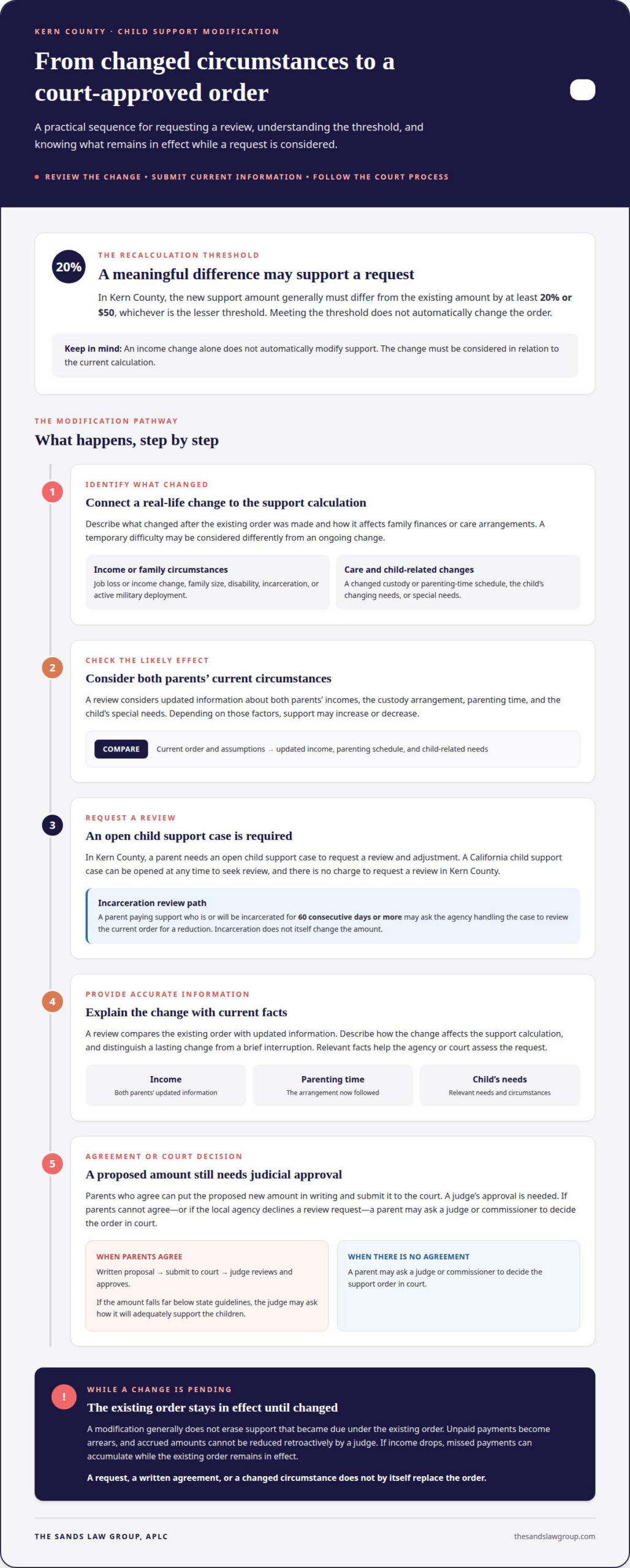
In Kern County, the new support amount generally must differ from the existing amount by at least 20% or $50, whichever is the lesser threshold. This comparison can help determine whether recalculation may be appropriate, but an income change alone does not automatically change the order.
How Support Amounts Can Change
A review considers updated information about both parents’ incomes, the custody arrangement, parenting time, and the child’s special needs. Depending on these factors, support may increase or decrease. A parent may ask a judge or commissioner to decide the order in court, including if the local agency declines a review request.
How long does a child support modification take in Kern County? It depends on whether the request goes through agency review or requires a court hearing, as well as whether the filing is complete and when the court can schedule it. To request an emergency or temporary change, explain the temporary hardship through the review or court process. Examples include a child’s medical emergency or a payer’s temporary inability to pay.
Retroactive Support Modifications
A child support modification generally does not erase support that became due under the existing order. Unpaid payments become arrears, and a judge cannot reduce those accrued amounts retroactively. If income drops, the existing order remains in effect until it is changed, and missed payments can accumulate. Parents modifying child support in Kern County should act promptly and document the circumstances supporting their request.
Eligibility for a support modification
Eligibility depends on whether a parent’s circumstances have changed in a way that may affect the child support calculation. In Kern County, relevant changes may involve income, parenting time, family size, disability, incarceration, or active military deployment. A request is more clearly supported when it connects a specific change to the existing order rather than relying only on disagreement with its amount.
Both parents’ circumstances matter, even when only one parent requests a change. A job loss may affect income, for example, while a new custody schedule may change how much time the child spends with each parent. The child’s special needs can also affect the calculation. Review focuses on current information relevant to support, not simply on which parent considers the existing amount unfair.
Eligibility is not limited to the parent paying support. Either parent may seek review when changed circumstances could affect the amount, including a change in the recipient parent’s income or the child’s living arrangements. A parent who has more parenting time, for example, can explain how the new schedule differs from the order’s assumptions. The facts should describe what changed and how it affects the support calculation.
Incarceration has a specific review path: according to the California Department of Child Support Services, a parent paying child support who is or will be incarcerated for 60 consecutive days or more may ask the agency handling the case to review the current support order for a reduction. The request concerns review of the order; incarceration does not itself change the amount.
Common circumstances that may support a request include:
- A job loss or other change in either parent’s income.
- A changed custody or visitation schedule that affects parenting time.
- A change in family size, disability, or a child’s needs.
- Incarceration or deployment to active military service.
These circumstances are reasons to request consideration, not grounds for automatic approval. Be prepared to describe the change accurately and provide information relevant to the support calculation. For example, distinguish a lasting income reduction from a brief interruption, and describe the actual parenting schedule now followed. Clear facts help the agency or court assess the request.
If a changed custody schedule is central to eligibility, discuss the support-order circumstances and how the parenting arrangement may affect the calculation.
Requesting a child support review and adjustment
A review compares the current support order with updated information about the parents and child. In Kern County, an open child support case is required to request a review and adjustment.
Requesting a Support Review
A review and adjustment request asks that the existing support amount be reconsidered in light of current circumstances. For parents modifying child support in Kern County, the first step is having an open case. A California child support case can be opened at any time to seek review. There is no charge to request a review in Kern County.
Accurate income information matters because support should reflect both parents’ financial circumstances. Current earnings, parenting arrangements, and relevant needs of the child help show whether the existing calculation still reflects the family’s situation. For example, a parent whose work hours have changed can provide updated income information instead of relying on figures from the earlier order.
Kern County Child Support Services helps parents modify child support orders. If the agency cannot request a modification for a parent, that parent may file a motion with the court. The Kern County Family Law Facilitator can assist with child support calculations for cases assigned to the Department of Child Support Services. The facilitator is not the parent’s lawyer, and communications with staff are not confidential.
Agency review and a court motion are separate routes. An agency request seeks review through Child Support Services, while a motion asks the court to consider a change. If the agency declines to request a modification, a parent may still ask a judge or commissioner to decide the order. Keep the reason for the proposed change consistent with the updated information provided.
Cost-of-Living Adjustment Clauses
A cost-of-living adjustment, or COLA, clause provides for support payments to increase annually based on an economic indicator, such as the Consumer Price Index. The order itself may set out annual adjustments tied to that indicator. When modifying child support in Kern County, distinguish an adjustment under an existing COLA clause from a broader request based on changed circumstances.
Read the existing order to see whether it includes a COLA clause and how it describes the adjustment. An order without one may be a candidate for adding a clause to account for cost-of-living increases. A COLA provision addresses annual adjustments under its terms; changed income, parenting time, or child needs may require a separate review request.
For example, an increase in living costs may relate to a COLA clause, while a change in a parent’s earnings involves updated financial information. Identifying the issue helps clarify what the review should consider and whether the order’s existing adjustment language addresses the change.
Stipulated agreements and court decisions
Parents in Kern County can propose a new child support amount together or ask the court to decide if they cannot agree. The route matters: an understanding between parents does not by itself replace the existing support order.
Are there filing fees or costs to modify child support in Kern County? There is no charge to request an agency review and adjustment. That applies to the review request, not necessarily to a separate court process.
When parents agree, they can sign a stipulated agreement stating the proposed support amount and file it with the court. This gives the judge a shared proposal to consider instead of competing requests. Make the terms clear, including the proposed amount and which order the parents want changed. A judge must approve the agreement before the change becomes a court-approved support order.
Agreement does not guarantee approval. A judge may ask for an explanation if the proposed amount falls far below state guidelines, including why it is justified and how it will adequately support the children. Parents proposing a lower amount should address the children’s needs and the circumstances behind the proposal. A written explanation connects the requested amount to the children’s welfare.
If parents cannot agree, either may ask the court for a hearing and present a case for an appropriate amount. The judge or commissioner considers the information presented and decides the support order. This route is relevant when parents dispute income figures, parenting time, or how changed circumstances should affect support. Each parent can present a position, but neither parent’s preferred amount becomes binding just because they disagree.
Court forms and paperwork should match the route being taken. For a stipulated agreement, the written terms should clearly identify the proposed change and be prepared for filing with the court. For a contested request, the filing should explain the change sought and the circumstances supporting it. Keep the existing order and proposed terms consistent throughout the paperwork so the court can understand what decision is requested.
Do not treat a signed agreement, a filed document, and an approved order as interchangeable. A signed stipulation records the parents’ proposal; filing submits it to the court; approval makes the change part of the court order. Until a judge approves the agreement or decides the contested request, the existing order remains in effect.
Before submitting a proposal, compare its terms with the children’s needs and the information supporting the requested amount. A clear agreement can narrow the issues for the judge, while a specific court request can focus a hearing when agreement is out of reach.
Agreement between parents to modify child support
When parents agree on a new support amount, they can put their proposal in writing and submit it to the court. This shared approach can narrow the issues, but agreement alone does not change the order. A judge must approve the proposal, so the written terms should clearly state what both parents want changed.
Start by identifying the current order and the specific amount both parents propose. Then explain the circumstances behind that amount, such as changed income, parenting time, or the child’s needs. These details connect the agreement to the factors used to determine support. Avoid relying only on a statement that the new amount feels fair; the court needs a reasoned proposal.
A useful written agreement can address:
- The support amount the parents propose and the order it would change.
- Current income information for both parents.
- The parenting schedule and time the child spends with each parent.
- Any child needs relevant to the proposed amount.
- The circumstances that led both parents to agree.
These points can make a proposal easier to understand, but they do not guarantee approval. If the agreed amount falls far below state guidelines, the judge may ask why it is justified and how it will adequately support the children. Parents proposing a lower amount should explain the circumstances behind it and how the children’s needs will be met.
Before filing, both parents should make sure the written terms reflect the same proposal. If one parent expects a different amount or schedule, the document may not accurately record their agreement. Address any uncertainty about income, parenting time, or the child’s needs in the proposal rather than leaving it to assumption.
Once signed, the agreement can be filed with the court for consideration. The judge reviews the proposal and may approve it or request further explanation, particularly when the amount differs substantially from guideline support. If the parents cannot resolve a disputed term, either may ask the court to decide the appropriate amount rather than treating a partial agreement as a complete resolution.
The central takeaway is practical: a parent-to-parent agreement is a proposed change, not a substitute for judicial approval. A clear written proposal gives the judge the amount, relevant family circumstances, and rationale in one place. For help evaluating an agreed support proposal, schedule a discussion about your agreement.
The Sands Law Group, APLC: Child Custody and Visitation Representation
The Sands Law Group, APLC provides Child Custody and Visitation Representation when parenting arrangements are part of a family law dispute. A change in custody or visitation can affect the time a child spends with each parent, which is considered in child support calculations. If parents agree on support but disagree about the parenting schedule, addressing both issues clearly can help keep the proposed arrangement consistent.
Support issues may also arise alongside divorce or other family changes involving property division or spousal support. Considering how these matters intersect can help you understand the broader effects of a proposed agreement while keeping the child’s needs in focus.
For guidance on the family law issues surrounding a proposed support change, contact The Sands Law Group, APLC.
Take the Next Step Toward a Workable Support Plan
A child support change affects more than a figure on paper. It can shape how parents plan for their child’s needs and manage ongoing family responsibilities. Consider what arrangement may remain workable as circumstances evolve and whether related family law issues need attention alongside support.
The Sands Law Group, APLC provides Divorce Legal Representation, Child Custody and Visitation Representation, and Spousal Support Representation. If you’re weighing an agreement or preparing for a court decision, focused legal guidance can help you understand the choices in front of you. For support with modifying child support in Kern County, contact The Sands Law Group, APLC to discuss your next step.
Thoughtful planning can help you move forward with greater clarity while keeping your child’s needs at the center of the process.
Frequently Asked Questions
How can I modify a child support order in Kern County, California?
To change an order in Kern County, request review through Child Support Services or file a motion with the court. If both parents agree, they can submit signed stipulated terms for judicial approval; if they disagree, either may request a hearing. Explain the changed circumstances and provide updated information relevant to the calculation. This article is for general informational purposes only and does not constitute legal advice.
Where do I file a child support modification request in Kern County?
An agency review request goes to Kern County Child Support Services; a court motion goes to the court handling the family case. The Kern County Family Law Facilitator is located at 1215 Truxtun Avenue, 1st Floor, Bakersfield, California 93301. It provides information and assistance, including calculations for cases assigned to the Department of Child Support Services, but it is not your lawyer.
What forms are required to change child support in California?
The paperwork depends on whether you seek agency review or a court decision. An agency request asks for a review of the existing order; a court request uses a motion. If both parents agree, they can file a signed stipulated agreement for the judge’s consideration. Identify the order and proposed change, and explain the circumstances behind it. The filing route determines which documents apply.
What changes in income or circumstances qualify for a child support modification?
Changes that may support a request include a job loss, changed earnings, a new parenting schedule, altered family size, disability, incarceration, active military deployment, or changed child needs. For example, a parent whose income has fallen can explain the new financial circumstances; a parent with a changed custody schedule can describe the time the child now spends with each parent. The change must relate to support calculation factors.
How is child support recalculated under California guidelines?
Support calculations may take account of both parents’ incomes, parenting arrangements, and the child’s needs. Updated information about these factors helps determine whether support should rise or fall. For example, a new parenting schedule may change the time allocation used in the calculation, while a change in income can alter the financial inputs. The calculation reflects the circumstances together, not just one factor.
What happens if the other parent disagrees with the requested change?
If parents cannot agree, either may ask the court for a hearing and present reasons for the requested amount. A judge or commissioner decides the support order after considering the information presented. Parents may dispute whether a new work schedule changes income or parenting time enough to affect support. Explain the disputed facts clearly and identify the order you are asking the court to make.
What documents and financial information are needed to request a modification?
Gather the existing support order and current information about both parents’ income, parenting arrangements, and the child’s relevant needs. Include records showing what changed, such as updated earnings information or a revised custody schedule. Connect each item to the requested adjustment: support an income change with current financial information, and describe a parenting-time change accurately and consistently.

Article by
Thomas D. Sands, Esq.
Thomas D. Sands is the founder and CEO of The Sands Law Group, APLC. A California attorney with more than two decades of experience, he represents clients in divorce and family law matters as well as civil litigation and real property disputes. His approach emphasizes attentive, practical, and cost-conscious representation.
Sands is a 2023 Litigator of the Year honoree of the American Institute of Trial Lawyers and a 2023 Lawyer of the Year honoree of the American Institute of Legal Professionals. His firm has also received recognition among the 2025 Best Law Firms in America, a 2026 Benchmark Best of award, and a 2026 Law Firm of the Year honor.

Article reviewed by
Thomas D. Sands, Esq.
Thomas D. Sands is the founder and CEO of The Sands Law Group, APLC. A California attorney with more than two decades of experience, he represents clients in divorce and family law matters as well as civil litigation and real property disputes. His approach emphasizes attentive, practical, and cost-conscious representation.
Sands is a 2023 Litigator of the Year honoree of the American Institute of Trial Lawyers and a 2023 Lawyer of the Year honoree of the American Institute of Legal Professionals. His firm has also received recognition among the 2025 Best Law Firms in America, a 2026 Benchmark Best of award, and a 2026 Law Firm of the Year honor.
TOLL-FREE: 855-SANDS4U