
A father’s refusal to attend a court-ordered genetic test may be treated as an admission of paternity in California. But refusing a test is not a straightforward way to end a dispute: the court may consider the legal and family circumstances, not just genetics. Paternity test legal representation in California can help you understand how testing fits into court proceedings and what a refusal may mean for parentage.
When a parent disputes a biological relationship or will not cooperate with testing, it is understandable to want a clear answer. But a test’s relevance in court depends on more than its result. Legal procedures, including chain of custody, also matter.
This article explains how California parentage disputes and court-ordered testing work, what may happen if a father refuses a test, and how legal parentage can affect child support, custody, and visitation. It also covers why a private test may not serve the same purpose as court-directed testing, and why a parentage decision can involve more than DNA.
Key Takeaways
- California parentage cases may use form FL-200, the Petition to Determine a Parental Relationship; understanding the court process can help you identify the right response to a dispute.
- Biological testing is not the only factor in determining legal parentage, so review any existing parentage declaration or judgment before deciding how to proceed.
- Legal parentage can shape a child’s access to financial support and a parent’s ability to seek custody or visitation orders.
- Deadlines can affect challenges to parentage, making it important to understand when a declaration or judgment was made and when the issue became known.
- Keep the parentage issue connected to the child’s longer-term needs, including stability, support, and a workable parenting arrangement.
What is the process for disputing paternity in California?
A California paternity dispute may involve a court petition, genetic testing, or a legal presumption of parentage. The process depends on whether the parents are married and whether a declaration or judgment already exists. Legal representation for a California paternity test dispute can help clarify how those facts affect the case and which issues may need the court’s attention.
Court-Ordered Paternity Testing
Court-ordered paternity testing is genetic testing directed or recognized by a family court to help resolve a dispute about a child’s genetic father. A privately arranged test may not establish parentage in court.
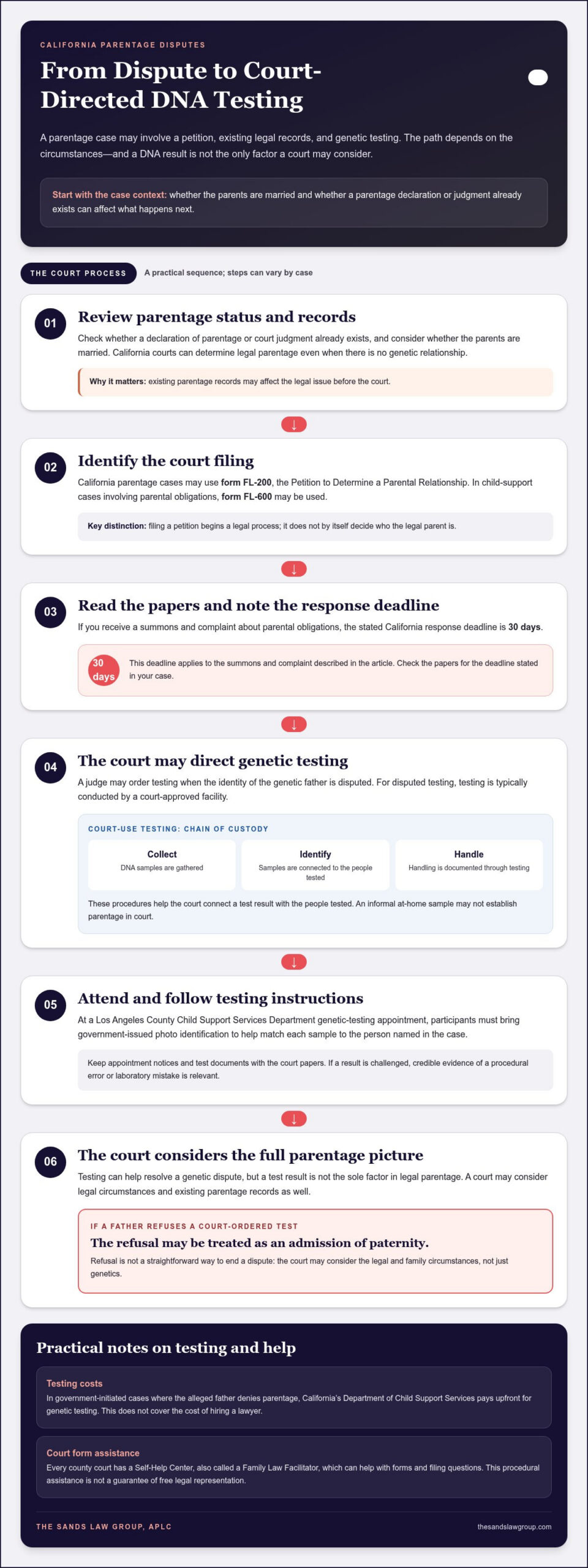
California parentage cases may use form FL-200, the Petition to Determine a Parental Relationship, according to the Judicial Council of California. Filing the petition begins a legal process; it does not itself decide who the legal parent is. If someone receives a summons and complaint about parental obligations, the response deadline stated for California is 30 days.
A judge may order testing when the genetic father’s identity is disputed. However, California courts can determine that someone is a child’s legal parent even without a genetic relationship. An attorney can assess how the petition, testing request, and existing parentage records relate to the judgment being sought. A father’s refusal to attend a court-ordered test may be treated as an admission of paternity.
DNA Test Chain of Custody and Compliance
Chain of custody documents how DNA samples are collected, identified, and handled through testing. It matters because the court needs to connect each result with the people tested.
Legal DNA testing uses chain-of-custody procedures for court use, and disputed testing is typically conducted by a court-approved facility. This differs from collecting a sample informally at home. If someone challenges a result, credible evidence of a procedural error or laboratory mistake is relevant.
At a Los Angeles County Child Support Services Department genetic-testing appointment, participants must bring government-issued photo identification. This helps match each sample to the person named in the case. Follow the appointment instructions and keep notices and test documents with the court papers.
Testing Costs and Legal Aid
Testing costs depend on how the case is handled and who arranges the test. In government-initiated cases where the alleged father denies parentage, California’s Department of Child Support Services pays upfront for genetic testing. This does not cover the cost of hiring a lawyer.
Are there free or low-cost legal aid services for paternity cases in California? Every county court has a Self-Help Center, also called a Family Law Facilitator, that can help with forms and filing questions. This is procedural assistance, not a guarantee of free legal representation.
For example, someone uncertain about completing a petition can seek help understanding court forms and where to file them. A person who needs an attorney to appear in court should distinguish that representation from paperwork assistance. Legal representation for a paternity test case in California may be relevant when a dispute involves contested evidence, existing parentage records, or court proceedings.
Effects on child support, custody, and visitation
Legal parentage connects a child’s relationship with a parent to financial responsibilities and court-ordered parenting rights. In California, only legal parents can obtain custody and visitation orders, and legal parents are responsible for financially supporting their child. Establishing parentage therefore affects more than a name on a record: it can shape support, parenting time, and access to family-related benefits.
How parentage affects support and parenting orders
Once legal parentage is established, a father may seek custody or visitation orders and become responsible for child support. A parentage finding does not itself determine a parenting schedule. California custody arrangements are based on the child’s best interests, while child support obligations after legal recognition are based on the father’s income.
These are related but separate questions. For example, a father may ask the court to set visitation while the court considers support obligations separately. A court order can address these issues through the applicable proceedings, and a parentage finding establishes the legal relationship needed to request those orders. A child may also gain rights to financial support from both parents, access to family medical records and medical benefits, and inheritance rights when applicable.
How a local child support agency may be involved
When parentage is disputed in a child support matter, a local child support agency can help obtain genetic testing. California child-support cases involving parental obligations may use form FL-600, Summons and Complaint Regarding Parental Obligations. The filing connects the parentage issue with the support case, rather than treating the test result as a complete determination of custody or visitation.
An agency’s role can be especially relevant when one parent seeks support and the other denies parentage. Legal parentage must be addressed before the court can impose parental support obligations. If parentage is already established through a filed Declaration of Parentage, it has the same force and effect as a court judgment for paternity, so the existing record matters to the next step.
Interstate enforcement and practical next steps
A parent’s move across state lines does not necessarily end a California support matter. The Uniform Interstate Family Support Act allows California to enforce child support orders across state lines. In Los Angeles County cases, Child Support Services can coordinate genetic testing in participants’ home states when parents live in different states.
Keep copies of parentage documents, court orders, and support filings together. If an order already exists, identify the court and the issues it covers before pursuing a change or additional relief. If legal parentage is established but parenting time remains unresolved, discussing child custody and visitation arrangements can help clarify the options for addressing that separate issue.
Disputing paternity
A paternity claim can affect legal parentage, support, and visitation. Start by identifying what already establishes the relationship. California courts consider more than genetic evidence: marriage, a voluntary declaration, and a prior judgment can change how a dispute proceeds. The relevant filing and deadline depend on which basis applies.
Review the existing parentage record
Start by locating any filed Voluntary Declaration of Paternity or Parentage, parentage judgment, and court papers. A filed declaration has the same force and effect as a court judgment for paternity. That makes the signed document legally significant, even when someone later questions the genetic relationship.
Genetic testing may be worth considering before signing a voluntary declaration. After the form is filed, parents may not request genetic testing, and someone seeking to challenge the declaration may face a limited window. A motion to set aside a voluntary declaration or judgment usually has a two-year filing window from when the person knew or should have known about the issue. Acting promptly matters.
Consider presumptions and deadlines
California law can presume a husband is a child’s father when the child is born during marriage or within 300 days after the marriage ends. A biological test does not automatically erase that presumption or decide every legal question. Courts may find a man is a legal father through parentage by estoppel, even without a genetic relationship.
A challenge to presumed parentage generally must be made within two years of the child’s birth. That deadline differs from the usual filing window for setting aside a declaration or judgment. For example, a person disputing a filed declaration should identify when they learned of the issue, while someone challenging presumed parentage must account for the child’s birth date.
Representation in an Orange County dispute
An Orange County family law attorney can assess which legal basis applies, what filings exist, and what relief the court can consider. The analysis may include the child’s relationship with the alleged father, prior care, and whether a judgment or declaration controls. California judges consider more than genetics, so a dispute may not be resolved by presenting a test result alone.
Before discussing strategy, gather the declaration or judgment, court notices, relevant dates, and any genetic test documentation. If a court case is active, note its county and filing status. A default paternity judgment can be difficult or impossible to undo, even when a later DNA test indicates the person is not the biological parent. An attorney can help evaluate the available challenge and its timing.
Legal paternity test procedures and chain of custody
A court-related genetic test must connect each biological sample to the person who provided it. Chain-of-custody procedures document that connection and the sample’s handling, helping the court assess whether results relate to the alleged father and child named in the case. Testing supports a parentage decision; it does not, by itself, resolve every question about parental rights or obligations.
When genetic testing is ordered, it is typically conducted by a court-approved facility. The county or regional child support agency can explain its testing process, which varies across California. In Los Angeles County, DNA is collected using cheek swabs rather than blood tests. Sample collection is described as taking about five minutes, but results take longer: in Los Angeles County, they usually take several weeks.
At a Los Angeles County Child Support Services Department appointment, each participant must bring government-issued photo identification. This helps match the person attending with the identity recorded for the genetic test. Follow the appointment instructions and ensure the alleged father appears as required. If someone refuses to attend a court-ordered test, a California court may treat that refusal as an admission of paternity.
For court use, the key issue is not simply whether DNA was collected. The process must document who provided each sample and preserve its connection to the reported result. If a party challenges a result, credible evidence of a procedural error or laboratory mistake matters. Disagreeing with the outcome alone does not establish that the testing process was flawed.
Results can have consequences beyond identifying a biological relationship. A court may issue a judgment of paternity when genetic results show a probability of parentage of 99% or higher. Legal parentage can then affect support obligations and requests for custody or visitation orders. It may also affect a child’s access to both parents’ medical benefits, including health insurance, where applicable.
Keep appointment notices, identification details, and the resulting report with the case papers. If a report appears to identify the wrong participant or contains an apparent laboratory error, preserve it and raise the specific concern in the court process. Because California county agency procedures vary, the relevant agency’s instructions govern appointment details, while the court addresses the dispute and its legal effect.
What is the difference between legal and at-home DNA paternity tests in California?
The key difference is whether the testing process can support a court proceeding. A private, at-home paternity test may provide personal information, but private paternity tests in California lack legal validity for court proceedings. If a parent needs a court to decide parentage, the test must fit the court process, not simply produce a result for private use.
When paternity is disputed, legal testing is typically conducted through a court-approved facility. The collection and handling process is documented to connect each sample with the person tested. That documentation distinguishes a court-use test from an at-home kit, which lacks a court-use chain of custody. A test result alone does not replace a court’s parentage decision.
An at-home test may seem like a faster way for family members to learn about a possible biological relationship. But if the result is meant to resolve an active California case, relying on a private test can leave the legal question unanswered. For example, a parent who receives a private result may still need to request genetic testing through the court process.
Consider the purpose of the test. For personal understanding, a private test and a court-use test serve different roles. To establish or challenge parentage in court, follow the court’s testing direction and use the designated process. If the alleged father disputes the claim, the court can consider a request for genetic testing; a private result does not automatically determine legal parentage.
Existing legal records also matter. A filed voluntary declaration or parentage judgment may affect whether genetic testing can be requested and what issue the court must decide. For instance, a parent questioning a declaration should not assume that an at-home result will set it aside. California law has strict deadlines for challenging parentage status or a judgment, so the document and timing require careful review.
Keep any private report, court notice, and parentage document separate and clearly labeled. Share a private result with an attorney as background, not as a substitute for court-directed evidence. If the court has already ordered testing, follow the appointment instructions rather than arranging a separate test and expecting it to replace the ordered process.
If you’re deciding how a DNA result fits into a California parentage case, discuss your paternity dispute with an attorney before relying on a private test to resolve a court issue.
The Sands Law Group, APLC: Divorce Legal Representation
The Sands Law Group, APLC provides Divorce Legal Representation for people addressing broader family-law issues that can accompany a parentage dispute. When questions about legal parentage overlap with divorce or disagreements about parenting time, Child Custody and Visitation Representation can help address those related concerns through the appropriate family-law process.
Consider seeking legal guidance when a dispute affects existing custody arrangements, visitation, or divorce proceedings. Court orders and family circumstances matter, and understanding how the issues connect can help clarify your priorities and next steps. The firm also handles Spousal Support Representation and Property Division Representation in divorce matters.
For information about legal representation, contact The Sands Law Group, APLC or visit thesandslawgroup.com.
Choose a Path That Protects Your Family’s Next Chapter
Paternity test legal representation in California can help you understand how a parentage dispute connects with broader family-law concerns. As you consider what comes next, identify the outcome you are seeking and any related decisions that may need attention. A focused discussion can help clarify your priorities and the issues to raise with counsel.
The Sands Law Group, APLC offers Divorce Legal Representation, Child Custody and Visitation Representation, and Spousal Support Representation. If a dispute overlaps with divorce proceedings, parenting arrangements, or support questions, paternity test legal representation in California can help you consider how those concerns fit together. Your family’s circumstances shape the next steps.
If you’re ready to discuss your situation, schedule a conversation with The Sands Law Group, APLC. A clear plan can help you move forward with greater purpose and steadiness.
Frequently Asked Questions
What If the Father Refuses the Test?
A California judge may treat an alleged father’s refusal to attend court-ordered genetic testing as an admission of paternity. The refusal does not itself decide custody, visitation, or support; those matters involve separate legal decisions. For example, a parent seeking a parenting arrangement should distinguish the court’s parentage determination from a later request for custody or visitation orders.
What role does a paternity lawyer play in the establishment process?
A paternity lawyer can help a parent understand which legal process applies and how parentage records affect the case. For example, a lawyer may review a filed declaration, court judgment, genetic-test report, or summons, then represent a parent in court proceedings. This can be especially relevant when establishing parentage is connected to child support or a dispute over parenting time.
Who is a legal parent?
A legal parent is someone recognized as a parent under California law, which can include a person who is not genetically related to the child. Legal status may arise through a court judgment, a filed declaration, or a legal presumption. For example, a husband may be presumed to be a child’s father in circumstances involving marriage, while parentage by estoppel can also affect a court’s determination.
Why is establishing paternity important in California?
Establishing legal parentage clarifies who has parental rights and responsibilities under the law. It can provide the basis for child support, custody, and visitation orders, and may affect a child’s access to benefits through both parents. For example, legal parentage may matter to a child’s access to family medical records, medical benefits, or inheritance rights when applicable.
When is a paternity test legally admissible in California?
A genetic test conducted through a court-approved process and documented with chain-of-custody procedures is intended for court use. Private at-home paternity tests lack legal validity for California court proceedings. For example, a private report may inform a family’s understanding, but it does not replace evidence obtained through the court process. Courts may issue a paternity judgment when results show a probability of parentage of 99% or higher.
How do you request a court-ordered paternity test in California?
A parent can raise the parentage dispute through a court case and request genetic testing as part of that process. California parentage cases may use form FL-200, the Petition to Determine a Parental Relationship, according to the Judicial Council of California. If the dispute concerns parental obligations, the case paperwork may follow a different route. The court or agency process determines the appropriate testing arrangement.
Does California require legal representation for a paternity case?
California courts provide Self-Help Centers, also called Family Law Facilitators, that can answer questions about forms and where to file them. This assistance can help someone understand filing procedures, but it is not the same as legal representation in court. A person facing disputed evidence, existing parentage documents, or a contested hearing may want to understand the role an attorney could play.
How can I find a California family law attorney for a paternity case?
The Sands Law Group, APLC handles formal paternity actions and family-law matters, including divorce, custody, visitation, and support representation. The firm serves clients in Los Angeles, Riverside, San Bernardino, and Kern. The website provides general information only, does not constitute legal advice, and contacting The Sands Law Group does not create an attorney-client relationship until a formal agreement is signed.

Article by
Thomas D. Sands, Esq.
Thomas D. Sands is the founder and CEO of The Sands Law Group, APLC. A California attorney with more than two decades of experience, he represents clients in divorce and family law matters as well as civil litigation and real property disputes. His approach emphasizes attentive, practical, and cost-conscious representation.
Sands is a 2023 Litigator of the Year honoree of the American Institute of Trial Lawyers and a 2023 Lawyer of the Year honoree of the American Institute of Legal Professionals. His firm has also received recognition among the 2025 Best Law Firms in America, a 2026 Benchmark Best of award, and a 2026 Law Firm of the Year honor.
Article reviewed by
Thomas D. Sands, Esq.
Thomas D. Sands is the founder and CEO of The Sands Law Group, APLC. A California attorney with more than two decades of experience, he represents clients in divorce and family law matters as well as civil litigation and real property disputes. His approach emphasizes attentive, practical, and cost-conscious representation.
Sands is a 2023 Litigator of the Year honoree of the American Institute of Trial Lawyers and a 2023 Lawyer of the Year honoree of the American Institute of Legal Professionals. His firm has also received recognition among the 2025 Best Law Firms in America, a 2026 Benchmark Best of award, and a 2026 Law Firm of the Year honor.
TOLL-FREE: 855-SANDS4U