
A child support modification may be sought when a current order differs by a significant margin from the amount calculated under current guidelines, or when a major shift in either parent’s income or a child’s needs affects the calculation. A post judgment divorce modification lawyer at The Sands Law Group, APLC can help you assess whether the facts support a formal request and how to present them effectively.
A change in earnings can feel urgent, especially when an existing order no longer reflects what a parent can pay or what a child needs. But a job loss or income shift does not automatically change the court-mandated order. The support calculation and the proper evidence of changed circumstances truly matter.
This article describes circumstances that may justify modifying child support, records that can help explain a change, and the general process for requesting a post-judgment modification. It also explains why an informal agreement may leave the existing court order in place and what may happen if the other parent contests the request.
Key Takeaways
- Compare the current child support order with the amount calculated under current Nevada guidelines; a difference of at least 20 percent may support seeking a modification.
- Gather current income records and documents showing changes in employment, a child’s needs, or healthcare coverage to help explain the request.
- Consider whether changes to custody, visitation, or parenting arrangements affect the circumstances behind the existing order.
- A post-judgment request involves filing with the court and giving the other parent notice; prepare to support the proposed change with clear evidence.
- Identify the specific change in circumstances and the adjustment you are asking the court to make before taking the next step.
How much does my income need to change before I can modify child support in Nevada?
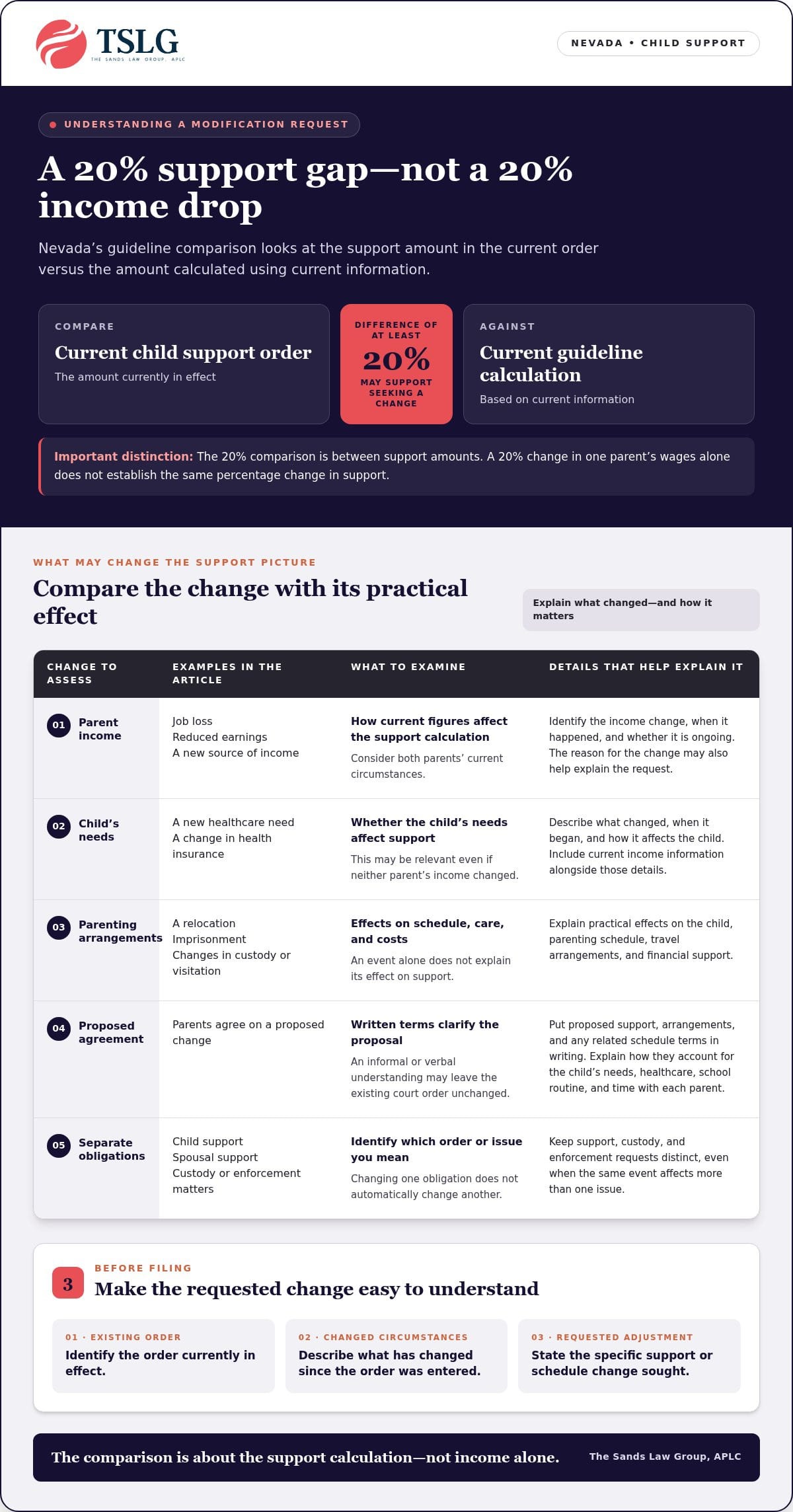
Nevada’s guideline comparison provides a practical threshold: a child support modification may be sought when the current order differs by at least 20 percent from the amount calculated under current child support guidelines. That figure compares support amounts, not simply one parent’s old and new income. A 20 percent wage decrease alone does not establish that the support calculation has changed by the same percentage.
Start by identifying the income change and how it may affect the support calculation. A job loss, reduced earnings, or a new source of income can change the financial picture, as can the other parent’s circumstances. For example, a parent who loses a job can gather records showing the change and compare the existing order with a calculation based on current information. The reason for the income change and whether it is ongoing may help explain the request.
A child’s needs may also be relevant even if neither parent’s income has changed. A new healthcare need or a change in the child’s health insurance may affect the support picture. Identify what changed, when it began, and how it affects the child. Presenting those details alongside current income information helps explain the requested adjustment.
Changes in custody or visitation may also affect the circumstances behind support. A parent’s relocation, for example, can alter travel arrangements and the time each parent cares for the child. Imprisonment may affect a parent’s income or ability to follow the parenting schedule. Explain the practical effects on the child, schedule, and financial support, rather than relying on the event alone.
Child support and spousal support are separate obligations, so a change affecting one does not automatically change the other. If income, health, or living circumstances have shifted, identify which order you want changed and why. Arizona State Legislature states that maintenance or support may be modified or terminated only for substantial and continuing changed circumstances, subject to exceptions. That is an Arizona rule, not Nevada’s standard, and should not be treated as controlling in a Nevada case.
For a Nevada request, focus on the changed circumstances and how they relate to the current support calculation. A post-judgment divorce modification lawyer can help organize financial and parenting information, distinguish a temporary disruption from a lasting change, and present the requested adjustment. Before filing, identify the existing order, what has changed since it was entered, and the specific support or schedule change you seek.
Child support modifications
A child support order may need review when income, a child’s needs, or family arrangements change. Keep a support request distinct from custody or enforcement issues, even when the same events affect each.
Child Support Order Changes
Compare the order in effect with a calculation based on current information. In Nevada, a modification may be sought when the existing order differs by at least 20 percent from the amount calculated under current guidelines. The comparison concerns the support amounts, not simply the percentage change in one parent’s income. A parent whose work hours fall should document the changed earnings and assess how the updated figures affect support.
Identify child support and family support accurately in the paperwork. State which obligation the existing order addresses and what change you seek. Do not assume that changing one obligation automatically changes another. If you seek a custody change as well, explain each request separately, including the proposed parenting schedule and its practical effect on the child.
Agreed Changes and Children’s Best Interests
If both parents agree on a proposed change, put the terms in writing, including the proposed amount, arrangements, and any related schedule terms. A written proposal clarifies what each parent intends, while an informal or verbal understanding may leave the existing court order unchanged. Explain how the proposed terms account for the child’s needs, healthcare, school routine, and time with each parent.
An agreement alone does not explain how the proposed terms address the child’s needs. For example, if relocation affects visitation, describe the proposed exchanges and how the child could maintain a stable routine. Keep support and custody terms clear, and explain the facts behind each requested change rather than relying on the parents’ agreement alone.
Child custody and support requests can overlap, but they address different questions. A custody proposal should describe the schedule change sought and its effect on the child’s day-to-day care. A support request should identify the financial information used to calculate the proposed amount. Keeping the explanations separate helps clarify the requested outcomes without confusing parenting time with a financial change.
In Clark County, the Division of Welfare and Supportive Services handles administrative child support enforcement separately from family court proceedings. Enforcement concerns, such as collecting support under an existing order, are therefore distinct from asking the family court to modify the order. Identify whether the issue is a changed support calculation, unpaid support, a custody adjustment, or more than one of these matters before preparing papers.
Before filing, prepare a concise comparison: the terms currently ordered, the new circumstances, and the specific change requested. Include the child’s needs and any related custody proposal, while distinguishing a modification request from enforcement. If you need help organizing child support and parenting issues, you can discuss your family law circumstances.
Documentation supporting a modification request
Organize records around the exact order you want changed and the circumstances that changed afterward. A dated, consistent record can connect each requested adjustment to supporting evidence.
Evidence of Ability to Pay Unpaid Support
For unpaid support, compare the payment history with the existing order and gather bank statements, payment confirmations, and written communications about missed payments. If you ask the court to consider your ability to pay, include recent pay records, employment changes, and necessary expenses. A timeline can help distinguish a temporary interruption from an ongoing financial problem; missed payments alone do not establish inability to pay.
Spousal Support Modification Records
For a spousal support modification, gather the current order, recent income records, and documents showing the changed circumstances behind the request. Examples include pay statements, job separation records, or medical documents describing an effect on work. If the request concerns temporary spousal support, identify it clearly and explain which financial circumstances have changed since the order was made.
Keep the original order at the front of your file and mark the exact child support, spousal support, custody, or visitation terms you want changed. Then create a dated timeline of relevant events, such as a job loss, new employment, or a change in the children’s care. This makes it easier to follow the connection between the order, the events, and the requested change.
- Income: Gather recent pay statements, employer records, and available tax documents for the relevant period.
- Employment: Preserve termination notices, reduced-hours communications, or records of a new position.
- Expenses: Organize bills and receipts that show recurring costs, especially expenses affecting a parent’s ability to pay.
- Parenting: Keep calendars and messages that document actual visitation or changes in the children’s care.
Use records that can be matched to specific dates and amounts. For example, pair a pay statement showing reduced earnings with an employer notice explaining the change. For unpaid support, compare the payment schedule in the order with bank records and receipts, and note disputed payments separately. Use written records where available rather than relying on memory.
Separate evidence supporting a change from material that explains the family’s broader circumstances. A child’s healthcare record may clarify a new need; a visitation calendar may show a changed care pattern. Keep private information focused on the issue and arrange documents by date. A short index naming each document and the fact it supports can make a complex request easier to review.
Before filing, check that the records tell a consistent story: what the order says, what changed, when it changed, and how the requested modification responds. If income records cover different periods, label each period clearly. If a spouse’s earnings or expenses are relevant to spousal support, keep those records distinct from child-related costs and unpaid support documentation.
Request for Order filing, service, and hearings
A post-judgment request asks the court to change an existing decree or order, not simply to record a private agreement. Filing, service, and hearing procedures depend on the court handling the case.
Filing and Serving a Modification Motion
To file a post-judgment modification request, identify the specific order terms you want changed, explain the changed circumstances, and provide records supporting the request. The motion is filed with the court handling the case; the other party must then be served with the filed papers and hearing information as required.
In Clark County, post-judgment motions are filed with the Family Division clerk at the Regional Justice Center, located at 200 Lewis Avenue in downtown Las Vegas. Keep copies of the filed motion and proof of service. If the other parent disputes the request, those records help establish what was filed and when notice was provided.
Mediation may provide a structured way for parents to discuss proposed changes before a contested hearing. It can help narrow disagreements about support or parenting schedules, but an agreement must go through the court process to change the decree. A conversation or mediation session alone does not replace a court order.
Required Documents and Court Rules
Nevada law governs the legal basis for changing an order, while the court handling the case determines applicable filing procedures, forms, service requirements, and hearing instructions. The county and case history may affect where papers must be filed, so the existing case and its court are important to the process.
Organize the current decree, the changes you seek, and evidence supporting each reason. For a support request, include relevant financial records; for a parenting request, explain the proposed schedule and its effect on the child. Before submitting papers, check that the names, case details, and requested relief match the existing order.
In Clark County, confirm which court has continuing jurisdiction before filing if the case originated in the Family Courts building on Pecos Road. Filing in the wrong court can delay consideration. Keep a copy of each submission and any court notice with the case records.
Hearings and Modification Timelines
The timeline for a post-judgment divorce modification depends on the court’s schedule, whether the other party contests the request, and whether additional evidence or hearings are needed. An agreed request may proceed differently from a disputed motion requiring the court to evaluate competing evidence.
At a hearing, be prepared to explain the existing order, what changed, and how the requested terms address that change. Arrange documents by date and identify the evidence supporting each point. If the other party objects, respond to the specific disagreement rather than repeating the entire history of the divorce.
An attorney can help prepare a motion, organize supporting evidence, and present a requested change clearly. The court’s written order records any approved modification. Until the order changes, the existing decree remains the reference point for the parties’ obligations.
Grounds for requesting post-judgment modifications
Which divorce orders can be modified after judgment, such as custody, child support, or alimony? Requests may concern child support, custody or visitation, and spousal support, but each order has its own requirements. Identify the exact provision at issue and the change you seek; don’t assume a change to one order automatically changes another.
A substantial change is more persuasive when you can connect it to the requested adjustment. For child support, compare the current order with a calculation using current guideline information; a difference of at least 20 percent may support seeking modification. A major income shift, a child’s changed needs, or new healthcare needs can help explain why the existing amount no longer fits the situation.
Parenting changes need a separate explanation. If relocation affects visitation, describe the proposed schedule, travel arrangements, and impact on the child’s routine. If a parent’s imprisonment disrupts the current arrangement, identify the practical change in care and the specific custody terms sought. Explain how the current order differs from the family’s circumstances now.
A spousal support request should identify the changed circumstances and connect them to the existing order. Records showing a change in income or health, for example, may explain why a spouse seeks a modification. State which terms you want changed, the reason for each change, and the evidence supporting it. A past disagreement or verbal agreement alone does not explain how the order should be revised.
When comparing post-judgment divorce modification lawyers, look for an attorney who handles family law modifications relevant to your order. Consider how clearly the attorney explains the process, evidence, and possible outcomes. Ask how your specific facts, such as an income change, relocation, or custody dispute, would be organized and presented.
A modification attorney should distinguish the changed circumstance from the adjustment you are requesting. Bring the existing decree, a concise timeline, and records tied to the change. For instance, pair employment documents with the support provision at issue, or provide a proposed visitation schedule alongside relocation details. This keeps the discussion focused on your circumstances rather than a general review of the divorce.
If you’re weighing a change to support, custody, or visitation, schedule a discussion about your modification request and the records that may support it.
The Sands Law Group, APLC: Divorce Legal Representation
The Sands Law Group, APLC provides divorce representation for people addressing family law matters after a judgment. If a changed financial situation affects child support or a revised parenting arrangement may require court review, legal representation can help clarify the order at issue, organize relevant records, and explain the process for requesting a change.
The Sands Law Group, APLC also represents clients in child custody and visitation and spousal support matters. These services may be relevant when a post-judgment request involves parenting time or support obligations. The current order and records showing what has changed can help focus the discussion on your circumstances and requested outcome.
For guidance on a post-judgment family law matter, contact The Sands Law Group, APLC or visit thesandslawgroup.com.
Take the Next Step Toward a Clearer Order
A family court order can shape finances and parenting long after a divorce ends. If your circumstances have changed, identify the practical outcome you seek, such as a support amount that reflects current circumstances, a workable parenting schedule, or both. Clear priorities can help keep the process focused on stability for your children and a manageable path forward.
Working with a post-judgment divorce modification lawyer can help you assess how requested changes relate to one another and prepare to explain them to the court. The Sands Law Group, APLC provides divorce representation, child custody and visitation representation, and spousal support representation for people addressing these family law matters.
When you’re ready to discuss your circumstances and possible next steps, contact The Sands Law Group, APLC. A thoughtful first conversation can help you move forward with greater clarity and purpose.
Frequently Asked Questions
Is Mediation Required Before Filing a Modification Motion in Nevada Family Court?
Mediation can help parents negotiate disputed terms, but it does not itself change a Nevada court order. Whether a court requires mediation depends on the case and applicable court procedures. A settlement discussion is not the filed motion, and agreed terms must still go through the court process to become part of the order. Counsel can explain the procedure for the assigned court.
Can I Move After My Divorce?
You may move after divorce, but relocating yourself is different from changing a child’s residence or parenting schedule. If a current order sets custody or visitation terms, consider how a move could affect exchanges, school routines, and the other parent’s time. A move within Nevada may require different arrangements from one that changes the child’s primary home. Review the decree before treating the move as a change to the order.
How Can a Post-Divorce Modification Lawyer Help?
A modification lawyer can review the existing judgment, identify the terms you want changed, and help organize records supporting your request. A support dispute may call for financial documentation, while a parenting issue may require a proposed schedule. The Sands Law Group, APLC provides family law representation in Los Angeles, Riverside, San Bernardino, and Kern, including matters involving divorce, custody and visitation, and spousal support.
How Do I Change My Placement and/or Custody Arrangement?
Start by identifying the custody or visitation terms in your current order and the schedule you propose instead. A clear calendar can show how exchanges, school days, holidays, and transportation would work. Explain the change affecting your family, such as a shift in a parent’s work schedule. Keep the proposal focused on the child’s routine rather than unrelated disagreements from the divorce.
How Do I Lower or Raise My Child Support or Family Support?
To request a lower or higher support amount, identify the support order and the financial or family change that supports the request. Reduced income may be relevant to a request for a reduction; changed income or a child’s needs may be relevant to a request for an increase. If the order uses the term “family support,” quote its wording rather than assuming it means only child support. Keep enforcement concerns, such as missed payments, distinct from a request to change future obligations.
What Happens When Your Kids Go to College?
College enrollment alone does not establish whether an existing support obligation ends or continues. Read the decree for terms addressing the child’s age, education, or duration of support, and distinguish those terms from tuition or other college expenses. A provision about support payments, for example, may not resolve how parents share education costs. If the order does not address college, identify that issue separately from any request to change current support.
What Do I Do If I No Longer Feel That My Divorce Settlement Is Fair?
Distinguish dissatisfaction with the original agreement from a change affecting an ongoing court order. Identify the specific term that concerns you, such as support or parenting time, and the new circumstance you believe matters. Property division may be treated differently from ongoing support or custody terms, so the decree’s wording is important. A concrete concern, such as a changed financial situation, is more useful to assess than a general sense that the settlement was unfair.
What Is a Post-Judgment Divorce Modification Lawyer?
A post-judgment divorce modification lawyer is an attorney who helps address requests to change terms in a divorce judgment, such as support or parenting arrangements. The information on this site is for general informational purposes only and does not constitute legal advice. Contacting The Sands Law Group, APLC does not create an attorney-client relationship; that relationship begins only after a formal agreement is signed. The firm handles family law matters in Los Angeles, Riverside, San Bernardino, and Kern.

Article by
Thomas D. Sands, Esq.
Thomas D. Sands is the founder and CEO of The Sands Law Group, APLC. A California attorney with more than two decades of experience, he represents clients in divorce and family law matters as well as civil litigation and real property disputes. His approach emphasizes attentive, practical, and cost-conscious representation.
Sands is a 2023 Litigator of the Year honoree of the American Institute of Trial Lawyers and a 2023 Lawyer of the Year honoree of the American Institute of Legal Professionals. His firm has also received recognition among the 2025 Best Law Firms in America, a 2026 Benchmark Best of award, and a 2026 Law Firm of the Year honor.
Article reviewed by
Thomas D. Sands, Esq.
Thomas D. Sands is the founder and CEO of The Sands Law Group, APLC. A California attorney with more than two decades of experience, he represents clients in divorce and family law matters as well as civil litigation and real property disputes. His approach emphasizes attentive, practical, and cost-conscious representation.
Sands is a 2023 Litigator of the Year honoree of the American Institute of Trial Lawyers and a 2023 Lawyer of the Year honoree of the American Institute of Legal Professionals. His firm has also received recognition among the 2025 Best Law Firms in America, a 2026 Benchmark Best of award, and a 2026 Law Firm of the Year honor.
TOLL-FREE: 855-SANDS4U