

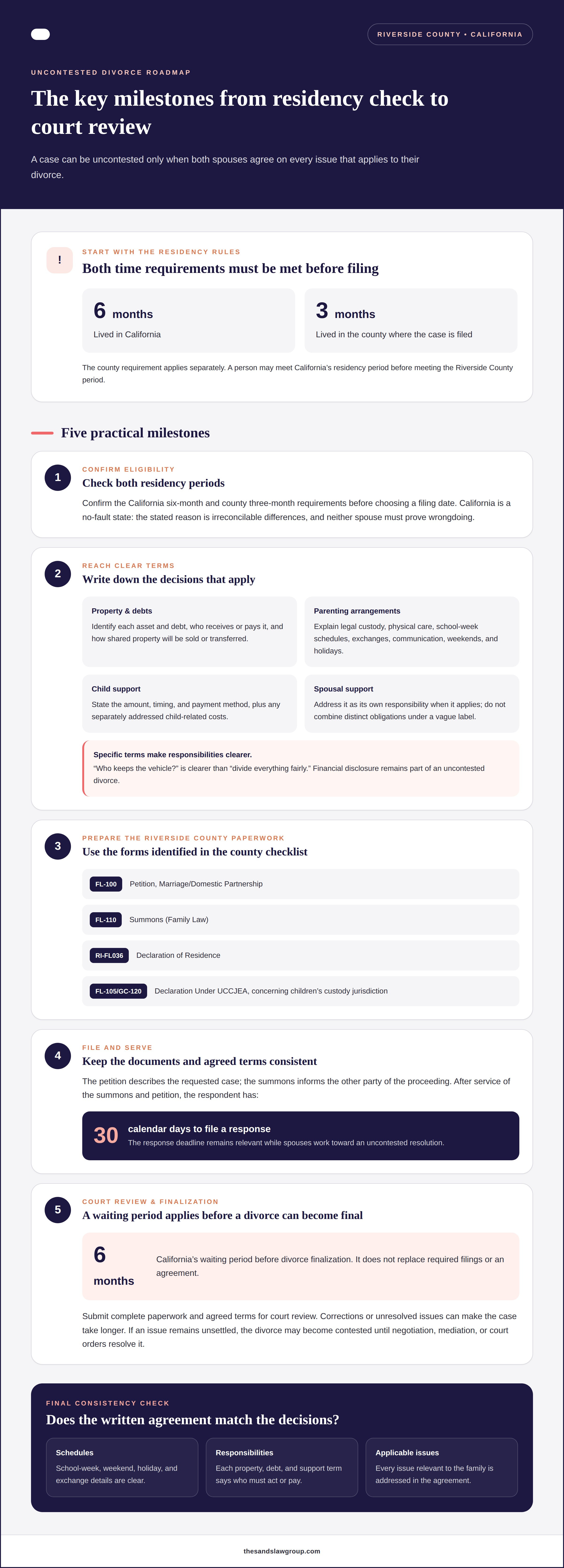
For a Riverside County uncontested divorce, the process generally starts by filing a petition in Riverside County Superior Court, then agreeing on the terms and submitting the paperwork for court review. At least one spouse must have lived in California for six months and in the county where the case is filed for three months before filing.
Even when both spouses want a straightforward resolution, decisions about property, parenting, child support, and spousal support can have lasting consequences. A complete agreement can clarify these responsibilities, but it must cover the issues that apply to your family and be prepared for court review.
This article explains Riverside County filing steps, California residency requirements, and how an agreement can cover property, parenting arrangements, and support. It also describes how legal representation can add structure and clarity to decisions that shape life after divorce.
Key Takeaways
- Confirm the residency rules before filing: according to the Judicial Council of California, a Riverside County filer must have lived in California for six months and in the county for three months.
- Account for property, debts, parenting arrangements, and applicable support terms in a complete agreement; an unresolved issue can change the path of the case.
- Financial disclosure remains part of an uncontested divorce, even when spouses agree on how to divide their assets and debts.
- Understand which forms and filing steps apply in Riverside County so paperwork is prepared for court review.
- Consider how child and spousal support terms will work in practice, not just how they read in the agreement.
Property, custody, parenting time, and support agreements
An uncontested divorce generally involves spouses reaching agreement on the issues that apply to their case. Their written terms can cover property, parenting, and support, giving Riverside County Superior Court a clear agreement to review.
Property Agreements
A property agreement should identify which assets and debts each spouse will receive or pay. For example, it can specify who keeps a vehicle and who takes responsibility for a listed credit-card balance. Clear descriptions distinguish each item and obligation, while broad phrases such as “divide everything fairly” leave important details unsettled.
Spouses should also address shared property that must be sold or transferred. The agreement can describe the action, who will carry it out, and how proceeds or remaining obligations will be allocated. Property Division Representation can help address complex ownership and division questions.
For parents, a custody agreement should explain legal custody and physical care arrangements in practical terms. A parenting plan can set out where children stay during the school week, how exchanges work, and how parents share decisions. The plan should reflect the children’s best interests for court approval.
Parenting time and visitation details matter because general promises can lead to conflicting expectations. A schedule might state which parent has the children on school days and how weekends alternate. It should also identify exchange locations and explain how parents will communicate changes, so each understands the arrangement.
Holiday schedules deserve separate attention. Parents can specify how they will divide school breaks, birthdays, and major holidays, including which parent has priority in alternating years. A written schedule can state when holiday arrangements replace the regular weekly plan, reducing uncertainty when calendars overlap.
Child Support Arrangements
Child support terms should clearly state the agreed arrangement, including the payment amount, timing, and method. The agreement should also explain how parents will handle child-related expenses they address separately, such as agreed educational or medical costs. Specific terms give both parents a shared reference point.
Support can be part of a broader California divorce or legal separation case, alongside custody, visitation, and property division. Spousal support is a separate issue that can also be covered in the agreement. Each term should identify the responsibility it covers instead of combining distinct obligations under a vague label.
Before signing, compare the written agreement with the decisions you actually reached. Check that the parenting schedule reflects the intended school-week and holiday arrangements, and that each property and support term identifies who must act. If even one issue remains unresolved, the divorce may become contested until negotiation, mediation, or court orders resolve it.
What residency requirements must I meet before getting divorced in California?
According to the Judicial Council of California, a person filing for divorce in Riverside County must have been a California resident for 6 months. The Judicial Council of California also says the filer must have lived in the filing county for three months. To qualify as uncontested, both parties must agree on every issue that applies to their divorce.
These residency rules determine where and when a dissolution case may begin. For example, a California resident who recently moved to Riverside County may meet the state requirement before meeting the county requirement. The county residence period applies separately, so consider both requirements when choosing a filing date.
California is a no-fault state. A spouse seeking divorce or legal separation states irreconcilable differences, and neither spouse must prove wrongdoing. This rule addresses the reason for ending the marriage, while agreement on issues such as parenting, property, and spousal support determines whether the case is uncontested.
Riverside County’s dissolution checklist identifies required forms, including the Petition, Marriage/Domestic Partnership (FL-100), Summons (Family Law) (FL-110), Declaration of Residence (RI-FL036), and Declaration Under UCCJEA (FL-105/GC-120). A filing checklist can help identify the documents needed for a case. The UCCJEA declaration concerns children’s custody jurisdiction, making accurate information important when parenting issues are part of the case.
Preparing forms involves more than filling in blanks. The petition describes the requested case, while the summons informs the other party of the proceeding. An attorney can organize required documents, review them for consistency, and prepare the filing sequence. This is especially relevant when the case also addresses custody, visitation, or support.
California’s waiting period affects when a divorce can become final. A divorce requires a six-month waiting period before finalization. This period does not replace required filings or an agreement. A case may take longer if paperwork needs correction or the parties have unresolved issues.
After service of the summons and petition, the respondent has 30 calendar days to file a response. If both parties agree, an attorney can help coordinate the documents and service steps while keeping the agreed terms consistent with the court filing. A response deadline remains relevant even when spouses are working toward an uncontested resolution.
Before filing, an attorney can assess residency, the forms, and any connected family-law concerns. If questions about parenting or spousal support affect the agreement, address them alongside the filing plan. To discuss the next steps, schedule a filing consultation.
Division of community property and debt
Property and debt agreements should make each allocation understandable and workable after dissolution. California spouses must exchange complete financial information, even when they agree on the division.
Community Property Division
Start by identifying each asset, its estimated value, and the proposed recipient. Include real estate, vehicles, bank accounts, household belongings, and retirement accounts when applicable. For a retirement account, note its type and the information used to describe its value. Clear records help both parties assess whether the proposed division reflects the financial information exchanged.
Then describe how each asset will be handled. An agreement might assign a vehicle to one spouse and a bank account to the other, while explaining any related payment or transfer. Avoid broad wording such as “split the assets.” Specific descriptions give the parties and the court a clearer account of their agreement.
Debt Division
List debts separately from assets, including the creditor, account type, current balance information, and proposed responsibility. A credit-card account and a vehicle loan create different practical obligations, so naming each helps prevent confusion. The agreement should state which spouse will pay each listed debt and how any shared obligation will be handled.
Review the debt list alongside the financial information exchanged during the case. If an account or balance appears in one spouse’s records but not the other’s, resolve the discrepancy before finalizing the agreement. A complete schedule helps ensure that debt allocation reflects the parties’ shared understanding rather than an incomplete snapshot.
Agreeing on Property Division
Reaching agreement requires more than matching assets with names. The parties should understand each item, its value, any debt connected to it, and the practical steps needed to carry out the allocation. If one spouse keeps a home with an outstanding loan, for example, the written terms should address the home and loan separately.
Retirement accounts deserve careful description because the account type and proposed division can affect how the agreement is carried out. State which account is involved and what allocation the parties accepted. Don’t assume that a general reference to “retirement” explains the intended result or provides enough detail to implement it.
Before signing, compare the proposed agreement with the financial disclosures and confirm that every identified asset and debt is addressed. Check that the wording distinguishes ownership from responsibility for payment. If the spouses disagree about an item’s value or who should receive it, that unresolved issue may prevent a fully uncontested dissolution until they reach agreement.
A careful review also considers timing. If an asset’s value may change before the agreement is implemented, the parties can state what information their allocation relies on. Property Division Representation can help organize the financial picture and clarify proposed terms when the division involves multiple accounts, debts, or competing interpretations.
What is the process of filing like in Riverside County?
A Riverside County divorce filing proceeds from the petition and response to agreement review and judgment. Incomplete documents or unresolved terms can delay review or make the case contested.
How a lawyer handles Riverside County Superior Court filing procedures
An attorney can organize the petition, summons, response or acknowledgment, and marital settlement agreement for submission to Riverside County Superior Court. The court reviews the signed forms and agreement before issuing a final judgment. If spouses live in different counties, a Riverside County resident may file in Riverside County or the other spouse’s county.
Riverside County has four court locations that handle family law. An attorney can identify the correct filing location and method because some documents can be submitted electronically, while others require paper filing. This helps align the case forms with the submission steps.
Court filing fees and fee waivers: what clients should know
Filers must submit the required fee or a fee-waiver request. Some people may qualify for a waiver based on eligibility for certain government programs or income thresholds.
An attorney can organize the filing materials and explain how the fee or waiver request fits into the submission. A waiver depends on eligibility, so include the applicable request in the filing package rather than assuming the fee is automatically removed.
Preparing documents for filing with a divorce lawyer
Riverside County dissolution filings require the original and at least one copy, with a maximum of two copies. The filing also requires the fee or a fee-waiver request. An attorney can assemble these materials and review whether each required document is included before submission.
Preparation also means keeping the petition, response, financial disclosures, and settlement terms consistent. For example, a support term in the agreement should not conflict with the parties’ other filed documents. Correcting mismatched information before filing can reduce requests for revisions during court review.
Mistakes or risks that can delay or invalidate an uncontested divorce in Riverside County, and how a lawyer can help avoid them
Missing forms, inconsistent information, or an incomplete agreement can lead to correction requests or delay court review. A single unresolved issue may make the divorce contested until negotiation, mediation, or court orders resolve it. An attorney can identify gaps and clarify terms before submitting the package.
Service and response steps also matter. In a California family-law case, the respondent has 30 calendar days after service of the summons and petition to file a response. A lawyer can track the filing sequence and address whether the other party has responded or acknowledged the case.
After submission, the court reviews the paperwork and may require clarification. A divorce can proceed without trial when the spouses agree on required terms, but a hearing may be needed if clarification is required or an issue becomes disputed. Careful document preparation helps the court assess the agreement as submitted.
Child and spousal support
Support terms shape financial responsibilities after separation, so give them careful attention before signing. In a Riverside County case, child support and spousal support are distinct issues, and each should be clearly addressed in the agreement.
Child Support and Parenting Arrangements
Consider child support alongside the parenting schedule. The time children spend with each parent affects household planning, while income and monthly expenses help explain the family’s financial picture. An attorney can organize these details and assess whether proposed terms address the children’s needs and both parents’ responsibilities.
For example, parents might agree on a weekly schedule but leave payment timing or shared child-related expenses unclear. Those gaps can create conflict after judgment. A written agreement should identify the support arrangement and explain how parents will handle expenses they have agreed to share, such as school costs.
Financial disclosure remains important even when parents agree. California spouses must exchange complete financial information in an uncontested divorce. Form FL-150 is among the financial disclosure forms identified for Riverside divorce cases. Reviewing disclosure information alongside the proposed support terms helps reveal whether the agreement reflects the family’s financial circumstances.
Custody or support disagreements can make a case contested, even when spouses agree on property. An attorney can represent a parent in discussions about custody, visitation, and support, clarify the requested arrangement, and identify unresolved terms before court review. The focus remains on the children’s interests and a workable plan.
Spousal Support and Clear Terms
Spousal support involves a different relationship and financial responsibility than child support. State the arrangement separately instead of combining it with child-related payments. Clear wording can identify the amount, payment timing, and any conditions the parties have agreed to include.
Before accepting proposed spousal support terms, each spouse should understand how they fit with the financial information exchanged in the case. An attorney can review income details, recurring expenses, and the proposed payment arrangement together. This can help identify a term that appears inconsistent with the information provided.
Riverside County Superior Court reviews the submitted agreement and paperwork. The judge’s review does not replace the parties’ responsibility to settle support issues clearly. If either spouse disputes a proposed term, it may require further negotiation or court resolution before the case can proceed as uncontested.
A practical review can follow three steps: separate child and spousal support, compare each proposal with financial disclosures, and clarify payment terms before signing. This helps spouses understand what each obligation covers and where the agreement still needs work.
For guidance on support proposals and related family-law concerns, schedule a support consultation.
The Sands Law Group, APLC: Divorce Legal Representation
The Sands Law Group, APLC provides divorce legal representation for people seeking a structured resolution in Riverside County. When an agreement involves parenting schedules, support obligations, or property division, legal guidance can help clarify the terms and prepare the case for court review.
Representation can also address a specific concern that needs careful attention, such as child custody and visitation, spousal support, or division of property and debt. If a disagreement emerges during an otherwise cooperative divorce, counsel can help assess the issue and explain how it may affect the case’s next steps.
Discussing your circumstances with an attorney can help you understand what decisions remain and how they fit into the filing process. Contact The Sands Law Group, APLC to talk about divorce representation.
Move forward with a plan that reflects your priorities
The decisions made during a Riverside County uncontested divorce can shape daily life long after the court process ends. Before moving ahead, consider which unresolved concern could most affect your family, whether it involves financial stability, parenting arrangements, or the practical steps needed to put an agreement into effect. A focused legal discussion can help turn uncertainty into a clearer path forward.
The Sands Law Group, APLC provides divorce legal representation, including assistance with child custody and visitation and spousal support matters. A useful next step is to discuss your circumstances, the decisions still before you, and the support you need to approach them thoughtfully. You don’t have to settle every question before seeking guidance.
Contact The Sands Law Group, APLC to discuss your situation and consider a way forward with greater clarity.
Frequently Asked Questions
Do Both Spouses Need a Lawyer in an Uncontested Divorce in California?
No, California law doesn’t require both spouses to hire separate attorneys in an uncontested divorce. Each spouse may choose independent representation, particularly if property, parenting, or support terms raise concerns. One attorney cannot ethically represent both spouses if their interests conflict. Contacting a law firm doesn’t create an attorney-client relationship before a formal agreement is executed. The website content is for general informational purposes only and does not constitute legal advice.
How can a lawyer help file for divorce in Riverside County?
A divorce lawyer can prepare and organize filing documents, help address how the case will be served, and follow the court’s review process. For example, an attorney can compare the requested orders in the petition with the spouses’ written agreement before submission. If Riverside County Superior Court requests clarification, counsel can help respond. This guidance can be useful even when both spouses expect to agree on the terms.
How can a divorce lawyer help me begin a divorce?
A lawyer can discuss your goals, identify the decisions the divorce must address, and prepare the initial petition for filing. For example, if you need orders about parenting or financial support, counsel can help identify those issues at the outset rather than leave them until later. The lawyer can also explain how filing and service fit together, so you understand what happens after the case starts.
How can a divorce lawyer help me end my marriage?
A lawyer can guide you through the dissolution case, help resolve terms that belong in the judgment, and prepare documents for court review. In California, divorce ends the marriage; legal separation does not, though a separation case may later become a divorce under certain circumstances. The court issues a Judgment of Dissolution after approving the paperwork. Counsel can help address the steps needed to bring the case to that point.
What Costs Are Involved in an Uncontested Divorce?
Some filers may qualify for a court fee waiver based on eligibility for certain government programs or income thresholds. A fee waiver concerns court filing costs, not attorney fees. Legal representation pricing depends on the case and is provided after a quote request; relevant factors can include the issues involved and work required.
What if I live in Riverside County but my spouse does not?
You may still be able to file in Riverside County. When spouses live in different counties, a Riverside County resident may file there or in the county where the other spouse lives. The appropriate filing choice can depend on the circumstances and residency requirements. A lawyer can assess those details and organize the case for the selected county, including documents about parenting or support when relevant.
How long must you live in California and Riverside County before filing for divorce?
A Riverside County divorce filer must have been a California resident for six months and lived in the filing county for three months before filing. These are separate residency requirements, so moving to Riverside County doesn’t by itself establish that both periods have been met. A divorce also requires a six-month waiting period before finalization.
Which Riverside County court handles divorce cases, and where can a lawyer file?
Four Riverside County court locations handle family law cases. The Riverside Family Law Courthouse is at 4175 Main Street, Riverside, California 92501. A lawyer can determine which family-law filing location applies and prepare documents for submission there. Riverside County courts accept some documents electronically, while others must be filed on paper, so the filing method depends on the document involved.

Article by
Thomas D. Sands, Esq.
Thomas D. Sands is the founder and CEO of The Sands Law Group, APLC. A California attorney with more than two decades of experience, he represents clients in divorce and family law matters as well as civil litigation and real property disputes. His approach emphasizes attentive, practical, and cost-conscious representation.
Sands is a 2023 Litigator of the Year honoree of the American Institute of Trial Lawyers and a 2023 Lawyer of the Year honoree of the American Institute of Legal Professionals. His firm has also received recognition among the 2025 Best Law Firms in America, a 2026 Benchmark Best of award, and a 2026 Law Firm of the Year honor.
Article reviewed by
Thomas D. Sands, Esq.
Thomas D. Sands is the founder and CEO of The Sands Law Group, APLC. A California attorney with more than two decades of experience, he represents clients in divorce and family law matters as well as civil litigation and real property disputes. His approach emphasizes attentive, practical, and cost-conscious representation.
Sands is a 2023 Litigator of the Year honoree of the American Institute of Trial Lawyers and a 2023 Lawyer of the Year honoree of the American Institute of Legal Professionals. His firm has also received recognition among the 2025 Best Law Firms in America, a 2026 Benchmark Best of award, and a 2026 Law Firm of the Year honor.
TOLL-FREE: 855-SANDS4U