
In California, custody decisions are based on the child’s best interests. High-conflict cases may involve mediation, Child Custody Recommending Counseling evaluations, and evidentiary hearings. Because temporary orders can shape later arrangements, a Riverside family law attorney should understand the legal issues and local court procedures. The goal is a parenting plan centered on the child’s needs, not the intensity of the conflict.
When parenting disputes escalate, it’s understandable to want clear answers about what happens next and how to protect your relationship with your child. This article explains how custody cases may proceed in Riverside and San Bernardino County, what can influence court decisions, and what to consider when choosing family law representation. It also outlines legal support for custody and visitation matters, helping you approach the next step with greater clarity.
Key Takeaways
- Understand how a child’s best interests guide custody decisions and why temporary orders can influence later arrangements.
- Learn what may happen in a high-conflict case, including mediation, Child Custody Recommending Counseling, and court hearings.
- Compare the practical factors that matter when choosing representation for custody disputes, divorce, or legal separation.
- See why local court procedures and scheduling can shape the steps involved in cases across Riverside and San Bernardino County.
- Use attorney credentials and professional recognition as context, while focusing on the experience and approach that fit your legal needs.
How are high-conflict custody cases handled in local courts?
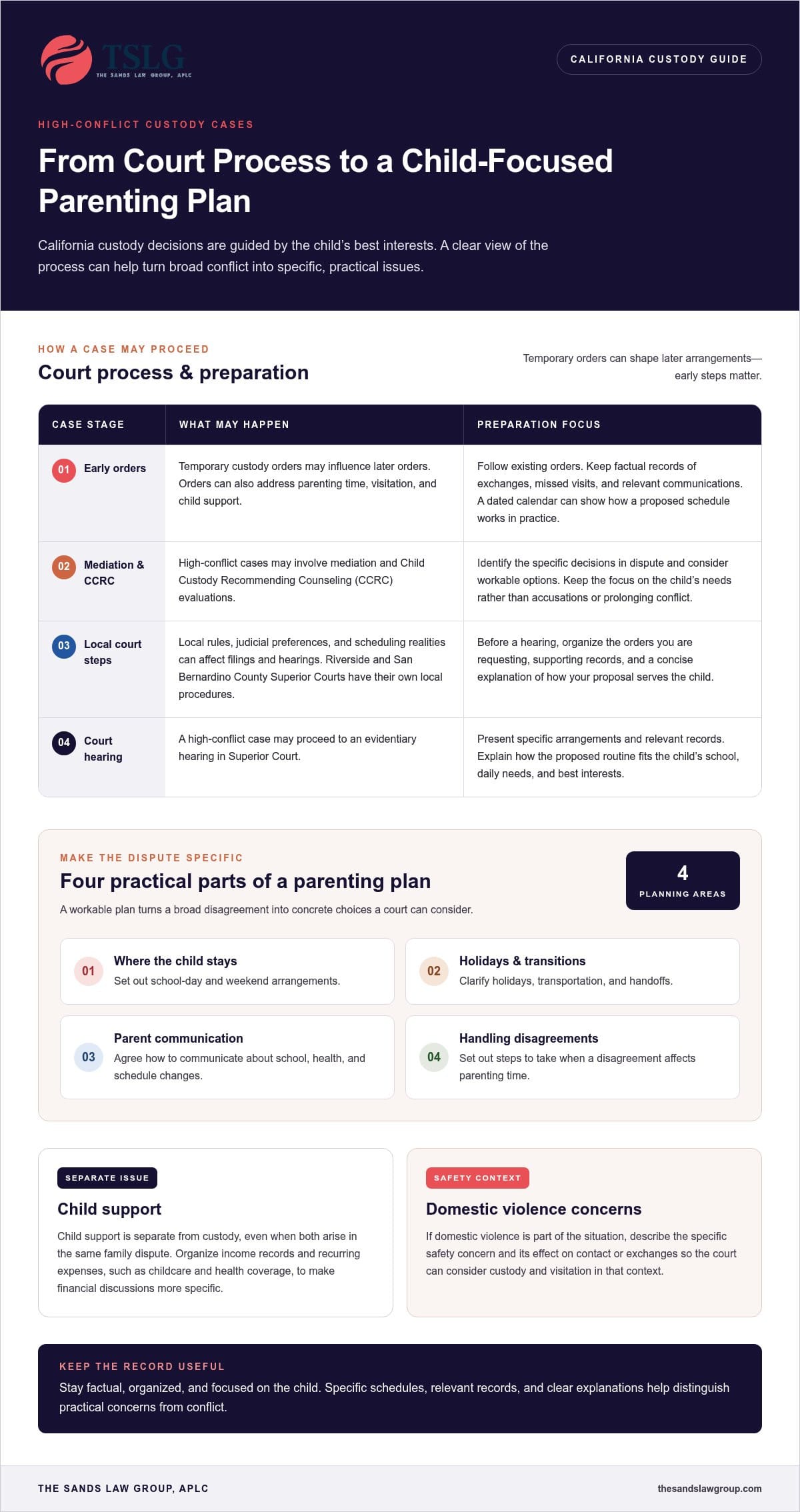
California courts decide child custody based on the child’s best interests. In Riverside County, high-conflict cases can involve mediation, Child Custody Recommending Counseling evaluations, and evidentiary hearings in Superior Court. Custody orders may also address parenting time, visitation, and child support.
Temporary custody orders can shape later orders, so the first court steps matter. Follow existing orders and keep a clear record of exchanges, missed visits, and relevant communications. A dated calendar, for example, can show how a proposed parenting schedule works in practice. Keep records factual and focused on the child, rather than using them to prolong disputes.
Local procedures affect how a case moves forward. Riverside Superior Court has local rules, judicial preferences, and scheduling realities that can shape filings and hearings. San Bernardino County Superior Court follows its own local procedures. Before a hearing, organize the orders you’re requesting, supporting records, and a concise explanation of how your proposal serves the child.
Child Custody Recommending Counseling, often called CCRC, may be part of a high-conflict custody process. To prepare, identify the specific decisions in dispute and consider workable options. A parenting plan can address:
- Where the child will stay on school days and weekends.
- How parents will handle holidays, transitions, and transportation.
- How they will communicate about school, health, and schedule changes.
- What steps they can take when a disagreement affects parenting time.
These details turn a broad disagreement into practical issues the court can consider. For example, a parent seeking a schedule change should explain the proposed routine and how it fits the child’s school and daily needs. Focus on specific arrangements, not accusations about the other parent.
Child support is separate from custody, even when both issues arise in the same family dispute. Organize income records and recurring expenses, such as childcare and health coverage, to make financial discussions more specific. Divorce proceedings may also address child and spousal support. If domestic violence is part of the situation, describe the specific safety concern and its effect on contact or exchanges so the court can consider custody and visitation in that context.
What should I look for in a family law attorney in Riverside or San Bernardino County?
In California, divorce may require resolving disputed financial and family matters through agreement or court proceedings. Compare lawyers by their experience with contested cases, communication, and familiarity with the county court handling your case.
For an initial meeting, bring court papers, a timeline of key events, and organized records about income, assets, debts, and parenting concerns.
Divorce and Legal Separation
Divorce ends a marriage, while legal separation allows spouses to address important family and financial issues without ending the marriage. In either case, identify whether you and your spouse agree about property, support, or parenting arrangements. A contested divorce requires attention to disputed issues and preparation for court proceedings. California Courts states that divorce cases have a minimum six-month waiting period.
Ask how the lawyer handles both negotiated resolutions and contested proceedings. A useful consultation should clarify which issues remain unresolved, what information is needed, and how the next steps relate to your priorities.
Comparing Attorneys by Experience and Reviews
Compare attorneys based on experience with the kind of case you face, such as contested divorce or complex property disputes. Look for reviews that describe communication, preparation, and responsiveness, rather than relying on broad praise alone. A Riverside family law attorney’s experience should relate to your legal needs, not simply years in practice.
Super Lawyers selects the top 5 percent of attorneys in each state for its annual Super Lawyers list and the top 2.5 percent for its annual Rising Stars list. Treat recognition as one comparison point, alongside case-specific experience and your assessment of the lawyer’s explanations.
Divorce and Partnership Dissolution
Marriage dissolution and partnership dissolution involve different legal relationships, so start by identifying which applies to you. In a consultation, explain how the relationship was legally established and list the questions you need resolved. This helps focus the discussion on the right process, including property or support concerns relevant to your circumstances.
For an initial meeting, bring court notices, existing agreements, recent financial records, and a short timeline of major events. If your case is in Riverside or San Bernardino County, note where it is pending and any upcoming hearing dates. Organized information makes the discussion more specific.
Before choosing, ask how the lawyer will explain options, address contested issues, and keep you informed about decisions. A conversation about divorce legal representation can help you clarify the support you need and the questions to address next.
Riverside and San Bernardino County representation
Family law representation should fit the issues in your case and the county handling it. Riverside Superior Court’s local rules, judicial preferences, and scheduling realities can shape case preparation.
For low-cost or free help in Riverside County, start with court self-help resources or legal aid organizations serving the county. These options may assist with procedures or eligible cases, while contested disputes may call for individualized legal representation.
Cases in Riverside and San Bernardino County may involve divorce, child custody, support, or property division. Identify the court handling your matter, the next filing or hearing date, and the decisions still unresolved. A Riverside County case requires attention to that court’s procedures; a San Bernardino County case follows its own local process.
Mediation gives parties a structured opportunity to discuss disputed issues and consider settlement. Prepare by listing the decisions that require agreement, gathering relevant financial information, and identifying workable options. For example, a proposed division of household expenses is more useful when based on actual income and recurring obligations.
A cost-conscious approach focuses effort on issues requiring legal analysis or court involvement. Organize documents by topic, respond promptly to requests, and distinguish essential disputes from points that may be resolved through negotiation. Clear priorities keep discussions centered on decisions affecting children, finances, or future arrangements.
Negotiation and trial preparation can go hand in hand. A lawyer can present proposals, review documents, and help assess the strengths and gaps in each position while preparing for a hearing if agreement remains out of reach. In Riverside Superior Court, attention to local rules, filing requirements, and hearing preparation matters.
Family law representation can address several connected issues. Divorce may involve property division and spousal support, while parenting disputes may involve custody, visitation, and child support. List each concern before seeking representation, then explain how one decision could affect another. This keeps the discussion practical.
To prepare for next steps, gather court papers, financial records, existing agreements, and a concise timeline. Mark upcoming deadlines and write down the outcome you’re seeking for each issue. A family law firm can use these details to explain possible next steps and identify matters that may be resolved through negotiation or mediation.
For example, if property division is disputed but support is not, prepare for those issues separately. Focus settlement discussions on the unresolved property questions and document any agreed terms clearly. This helps clarify what still needs attention in Riverside or San Bernardino County.
Attorney credentials and professional service
Credentials can help you assess an attorney, but they don’t show how that person will handle your case. In California, compare relevant family law experience, communication practices, and familiarity with the court where your matter is pending. For a custody dispute, ask how the attorney approaches parenting plans, evidence, and the child’s interests.
Professional recognition offers context, not a substitute for a case-specific discussion. Super Lawyers selects the top 5 percent of attorneys in each state for its annual Super Lawyers list. Its Rising Stars list selects the top 2.5 percent each year. Candidates must be 40 years old or younger or have practiced for 10 years or less. Consider these distinctions alongside the attorney’s work with cases like yours.
Specialized knowledge can also matter. The State Bar of California’s Family Law Advisory Commission is limited to 10 family law specialists from across California. When reviewing an attorney’s background, distinguish a formal specialty credential from general experience in family law. Ask what the credential represents and how that knowledge applies to the questions you need resolved.
Assess service through practical questions. Ask who handles routine communications, how updates are provided, and how urgent developments are addressed. If a proposed parenting-time change arrives before a hearing, for instance, you need to know who will review it and explain your options. Clear communication supports informed decisions, especially when children and family stability are at stake.
If your case is in Riverside or San Bernardino County, ask about experience with the relevant court. Riverside Superior Court’s local rules, judicial preferences, and scheduling realities can affect preparation. A useful answer explains how the attorney accounts for those procedures, rather than relying on a broad claim of local familiarity.
Before deciding, prepare a short list of questions and compare the answers. Consider whether the attorney listens closely, explains legal terms plainly, and identifies the documents or decisions requiring attention. A family law specialist may offer focused knowledge, while the attorney’s communication and preparation approach show how that knowledge may serve your interests.
- Ask about experience with the specific issue, such as custody or support.
- Clarify who will manage communications and explain case developments.
- Discuss how local court procedures affect preparation and scheduling.
- Review credentials as context, then assess whether the attorney’s explanations address your priorities.
These steps help you evaluate both professional background and day-to-day service. In a case involving children, ask how the attorney will keep proposed arrangements focused on their needs while presenting your position clearly.
Riverside family law attorney listings
Attorney listings can help you build a shortlist, but a profile is only a starting point. Compare each Riverside family law attorney by the family law matters handled, relevant credentials, and clarity about next steps. A polished listing alone cannot show whether the lawyer’s approach fits your priorities.
Recognition provides one point of comparison. Super Lawyers selects the top 5 percent of attorneys in each state for its annual Super Lawyers list. Its annual Rising Stars list selects the top 2.5 percent. Rising Stars candidates must be 40 years old or younger or have practiced for 10 years or less. Treat recognition as context, then look for experience related to your issue.
A listing that identifies a certified Family Law Specialist highlights a specific credential. Read the profile closely to understand who holds it and whether the attorney’s work relates to your concerns. For example, a parent facing a contested custody dispute should focus on experience with custody proceedings, not just a general claim of family law practice.
California family law cases can involve connected questions about children, support, and assets. California follows community property principles, under which assets and debts acquired during marriage are generally divided equally in divorce. If a listing describes divorce experience, consider whether it addresses property division alongside the other issues relevant to your situation.
Use a consistent review process for every profile:
- Note the lawyer’s stated focus and whether it matches your legal issue.
- Identify any specialist credentials or professional recognition described.
- Read client reviews for concrete details about communication and preparation.
- Write down questions about the court, process, and decisions in your case.
Reviews can show how former clients describe service, but they don’t establish how another case will proceed. Look for specific examples, such as clear explanations or timely updates, rather than relying on a single rating. In a consultation, ask how the attorney would approach your issue and what information would help assess it.
Listings can help distinguish experience from marketing language. A profile that names family law matters, professional credentials, and the attorney’s role gives you more to evaluate than one relying on broad claims. Compare the same details across profiles, then ask questions to assess how well each explanation addresses your needs.
Once you have a shortlist, arrange a conversation to discuss your priorities and the records relevant to your case. If you’re ready to explore representation, schedule a conversation about your family law matter.
The Sands Law Group, APLC: Divorce Legal Representation
The Sands Law Group, APLC provides Divorce Legal Representation for people navigating contested or uncontested divorce. When custody arrangements, financial support, or property division are also at issue, focused legal guidance can help you understand how those decisions connect and what needs attention first.
The firm also handles Child Custody and Visitation Representation, Spousal Support Representation, and Property Division Representation. If you’re facing a parenting dispute, working through support questions, or addressing assets during divorce, gather relevant court papers, financial records, and a concise list of concerns before discussing your situation.
Choosing representation is a personal decision, especially when family relationships and future stability are involved. Contact The Sands Law Group, APLC or visit thesandslawgroup.com to discuss your family law matter.
Choose a Clear Next Step for Your Family
Family disputes can make it difficult to separate urgent decisions from issues that can wait. Write down what needs resolution, what matters most to you, and which documents may help explain the situation. This preparation can make a conversation with a Riverside family law attorney more focused and help you understand the choices ahead.
The Sands Law Group, APLC provides Divorce Legal Representation, Child Custody and Visitation Representation, and Spousal Support Representation. If these issues shape your next chapter, discuss how they relate to your circumstances and what kind of representation may fit your needs. You can bring your questions without having every answer settled.
Taking time to seek guidance can help replace uncertainty with a clearer plan. Schedule a conversation with The Sands Law Group, APLC to discuss your family law concerns and possible next steps.
Frequently Asked Questions
Are you searching for a top family law lawyer in Riverside, California?
A strong fit is an attorney whose experience and communication style suit your legal needs, not simply the most visible listing. Consider whether the lawyer handles your specific issue, explains possible paths clearly, and describes who will manage your matter. Bring your priorities to a consultation to assess whether the attorney understands the decisions affecting your family.
How is property divided in a California divorce?
California generally divides assets and debts acquired during marriage equally under community property principles. To prepare for a property discussion, gather account statements, loan records, and documents showing when assets were acquired. Records tracking retirement contributions across different periods, for example, can help clarify what needs review. Organized documents make it easier to identify disputed values and questions requiring further attention.
What Should I Look for When Hiring a Riverside Divorce Lawyer?
Look for relevant divorce experience, clear explanations, and a practical plan for handling unresolved issues. Ask how the lawyer will communicate, who will respond to routine questions, and what documents would help assess your circumstances. If you have a business or several properties, raise that early and ask how those assets may affect the decisions in your case. Notice whether the answers address your actual concerns.
How do I find a family law attorney in Riverside, California?
Start by identifying the main issue you need help resolving, then compare attorneys whose work addresses it. For a matter in Riverside, San Bernardino, Los Angeles, or Kern County, consider whether the attorney serves the county where your case is pending. Prepare a concise timeline, relevant court papers, and questions about next steps to make an initial conversation specific and productive.
What family law services do Riverside attorneys handle?
Family law representation may address divorce, child custody and visitation, spousal support, property division, and paternity actions. These issues can connect: a parent establishing legal parentage, for example, may also need to resolve custody or child support. Identify the decisions you need help with instead of relying only on a broad service label. This can clarify what legal support fits your situation.
How much does a family law attorney cost in Riverside, CA?
The cost depends on the case and is provided after a quote request. Factors include the issues involved, whether the parties agree or contest key matters, the records requiring review, and preparation for negotiations or hearings. Before discussing representation, organize court papers and note the disputed decisions. A clear overview helps explain the work your case may require.
What qualifications should I check when hiring a Riverside divorce attorney?
Review the attorney’s education, relevant family law experience, and any specialty credentials. Ask what a credential means and how the lawyer’s experience relates to your case, such as contested divorce or complex property questions. You can also assess how clearly the attorney explains legal terms and responds to your concerns. Look for specific, relevant answers rather than general promotional language.
How are spousal support and property division handled in California?
Property division addresses marital assets and debts, while spousal support concerns financial assistance between spouses. California generally applies community property principles to assets and debts acquired during marriage. For support discussions, gather income information, recurring expenses, and records showing the household’s financial circumstances. These documents help frame the questions to resolve and clarify how support and property issues may interact.

Article by
Thomas D. Sands, Esq.
Thomas D. Sands is the founder and CEO of The Sands Law Group, APLC. A California attorney with more than two decades of experience, he represents clients in divorce and family law matters as well as civil litigation and real property disputes. His approach emphasizes attentive, practical, and cost-conscious representation.
Sands is a 2023 Litigator of the Year honoree of the American Institute of Trial Lawyers and a 2023 Lawyer of the Year honoree of the American Institute of Legal Professionals. His firm has also received recognition among the 2025 Best Law Firms in America, a 2026 Benchmark Best of award, and a 2026 Law Firm of the Year honor.
Article reviewed by
Thomas D. Sands, Esq.
Thomas D. Sands is the founder and CEO of The Sands Law Group, APLC. A California attorney with more than two decades of experience, he represents clients in divorce and family law matters as well as civil litigation and real property disputes. His approach emphasizes attentive, practical, and cost-conscious representation.
Sands is a 2023 Litigator of the Year honoree of the American Institute of Trial Lawyers and a 2023 Lawyer of the Year honoree of the American Institute of Legal Professionals. His firm has also received recognition among the 2025 Best Law Firms in America, a 2026 Benchmark Best of award, and a 2026 Law Firm of the Year honor.
TOLL-FREE: 855-SANDS4U