The right filing may require both California forms and San Bernardino County local family law forms. For divorce, at least one spouse must have lived in California for the last 6 months and in San Bernardino County for the last 3 months, according to California Courts. Knowing which forms fit your case is an important first step toward preparing a complete filing.
When you need San Bernardino County family court forms, start by identifying the type of case and the specific request you want the court to address. Residency rules affect where you file, while custody and support matters may involve different petitions and supporting documents.
This guide explains how to distinguish statewide forms from county forms, prepare paperwork, and review key details before filing. Use it to organize your next steps, while remembering that the right forms depend on your case and the orders you are seeking.
Key Takeaways
- According to California Courts, at least one spouse must have lived in California for the last 6 months to file for divorce in San Bernardino County.
- Identify whether your matter concerns custody, visitation, child support, or another family law issue before choosing petition forms.
- Learn how forms such as FL-300, FL-350, and FL-150 relate to requesting or changing child support.
- Distinguish California-wide forms from San Bernardino County local forms, which may address specific court procedures.
- Understand how online form preparation can help organize paperwork, while legal representation may be useful when custody, support, or property issues are contested.
California and county residency requirements
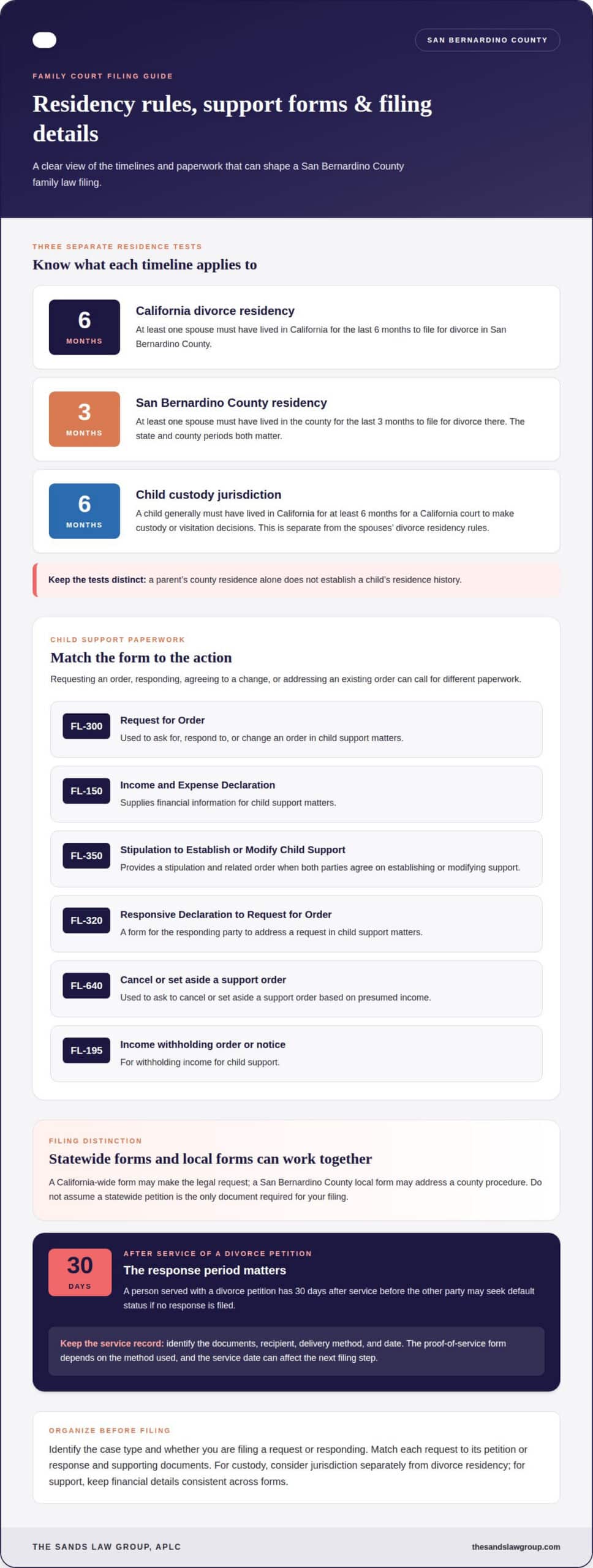
California residency means meeting the state’s residence rule before filing for divorce. According to California Courts, at least one spouse must have lived in California for the last 6 months to file for divorce in San Bernardino County. The rule concerns either spouse, not necessarily both. A couple living in California can still need to identify which county has filing authority.
County residency means meeting San Bernardino County’s separate residence requirement. According to California Courts, at least one spouse must have lived in the county for the last 3 months to file for divorce there. The state and county periods both matter. For example, a spouse who meets California’s 6-month requirement but has lived in San Bernardino County for less than 3 months may not meet the county rule.
Custody jurisdiction concerns whether a California court can make decisions about a child’s custody or visitation. A child generally must have lived in California for at least 6 months for the court to make custody or visitation decisions, according to California Courts. This is a child-focused rule, separate from the spouses’ divorce residency requirements. A parent’s county residence alone doesn’t establish the child’s residence history.
Support petitions request or respond to court orders involving financial support. For child support matters, San Bernardino County lists Request for Order form FL-300, Income and Expense Declaration form FL-150, and Stipulation to Establish or Modify Child Support form FL-350. These forms address different steps, so the requested order and whether both parties agree affect which applies. Additional California child support forms may also be relevant to a request, response, or existing order. Spousal support filings likewise depend on the order sought and the financial information required.
California Rules of Court set statewide procedures, alongside California family law and San Bernardino County Superior Court requirements. A statewide form may make the legal request, while a local form may address a county procedure. When preparing San Bernardino County family court forms, do not assume that a statewide petition is the only document required for your filing.
Service is the formal delivery of filed papers to another party. The service record should identify the documents, recipient, delivery method, and date; the proof-of-service form depends on the method used. A person served with a divorce petition has 30 days after service before the other party may seek default status if no response is filed. Keep the proof with the case papers, since the service date can affect the next filing step.
First identify the case type and whether you are filing a request or responding to one. Then distinguish statewide forms from local forms, and match each request to its petition or response and supporting financial documents. If children are involved, consider custody jurisdiction separately from divorce residency. These steps help you identify applicable requirements before filing in San Bernardino County Superior Court.
Custody and support petitions
A custody petition asks the court to establish or change arrangements for a child. Clarify whether you are asking about legal custody, physical custody, visitation, or an existing order. A proposed parenting schedule can set out regular exchanges, school-day routines, holidays, and how parents will handle changes. If you are seeking a change to an existing order, identify it and explain which terms you want the court to address.
A support request may ask the court to establish, modify, enforce, or end an order. Child support and spousal support involve different circumstances, so use forms and supporting information that match the type of request. San Bernardino County’s Department of Child Support Services lists common forms for requesting, enforcing, and ending child support, and directs readers to California Courts for additional child support forms. To seek a change, identify the existing order and explain what change you are requesting.
For child support, FL-300 is the Request for Order used to ask for, respond to, or change an order. FL-150, the Income and Expense Declaration, supplies financial information for child support matters. If both parties agree on establishing or modifying support, FL-350 provides a stipulation and related order. These documents have distinct purposes. A proposed agreement does not replace the financial details needed to explain the requested amount or change.
- FL-320: A Responsive Declaration to Request for Order used in child support matters. It gives the responding party a form for addressing the request.
- FL-640: A form for asking to cancel or set aside a support order based on presumed income.
- FL-195: An income withholding order or notice to withhold income for child support.
- FL-150: An Income and Expense Declaration used in child support matters.
Choose forms based on the action you are taking, not just the general topic. Requesting a new support order, responding to a pending request, and asking the court to use presumed income can involve different paperwork. In a custody case, the proposed parenting arrangement and any existing orders shape what information to include. Organize supporting records by issue, such as financial documents for support and proposed schedules for custody, and keep details consistent across forms.
When custody or support issues affect a child’s routine or a parent’s financial stability, the form choice can carry significant consequences. Child Custody and Visitation Representation or Spousal Support Representation may help address the legal issues behind the paperwork. To discuss custody or support representation with The Sands Law Group, APLC, consider how the requested order would address the specific issue in your case.
Establishing or modifying child support
Establishing child support means asking the court to create an order. Modifying child support means asking to change an existing order. In San Bernardino County, the forms depend on the action requested and whether the other party agrees. Identify any current order, describe the change or outcome you are seeking, and organize relevant supporting documents, including financial information.
FL-300 is the California Request for Order form used to ask for, respond to, or change a child support order. It provides the central request in a filing, rather than replacing financial forms. For example, a parent seeking a new order can use FL-300 to present that request. Someone responding to a pending request uses the response process instead. The form’s role should match the party’s position.
FL-150 is the Income and Expense Declaration listed for child support matters. It organizes financial information alongside the request. Complete financial details help explain the circumstances behind a proposed order or change. Keep supporting documents arranged by the information they relate to, such as income or recurring expenses. This makes the connection between the declaration and the request easier to follow.
FL-350 is the form for stipulating to establish or modify child support and for the related order. It fits an agreement between the parties, rather than a request asking the court to resolve a disagreement. The distinction matters: an agreed proposal and a contested request follow different paperwork paths. Read the form as part of the complete filing, not as a substitute for unrelated supporting documents.
- FL-300: Use it to ask for, respond to, or change a child support order.
- FL-150: Use it to present income and expense information in a child support matter.
- FL-350: Use it to document a stipulation establishing or modifying support, with the related order.
FL-320 is the Responsive Declaration to Request for Order form listed for child support matters. It is relevant when responding to a request, while FL-300 presents the request itself. FL-640 is used to request cancellation or setting aside of a support order based on presumed income. These forms address distinct procedural situations, so the case history and requested action guide selection.
FL-195 is an income withholding order or notice to withhold income for child support. It concerns income withholding, not the initial request to establish or modify support. San Bernardino County also identifies common forms for requesting, enforcing, and ending child support. California Courts provides additional child support forms. Use that distinction to separate the order being requested from documents addressing enforcement or withholding.
Before filing, arrange the paperwork in a clear sequence: identify the action, select the matching request or response, and gather financial documents that support the information provided. Check that names, case details, and requested terms remain consistent across forms. For example, an FL-300 request to change an order should align with the financial information in FL-150. That consistency helps present the issue clearly.
Family law forms and online form preparation
Family law form preparation means completing court documents for a specific request. Online tools can help organize case information, but preparing forms and filing them with the court are separate steps.
Family Law Form Preparation
To prepare family law forms, identify the case type and your role in the filing. If you are responding to a request, use responsive paperwork; if you are asking the court for relief, use the corresponding petition or request. Check that the form title and case number are consistent across related documents.
Use each document for its stated purpose. California’s Petition for Dissolution of Marriage is FL-100. San Bernardino County also lists a Declaration Regarding Ex Parte Notice, revised 03/11/13, and a Stipulation and Order on Request for Order, revised 11/05/12. These titles signal different procedures, so selecting by name alone may not resolve which documents belong together.
A court self-help center may provide assistance with form fields and filing procedures, while you remain responsible for supplying accurate case information. Before you begin, organize the orders you are requesting and any relevant financial documents. Keep a copy of each completed form so you can refer to the same information when responding to later filings.
Filing Forms Online or in Person
Filing is the act of submitting completed court documents for a case. Online form preparation does not, by itself, submit paperwork to the court. For online filing, follow the San Bernardino County Superior Court’s filing instructions for the specific case and form. For an in-person visit, the Family Law Court is at 351 North Arrowhead Avenue, Third Floor, San Bernardino, California.
Before submission, confirm the form set matches the requested action. For example, the court lists a Request to Set Uncontested Matter, revised 04/01/13, and a Notice of Continuance of Hearing (Family Law), revised 05/01/19. Those titles relate to distinct court events, not interchangeable filing purposes. Check that all required fields are completed and supporting documents accompany the correct request.
The San Bernardino County Superior Court lists local rules effective January 1, 2026. A local rule may affect how a filing is handled, while the statewide form captures the underlying request. Keep the applicable local instructions with the form set. If a parent is responding, organize the response around the request received, rather than starting with unrelated forms.
A self-help center can provide procedural guidance on family forms. Bring the form names, court papers you have received, and questions about completing specific fields. The court’s Family Law Court location is an in-person resource. Preparing forms online does not itself file them; submit them through the court’s designated process.
San Bernardino County local family law forms
Local family law forms address procedures in San Bernardino County Superior Court and supplement statewide forms. A divorce filing may therefore involve both. Read each local form’s title to understand whether it relates to trial setting, settlement, or another court process. Match the county form to your case stage and purpose rather than using it in place of a statewide petition.
The Settlement Conference Brief is a local form listed by the court for settlement conference matters. San Bernardino County Superior Court lists it as revised on 09/17/13. The Family Law At-Issue Memorandum for Trial Setting concerns trial setting, and the court lists it as revised on 02/16/17. These examples show how local documents can support specific stages after the initial filing.
An Agreement for Judgment records an agreed judgment, with separate versions for cases with children and without children. San Bernardino County Superior Court lists both versions as revised on 06/10/19. The distinction matters because a case involving children may require terms addressing their circumstances. Use the form that corresponds to the case, and keep its terms consistent with the parties’ agreement and related filings.
Other local forms address specific family-law situations. The court lists a Petition for Grandparent Visitation, revised on 08/01/20, along with an Order on Petition for Grandparent Visitation and a Response to Petition for Grandparent Visitation, each revised on 08/01/20. A petition initiates a request, while a response addresses one already made. The related order serves a different function, so these documents should not be confused.
The local forms also include a Declaration Regarding Compliance with Custody Orders, revised on 11/05/21, and a Petition for Family Visitation, revised on 03/12/13. A declaration and a petition are different document types: one addresses compliance, while the other presents a request. For example, a summons in a case does not replace a local declaration or petition required for a separate purpose.
A fee waiver is a request for the court to excuse filing fees. Submit the court’s fee-waiver request through its process; eligibility is determined under applicable rules. A listed fee amount for divorce does not necessarily apply to every family law filing.
Use the current local form title that fits the case stage, then pair it with the relevant statewide paperwork. If an agreement concerns support between spouses, discuss spousal support representation to address the legal issues behind the proposed terms.
The Sands Law Group, APLC
The Sands Law Group, APLC represents clients in divorce and family law matters. Court forms record requests and information, but paperwork alone may not resolve disputes involving custody, support, property division, or parentage.
Consider legal representation if you need to establish or respond to custody and visitation arrangements, address spousal support, divide property, or bring a paternity action. The relevant forms depend on the case and the order requested. The Sands Law Group, APLC provides representation in divorce and family law matters, including custody, spousal support, and property division.
For guidance on how family law issues relate to your court paperwork, contact The Sands Law Group, APLC.
Choose a Clear Next Step
Preparing San Bernardino County family court forms can help organize your filing, but each form reflects a decision about what you are asking the court to do. Identify the outcome you need and consider how it may affect your family. When several issues overlap, setting clear priorities can help you focus on the decisions ahead.
The Sands Law Group, APLC offers Divorce Legal Representation, Child Custody and Visitation Representation, and Spousal Support Representation. These services may be relevant when paperwork connects to difficult decisions about parenting arrangements, financial support, or the terms of a divorce. Legal guidance can help you understand the issues involved and approach those decisions with care.
You don’t have to resolve every question before taking a first step. Schedule a conversation with The Sands Law Group, APLC to discuss your family law concerns and consider a path forward. A thoughtful next step can make a complex process feel more manageable.
Frequently Asked Questions
Where can I find official San Bernardino County family court forms?
Find county-specific documents in the San Bernardino County Superior Court’s family law forms resources, and statewide Judicial Council forms through California Courts. Begin with the court handling your case, then check the document title and revision date to avoid using an older version saved on your device. Keep downloaded forms organized by case issue.
What forms are needed to request child custody or visitation orders in San Bernardino County?
The forms depend on whether you’re requesting an order, responding to a request, or addressing an existing order. FL-300 is used to request a court order, including custody or visitation relief; describe the schedule or change sought clearly. For example, specify the parenting arrangement at issue rather than leaving the request general. A response should address the orders requested in the papers served on you.
Are there local San Bernardino County family court forms or rules in addition to California Judicial Council forms?
Yes. San Bernardino County Superior Court provides local family law forms and local court rules that may apply alongside California Judicial Council forms. Local documents address county procedures, while statewide forms cover common requests. Match each document to your case stage and purpose, and review applicable local instructions before filing. The website content is for general informational purposes only and does not constitute legal advice.
How do I serve family court papers in San Bernardino County, and which forms document service?
Serve filed papers by formally delivering them to the other party. The proof-of-service form depends on the delivery method. Record the documents served, recipient, method, and date, and complete the applicable proof of service.
What are the filing fees for family law cases in San Bernardino County, and how do I request a fee waiver?
No fee-waiver request steps are provided.

Article by
Thomas D. Sands, Esq.
Thomas D. Sands is the founder and CEO of The Sands Law Group, APLC. A California attorney with more than two decades of experience, he represents clients in divorce and family law matters as well as civil litigation and real property disputes. His approach emphasizes attentive, practical, and cost-conscious representation.
Sands is a 2023 Litigator of the Year honoree of the American Institute of Trial Lawyers and a 2023 Lawyer of the Year honoree of the American Institute of Legal Professionals. His firm has also received recognition among the 2025 Best Law Firms in America, a 2026 Benchmark Best of award, and a 2026 Law Firm of the Year honor.

Article reviewed by
Thomas D. Sands, Esq.
Thomas D. Sands is the founder and CEO of The Sands Law Group, APLC. A California attorney with more than two decades of experience, he represents clients in divorce and family law matters as well as civil litigation and real property disputes. His approach emphasizes attentive, practical, and cost-conscious representation.
Sands is a 2023 Litigator of the Year honoree of the American Institute of Trial Lawyers and a 2023 Lawyer of the Year honoree of the American Institute of Legal Professionals. His firm has also received recognition among the 2025 Best Law Firms in America, a 2026 Benchmark Best of award, and a 2026 Law Firm of the Year honor.
TOLL-FREE: 855-SANDS4U