

What happens when separation interrupts access to household income, but the divorce case is still months from resolution? You may be able to ask the court for temporary support while the case is pending, or need to respond to your spouse’s request. Questions about financial need, ability to pay, disclosures, and hearing preparation can feel daunting. A temporary spousal support california attorney can help you understand the process and present a clear, fact-based position.
Temporary support addresses financial circumstances during a case, but California courts do not apply one identical calculation in every county. Courts commonly use local guideline calculations and consider each party’s finances. This article explains when you can request temporary support, what courts may consider, and how temporary support differs from support decided at the end of a divorce. It also covers useful financial records, the role of a Request for Order, and how legal guidance can help whether you’re seeking support or responding.
Key Takeaways
- You may request temporary spousal support while a qualifying California family law case is pending. The order addresses financial circumstances during the proceedings.
- Courts may consider each spouse’s financial need and ability to pay. Guideline calculations can provide a starting point, not a guaranteed result.
- Temporary support differs from support decided at the end of a divorce in its timing, purpose, and place in the case.
- Organize your financial information and understand the filing, service, and hearing steps before presenting a request or response.
- A temporary spousal support california attorney can help either spouse prepare a clear, fact-based position and understand available options.
What Is Temporary Spousal Support in California, and When Can You Request It?
Separation can change who has access to income long before a divorce or legal-separation case is resolved. Rent, utilities, insurance, and other ordinary expenses continue while spouses adjust to separate households and changing finances. Temporary spousal support may help address that financial gap during the case, but separation alone does not automatically create a support order.
Temporary spousal support is court-ordered financial assistance during a pending family law case. Support ordered as the case concludes addresses the parties’ circumstances at resolution. A temporary order applies before the court makes its final decisions. It does not, by itself, determine what support the court may order later.
When may a spouse ask for temporary support in California?
A request is generally made within a filed divorce or legal-separation case. If spouses agree on support, they can ask the court to formalize their agreement. If they cannot agree, either spouse may ask a judge to decide after reviewing the request and relevant financial information. The case’s status and the court handling it affect the applicable timing and procedure, so identify any existing orders and deadlines before preparing a filing.
A request does not guarantee an order. The court considers the circumstances and applicable law, including each party’s financial position. Temporary support is also separate from any decision about support at the end of the case.
Who can request support, and who may have to respond?
Either spouse may raise the issue. The spouse requesting support will generally need to explain their current financial needs. The other spouse may need to provide information about income, expenses, and ability to pay. These roles do not depend on gender or on who initiated the case; either spouse’s access to income may change after separation.
For example, one spouse may have paid shared household expenses before separation, while the other now has limited access to funds for basic bills. The court needs a fact-based picture of both parties’ finances, rather than an assumption that one spouse is automatically entitled to support or can pay a particular amount.
A temporary spousal support california attorney can help a requesting spouse identify the needs they want the court to address, or help a responding spouse organize an accurate account of their finances. The aim is to present relevant information clearly and understand available options, not to predict what the judge will decide.
How Do California Courts Assess Temporary Spousal Support?
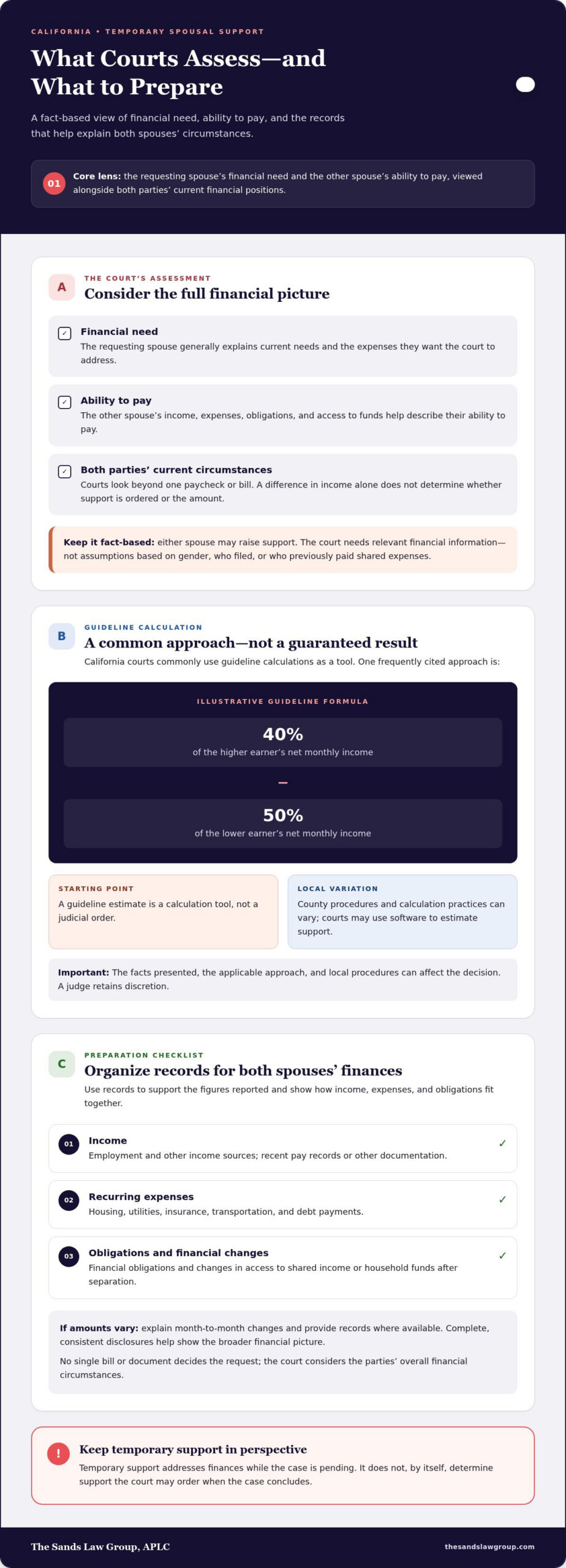
For a temporary-support request, the court generally focuses on the requesting spouse’s financial need and the other spouse’s ability to pay. The court evaluates the parties’ current financial positions while the case is pending. A difference in income alone does not determine whether support should be ordered or what amount is appropriate.
California courts commonly use guideline calculations as a tool in temporary-support matters. One frequently cited approach calculates 40% of the higher earner’s net monthly income minus 50% of the lower earner’s net monthly income. County procedures and calculation practices can vary, however. Courts may use software to help estimate support, and a guideline result is a starting point, not a guaranteed award.
What financial information can affect a temporary-support request?
Useful information shows the financial picture for both spouses, not just one expense or one paycheck. Gather records that support the figures you report, such as:
- Income from employment and other sources, with recent pay records or other documentation.
- Recurring expenses, including housing, utilities, insurance, transportation, and debt payments.
- Financial obligations and changes in access to shared income or household funds after separation.
Complete, consistent financial disclosures help show how income and expenses fit together. If a reported amount changes from month to month, explain the variation and provide records where available. No single bill or document decides the request; the court considers the parties’ broader financial circumstances.
Is a guideline estimate the amount the judge must order?
No. A guideline estimate is a calculation tool, not a judicial order. The applicable approach, local procedures, and facts presented can affect the court’s decision, and a judge retains discretion. County practices may differ, so review the current calculation method and procedures for the court handling your case before relying on an estimate.
For a broader explanation of support calculations, consult the guide How Is Spousal Support Calculated in California? If you’re deciding how to present your financial position or respond to a request, a temporary spousal support california attorney can help organize relevant records and clarify the issues. The Sands Law Group, APLC represents both spouses in support matters. You can discuss your support matter with the firm.
Temporary vs. Long-Term Spousal Support: What Is the Difference?
A temporary order can affect day-to-day finances during a divorce, but it does not settle what support will look like after the case ends. The two decisions serve different purposes and happen at different stages. An early estimate or order should not be treated as a preview of the final result.
| Feature | Temporary spousal support | Long-term spousal support |
|---|---|---|
| Timing | During a pending family law case | As the case is resolved, often in the judgment |
| Purpose | Addresses financial circumstances while proceedings continue | Determines support as part of the final resolution |
| Place in the case | An interim order that applies before final decisions | A final support determination, subject to applicable law and any later order |
Why does a temporary order not automatically decide final support?
Temporary support addresses the parties’ financial circumstances while the case is pending. The final determination takes place as the case is resolved and involves a broader legal assessment. Under California Family Code section 4320, courts consider statutory factors when deciding long-term support, including the parties’ circumstances and relevant needs and resources.
That final analysis is not interchangeable with a temporary guideline calculation. A preliminary estimate may help frame an interim request, but it does not guarantee the amount, duration, or outcome of the final support decision. Evidence or financial circumstances may also change during the case and affect what the court considers at resolution.
How long can temporary spousal support continue?
Temporary support generally applies while the case is pending and is governed by the order in effect. It does not last for one fixed number of months in every case. The order’s wording, later court orders, and the case’s progress matter. A subsequent order or final judgment, for example, may replace or otherwise address temporary support.
Review the specific order rather than assuming payments continue unchanged until a certain date or end automatically at a particular stage. A temporary spousal support california attorney can help explain how an interim order fits into the broader case and help either spouse prepare for the final support determination.
How to Request Temporary Spousal Support in California
A well-prepared request connects the support sought to clear financial information and the procedural requirements of the court handling the case. Use the steps below as a practical framework. Filing rules, deadlines, service requirements, and hearing practices can vary, so review current instructions for your court before acting.
- Identify the case posture. Confirm that a divorce or legal-separation case has been filed and identify any orders already in place. The stage of the case can affect how and when you ask the court to address support.
- Organize financial information. Gather current records of income, monthly expenses, and significant financial obligations. Use consistent figures and distinguish documented amounts from estimates.
- Prepare the required forms. California’s Request for Order, Form FL-300, is used to ask the court for orders, including temporary support. The Income and Expense Declaration, Form FL-150, provides financial information. Use current versions and follow the court’s instructions for completing and filing them.
- File and serve the papers. Follow the filing method, service rules, and deadlines that apply to your court and request. The process may differ by county.
- Prepare for the hearing. Be ready to explain what you’re asking for, how your financial information supports the request, and which facts are disputed. The spouses may reach an agreement, or the judge may decide the issue.
What information and documents may help explain your request?
Gather income records, a practical account of recurring monthly expenses, and information about significant obligations such as housing costs or debt payments. Organize supporting documents so the figures on your forms match the records you plan to discuss. If income or expenses have changed, identify what changed and when. Label estimates clearly rather than presenting them as confirmed amounts.
What should you expect after filing a request?
After filing, the other party generally must receive the papers as required by the applicable service rules. The court handles the request according to its procedures, which may include a hearing. In Los Angeles, Riverside, San Bernardino, and Kern Counties, filing instructions and hearing practices may differ. Review the requirements for the specific court and case.
For guidance on preparing and presenting your position, see Spousal Support Lawyer in California: How to Find the Right Advocate. A temporary spousal support california attorney can help organize the financial record and clarify the requested relief, whether you’re seeking support or responding. You can schedule a conversation about your support matter with The Sands Law Group, APLC.
When Can a California Temporary Spousal Support Attorney Help?
Legal guidance can help when financial facts are difficult to present clearly or spouses disagree about what those facts mean. Counsel can help organize income and expense information, identify the relief being requested, and prepare a focused position for negotiation or court. This can be useful whether you’re asking for payments or responding to a request. Neither role makes a spouse automatically right.
When might legal guidance be especially useful?
Consider case-specific advice if income is disputed, financial disclosures appear incomplete, earnings vary from month to month, or substantial obligations affect either spouse’s ability to meet expenses. A temporary spousal support california attorney can help identify records that explain the situation, gaps or inconsistencies in the information, and the facts relevant to a request or response.
Counsel may also assist with support negotiations, court filings, and hearing preparation. For a receiving spouse, this can mean clarifying how current expenses and available income relate to the requested support. For a paying spouse, it can mean presenting an accurate picture of income, obligations, and ability to pay. The aim is to make each position understandable and fact-based, not to guarantee a particular order or shorten the case.
How can a consultation help clarify your next steps?
A focused discussion is more useful when you bring materials showing where the case stands and how your finances have changed. Consider gathering:
- Filed case documents and any current support orders or requests.
- Recent income records and a summary of regular monthly expenses.
- Documents reflecting significant financial obligations or changes in earnings.
- A concise timeline of separation, filings, prior agreements, and important financial changes.
These materials can help identify questions about a request, a response, deadlines, or an existing order. The Sands Law Group, APLC represents both receiving and paying spouses in support matters and handles divorce and legal-separation cases in Los Angeles, Riverside, San Bernardino, and Kern Counties. Local court procedures may differ, so case-specific guidance can help you understand what applies to your matter.
Preserve relevant financial records, review the wording of any current order, and avoid relying on informal assumptions about what it requires. If you’re ready to discuss your circumstances and possible next steps, schedule a consultation with The Sands Law Group, APLC.
Take the Next Step With Clearer Financial Information
Temporary support can address financial needs while a California family law case is pending, but a guideline estimate is not a guaranteed award, and an interim order does not decide final support. Clear, consistent financial records can help explain your position, whether you’re requesting support or responding.
A temporary spousal support california attorney can help you understand your options, organize relevant information, and prepare for negotiations or court proceedings. The Sands Law Group, APLC represents both paying and receiving spouses in support matters in Los Angeles, Riverside, San Bernardino, and Kern Counties.
If you’re ready to discuss your circumstances and possible next steps, schedule a consultation with The Sands Law Group. Focused legal guidance can help you move forward with a clearer understanding of your options.
Frequently Asked Questions
Can I request temporary spousal support before my California divorce is final?
Yes. You can generally ask for temporary spousal support after a divorce or legal-separation case has been filed, while the case is pending. The request is commonly made using a Request for Order, Form FL-300, with financial information for the court to review. If you and your spouse agree on support, you may ask the court to formalize the agreement. Follow the court’s current filing and service instructions.
How is temporary spousal support calculated in California?
Courts commonly use a county guideline calculation as a starting point, considering each spouse’s income and financial circumstances. One frequently cited approach calculates 40% of the higher earner’s net monthly income minus 50% of the lower earner’s net monthly income, but local methods may differ. The estimate is not a guaranteed award. Accurate income and expense information matters, and procedures vary by court.
Is temporary spousal support the same as long-term spousal support?
No. Temporary support addresses financial circumstances while a divorce or legal-separation case is pending. Long-term support is considered as the case is resolved and is assessed under applicable legal factors, including those in California Family Code section 4320. A temporary guideline estimate or order does not automatically determine the final amount or duration. The decisions serve different purposes and are not interchangeable.
How long does temporary spousal support last in California?
Temporary support generally lasts according to the controlling order and the status of the case, rather than for a fixed statewide period. A later court order or final judgment may replace or otherwise address the temporary order. Read the order’s terms carefully and do not assume payments end or continue on a particular date without checking what it says. If circumstances change, get advice about the order’s effect.
Can temporary spousal support be changed if my finances change?
Possibly. A substantial change in circumstances, such as an involuntary change in income, may support a request to modify an existing order, but the outcome depends on the facts and applicable law. Gather records showing what changed, when it happened, and how it affects income or expenses. Do not assume the order changes automatically or stop following it without obtaining legal guidance or a new court order.
Do I need an attorney to request temporary spousal support in California?
You may be able to request support without an attorney, but legal guidance can help organize financial disclosures, prepare a clear request or response, and plan for negotiation or a hearing. A temporary spousal support california attorney may be useful when income is disputed, earnings vary, or financial obligations are complex. The Sands Law Group represents paying and receiving spouses in Los Angeles, Riverside, San Bernardino, and Kern Counties.

Article by
Thomas D. Sands, Esq.
Thomas D. Sands is the founder and CEO of The Sands Law Group, APLC. A California attorney with more than two decades of experience, he represents clients in divorce and family law matters as well as civil litigation and real property disputes. His approach emphasizes attentive, practical, and cost-conscious representation.
Sands is a 2023 Litigator of the Year honoree of the American Institute of Trial Lawyers and a 2023 Lawyer of the Year honoree of the American Institute of Legal Professionals. His firm has also received recognition among the 2025 Best Law Firms in America, a 2026 Benchmark Best of award, and a 2026 Law Firm of the Year honor.
Article reviewed by
Thomas D. Sands, Esq.
Thomas D. Sands is the founder and CEO of The Sands Law Group, APLC. A California attorney with more than two decades of experience, he represents clients in divorce and family law matters as well as civil litigation and real property disputes. His approach emphasizes attentive, practical, and cost-conscious representation.
Sands is a 2023 Litigator of the Year honoree of the American Institute of Trial Lawyers and a 2023 Lawyer of the Year honoree of the American Institute of Legal Professionals. His firm has also received recognition among the 2025 Best Law Firms in America, a 2026 Benchmark Best of award, and a 2026 Law Firm of the Year honor.
TOLL-FREE: 855-SANDS4U