

What if a financial disclosure that doesn’t add up is a reason to ask better questions, not proof that an asset is being hidden? In a California divorce, uncertainty about accounts, property, business interests, or income can make an already difficult process feel less secure. If you’re looking for guidance on uncovering hidden assets divorce california, start with a measured approach: an inconsistency is a lead to verify, not a conclusion.
Unexplained gaps deserve attention, especially when property division could affect your financial future. California divorce law requires financial disclosure, and spouses have duties of good faith and fair dealing. But concerns should be investigated through lawful, evidence-based steps. This article covers patterns that may warrant follow-up, records that can help clarify the picture, and discovery options such as document requests and subpoenas. It also explains when a financial professional may assist and how legal counsel can help organize concerns and assess next steps. Whether your divorce involves property in Los Angeles, Riverside, San Bernardino, or Kern, a steady, evidence-based process can help protect your interests without treating suspicion as established fact.
Key Takeaways
- A hidden asset involves financial value intentionally concealed or omitted from required disclosure. An unexplained change alone doesn’t establish wrongdoing.
- Compare financial records, reported income, spending, and ownership changes, while considering timing and possible innocent explanations.
- When uncovering hidden assets divorce california, focus on concrete discrepancies and preserve records you can lawfully access.
- Formal discovery can seek relevant financial information through appropriate legal procedures. Tailor each step to the facts and court rules.
- If assets are identified, potential effects on property division depend on the evidence, case posture, and applicable California law.
What Counts as a Hidden Asset in a California Divorce?
When financial disclosures seem incomplete, it can be hard to know what you can rely on. But a gap, an unfamiliar account, or a disagreement about an asset’s value doesn’t by itself establish intentional concealment. A careful review separates what is known from what remains uncertain and identifies the evidence that could clarify the issue.
A hidden asset is property or financial value that a spouse intentionally conceals or omits from required divorce disclosures. By contrast, spouses may disclose the same asset but disagree about its value, whether it belongs to one or both of them, or how it should be treated in the division. Those are valuation or classification disputes, not necessarily concealment.
Which financial interests can be difficult to see?
Financial interests may include bank or investment accounts, income, retirement holdings, business interests, real estate, and digital assets. In a complex estate, the value or control of an asset may be harder to understand when ownership involves a business entity, records are incomplete, or interests are held in different forms. Complexity alone, however, is not evidence of wrongdoing.
Context is essential. A transfer, unfamiliar account, or change in reported income may have an ordinary explanation. Considered alongside other records, it may also raise a question worth clarifying. When uncovering hidden assets divorce california, the goal is not to treat every financial difference as proof. It is to identify what information is missing and why it matters.
It also helps to distinguish ownership from classification. California is a community property state, and understanding the general idea of community property can provide context for why the timing and source of an asset may matter. Whether a particular asset is community or separate property depends on the facts and applicable law, not simply on whose name appears on an account or document.
Why California divorce disclosures matter
California divorce involves an exchange of financial information so each spouse can assess the assets and liabilities involved. California Family Code sections 2100 and following address disclosure obligations, including disclosure of assets and liabilities. Section 721 describes spouses’ fiduciary duties toward one another. These requirements support informed decisions, but they do not guarantee agreement about an asset’s value, ownership, or division.
Full and accurate disclosure matters because an incomplete financial picture can make it harder to evaluate the marital estate, compare proposed division terms, or identify questions for follow-up. Records and explanations let each side assess the information rather than rely on assumptions. For an overview of how assets are considered in divorce, the firm’s California Property Division Attorney: A Clear Guide to Divorce Assets article provides related context. In complex matters involving property, businesses, or separate-property claims, legal guidance can help organize the issues and determine appropriate next steps.
What Financial Patterns May Point to Undisclosed Assets?
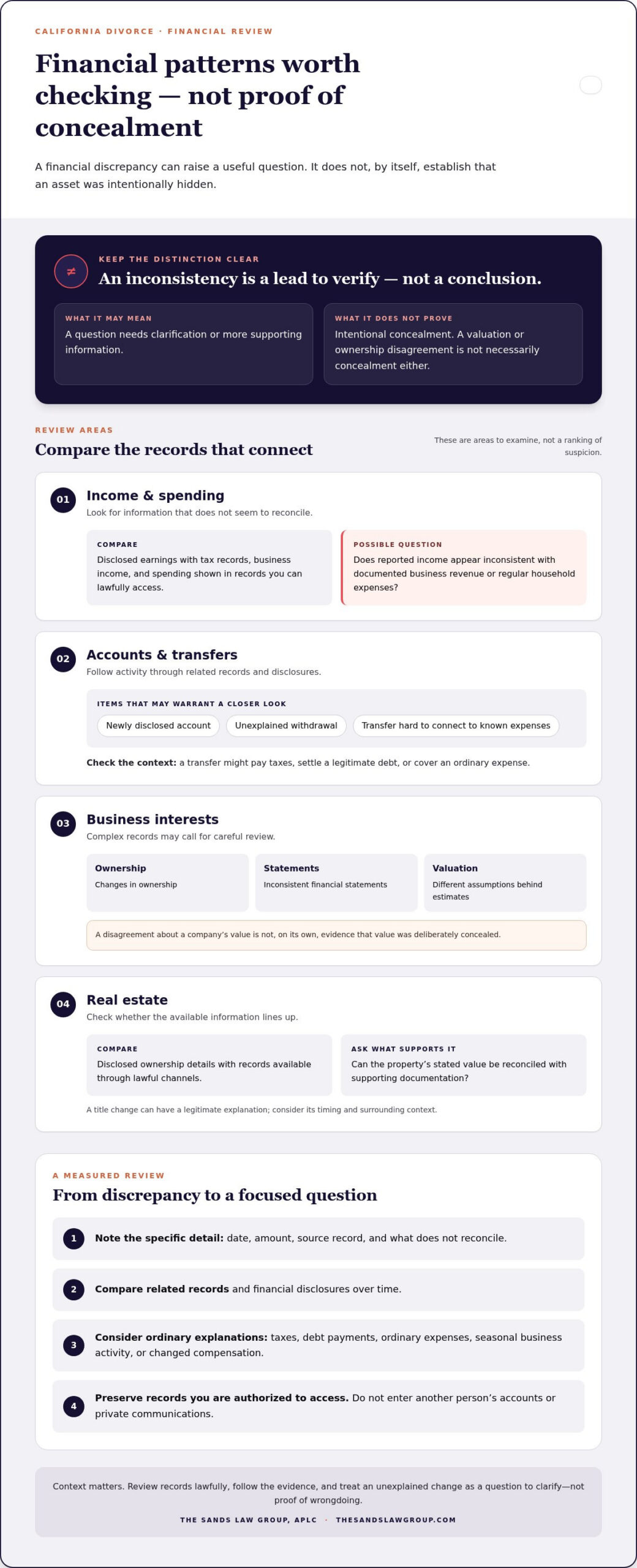
A financial discrepancy can be unsettling, particularly when you’re trying to understand the full scope of a high-value marital estate. It may justify a focused question, but it does not answer that question by itself. A transfer may be a routine expense, a withdrawal may reflect a debt payment, and a change in reported income may have a legitimate explanation. Start by comparing records over time and identifying what does not reconcile.
Income, spending, and account activity
Compare disclosed earnings with tax records, business income, and spending reflected in financial records you can lawfully access. For example, reported income that appears inconsistent with documented business revenue or regular household expenses may call for an explanation. A newly disclosed account, an unexplained withdrawal, or transfers that are difficult to connect to known expenses may also warrant a closer look. None of these facts alone establishes concealment.
Timing and context matter. A transfer might pay taxes, settle a legitimate debt, or cover an ordinary expense. A shift in income might reflect seasonal business activity or a change in compensation. Rather than drawing conclusions from one entry, note the date, amount, source record, and specific question it raises. Compare related statements and disclosures, and preserve records you’re authorized to access. Don’t try to enter another person’s accounts or private communications.
Business interests, real estate, and digital holdings
Business records can be complex. Changes in ownership, inconsistent financial statements, or valuations based on different assumptions may raise questions that require careful professional review. A disagreement about a company’s value is not itself evidence that value was deliberately concealed. Reviewing relevant records and valuation methods can help clarify whether the issue is incomplete information, a genuine dispute, or something that warrants further investigation.
Real estate may also merit closer examination when disclosed ownership information differs from records available through lawful channels, or when a property’s stated value is difficult to reconcile with supporting documentation. A title change can have a legitimate explanation, so its timing and surrounding records matter. Digital holdings, including cryptocurrency, are another category to consider, but owning or using digital assets alone does not suggest concealment.
For general information about California divorce procedures and disclosures, the California Courts Self-Help Guide to Divorce is an official starting point. In complex estates, legal counsel can help organize discrepancies and assess appropriate ways to clarify them. If you’re unsure how to evaluate a concern, discussing the financial questions with a family-law attorney can help you consider a measured next step. Uncovering hidden assets divorce california calls for evidence-based review, not assumptions.
How Can Lawful Discovery Test a Concern About Hidden Assets?
Once you’ve identified a specific gap, don’t assume what it means. Instead, determine what information could answer the question and how to obtain it properly. In a California divorce, discovery is a formal process for requesting relevant information and records. Its scope and method should reflect the issue, available evidence, and applicable court rules.
A measured approach keeps a financial concern focused. If a statement shows a transfer but not its destination, for example, the question may be what records could clarify where the funds went. An unexplained entry is a reason to seek information, not proof of intentional concealment. Counsel can help assess which steps are appropriate and avoid unnecessary or improper requests.
Start with disclosures and records already available
Compare financial disclosures with records you can lawfully access, such as account statements, tax returns, loan documents, and business records. Note the date, document, missing information, and question raised. Keep complete copies in their original context rather than relying on isolated excerpts or notes from memory.
- Identify records that appear to be missing or incomplete.
- Record changes in balances, income, or ownership that need explanation.
- List the specific document or answer that could clarify each discrepancy.
This organized record helps distinguish a documented inconsistency from a suspicion and gives counsel a clearer basis to evaluate possible next steps. Financial records can contain sensitive information, so don’t alter them or try to access accounts or documents without authorization.
When formal discovery or forensic accounting may help
If available records leave a material question unresolved, counsel can assess whether targeted discovery is suitable. Depending on the issue and current procedural requirements, formal tools may include written questions, requests for relevant documents, sworn testimony through a deposition, or subpoenas seeking records from third parties. These methods have rules and limits. They are not permission to seek unrelated information or bypass legal process.
Each request should connect to a concrete question. For instance, if a business’s reported income differs across records, a focused request might seek financial documents needed to understand that difference. The appropriate scope depends on the facts, evidence, proportionality, and court procedures. Broad or premature requests may add expense and delay without resolving the concern.
A forensic accountant may assist when records are extensive or financial issues are complex, such as tracing transactions or analyzing business finances. That expertise can help interpret financial information, but it is not required in every divorce case. Forensic accounting analyzes records; it does not independently establish intent. The analysis may help clarify what happened, while legal counsel assesses how the findings relate to the case. When uncovering hidden assets divorce california, tie each investigative step to evidence and pursue it through lawful procedures.
What Should You Do If You Suspect Your Spouse Is Hiding Assets?
Concern about missing financial information can create pressure to act quickly, but a calm, documented response is more useful than an accusation based on one unexplained entry. Start with records you’re authorized to access, note the specific gaps, and seek legal guidance before taking steps that could affect property or the divorce process.
Organize concerns without escalating the dispute
Create a simple index that lets you and your attorney trace each concern back to its source. Keep documents and communications in their original form where possible. Make clear what the record shows and what you still need to understand.
- Record the date and source. Identify the statement, disclosure, tax record, or other document and the relevant account or asset.
- State the discrepancy. Describe what appears incomplete or inconsistent without labeling it concealment.
- Write down the open question. Note what information could clarify the issue, such as a missing statement or an unexplained change.
- Separate fact from interpretation. Mark what you know, what remains unanswered, and what is only a concern or assumption.
Don’t alter, destroy, conceal, or improperly access financial records or accounts. Avoid moving, hiding, or disposing of property in response to suspicion, and don’t confront your spouse with an accusation based only on an incomplete statement. Those actions can complicate an already sensitive financial dispute.
Understand the difference between suspicion and proof
A pattern can help identify what deserves follow-up, but it does not establish intent on its own. A transaction may reflect ordinary expenses or debt payments. A difference between records may result from timing, missing documents, or disagreement about how an asset should be classified. Ownership and the distinction between community and separate property may also require a fact-specific legal assessment.
Family-law counsel can help evaluate which records matter, organize the chronology, and determine whether a question should be addressed through appropriate legal procedures. This is especially important if you’re concerned that property may be transferred, records may become unavailable, or a financial deadline is approaching. Raise urgent concerns promptly. The available steps depend on the facts and procedural posture, and no particular outcome can be assumed.
Thoughtful preparation can make a conversation with counsel more focused. When uncovering hidden assets divorce california, the aim is to preserve reliable information and identify lawful next steps, not to prove a suspicion before the evidence has been reviewed. If you’re concerned about a financial discrepancy or complex property division, schedule a conversation with a California family-law attorney to discuss your situation.
What Happens When Hidden Assets Are Found in a California Divorce?
Learning that an asset may have been left out of financial disclosures can raise immediate questions about fairness and what happens next. But a suspected omission and a court finding that a spouse violated disclosure duties are not the same. Any response depends on the evidence, the stage of the case, and the California law that applies. Identifying an asset does not automatically determine how it will be divided or what consequences may follow.
Possible court responses depend on the proven facts
California Family Code section 1101 addresses remedies for breaches of spousal fiduciary duties involving community property. Under section 1101(g), a court may award the other spouse 50% of the value of an asset when the statutory requirements are met, along with attorney’s fees and costs related to uncovering it. Section 1101(h) permits a court to award 100% of a deliberately hidden asset to the other spouse when the concealment involved oppression, fraud, or malice. These are potential remedies, not automatic outcomes. The evidence and statutory criteria matter.
The procedural setting matters, too. During settlement negotiations, spouses may address newly identified property as part of resolving property division, but an allegation alone does not establish a violation or dictate settlement terms. At trial, the court considers the evidence and applicable law. If a judgment has already been entered, seeking further relief involves separate procedural considerations and is not guaranteed. Timing, the record, and the legal basis for a request can affect what options are available.
Get guidance for a complex California property division
For complex estates, it can be difficult to assess how an asset’s ownership, value, or disclosure history may affect the overall division. The Sands Law Group, APLC focuses exclusively on family law and represents clients in complex property-division matters involving assets and liabilities. Its attorneys guide clients through settlement negotiations and trial proceedings, helping them evaluate financial concerns in light of the case and applicable law.
Before a first discussion, consider gathering the relevant disclosures, records you lawfully possess, a concise timeline, and a list of unanswered questions. Separate documented facts from concerns that still need investigation. This preparation can help clarify the issue without assuming what a court will decide. The firm serves clients in Los Angeles, Riverside, San Bernardino, and Kern.
If you’re facing questions about a complex asset or an incomplete disclosure, Schedule a consultation to discuss your California divorce concerns. Careful legal guidance can help you understand the issues and consider an appropriate path forward.
Move Forward With a Clearer Financial Picture
Uncertainty about the financial picture can make it difficult to plan for what comes next. You don’t have to resolve every unanswered question before seeking guidance. A focused discussion can help you identify which concerns deserve attention and make a more informed decision about your next step.
When uncovering hidden assets divorce california, the aim is a fair, evidence-based process, not a conclusion reached through fear or guesswork. The Sands Law Group, APLC focuses exclusively on family law and represents clients in complex property division, including matters involving real estate, retirement accounts, and business interests. The firm supports clients through settlement negotiations and trial proceedings, with an approach tailored to the demands of the case.
Schedule a consultation with The Sands Law Group, APLC to discuss the financial questions affecting your divorce. With clear guidance, you can take the next step with greater confidence.
Frequently Asked Questions
Does an unexplained withdrawal prove my spouse is hiding assets?
No. A withdrawal alone doesn’t prove concealment or intent. It may reflect an ordinary expense, debt payment, or another legitimate transaction. Its significance depends on when it occurred, what related records show, and how it fits the broader financial picture. Preserve any statement you lawfully have, note what information is missing, and avoid unsupported accusations. Legal counsel can assess whether there’s a proper way to seek additional information.
Can I look at my spouse’s private bank account during a divorce?
Only review records you lawfully possess or are authorized to access. A divorce doesn’t give you permission to guess passwords, bypass account security, or take private documents or communications. If you believe an account contains relevant information, raise the concern with counsel rather than trying to access it yourself. Relevant records may be sought through required disclosures or formal discovery, subject to current procedures and legal limits.
Can a forensic accountant find hidden assets in a California divorce?
A forensic accountant can analyze available financial records, trace transactions, and examine complex business or income information. For example, an accountant may compare records to understand how funds moved through business accounts. The analysis depends on the documents available and the questions being investigated. It can’t guarantee discovery or decide the legal outcome. Counsel can help determine whether the analysis is appropriate and how it may fit within lawful discovery.
What if a hidden asset is discovered after a California divorce is final?
A final judgment doesn’t automatically reopen just because an asset is later discovered. Whether any post-judgment option exists depends on the evidence, timing, judgment, and applicable procedural rules. Don’t assume a new division or other remedy is guaranteed. Preserve the newly discovered records and arrange prompt legal review of both the documents and judgment. A California family-law attorney can assess current law and explain which procedural questions apply to your circumstances.
Can a spouse hide income by routing it through a business?
Business income can be difficult to interpret, but unusual accounting or differences between reported income and available records don’t prove concealment by themselves. Relevant information may include business financial statements, tax materials, and transaction histories. Obtain those documents through lawful procedures, not by accessing accounts without authorization. A legal and financial review can help distinguish business timing, expenses, or incomplete records from evidence that warrants further investigation.
Are cryptocurrency and other digital assets included in California divorce disclosures?
Digital holdings may have financial value and can raise questions about ownership, valuation, and disclosure. Whether a particular holding must be disclosed depends on current California law and the facts, so avoid relying on assumptions about a specific asset. Using cryptocurrency or another digital asset doesn’t, by itself, establish concealment. If you’re researching “uncovering hidden assets divorce california,” ask counsel how relevant information can be addressed through proper disclosure and discovery.
Can hidden assets affect spousal support in California?
Income and other financial information may matter in a spousal support dispute, but the effect of a particular asset or transaction depends on the facts and applicable law. Discovering an account or income discrepancy doesn’t automatically change support or guarantee a particular result. If you’re in Los Angeles, Riverside, San Bernardino, or Kern and have concerns about how financial information relates to support, seek case-specific legal guidance and have current statutory factors reviewed.

Article by
Thomas D. Sands, Esq.
Thomas D. Sands is the founder and CEO of The Sands Law Group, APLC. A California attorney with more than two decades of experience, he represents clients in divorce and family law matters as well as civil litigation and real property disputes. His approach emphasizes attentive, practical, and cost-conscious representation.
Sands is a 2023 Litigator of the Year honoree of the American Institute of Trial Lawyers and a 2023 Lawyer of the Year honoree of the American Institute of Legal Professionals. His firm has also received recognition among the 2025 Best Law Firms in America, a 2026 Benchmark Best of award, and a 2026 Law Firm of the Year honor.
Article reviewed by
Thomas D. Sands, Esq.
Thomas D. Sands is the founder and CEO of The Sands Law Group, APLC. A California attorney with more than two decades of experience, he represents clients in divorce and family law matters as well as civil litigation and real property disputes. His approach emphasizes attentive, practical, and cost-conscious representation.
Sands is a 2023 Litigator of the Year honoree of the American Institute of Trial Lawyers and a 2023 Lawyer of the Year honoree of the American Institute of Legal Professionals. His firm has also received recognition among the 2025 Best Law Firms in America, a 2026 Benchmark Best of award, and a 2026 Law Firm of the Year honor.
TOLL-FREE: 855-SANDS4U