

What does dividing business in divorce California proceedings actually involve, and does it mean putting the company up for sale? Not necessarily. The answer depends on more than whose name appears on the paperwork. You may be trying to protect a business you built while facing questions about whether it is community or separate property, what it is worth, and whether a proposed division could disrupt its operations.
Those concerns are understandable. A business started during marriage is generally presumed to be community property, while a business owned before marriage may still have a community interest in its growth. A valuation that overlooks assets, goodwill, or a spouse’s contributions can complicate negotiations. Characterization, valuation, and distribution are separate decisions, each of which can shape the outcome.
This article explains how California courts approach those decisions, what can affect a business’s value, and which resolution options may help preserve operations while addressing each spouse’s interest. It also covers what information to organize before negotiating and how legal strategy can account for property division and the business’s future.
Key Takeaways
- Distinguish who owns the business interest from what it is worth. The interest may be community property, separate property, or a mix of both.
- Consider how assets, liabilities, earnings, market evidence, and business-specific circumstances may affect a valuation.
- Compare a buyout, an asset offset, a sale, or continued co-ownership by weighing control, liquidity, cooperation, and business continuity.
- For dividing business in divorce california, preserve records, map ownership, and identify disputed issues before discussing valuation and settlement options.
- Family-law representation can help organize evidence, negotiate workable terms, and present unresolved property-division disputes in court when needed.
Dividing a Business in a California Divorce Starts With Characterization
A family business can be more than a line on a balance sheet. It may provide income, reflect years of work, and support employees who depend on its continued operation. Before deciding how to address the business in a divorce, spouses need to determine the nature of their property interest. This legal step, called characterization, asks whether the interest is community property, separate property, or a combination of both.
California generally presumes that property acquired during marriage is community property, subject to exceptions and evidence about its source. Family Code section 760 establishes that presumption; sections 770 and 771 address categories of separate property, including property owned before marriage and earnings after separation. The presumption guides the analysis but does not automatically resolve every dispute. Community property laws in California provide background on the general framework. The facts and applicable California law determine how a particular business interest is treated.
When may a business interest be community or separate property?
Timing matters. A business established during marriage is generally presumed to be community property, while an interest acquired before marriage may be separate property. The history can be more complicated, however. Marital funds invested in a premarital business, or a spouse’s work during marriage, may raise questions about whether the community acquired an interest in some of the business’s value or growth.
The analysis may also depend on when the spouses married, separated, and acquired or funded particular interests. For example, a spouse may have formed a company before marriage and later used marital earnings to support it. Formation documents alone do not show where those later funds came from or how they affected the ownership interest. Records of contributions, transfers, and business activity can help establish the timeline. The broader rules for separate and community property in California help frame these distinctions.
Why doesn’t legal title answer every question?
A company’s shares or membership interests may be registered in one spouse’s name, but record ownership and characterization in a divorce are distinct questions. A title document can show who appears on the company’s records. By itself, it may not establish whether the interest was acquired with separate or community resources. The court’s analysis may require looking beyond the name on the paperwork.
Useful records may include formation documents, ownership agreements, tax returns, bank statements, financial statements, and records of ownership changes or capital contributions. Together, they can help show when the interest was acquired, what funds supported it, and whether ownership changed during the marriage. These details matter before deciding how to address the business interest. In dividing business in divorce california, a clear characterization analysis lays the groundwork for valuation and distribution, while identifying what is established and what remains disputed.
How California Business Valuation Works in a Divorce
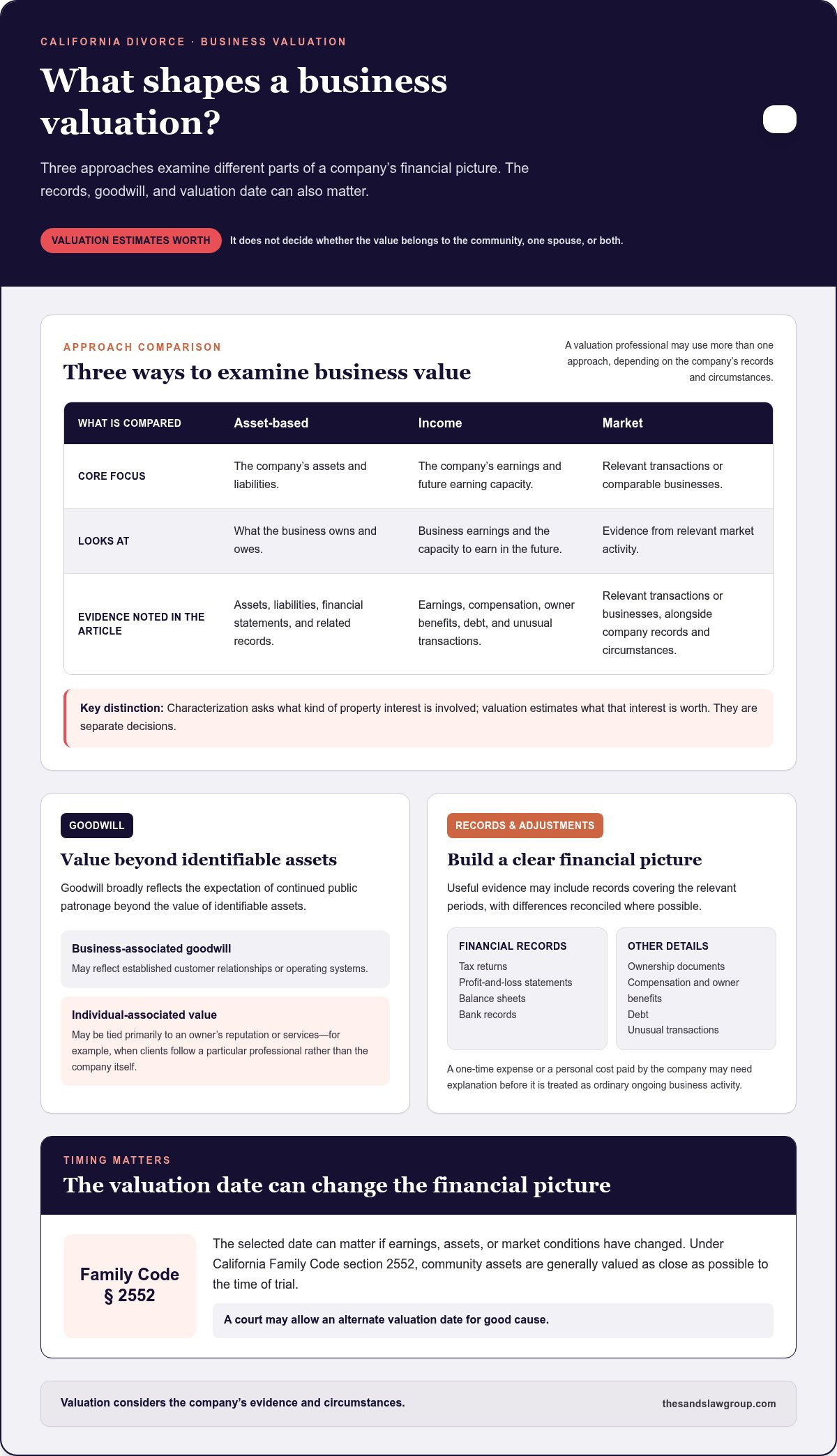
Once the property interest has been characterized, the next question is what that interest is worth. Valuation does not decide whether the value belongs to the community, one spouse, or both. It estimates the business’s worth so the parties or court can address the interest based on the ownership analysis.
Business valuation in divorce is the process of estimating a business’s worth at a relevant date to help determine the value of the interest being addressed. No single method applies to every company. An asset-based approach focuses on assets and liabilities; an income approach examines earnings and future earning capacity; a market approach compares relevant transactions or businesses. Depending on the company’s records and circumstances, a valuation professional may use more than one approach.
Goodwill can also affect value. Broadly, it reflects the expectation of continued public patronage beyond the value of identifiable assets. The analysis may distinguish goodwill associated with the business, such as established customer relationships or operating systems, from value tied primarily to an individual owner’s reputation or services. This distinction can be especially important when clients follow a particular professional rather than the company itself.
What records can help establish business value?
Useful evidence often includes tax returns, profit-and-loss statements, balance sheets, bank records, and ownership documents. Gather records covering the relevant periods and, where possible, reconcile differences between tax filings, internal accounts, and bank activity. Compensation, owner benefits, debt, and unusual transactions may also affect the analysis. For example, a one-time expense or a personal cost paid by the company may need explanation before it can be treated as ordinary ongoing business activity.
Why does the valuation date matter?
The date selected can affect the financial picture, especially if earnings, assets, or market conditions have changed. Under California Family Code section 2552, community assets are generally valued as close as possible to the time of trial, although a court may allow an alternate date for good cause. The appropriate date and its application depend on the case. A valuation prepared for settlement may need review if circumstances change before the matter is resolved.
When might a valuation professional be useful?
A qualified valuation professional can examine financial evidence, identify assumptions, and explain how different methods affect an estimate. A clear scope should state what interest is being valued, the purpose of the analysis, and the valuation date. If the spouses’ analyses reach different conclusions, further negotiation or court resolution may be needed. An expert opinion does not guarantee agreement or dictate the result.
In dividing business in divorce california, a sound valuation can make settlement discussions more informed, but it remains one part of a broader property-division strategy. Legal counsel can help organize the evidence and address disputed assumptions. If you are weighing a business valuation as part of your divorce, you can schedule a consultation to discuss the property-division issues involved.
Business Division Options: Buyout, Asset Offset, Sale, or Co-Ownership
Addressing a business interest does not automatically mean closing or selling the company. Depending on the spouses’ agreement, the business structure, and the other property being divided, several paths may be considered. The practical question is which option can address each spouse’s interest while accounting for cash flow, control, cooperation, and the company’s ability to keep operating.
A buyout allows one spouse to retain the business interest while addressing the other spouse’s share through the overall settlement. An asset offset is a different kind of trade: one spouse keeps the business interest while the other receives other property, subject to agreed values and legal review. Both approaches depend on a supportable valuation, but neither ensures that the parties will agree on terms.
| Option | Potential advantage | Trade-off and key question |
|---|---|---|
| Buyout | May allow one spouse to retain control and preserve day-to-day operations. | Can the retaining spouse fund the settlement, and what payment terms are workable? |
| Asset offset | May reduce the need for an immediate cash payment by exchanging other property. | Are suitable assets available, and do the parties agree on their values and allocation? |
| Sale | Converts the business interest into proceeds that can be divided. | Is a sale acceptable and practical, and how could the process affect employees or operations? |
| Co-ownership | May preserve both spouses’ involvement in a business they want to continue operating. | Can they make decisions, share financial information, and define responsibilities after divorce? |
Could one spouse retain the business through a buyout or offset?
A valuation can inform discussions about the interest one spouse will retain and the settlement needed to address the other spouse’s share. It does not set the terms by itself. A buyout may require available funds or financing, while an offset depends on whether other divisible assets can form a reasonable exchange. For example, one spouse might retain the company while the other receives a greater share of another asset, if the overall agreement supports that arrangement.
An agreement should explain how it will be carried out, including payment timing, any required ownership transfer, and the steps for completing the settlement. Clear terms can help manage both spouses’ expectations and protect business continuity.
When might sale or continued co-ownership be considered?
A sale may be considered if neither spouse can or wants to retain the business, or if a buyout or offset is not workable. A sale can provide a clear division of proceeds, but may disrupt operations and raise practical questions about timing and process. Continued co-ownership may also be possible, though it requires workable decision-making, access to financial information, and defined roles after the marriage ends.
No option is automatically required or best. The business structure, the spouses’ ability to cooperate, liquidity needs, and operational realities all matter. A sound plan for dividing business in divorce california compares these trade-offs before settlement terms are finalized.
Prepare for Business Division With Records and a Clear Strategy
Business records can turn uncertainty into questions that can be answered with evidence. As you prepare for dividing business in divorce california, preserve an accurate picture of ownership, finances, and ordinary operations. Do not destroy records, conceal assets, or make unusual transfers to change the business’s apparent value or ownership. Those actions may undermine credibility, complicate financial review, and affect how disputes are addressed. If a transaction is necessary for ordinary business reasons, keep clear records of its purpose and terms.
This sequence can help you organize the issues before settlement discussions:
- Preserve records. Keep original files where practical, retain relevant electronic records, and avoid altering or selectively removing documents.
- Map ownership. Record when the business was formed, who holds each interest, and any known ownership changes or contributions.
- Identify disputed issues. Note what remains unclear, such as the source of funds, the effect of a spouse’s contributions, or differences in financial records.
- Discuss valuation and options. Bring the organized information to counsel to consider valuation assumptions and practical outcomes, including a buyout, offset, sale, or continued ownership.
Continue documenting ordinary business activity during the case. Keep financial statements and records of significant transactions, and distinguish routine expenses from unusual events where possible. A clear record helps show how the business operated and can prevent avoidable disputes over missing information.
Which documents should a business owner organize?
Gather documents that show how the business was formed, funded, operated, and financed. Relevant materials may include:
- Formation papers, ownership agreements, and records of changes in ownership
- Tax filings, financial statements, and compensation records
- Loan documents, contracts, and records of major operational changes
Keep files secure and preserve dates and original versions where practical. If records appear inconsistent, note the discrepancy rather than changing or discarding the underlying documents.
How can local counsel help manage a California business-divorce dispute?
Family-law counsel can assess disputed characterization, review valuation evidence and assumptions, and evaluate whether a proposed settlement addresses both property division and business continuity. The Sands Law Group, APLC represents clients in complex property division involving business interests, from negotiation through trial when needed. The firm serves clients in Los Angeles, Riverside, San Bernardino, and Kern.
Before meeting with counsel, prepare questions about what evidence supports the ownership analysis, which valuation assumptions are contested, and what outcomes would be acceptable or impractical for you. Schedule a consultation to discuss your business property-division concerns and how a clear, evidence-based strategy may help address them.
A California Divorce Attorney Can Help Turn Business Questions Into a Plan
A family business can make divorce decisions feel especially consequential because the outcome may affect income, ownership, and ongoing operations. A sound legal strategy brings three questions into focus: how the business interest should be characterized, what evidence supports its value, and which distribution options may work in the circumstances. Addressing them in sequence can turn broad uncertainty into specific issues to resolve.
Family-law representation can help organize records, assess evidence, and identify where the spouses agree or disagree. Counsel can also evaluate proposed settlement terms, negotiate where appropriate, and present unresolved disputes in court when needed. The aim is not to promise a particular valuation or outcome, but to support informed decisions through a lawful process that considers property claims and business continuity.
What should you discuss in an initial consultation?
A focused first conversation can start with a concise account of the business and its history. Consider preparing:
- A summary of the business, its ownership structure, and any major ownership changes
- The marriage and separation timeline, along with concerns about contributions or funding
- Available financial records and known disagreements about value or valuation assumptions
- Proposed settlement terms, immediate operational concerns, and outcomes you would consider workable
You do not need to resolve every uncertainty before speaking with counsel. Identifying what you know, what you are unsure about, and which records are available can clarify which questions need attention first. Ask how negotiation and, if necessary, litigation may affect the available paths, including the practical requirements of a buyout, asset offset, sale, or continued co-ownership.
How can legal guidance support a business-aware resolution?
Characterization and valuation inform one another, but they answer different questions. Legal guidance can help examine the evidence behind each, identify gaps that may need further analysis, and assess whether a settlement proposal reflects the relevant property claims. It can also help address the terms needed to implement an agreement, rather than focusing only on the headline value or ownership outcome.
Business continuity may matter alongside the parties’ property rights. A proposed arrangement, for example, may raise questions about who will make decisions, how ownership will change, or whether the business can meet agreed payment terms. Those details depend on the facts and structure of the company. They deserve careful review, not assumptions or assurances of a guaranteed result.
If you are considering dividing business in divorce california, a consultation can help clarify which issues are specific to your circumstances and what information may help address them. The Sands Law Group, APLC represents clients in complex property division involving business interests, from negotiations through trial. Schedule a consultation with The Sands Law Group to discuss a business-aware legal strategy for your divorce.
Take the Next Step With a Clear Business Strategy
Choices made during divorce can shape how you move forward financially and professionally. Before agreeing to terms, consider what you need the business to support after the divorce, which risks you can realistically manage, and what information would help you make a confident decision. A thoughtful plan for dividing business in divorce california should account for your priorities while keeping unresolved legal and financial questions in view.
You do not have to make every decision at once. A focused conversation with counsel can identify the next questions to address, clarify where evidence or analysis may be needed, and help you evaluate possible terms carefully. The Sands Law Group, APLC represents clients in complex property division involving business interests and can guide matters through negotiation or trial as circumstances require.
Schedule a consultation with The Sands Law Group to discuss the issues affecting your situation and plan your next steps. Informed guidance can help you approach a difficult transition with greater clarity and purpose.
Frequently Asked Questions
Is a business automatically split equally in a California divorce?
No. California generally divides the net community estate equally, but that does not require dividing the company itself into equal ownership shares. The court must first determine what portion of the business interest is community property and account for related assets and liabilities. Depending on the circumstances, one spouse may keep the business while the overall property division addresses the other spouse’s community interest.
Can a spouse claim part of a business that was started before marriage?
Possibly. Starting a business before marriage may support a separate-property claim, but later marital contributions can raise questions about whether the community gained an interest in some of its growth. For example, marital funds used to acquire equipment or repay business debt may be relevant. A spouse’s work during marriage can also matter. The result depends on tracing the funds, contributions, and changes in value.
What happens if spouses disagree about the value of a business?
A valuation disagreement may require closer review of the records, assumptions, and methods behind each estimate. For instance, spouses may dispute how recurring earnings were calculated or whether a transaction was unusual rather than representative of normal operations. A valuation professional may help explain those differences, but the opinions do not automatically settle the issue. If negotiation does not resolve it, the court may consider the evidence and decide the disputed value.
Can a spouse receive other assets instead of a share of the business?
Yes. As part of a negotiated property division, one spouse may keep the business while the other receives other property instead of a direct ownership interest. The proposed exchange needs careful comparison: a retirement account, real estate, and a business interest may differ in liquidity, debt, and tax treatment. Legal and financial review can help assess whether the allocation is workable and how it should be documented.
Are business debts considered when dividing a business in a California divorce?
Yes. Business liabilities can affect the value of the interest and the overall property division, but a debt is not automatically assigned to a spouse simply because it appears on company records. Relevant details may include when the obligation arose, its purpose, who signed for it, and how the borrowed funds were used. For dividing business in divorce california, distinguishing business obligations from personal debts can help clarify the financial picture.
Can spouses continue operating a business together after divorce?
They can agree to continue as co-owners, but divorce does not resolve how they will handle future disagreements. A workable arrangement should address decision-making authority, access to financial information, each person’s duties, and how either owner can exit. For example, the agreement might specify a process for resolving a deadlock or handling a proposed sale. If communication is already difficult, ongoing shared control may create additional conflict.
What happens to business income while a California divorce is pending?
It depends on the source and character of the income, the business’s ownership, and any applicable court orders. Income from a spouse’s post-separation work may be treated differently from returns generated by community business assets, so deposits or distributions should not automatically be assumed to belong to one spouse. Keep accurate records of revenue, expenses, owner compensation, and transfers during the case. Those records can support later accounting and legal review.

Article by
Thomas D. Sands, Esq.
Thomas D. Sands is the founder and CEO of The Sands Law Group, APLC. A California attorney with more than two decades of experience, he represents clients in divorce and family law matters as well as civil litigation and real property disputes. His approach emphasizes attentive, practical, and cost-conscious representation.
Sands is a 2023 Litigator of the Year honoree of the American Institute of Trial Lawyers and a 2023 Lawyer of the Year honoree of the American Institute of Legal Professionals. His firm has also received recognition among the 2025 Best Law Firms in America, a 2026 Benchmark Best of award, and a 2026 Law Firm of the Year honor.
Article reviewed by
Thomas D. Sands, Esq.
Thomas D. Sands is the founder and CEO of The Sands Law Group, APLC. A California attorney with more than two decades of experience, he represents clients in divorce and family law matters as well as civil litigation and real property disputes. His approach emphasizes attentive, practical, and cost-conscious representation.
Sands is a 2023 Litigator of the Year honoree of the American Institute of Trial Lawyers and a 2023 Lawyer of the Year honoree of the American Institute of Legal Professionals. His firm has also received recognition among the 2025 Best Law Firms in America, a 2026 Benchmark Best of award, and a 2026 Law Firm of the Year honor.
TOLL-FREE: 855-SANDS4U