

Could an asset in your name still be treated as shared property in a California divorce? The answer to separate property vs community property california depends on more than whose name appears on a title or account. When an asset was acquired, where the funds came from, and how it was handled during the marriage can all affect its classification.
It’s understandable to worry that combining funds or making mortgage payments from marital earnings may have changed your rights. Those facts can complicate the analysis, but they don’t necessarily settle it. The asset’s financial history and the records that support it are often central to understanding a property claim.
This article explains California’s general rules for separate and community property, the role of the date of separation, and how commingling can make classification harder. It also outlines which records, including account statements, purchase documents, and payment histories, may help clarify an asset’s origins. When the financial history is complex, individualized legal guidance can help assess the evidence and address property division in a divorce.
Key Takeaways
- In separate property vs community property california, acquisition timing, how an asset was obtained, and the source of payment can all shape its classification.
- Combining funds doesn’t automatically resolve ownership. Tracing may help distinguish separate and community contributions when supporting records exist.
- Build a financial timeline by connecting an asset’s purchase with account activity and later payments.
- Preserve relevant records, list disputed assets, and note unanswered questions before deciding what needs further review.
- Real estate, retirement accounts, business interests, and mixed funds may call for individualized legal analysis.
Separate Property vs. Community Property in California: What Is the Difference?
During a divorce, property classification affects what each spouse retains and how the community estate is divided. The facts behind each asset matter: Was it acquired before or during the marriage? Did one spouse receive it as a gift or inheritance? Did marital earnings help pay for it? The distinction in separate property vs community property california law turns on legal rules and an asset’s history, not simply whose name appears on an account or title.
California Family Code section 760 establishes a general presumption that property acquired by a married person while domiciled in California is community property, unless the law provides otherwise. Section 770 generally identifies property owned before marriage, or received during marriage by gift or inheritance, as separate property. These rules are part of community property laws in California, but the statutes and the facts determine how a specific claim is assessed.
| Factor | Community property | Separate property |
|---|---|---|
| Timing | Generally acquired during marriage while domiciled in California | Generally owned before marriage or acquired after separation |
| Source | Often purchased with earnings or other community funds | May come from a gift, inheritance, or separate funds |
| Ownership | Generally belongs to the marital community, even if titled in one spouse’s name | Generally belongs to the spouse whose separate property it is |
| Common complications | Separate funds or interests may be combined with community contributions | Records, title changes, or marital contributions may affect the analysis |
What generally counts as community property in California?
Property acquired during marriage while the spouses are domiciled in California is generally presumed to be community property. Wages earned during marriage and purchases made with those earnings are common examples, subject to exceptions and evidence that may support a different classification.
In general, California presumes that property acquired during marriage while the spouses are domiciled in the state is community property unless a legal exception or evidence establishes otherwise.
What generally counts as separate property?
Separate property generally includes assets a spouse owned before marriage and gifts or inheritances received by that spouse during marriage. Under Family Code section 771, earnings and accumulations after the date of separation are generally treated as separate property. The date of separation and the circumstances surrounding an asset still matter.
An inheritance, for example, may begin as separate property, but later use of the funds or contributions toward an asset can raise questions about the interests involved. The classification of a particular asset depends on its full history and supporting evidence.
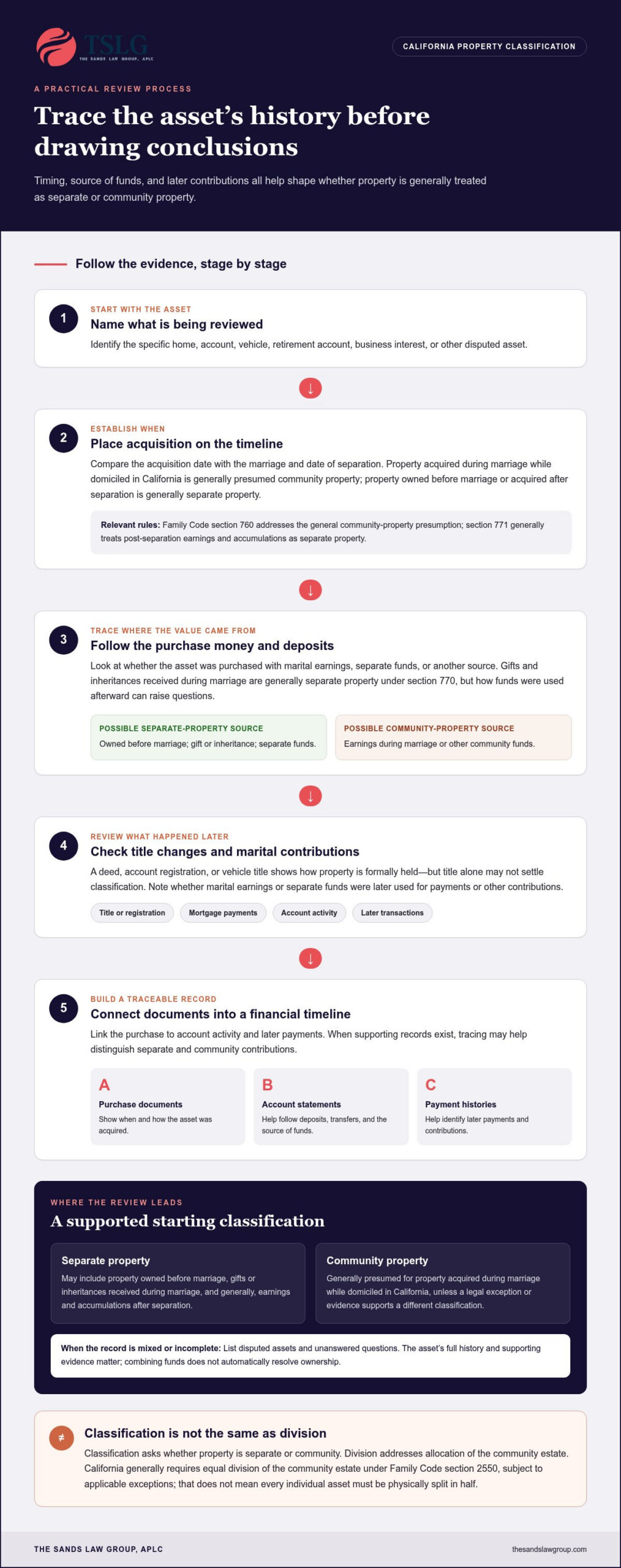
Classification and division are related, but they are different questions. Classification asks whether an asset is community or separate property. Division addresses how the community estate is allocated in a divorce. California generally requires equal division of the community estate under Family Code section 2550, subject to applicable exceptions. That doesn’t mean every individual asset must be physically split in half.
How California Determines Whether Property Is Separate or Community
Once you identify an asset, consider how its history fits California’s rules. Courts generally look at when it was acquired, how it was obtained, and what money or other property was used. These facts can matter more than a single document or a spouse’s assumption, particularly when financial activity spans years or multiple accounts.
Why the acquisition date and source of funds matter
California Family Code section 760 generally presumes that property acquired during marriage while the spouses are domiciled in California is community property. Section 770 generally treats property owned before marriage, and property received during marriage by gift or inheritance, as separate property. Section 771 generally addresses earnings and accumulations after the date of separation, which are treated as separate property.
Compare a home purchased before marriage using one spouse’s funds with a vehicle bought during marriage using wages earned during the marriage. The acquisition dates and payment sources point to different starting presumptions, although later contributions or transactions may complicate the analysis. An inheritance may initially be separate property, but how it is used afterward can affect the evaluation of a claim.
Under California Family Code sections 760, 770, and 771, acquisition timing and source help determine the starting classification, subject to the facts and applicable exceptions. The legal definition of community property offers a general overview, but applying California’s rules requires looking at the specific asset and its history.
Why title alone may not settle the classification
A deed, account registration, or vehicle title can show how property is formally held, so include it in your review. But title may not answer how the asset was acquired or whether separate or community funds contributed to it. A bank account in one spouse’s name, for example, may still require an examination of the source of its deposits.
Distinguish ownership documents from records that show the financial path. A title may identify the recorded owner, while purchase documents, account statements, and payment records may help establish when an asset was acquired and how it was funded. Review these records together: they can support a timeline and help show whether the legal presumption fits the circumstances or other evidence points to a different characterization.
The date of separation can also affect the analysis because section 771 addresses earnings and accumulations after that date. If spouses disagree about when the relationship ended, the date may require a fact-specific assessment. Moving into separate homes, by itself, may not resolve the dispute. For complex assets or competing timelines, discussing the property history with a family law attorney can help identify which evidence may matter.
When Separate and Community Property Become Mixed
Separate and community funds can overlap over time, especially when spouses use one account for income, inheritance, household expenses, and asset payments. This is called commingling. It can make a property claim harder to prove, but combining funds does not automatically change every contribution’s legal character. The history of the funds and the available records matter.
Commingling is distinct from transmutation, which refers to a change in the character of property between spouses. Under California Family Code section 852, a transmutation generally requires an express written declaration made, joined in, or accepted by the spouse whose interest is adversely affected. A deposit into a joint account or a change in how an asset is managed should not automatically be treated as proof of a valid transmutation. The document and circumstances need to be assessed under the applicable law.
Can commingled funds still be traced?
The practical question is whether records can connect money in a mixed account to its source and show what happened next. Bank statements may show an inheritance deposit, while transaction histories and purchase records may help track later transfers or payments. Inheritance documents or statements from the original account can add context. No single record necessarily resolves the issue; the records should support a coherent account of the funds’ path.
Gaps can make tracing more difficult. Missing statements, interwoven deposits and withdrawals, or records that begin long after an account was opened may make it harder to distinguish separate funds from community earnings. That doesn’t decide the claim automatically, but it can limit what the available evidence establishes. In disputes involving separate property vs community property california, tracing depends on evidence, not simply a label attached to an account.
How marital contributions can affect a separately acquired asset
Consider a home one spouse owned before marriage. During the marriage, community earnings might be used for mortgage payments, while the home’s value also changes. The original ownership and later contributions are distinct parts of the property’s history. Depending on the facts, records, and applicable law, community payments may support a claim to an interest or reimbursement. They do not automatically determine the result or mean that the entire home became community property.
California courts may apply the Moore/Marsden framework in some cases involving a separately acquired residence and community contributions to mortgage principal. Any calculation depends on details such as the property’s value, loan history, and the nature of the payments. It should not be reduced to a simple estimate without legal review.
For a mixed account, home, or other asset with overlapping contributions, preserve statements and transaction records to help clarify the timeline. A property division attorney can assess the evidence, applicable rules, and potential tracing, transmutation, or reimbursement issues. Commingling alone does not settle ownership.
What Records Can Help Clarify a California Property Claim?
Gathering financial records can feel overwhelming, especially when years of transactions overlap. You don’t need every document before you begin. Start with records that establish when an asset was acquired and where its purchase funds came from, then follow the money through later deposits, transfers, or payments. A consistent timeline can make a complicated claim easier to understand and evaluate.
Which documents may help establish when property was acquired?
Begin with records tied to the asset’s acquisition and original funding. Depending on the property and the questions involved, useful documents may include:
- Purchase agreements, deeds, and account statements showing ownership and acquisition dates
- Closing statements and loan histories for real property
- Gift letters, inheritance documents, or records showing funds received
- Statements from accounts used to make the purchase or receive later payments
Read these materials together rather than treating any single document as conclusive. A deed may show title, while bank records may help explain the source of the purchase funds.
How to organize records when finances overlap
For accounts or assets with mixed activity, arrange records chronologically. Note the acquisition date, deposits, transfers between accounts, and major payments. When possible, connect each event to the document that supports it. This can reveal missing periods and help distinguish what the records show from what still needs clarification.
- Save complete copies of original statements and transaction histories.
- Group records by asset or account, then place them in date order.
- Keep your notes, calculations, and questions separate from original documents.
- Mark missing records or uncertain dates without filling gaps with assumptions.
For tracing, useful records often include statements from the original source account, transfer histories, deposit records, purchase documents, and payment histories that connect funds from origin to use. The strength of the timeline depends on how consistently those documents fit together, not on one isolated statement.
Preserve records in full and avoid editing, annotating, or sharing selective excerpts in place of complete copies. Keep a separate working copy for notes, and record where each document came from. These steps help maintain context and make it easier to identify what is missing.
Organized records can help clarify evidence relevant to separate property vs community property california claims. The firm’s California property division guide provides broader context for how assets are addressed in divorce. If overlapping transactions or missing records leave important questions, schedule a discussion about your property records to assess the evidence and possible next steps.
What to Do Next When Property Classification Is Unclear
Uncertainty about an asset doesn’t mean you need to resolve every detail before taking a practical next step. Preserve the records you have, identify the disputed assets, and write down what remains unclear. This creates an organized starting point for assessing how the facts fit the rules for separate property vs community property california.
- Preserve relevant records. Keep complete copies of available statements, deeds, purchase documents, account histories, and other records connected to the asset. Avoid altering originals or discarding documents that seem incomplete.
- List the assets in question. Note each asset, how it is titled, when you believe it was acquired, and what classification is disputed. Include real estate, retirement accounts, business interests, and accounts with mixed funds where relevant.
- Record unanswered questions. Note uncertain dates, missing records, transfers you can’t explain, and payments whose source is unclear. Distinguish what you know from what you still need to verify.
When a property classification issue deserves legal review
Individualized review may be useful when records conflict, a substantial asset has a complicated financial history, or spouses disagree about the date of separation. Real estate with both premarital equity and later marital payments, retirement accounts with contributions from different periods, and businesses with changing ownership or value can require careful, asset-specific analysis. Mixed funds may also raise questions that a simple account balance cannot answer.
These issues can overlap. Legal analysis may consider an asset’s characterization, its valuation, possible reimbursement claims, and how it fits into the overall division of property. A lawyer can assess the records, identify relevant legal questions, and discuss possible approaches through negotiation or court proceedings. That review can clarify the issues, but it can’t guarantee a particular classification or property division.
Prepare for a focused conversation about your assets
You don’t need a perfect file. Bring an asset list, any timeline you’ve prepared, and the records you have gathered so far. Mark incomplete documents and identify your most urgent questions, such as whether a payment came from separate funds or how an account’s history should be evaluated. A focused starting point can make the discussion more useful.
The Sands Law Group, APLC represents clients in California divorce and property division matters, including complex claims involving real estate, retirement accounts, business interests, and separate property. The firm serves clients in Los Angeles, Riverside, San Bernardino, and Kern counties. If you would like guidance tailored to your circumstances, you can schedule a consultation to discuss the assets and questions you’ve identified.
Take the Next Step With Greater Clarity
When divorce leaves financial questions unresolved, it can be difficult to know which decision deserves attention first. You don’t have to settle every disputed issue at once. Start by identifying the choices that could affect your financial stability, the information those choices depend on, and a plan for addressing what remains uncertain.
With separate property vs community property california issues, a case-specific review can turn uncertainty into questions that can be evaluated in context. The goal is to understand the possible implications of each position and make decisions with a clearer view of your priorities. That perspective can support more deliberate discussions as your divorce proceeds.
The Sands Law Group, APLC represents clients in divorce and property division matters in Los Angeles, Riverside, San Bernardino, and Kern counties. Schedule a consultation to discuss your California property questions.
Frequently Asked Questions
Is California a community property state?
Yes. California is a community property state, and the general rule applies to property acquired during marriage while spouses are domiciled in California, subject to legal exceptions. That doesn’t mean every asset is automatically shared: premarital property, gifts, inheritances, and certain post-separation earnings may receive different treatment. For separate property vs community property california questions, both the applicable law and the asset’s documented history matter.
Does California divide every asset exactly in half in a divorce?
No. California generally requires an equal division of the community estate’s net value, not an identical split of every individual asset. Spouses may, for example, agree on an allocation of different assets that accounts for their relative values. Debt, disputed valuations, agreements, and legal exceptions can affect the overall accounting, so assess a proposed division across the community estate rather than judging whether each item is divided equally.
Can spouses agree that an asset will be separate property?
Yes, spouses can make agreements about property, but a casual understanding or account label may not be enough to change an asset’s legal character. A transmutation generally requires an express written declaration under California Family Code section 852, with requirements concerning the spouse whose interest is affected. Premarital or marital agreements may also address property rights. Whether an agreement is effective depends on its terms and circumstances, so review it before relying on it.
Are debts acquired during marriage community property in California?
Generally, debts incurred during marriage may be treated as community obligations, but the answer can depend on when and why the debt arose and whether an exception applies. The community estate’s responsibility to creditors is also distinct from how spouses may allocate a debt between themselves in divorce. Student loans, for example, receive special treatment under California law. Before assuming a debt will be shared, identify the borrower, timing, purpose, and relevant agreements.
Does a spouse have to disclose separate property during a California divorce?
Yes. A spouse generally must disclose assets and debts in the divorce financial disclosure process, including property they believe is separate. Disclosure doesn’t concede that an asset belongs to the community; it allows both sides to evaluate the estate and disputed claims. Leaving out an account or property because you consider it separate can create avoidable problems. Describe the asset and your claim accurately, and provide supporting records through the required process.
What happens if spouses disagree about the date of separation?
If spouses dispute the date, a court may need to determine when a complete and final break occurred by considering intent and conduct, rather than relying on a single event. Living apart may be relevant, but it isn’t automatically decisive. Communications, financial arrangements, and other actions may help establish the timeline. The Sands Law Group, APLC represents clients in family-law property division matters in Los Angeles, Riverside, San Bernardino, and Kern counties.

Article by
Thomas D. Sands, Esq.
Thomas D. Sands is the founder and CEO of The Sands Law Group, APLC. A California attorney with more than two decades of experience, he represents clients in divorce and family law matters as well as civil litigation and real property disputes. His approach emphasizes attentive, practical, and cost-conscious representation.
Sands is a 2023 Litigator of the Year honoree of the American Institute of Trial Lawyers and a 2023 Lawyer of the Year honoree of the American Institute of Legal Professionals. His firm has also received recognition among the 2025 Best Law Firms in America, a 2026 Benchmark Best of award, and a 2026 Law Firm of the Year honor.
Article reviewed by
Thomas D. Sands, Esq.
Thomas D. Sands is the founder and CEO of The Sands Law Group, APLC. A California attorney with more than two decades of experience, he represents clients in divorce and family law matters as well as civil litigation and real property disputes. His approach emphasizes attentive, practical, and cost-conscious representation.
Sands is a 2023 Litigator of the Year honoree of the American Institute of Trial Lawyers and a 2023 Lawyer of the Year honoree of the American Institute of Legal Professionals. His firm has also received recognition among the 2025 Best Law Firms in America, a 2026 Benchmark Best of award, and a 2026 Law Firm of the Year honor.
TOLL-FREE: 855-SANDS4U