

What if you need court orders about parenting, support, or property without ending your marriage? That distinction is central to how to file for legal separation in california, and it can shape your choices from the beginning. Legal separation follows a court process similar to divorce, but a judgment of separation doesn’t end the marriage, so neither spouse can remarry.
Sorting through forms, service rules, and deadlines while trying to protect your financial stability and parenting arrangements can feel difficult. The process becomes clearer when you know which issues the court can address and what each filing step involves.
This guide explains the main forms, including the petition and summons, how to serve filed papers, and what to expect after service, including the 30-day response deadline. It also covers financial disclosures, potential orders involving children, support, and property, and what legal separation does not change. Use it to prepare documents and focused questions for individualized legal guidance.
Key Takeaways
- Understand which issues a legal separation case may address and why it does not end your marriage.
- Learn how to file for legal separation in california, from preparing forms to filing and arranging service.
- See how your county, children, financial circumstances, and requested temporary orders can affect which documents you need.
- Know why filing papers alone may not resolve parenting, support, or property issues, and what further steps may be needed.
- Prepare focused questions about filing choices and related family-law issues before seeking individualized legal guidance.
What filing for legal separation in California does, and does not, change
A court filing can feel decisive when you’re already managing uncertainty about finances, parenting, or where you’ll live. Start by separating what a legal separation case can address from what it cannot change. That distinction helps you approach how to file for legal separation in california with a practical understanding of the choices ahead, rather than assuming the filing itself settles every issue.
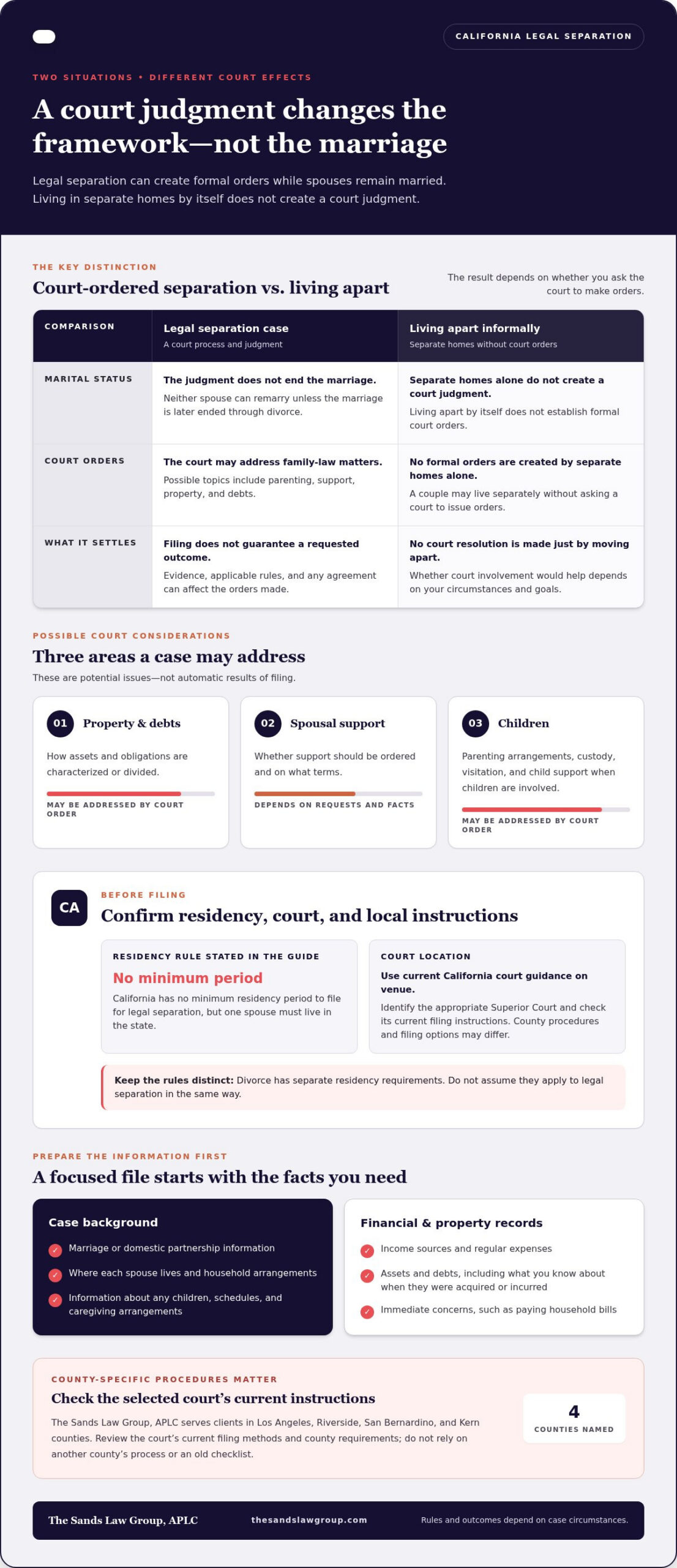
In a California legal separation, spouses remain legally married, but the court may make orders about family-law matters. Neither spouse may marry someone else unless the marriage is later ended through a divorce. The general concept of legal separation takes different forms, so California-specific court rules matter when you consider the consequences of a case.
Living apart informally is different from obtaining a legal separation judgment. A couple may live separately without asking a court to issue orders, and not every couple needs court involvement. But living in separate homes alone does not create a court judgment or establish formal orders about parenting, support, debts, or property. Whether court orders would help depends on your circumstances and goals.
What orders can a California legal separation case address?
Depending on the facts and the requests made, a case may address:
- Property and debts: How assets and obligations are characterized or divided.
- Spousal support: Whether support should be ordered and on what terms.
- Child-related matters: Parenting arrangements, custody, visitation, and child support when children are involved.
These are issues the court may consider, not automatic results of filing. For example, requesting a parenting order does not mean the court will adopt one parent’s preferred schedule. The evidence, applicable rules, and any agreement between the spouses can affect the orders made. Identify the specific protections or arrangements you need before preparing your requests.
Why might someone choose separation instead of divorce?
The decision may reflect personal, religious, financial, or benefits-related considerations, but the effect of separation on benefits or other obligations depends on the circumstances and governing rules. Some people want a formal framework for support, property, or parenting matters while preserving their marital status; others may prefer to live apart without seeking court orders. Neither choice is right for every couple.
Legal separation may suit someone who does not want the marriage terminated, but it is not simply a temporary version of divorce with identical consequences. Eligibility, financial effects, and the orders worth requesting call for case-specific review. Before deciding, consider which issues need formal resolution and which changes you want to avoid. That distinction provides a useful foundation for the filing steps that follow.
Before filing: confirm California rules, county, and the orders you need
Before preparing paperwork, clarify whether California’s legal separation rules fit your circumstances and which court should receive the case. Don’t assume divorce residency requirements apply in the same way. California has no minimum residency period to file for legal separation, although one spouse must live in the state. Divorce has separate residency requirements. Check current information through California’s official court resources before acting.
Next, identify what you need the case to address. You might seek a clear parenting schedule, temporary financial support, or a process for dividing property and debts. A focused list can help you separate urgent concerns from longer-term decisions and identify which forms and requests may be relevant. The steps involved in how to file for legal separation in california can depend on those choices.
How do I identify the right California court?
Start with current California court guidance on venue, then identify the appropriate Superior Court and review its filing instructions. The Sands Law Group, APLC serves clients in Los Angeles, Riverside, San Bernardino, and Kern counties, where local procedures and filing options may differ. Review the selected court’s current instructions for filing methods and county-specific requirements. Don’t rely on another county’s process or an old checklist.
Venue can depend on the details of your case, so don’t choose a courthouse based only on convenience. If you’re unsure which county is appropriate, or if either spouse lives outside California, get case-specific legal guidance before filing. Filing in the wrong location can create avoidable delay and uncertainty.
What should I organize before completing forms?
Gather accurate background information first. Depending on the forms and requests, useful details may include your marriage or domestic partnership information, where each spouse lives, household arrangements, and information about any children. Domestic partnerships and unusual jurisdictional circumstances may involve different rules, so have them reviewed rather than assuming the process is identical in every case.
For a private working checklist, organize:
- Financial records: Income sources, regular expenses, assets, debts, and immediate concerns such as paying household bills.
- Property information: Major assets and obligations, including what you know about when they were acquired or incurred.
- Parenting needs: Children’s schedules, caregiving arrangements, and urgent questions about custody or support.
Use this preparation to identify what you may need to ask the court to address, not to assume an outcome. A routine the parents have followed informally may help explain the children’s current needs, but it isn’t automatically a court order. If you’re weighing filing choices or related custody, support, or property issues, a confidential legal consultation can help you prepare questions specific to your circumstances.
Which California legal separation forms begin the court case?
The initial filing commonly starts with a petition and summons. Together, these documents identify the case and give formal notice to the other spouse. Other paperwork may depend on whether you have minor children, what orders you’re requesting, and whether you and your spouse are filing jointly. Use current California Judicial Council forms and instructions, and review the selected court’s local requirements before completing a packet.
This overview describes forms that may arise at different stages. Confirm each form’s current title, revision, and applicability through official court guidance before filing.
| Form | Purpose and when it may apply |
|---|---|
| FL-100, Petition | Common starting document. Select legal separation and state the orders you’re asking the court to consider. |
| FL-110, Summons | Common starting document that gives formal notice of the case and explains the responding spouse’s next steps. |
| FL-105, UCCJEA Declaration | Generally required when the case involves minor children. It provides information about the children’s residences and history relevant to custody matters. |
| FL-700, Joint Petition | May apply when both spouses agree on all terms and choose to file jointly. Verify current eligibility and instructions. |
| FL-140, FL-150, and FL-142 | Financial disclosure documents used after the case begins, including a disclosure declaration, income and expense information, and a schedule of assets and debts. |
| FL-120, Response | A document the responding spouse may file after being served. It is not part of the petitioner’s initial filing packet. |
What do the petition and summons do?
The petition identifies the requested case type and the relief sought, such as orders concerning support, property, or children. The summons formally notifies the other spouse that a court case has begun; it does not decide the disputed issues. Before relying on a form number or an older packet, confirm the current Judicial Council form title and completion instructions, since forms and filing requirements can be revised.
When might child or financial forms also be needed?
Children’s circumstances can require additional declarations, and requests for temporary orders may call for further paperwork. Financial disclosures are separate from the initial petition. Both parties exchange preliminary disclosures within 60 days after filing. These may include FL-140, FL-150, and FL-142. For context on the disclosure process, see this California divorce financial disclosure guide; confirm which instructions apply to your separation case. Matching forms to their purpose and timing makes how to file for legal separation in california easier to manage without treating every document as due at once.
How to file and serve legal separation papers: the practical sequence
Filing starts the case, but it doesn’t complete the notice process. Service is a separate step, and mistakes in either process can cause delay or complicate what happens next. Use this sequence as a roadmap, then confirm the current forms, service rules, and filing instructions for your court. Details can vary by county and by the circumstances of the case.
- Complete the required forms. Use current California Judicial Council forms and follow their instructions carefully. Check that the case type and requested orders are stated accurately, and include any additional documents required for your circumstances, such as forms related to minor children or temporary orders.
- Review local court instructions. Before submitting anything, confirm the selected Superior Court’s current procedures, filing options, and requirements for copies or local forms. A packet prepared for one county may not address another county’s process.
- File the documents with the court. Submit the completed papers using an accepted filing method. Once accepted, the documents receive case information or other court endorsements. Keep track of the case number and any instructions returned with the filed papers.
- Obtain and retain filed copies. Keep copies of the court-stamped documents in a secure place. The person arranging service needs the correct filed papers, and you’ll need your own set to track the case and prepare for later steps.
- Arrange proper service. The other spouse must receive formal notice through a person authorized to serve the papers. The filing spouse must not personally serve them. Confirm which documents must be served, the permitted method, and any timing requirements under current court rules.
What happens after the papers are filed?
The court opens a case and assigns case information to the accepted filing. Service then gives the other spouse formal notice; it is not the same as filing papers with the court. Local procedures may differ, including how documents are submitted and what must be served. Follow the selected county’s current instructions rather than relying on a process used in another courthouse.
What should I do after serving the other spouse?
Keep the completed proof of service and confirm whether and how it must be filed with the court. Record the service date, then use current court instructions to calculate the response deadline. The responding spouse generally has 30 days after service to file a response, but verify the applicable deadline and rules for your case. A response may affect whether issues proceed by agreement or remain disputed.
If a safety concern makes service or waiting unsafe, prioritize protection and seek immediate legal or emergency assistance. Don’t delay urgent safety measures while trying to complete routine paperwork. If you’re unsure how to file for legal separation in california or serve the documents correctly, schedule a confidential consultation about your filing steps to discuss your circumstances and questions.
After filing: understand court orders, resolution options, and legal guidance
Submitting paperwork begins a court case, but it doesn’t resolve every financial or parenting question. Until terms are documented and any required court review is completed, an understanding between spouses may not provide the formal orders either person expects. Track what has been requested, what has been agreed, and what remains unsettled so you can see which steps are still ahead.
A legal separation judgment preserves your marital status. If you later decide to end the marriage, moving from separation to divorce requires legal procedure. California’s process may allow a separation case to be amended to a dissolution case before a final separation judgment is entered, once the divorce residency requirements are met. Because timing and eligibility matter, get advice before relying on an informal plan to change course.
What if we agree, or disagree, about the requested orders?
Agreement can narrow the issues that need attention, but it doesn’t necessarily complete the case. Put agreed terms in the appropriate form and follow the court’s submission and approval requirements; a private understanding alone may not become an enforceable court order. Cooperation also doesn’t remove required filing or financial disclosure responsibilities.
If you disagree about support, property, debts, or parenting arrangements, unresolved matters may require further negotiation or a court decision. Identify which points are settled and which need resolution. Don’t treat a partial agreement as a complete plan, particularly if it leaves practical questions unanswered, such as how a parenting schedule will work or how shared expenses will be handled.
When can a California family-law attorney help?
Individual legal guidance can be valuable when property or debts are complex, support needs are disputed, parenting arrangements are urgent, or filing and service questions remain. Counsel can review the relief requested, help you understand disclosure responsibilities, and support negotiations or court proceedings without promising a particular result.
The Sands Law Group, APLC represents clients in legal separation and divorce matters, including custody, support, and property division. The firm serves Los Angeles, Riverside, San Bernardino, and Kern counties. If you’re weighing what to request or how to address unresolved issues, schedule a consultation to discuss guidance tailored to your circumstances and the next steps in your case.
Understanding how to file for legal separation in california is one part of making an informed decision. The orders you seek, the documents you exchange, and whether your long-term goal is to remain married or pursue divorce can all shape the path forward. A careful review can help you prepare questions and consider those choices with greater clarity.
Choose your next step with clarity
Your next decision doesn’t have to settle every question about the future. Start by identifying what you need guidance on now, what can wait, and which choices could affect your long-term plans. That perspective can help you approach how to file for legal separation in california as part of a considered strategy, rather than a rushed response to a difficult moment.
Before moving forward, write down the questions that matter most to you. You may want to understand how a proposed request could affect your finances, parenting arrangements, or future options. Bringing those concerns into a confidential conversation can help you evaluate your choices and identify practical next steps without assuming a particular outcome.
Discuss your California legal separation questions with The Sands Law Group, APLC. Individualized legal guidance can help you assess your options and plan your next steps.
Frequently Asked Questions
Can I file for legal separation in California if I have not lived there for six months?
Generally, you don’t need to live in California for six months before filing for legal separation. California has no minimum state residency period for separation, though one spouse must live in California. Divorce residency rules are different, so don’t apply them automatically. Check current California Courts guidance for your case and filing location, including the relevant court in Los Angeles, Riverside, San Bernardino, or Kern. If you recently moved or have a registered domestic partnership, seek case-specific legal advice.
What forms do I need to file for legal separation in California?
Most cases begin with a petition and summons, but the complete packet depends on your circumstances and the orders you request. For example, a case involving children may require a child-related declaration, while a request for temporary orders can involve additional paperwork. Before submitting forms, check that you have the current versions and instructions, and review any local requirements. A careful form review is an important part of how to file for legal separation in california.
Does legal separation end a marriage in California?
No. A legal separation does not change either spouse’s marital status, so neither may marry someone else unless the marriage is later ended through a separate legal process. The distinction matters when making decisions about future plans: don’t treat a separation judgment as a divorce decree. If your goal changes, ask how that could affect the existing case before taking action, particularly if the court has already entered a final judgment.
How do I serve legal separation papers in California?
After filing, arrange service according to current California rules rather than delivering the papers yourself. Confirm who is permitted to serve, which filed documents must be delivered, and how service must be recorded. If your spouse is difficult to locate, refuses to cooperate, or there are safety concerns, don’t improvise a method that could undermine proper notice. Get guidance about lawful service options and keep the completed service record with your case documents.
How long does legal separation take in California?
There’s no single timeline that fits every case. California legal separation has no mandatory waiting period to finalize, but court processing, successful service, required disclosures, and unresolved disputes can affect how long the case takes. Agreement on terms may narrow the remaining issues, while disagreements about parenting or property can require further steps. Ask the court about current processing procedures and get advice based on your case status before planning around a specific date.
Can legal separation orders cover child custody and support in California?
Yes, a case may include requests about custody, parenting time, and child support when children are involved. The orders depend on the facts and applicable law, so filing doesn’t guarantee a particular schedule or support arrangement. To prepare, keep clear records of existing caregiving routines, school schedules, and expenses related to the children’s needs. If a child’s safety or immediate care is at risk, seek prompt legal or emergency assistance.
Can I change a legal separation case to a divorce in California?
You may be able to pursue dissolution through further court procedures, but a separation case doesn’t automatically become a divorce. California procedure may allow a case to be amended before a final legal separation judgment, once divorce residency requirements are met. The correct step depends on the case’s status and your circumstances. Before changing course, review current court instructions or consult a California family-law attorney so you understand how the requested outcome and existing orders may be affected.

Article by
Thomas D. Sands, Esq.
Thomas D. Sands is the founder and CEO of The Sands Law Group, APLC. A California attorney with more than two decades of experience, he represents clients in divorce and family law matters as well as civil litigation and real property disputes. His approach emphasizes attentive, practical, and cost-conscious representation.
Sands is a 2023 Litigator of the Year honoree of the American Institute of Trial Lawyers and a 2023 Lawyer of the Year honoree of the American Institute of Legal Professionals. His firm has also received recognition among the 2025 Best Law Firms in America, a 2026 Benchmark Best of award, and a 2026 Law Firm of the Year honor.
Article reviewed by
Thomas D. Sands, Esq.
Thomas D. Sands is the founder and CEO of The Sands Law Group, APLC. A California attorney with more than two decades of experience, he represents clients in divorce and family law matters as well as civil litigation and real property disputes. His approach emphasizes attentive, practical, and cost-conscious representation.
Sands is a 2023 Litigator of the Year honoree of the American Institute of Trial Lawyers and a 2023 Lawyer of the Year honoree of the American Institute of Legal Professionals. His firm has also received recognition among the 2025 Best Law Firms in America, a 2026 Benchmark Best of award, and a 2026 Law Firm of the Year honor.
TOLL-FREE: 855-SANDS4U