

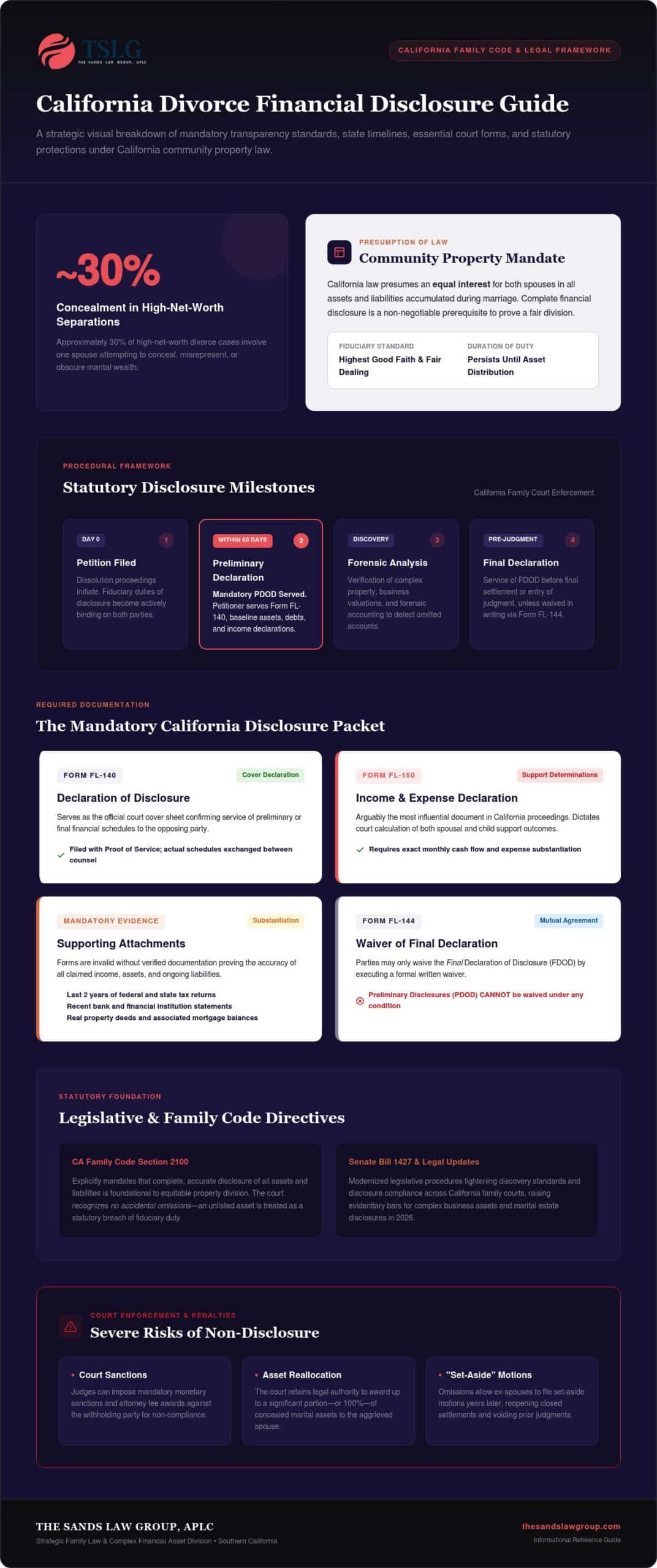
Did you know that in high-net-worth separations, approximately 30% of cases involve one party attempting to conceal or misrepresent their wealth? When your financial future is on the line, the anxiety of a spouse hiding assets or the sheer volume of required documentation can feel paralyzing. Partnering with an experienced divorce financial disclosure lawyer california isn’t just a procedural choice; it’s a vital step in safeguarding your legacy under the state’s rigorous community property standards.
You likely feel overwhelmed by the meticulous demands of Form FL-150 and the fear that a single oversight could lead to severe court sanctions. We understand this burden and believe that transparency should serve as your shield, not your vulnerability. This article provides you with a strategic legal framework to navigate the complexities of California’s mandatory disclosure process in 2026. We will explore how to identify hidden accounts, comply with the latest legislative updates like Senate Bill 1427, and secure a fair distribution that reflects the true value of your marital estate.
Key Takeaways
- Understand the profound fiduciary duty that mandates absolute transparency, ensuring your spouse cannot legally withhold critical financial information during the proceedings.
- Learn the critical distinctions between Preliminary and Final Declarations of Disclosure to avoid procedural delays and ensure your filing meets strict California court deadlines.
- Discover how a divorce financial disclosure lawyer california utilizes forensic accounting and strategic discovery to uncover hidden wealth and accurately value complex community property.
- Identify the severe legal risks of non-disclosure, including court-ordered sanctions and the potential for the court to award a significant portion of concealed assets to the other party.
- Gain peace of mind by understanding how tailored legal advocacy protects your long-term stability while navigating the specific local rules of Southern California court systems.
Understanding Financial Disclosure in California Divorce
California operates as a Community Property State, a legal framework that presumes an equal interest for both spouses in all assets and debts acquired during the marriage. To ensure this division is handled with integrity, the law mandates a process known as financial disclosure. This isn’t merely a paperwork exercise; it’s a comprehensive, transparent exchange of every financial detail, from bank balances to retirement accounts. Without this foundation, the court cannot verify that a settlement is fair, making disclosure a non-negotiable prerequisite for any final judgment.
One of the most critical aspects of this process is the “fiduciary duty” spouses owe to one another. Under California law, this duty requires you to act with the highest degree of good faith and fair dealing. It’s a standard that doesn’t end when you separate. It persists until every asset is distributed. A divorce financial disclosure lawyer california ensures you meet these obligations while protecting you from a spouse who might attempt to circumvent them. The timeline is strict. The petitioner typically must serve their preliminary disclosure within 60 days of filing, a key milestone in the divorce process in california.
The Legal Duty of Absolute Transparency
California Family Code Section 2100 explicitly states that a full and accurate disclosure of all assets and liabilities is essential to the proper division of property. In the eyes of the court, there’s no such thing as an accidental omission. If you “forget” to list a brokerage account or a piece of real estate, the law treats it as a breach of your fiduciary duty. This transparency protects you in the long run. By being thorough now, you prevent your ex-spouse from filing a “set-aside” motion years later, which could reopen the case and jeopardize your financial stability.
Who Must File Financial Disclosures?
Many clients ask if they can skip this step if their separation is amicable. The answer is almost always no. Whether your case is highly contested or entirely uncontested, both parties must serve a Preliminary Declaration of Disclosure. While a summary dissolution offers a slightly more streamlined path for couples with limited assets and no children, the vast majority of cases require formal filings. Even when you’re in full agreement, the court needs proof that both parties made informed decisions based on a complete financial picture. A divorce financial disclosure lawyer california provides the necessary oversight to ensure these documents are legally sound, preventing future disputes from undermining your peace of mind.
The Mandatory Forms: Preliminary and Final Declarations of Disclosure
The procedural requirements of California law are incredibly precise. You’ll encounter the Preliminary Declaration of Disclosure (PDOD) early in your case, typically within 60 days of filing. This set of documents provides the baseline for all future negotiations. While the official guide to financial disclosure outlines the basic steps, the true strategy lies in how you present your data to the court. Navigating these forms without a divorce financial disclosure lawyer california can lead to costly errors that delay your resolution. Later in the process, the Final Declaration of Disclosure (FDOD) is required unless both parties sign a written waiver using Form FL-144. Skipping the PDOD is never an option, but waiving the FDOD can sometimes streamline a settlement if both sides are satisfied with the initial exchange.
To satisfy the court, you must submit a specific packet of forms. Form FL-140 serves as your cover sheet, while supporting documentation acts as the evidence for your claims. You’re required to provide your last two years of federal and state tax returns, recent bank statements, and property deeds. These attachments prove the validity of your declarations and satisfy the mandate for absolute transparency. If you find the volume of documentation overwhelming, reaching out to The Sands Law Group, APLC can provide the clarity and organization you need to move forward confidently.
FL-150: The Income and Expense Declaration
The Income and Expense Declaration (FL-150) is arguably the most influential document in your case. It directly impacts child and spousal support outcomes. Many individuals mistakenly report only their current month’s expenses rather than calculating a 12-month average. If your income fluctuates due to bonuses, commissions, or seasonal work, a long-term average is vital for accuracy. A divorce financial disclosure lawyer california helps you verify that these numbers reflect your true financial reality, preventing you from being saddled with an unsustainable support order or receiving less than you deserve.
FL-142: Cataloging Community and Separate Property
Cataloging your life’s work on the Schedule of Assets and Debts (FL-142) requires a careful distinction between pre-marital assets and marital growth. You must list everything: real estate, vehicles, retirement accounts, and household items. It’s not just about what you own; you must also list all liabilities, including credit cards and student loans. If you owned a home before marriage that increased in value during the union, calculating the community interest in that growth is legally complex. Accurately valuing these items ensures the 50/50 split required by law is based on facts rather than estimates.
Strategy for Complex Assets and Uncovering Hidden Finances
While the initial forms provide a snapshot, they rarely tell the whole story, especially when significant wealth is at stake. Research indicates that in high-net-worth divorces, roughly 30% of cases involve some attempt to conceal or misrepresent assets. If you suspect your spouse isn’t being entirely transparent, the disclosure process shifts from simple reporting to active discovery. A divorce financial disclosure lawyer california acts as a compassionate protector during this phase, handling the heavy lifting of investigation so you don’t have to. We look beyond the surface to secure your interest in 401k and retirement assets, cryptocurrency, and offshore accounts that a spouse might try to shield from division. Digital assets like Bitcoin or NFTs often require specialized forensic tracking to ensure they’re properly characterized and divided.
Uncovering the “Hidden” Paper Trail
Transparency isn’t always voluntary. When a spouse omits information, we utilize formal discovery tools to compel the truth. This includes subpoenaing records directly from banks, brokerage firms, and employers to verify reported income and account balances. Depositions allow us to question the opposing party under oath, where evasive answers can lead to significant legal consequences. We also use interrogatories, which are specific written questions that require verified responses. These methods ensure that no stone is left unturned, providing the clarity needed for a truly equitable settlement and protecting you from future financial surprises.
Valuing the Family Business or Professional Practice
For business owners, the stakes are even higher, as nearly 25% of business-owning spouses in disputed cases have been reported to falsify income records. A common mistake is relying on “book value,” which often fails to reflect the true “fair market value” of the enterprise. We collaborate with forensic accountants to conduct thorough cash flow analyses and determine the value of “goodwill,” an intangible asset that represents the business’s reputation and future earning potential. This process involves scrutinizing tax returns and ledger entries to identify personal expenses run through the company. Our goal is to protect the business owner from an unfair distribution while ensuring the non-owning spouse receives their rightful community share. This strategic approach prevents the business from being dismantled while maintaining the 50/50 principle central to California law.
Consequences of Incomplete or Fraudulent Financial Disclosures
Attempting to conceal wealth or misrepresent income during a separation carries severe legal penalties. California courts take a hard line on financial misconduct, routinely ordering monetary sanctions and requiring the offending party to pay the other spouse’s attorney fees. Because these forms are signed under penalty of perjury, falsifying records can even result in criminal charges. Under California Family Code Section 1101, the court has the authority to award up to 100% of a concealed asset’s value directly to the victimized spouse. If you were recently served divorce papers in California and suspect your spouse is actively hiding assets, immediate strategic action is required. Retaining a divorce financial disclosure lawyer california allows you to address these discrepancies before they compromise your final settlement.
Setting Aside a Judgment Years Later
A simple disclosure error can dismantle your life a decade after your case concludes. In California family law, there’s no statute of limitations for fraud, meaning a hidden account or an intentional misstatement can be used to reopen your case years down the road. This lack of finality exposes your post-divorce earnings and new investments to litigation. Working with a dedicated advocate protects the integrity of your final decree, ensuring your disclosures are legally sound from day one.
Evidentiary Sanctions: Losing Your Voice in Court
When a party fails to comply with disclosure mandates, judges often impose evidentiary sanctions. The court can block you from presenting testimony or introducing evidence regarding your finances, effectively silencing your defense. Even more damaging is an “Issue Sanction,” where the judge simply assumes the other side’s financial claims are entirely true. A divorce financial disclosure lawyer california acts as your shield against these outcomes, helping you compile accurate documentation to avoid accidental omissions. If you suspect your spouse is falsifying records, contact The Sands Law Group today to secure your financial future.
How a California Divorce Lawyer Protects Your Financial Interests
Navigating the intricacies of a high-stakes separation requires more than just administrative compliance; it demands a strategic partner who can absorb your burden while advocating for your long-term stability. At The Sands Law Group, our approach blends deep empathy for your personal hardship with the resolute authority needed to manage complex interpersonal conflict. A seasoned divorce financial disclosure lawyer california doesn’t simply fill out forms. We act as a steadfast guide through the specific local rules of the Los Angeles, Riverside, and San Bernardino court systems, ensuring every filing is beyond reproach. One critical task we manage is drafting the ‘Declaration regarding Service of Declaration of Disclosure’ (FL-141). This document serves as the formal proof to the court that you’ve fulfilled your fiduciary duties, effectively clearing the path for the final resolution of your estate.
Why Legal Representation is Essential for Disclosures
Legal representation is vital because financial data alone doesn’t win cases; the interpretation of that data does. We translate dense tax records and complex business ledgers into persuasive legal arguments that protect your interests. Beyond the math, we serve as a protective shield between you and an aggressive spouse, managing the communication and discovery demands that often fuel anxiety. By ensuring every deadline is met with precision, we prevent the case delays and evidentiary sanctions that can arise from procedural errors. Our goal is to secure a settlement that reflects your true contributions to the marriage, providing a foundation for your future restructuring. A divorce financial disclosure lawyer california provides the clearheaded advocacy necessary when the emotional weight of a dispute threatens to cloud objective decision-making.
Next Steps: Securing Your Financial Future
Taking the first step toward clarity begins with organization. We recommend gathering your most recent tax returns, pay stubs, and statements for all bank and retirement accounts to prepare for your initial meeting. This proactive preparation allows us to build a strategy that prioritizes your stability from the very beginning. You don’t have to face the overwhelming volume of documentation alone. We’re here to translate legal complexity into actionable steps, advocating firmly for a resolution that respects your legacy. We invite you to schedule a consultation with The Sands Law Group today to begin developing a strategic framework designed to protect your wealth and preserve your peace of mind.
Taking Control of Your Financial Future
The path through a mandatory asset exchange can feel fraught with vulnerability, yet it remains the single most critical mechanism for preserving your wealth. By understanding the absolute nature of marital fiduciary duties and leveraging formal discovery tools, you can ensure that no community asset remains obscured. Partnering with a dedicated divorce financial disclosure lawyer california transforms this overwhelming administrative burden into a structured strategy for long-term stability.
As strategic counselors in Los Angeles, Riverside, and Kern counties, The Sands Law Group serves as a compassionate advocate for Southern California families. Our firm provides deep expertise in high-asset and complex property division, ensuring your disclosures satisfy the court while shielding you from aggressive tactics. You don’t have to carry this heavy emotional and financial weight alone. To safeguard your legacy and achieve the finality you deserve, Consult with a California Divorce Financial Disclosure Specialist today. Clearer skies and a secure foundation for your next chapter are entirely within your reach.
Frequently Asked Questions
Is financial disclosure mandatory if we have a prenuptial agreement?
Yes, financial disclosure remains a mandatory requirement even if a prenuptial agreement exists. While your agreement may dictate how assets are divided, California law requires a current, transparent snapshot of all finances to ensure the agreement is enforced fairly. Failing to disclose could lead a judge in Los Angeles or Riverside to question the validity of the contract itself, potentially reopening assets you intended to protect through your original agreement.
How long do I have to complete my financial disclosures in California?
In California, the petitioner must serve their Preliminary Declaration of Disclosure within 60 days of filing the initial petition. The respondent similarly has 60 days after filing their response to serve their own documents. These deadlines are strict, though extensions can be granted via written agreement. Timely filing is essential in Southern California courts to avoid case delays or potential sanctions that could jeopardize your property division goals.
Can I waive the final declaration of disclosure?
You can waive the Final Declaration of Disclosure if both parties sign a written agreement using Form FL-144. However, the Preliminary Declaration of Disclosure is strictly non-waivable under state law. Many couples in San Bernardino and Kern counties choose to waive the final version to streamline the process once they’ve reached a settlement, provided they are confident that all assets were fully revealed during the initial exchange.
What happens if my spouse refuses to provide their financial information?
If your spouse refuses to cooperate, your divorce financial disclosure lawyer california can utilize formal discovery tools to compel transparency. This includes issuing subpoenas to banks and employers or filing a motion to compel with the court. Judges take non-compliance seriously and can issue monetary sanctions or even award the hidden assets to you as a penalty for their breach of fiduciary duty during the proceedings.
Do I have to disclose assets I owned before the marriage?
You must disclose all assets, including separate property owned before the marriage or received via inheritance. While these assets may not be subject to the 50/50 community property split, the court requires a full accounting to verify their characterization. Listing these items clearly helps prevent commingling disputes and ensures your pre-marital wealth is legally recognized as your separate property during the final distribution of the marital estate.
Is my financial disclosure public record in California?
Your detailed financial disclosure forms, such as the Schedule of Assets and Debts, are generally not filed with the court and do not become public record. Instead, you file a Declaration Regarding Service, which simply notifies the judge that the exchange occurred. This procedural step protects your privacy in Southern California while still satisfying the legal requirement for transparency between you and your spouse during the litigation.
What documents do I need to prepare for my divorce financial disclosure?
Preparation requires a comprehensive collection of financial evidence. You will typically need to gather:
- Federal and state tax returns from the last two years.
- Recent bank, brokerage, and retirement account statements.
- Real estate deeds and current mortgage balances.
- Proof of income, such as pay stubs or profit and loss statements.
Compiling these early allows your divorce financial disclosure lawyer california to build a robust framework for your case.
How much does a divorce financial disclosure lawyer cost in California?
The cost of legal representation varies significantly based on the complexity of your marital estate and whether the case is contested. High-asset divorces involving business valuations or forensic accounting naturally require more intensive labor than amicable separations. While we don’t provide specific pricing here, investing in professional counsel helps prevent the far more expensive consequences of hidden assets or court-ordered sanctions due to disclosure errors or omissions.

Article by
Thomas D. Sands, Esq.
Thomas D. Sands is the founder and CEO of The Sands Law Group, APLC. A California attorney with more than two decades of experience, he represents clients in divorce and family law matters as well as civil litigation and real property disputes. His approach emphasizes attentive, practical, and cost-conscious representation.
Sands is a 2023 Litigator of the Year honoree of the American Institute of Trial Lawyers and a 2023 Lawyer of the Year honoree of the American Institute of Legal Professionals. His firm has also received recognition among the 2025 Best Law Firms in America, a 2026 Benchmark Best of award, and a 2026 Law Firm of the Year honor.









Leave A Comment