

Trying to protect a 401(k) by moving or withdrawing money quickly can create complications rather than preserve your rights. If your question is “how to protect 401k during divorce california,” start by understanding the account’s history, not by concealing or transferring funds. In California, contributions made during marriage may be community property, while contributions from before marriage or after separation may be separate property. Investment growth and the records behind it can matter too.
It’s understandable to worry that a rushed agreement, an unclear valuation date, or a withdrawal could affect your long-term financial security. This article explains how separate and community portions may be assessed, why account statements and contribution records matter, and how a Qualified Domestic Relations Order (QDRO) can be used to divide a retirement plan. You’ll also find practical questions to consider before agreeing to a division or changing the account. Because the result depends on the account’s history and the circumstances of your divorce, a careful property-division analysis can help clarify your options and protect your position.
Key Takeaways
- Account ownership alone doesn’t determine how a 401(k) is treated in divorce. The account’s history and the timing of contributions can matter.
- The current balance may not equal the amount subject to division. Employer contributions and investment gains or losses may also affect the analysis.
- A QDRO differs from a divorce judgment or settlement. Understanding that distinction helps ensure an agreed division can be carried out.
- To learn how to protect 401k during divorce california, preserve account records, disclose information accurately, and review settlement terms before signing.
- Legal guidance can help assess account characterization, valuation questions, and the language used to divide retirement benefits.
How California Divorce Law Treats Your 401(k)
Divorce can make retirement security feel uncertain, particularly when a 401(k) is one of your largest assets. A useful first step is to understand how the account may be characterized under California law. A 401(k) is an employer-sponsored retirement plan funded through employee contributions and, in some plans, employer contributions. The account may be in one spouse’s name, but that alone doesn’t determine whether its value is separate property, community property, or a combination.
California is a community property state, and assets and earnings acquired during marriage are generally subject to community-property rules. That doesn’t mean the entire current account balance is automatically divided. The result depends on the account’s history, the timing and source of contributions, applicable law, and available evidence. Accurate disclosure is part of the process. Protecting your interests means identifying and documenting the account, not hiding it or moving funds to keep them out of view.
When can a 401(k) be community or separate property?
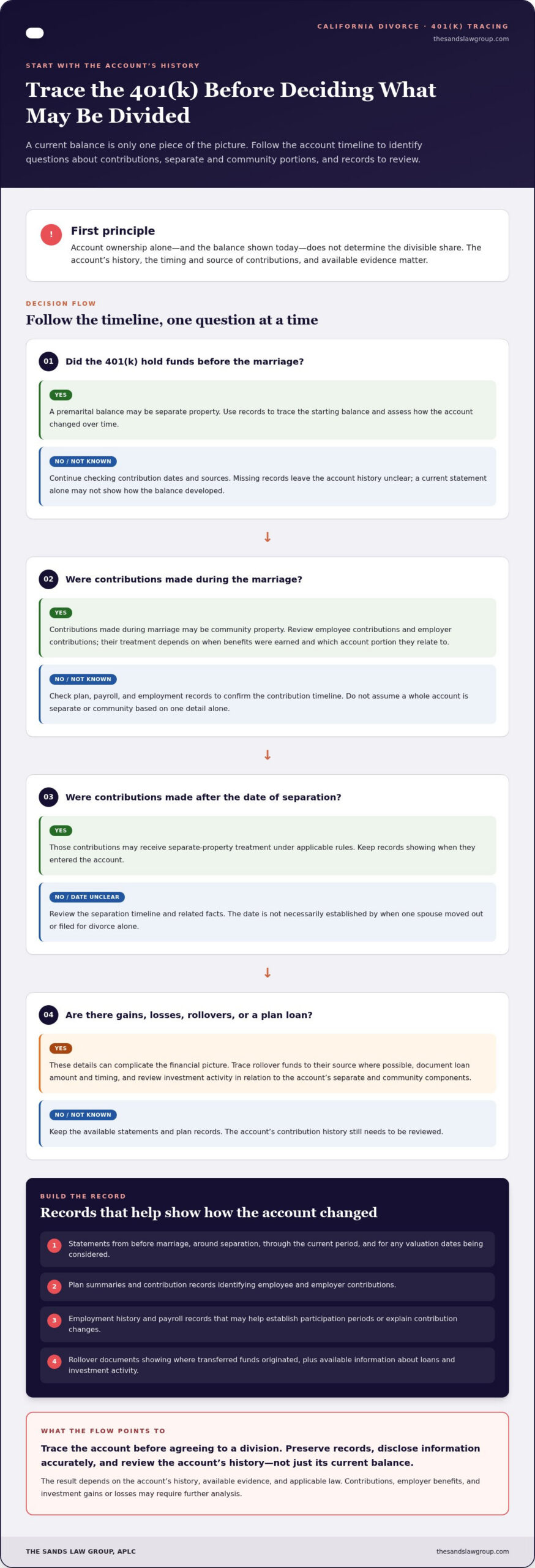
Contributions made during marriage may be community property, while contributions made before marriage may be separate property. Contributions made after the date of separation may also receive separate-property treatment under applicable rules. Employer contributions and investment gains or losses may require analysis of when the underlying benefits were earned and which portion of the account they relate to.
A premarital balance doesn’t necessarily make the entire account separate, just as contributions during marriage don’t automatically make every dollar community property. If the account contains both types of funds, tracing may be needed to identify the portions. The account’s growth may also need to be analyzed in relation to its separate and community components.
Why do the date of separation and account history matter?
The date of separation can affect how later contributions are characterized, so it may be important if spouses disagree about when the marriage ended. The date isn’t necessarily established by when one spouse moved out or filed for divorce alone. The surrounding facts and applicable legal standards matter. Records showing when contributions entered the account can help clarify the timeline.
Gather statements from before marriage, around separation, and through the current period, along with plan records showing employee and employer contributions. Employment history and payroll records may help fill gaps or explain changes in contribution levels. Keep complete records rather than relying only on a current balance, which may not show how the account developed.
Account history helps distinguish potentially separate and community portions by showing when contributions were made and how the balance changed over time.
If you’re considering how to protect 401k during divorce california, begin with accurate disclosure and a clear record of the account timeline. A careful review can identify characterization questions to resolve before retirement assets are addressed in a settlement or court proceeding.
How a California Divorce Determines the Divisible 401(k) Share
A current account statement shows what the plan is worth now, but it doesn’t necessarily show what portion may be divisible in a divorce. The analysis may need to distinguish employee contributions, employer contributions, investment gains or losses, and funds that were in the account before marriage. Each component has a timeline, and how it’s characterized can depend on the facts, records, and applicable law.
Tracing is a records-based analysis, not a conclusion drawn from whose name appears on the account. For example, if a 401(k) began before marriage and continued to receive contributions afterward, records may help identify the premarital balance and show how the account changed. A rollover from another plan can add another layer because the source and timing of those funds may matter.
Which records help trace a 401(k)?
Collect available statements from around the marriage date, the separation date, and any valuation dates being considered. Plan summaries, contribution records, employment history, and rollover documents can help connect balances to their sources and timing. If older statements are missing, note the periods involved and keep written requests or correspondence as you seek records.
- Statements showing account balances and investment activity
- Plan and contribution records identifying employee and employer contributions
- Employment records that help establish the period of participation
- Rollover documentation showing where transferred funds originated
How can loans, rollovers, and employer contributions complicate valuation?
An account loan or outstanding balance can affect the financial picture. Document the loan amount, timing, and available plan information rather than treating the statement balance as the whole story. If funds moved between plans, trace the rollover to its source where possible. Employer contributions and investment growth also require review. Their treatment shouldn’t be assumed to be identical across every account or set of circumstances.
Imagine an account that held funds before marriage, received contributions during marriage, and later experienced both gains and losses. A current balance combines those events into one figure. Historical statements and plan records can help show how the account developed, although missing records or multiple transfers may make the analysis more involved.
The divisible share depends on the account timeline and available evidence, subject to legal review. Determining that share is distinct from carrying out a division through the required plan documents. The IRS guidance on Qualified Domestic Relations Orders (QDROs) provides information about these orders and retirement benefits.
If you’re unsure how to protect 401k during divorce california, an organized record set can make it easier to assess the account as part of the broader property division. You can discuss retirement-account property division with The Sands Law Group, APLC in light of your circumstances.
QDROs, Settlement Options, and the Risks of Moving Funds Too Soon
Agreeing how to divide a 401(k) isn’t always the same as completing the division. A divorce judgment or settlement can set out the spouses’ agreement, but the plan may require a separate order before it can pay benefits to the other spouse. Terms that seem clear between spouses may not, by themselves, tell the plan administrator how to carry them out.
A community share doesn’t necessarily mean giving up the entire account. Depending on the account analysis and the overall settlement, spouses may divide plan benefits or negotiate for one spouse to keep the 401(k) while the other receives other assets of agreed value. Any trade-off should account for the assets’ terms and value, not just compare headline balances.
What a QDRO does, and what it doesn’t do
A Qualified Domestic Relations Order, or QDRO, is commonly used to assign eligible retirement-plan benefits to an “alternate payee,” often the other spouse. If properly prepared and accepted under the plan’s procedures, it directs the plan to recognize that person’s rights to a specified benefit. Plan terms and federal rules shape what the order must say, so requirements and submission steps aren’t identical for every plan.
A QDRO implements a division. It doesn’t determine by itself which funds are community or separate property, or resolve every valuation issue. The judgment or settlement should establish the agreed division, while the order translates it into plan terms. Reviewing IRS guidance on Qualified Domestic Relations Orders (QDROs) can clarify the order’s role, but plan-specific procedures still need careful attention.
Why can moving funds too soon backfire?
Withdrawing or transferring retirement funds before understanding the division and plan process can have lasting consequences. A withdrawal may be taxable and could trigger an additional penalty, depending on the circumstances and applicable exceptions. A transfer made outside the appropriate process may also complicate the division or create a dispute about what happened to the funds.
Concealment or incomplete disclosure can undermine credibility and expose a spouse to legal consequences. Preserve statements and plan records, disclose the account accurately, and avoid withdrawals, transfers, or changes made to frustrate a division. If funds have already been moved, document the transaction and raise it promptly with counsel rather than attempting to obscure it.
Before signing a settlement or waiving a claim, make sure you understand the account share, the proposed treatment of other assets, and what steps remain before the plan can implement the agreement. The Sands Law Group, APLC handles divorce and property-division matters involving retirement accounts. You can discuss your retirement-account division in light of your circumstances.
Steps to Protect Your 401(k) Before and During a California Divorce
Divorce involves difficult decisions, and organizing financial records can make retirement-account issues more manageable. A practical answer to how to protect 401k during divorce california starts with preserving a reliable account history, then reviewing any proposed division before agreeing to it. Treat the 401(k) as part of the broader property picture, alongside other assets and liabilities, rather than evaluating it in isolation.
- Preserve existing records. Save account statements, plan documents, contribution histories, beneficiary records, and communications from the plan or employer. Keep complete copies in a secure location, and don’t alter, delete, or selectively share relevant financial records.
- Document the account timeline. Note the dates of marriage and separation, employment changes, rollovers, and major account events. This timeline can help organize the records and identify gaps that need attention.
- Disclose the account accurately. Provide complete financial information through the divorce process. Don’t omit the account or assume that its title determines how it should be characterized.
- Review proposed terms before agreeing. Understand how the proposal defines the share, addresses valuation, and allocates responsibility for preparing and submitting any required plan order. Don’t sign a waiver or settlement term you don’t understand.
- Complete the implementation steps. Confirm that the final documents reflect the agreed division and follow the plan’s applicable procedures. Keep copies of submitted and accepted orders and related communications.
Build a clear retirement-account document file
Organize records chronologically so account statements, plan summaries, contribution information, and employment records can be compared. Include rollover paperwork and relevant account communications, along with beneficiary records showing what information was on file. If historical statements are missing, note which periods are unavailable and keep requests and responses as you seek copies. A clear file helps counsel assess the account history and identify unresolved questions.
Review settlement language before agreeing to a division
Read the proposed terms closely. Do they specify the share to be divided, the valuation approach, and who will prepare the plan order? Consider tax treatment, plan limitations, and implementation timing with appropriate legal and tax guidance. Then compare the retirement proposal with the overall allocation of property and liabilities. A larger share of one asset may affect the fairness of the full settlement.
For a broader framework on how assets are addressed in a California divorce, the firm’s California property division guide can help put retirement benefits in context. The Sands Law Group, APLC handles California divorce and complex property division involving retirement accounts. Schedule a discussion about your property-division concerns based on your circumstances.
When California Divorce Counsel Can Help Protect Your Retirement Interests
Questions about a 401(k) can be difficult to separate from the rest of a divorce. Legal counsel can review account records, assess which portions may be characterized as separate or community property, identify valuation questions, and evaluate whether proposed settlement language clearly addresses the division. Counsel can also help consider what steps are needed to implement an agreement through the retirement plan. No single document or fact determines every outcome. The account history and applicable law matter.
The Sands Law Group, APLC represents clients in California divorce and complex property division involving retirement accounts, from negotiations through trial proceedings. The firm serves clients in Los Angeles, Riverside, San Bernardino, and Kern. A focused review can help you understand the issues to resolve and how the retirement account fits into the broader division, without assuming a particular result.
Situations where individualized review may be especially important
Some account histories call for closer analysis, including a 401(k) opened before marriage, a long marriage, incomplete records, or multiple rollovers. A disputed separation date, complex compensation, or substantial changes in account value may also raise questions about the timeline and appropriate valuation. These circumstances don’t determine the outcome on their own, but they can make a careful review of records and proposed terms especially useful.
Prepare for a focused conversation about your 401(k)
Bring what you have, even if the records are incomplete. A clear list of missing documents or unresolved questions can help focus the discussion and identify useful next steps.
- Available account statements, plan information, contribution records, and rollover documents
- Marriage and separation dates, plus relevant employment changes
- Any proposed settlement terms, waivers, or draft orders affecting the account
Consider asking questions that address both legal characterization and practical implementation:
- Which parts of the account may be separate property or community property, and what records support that analysis?
- What valuation approach is being proposed, and are any account changes or missing statements relevant?
- How should settlement language describe the division, and what plan order or approval steps may be needed?
- What tax-sensitive issues should be understood before funds are transferred or benefits are distributed?
These questions can help you assess how to protect 401k during divorce california by focusing on informed decisions, complete disclosure, and workable implementation. You don’t need to resolve every uncertainty before seeking guidance. An initial review can help identify what needs clarification and which records may support it.
For case-specific guidance on your retirement interests as part of a California divorce, Schedule a consultation with The Sands Law Group, APLC.
Take the Next Step Toward Financial Clarity
Divorce can make long-term financial decisions feel urgent, but you don’t have to resolve every question at once. Identify what remains uncertain, gather the documents you have, and seek guidance before signing terms that could affect your future. A measured approach can help you move forward without making decisions under pressure.
If you’re still asking how to protect 401k during divorce california, discuss your account history and proposed division with counsel before finalizing an agreement. A conversation focused on your circumstances can help clarify the issues that need attention and the choices available to you.
Schedule a consultation with The Sands Law Group to discuss your retirement interests as part of your divorce. With thoughtful preparation and informed guidance, you can take the next step toward greater financial clarity.
Frequently Asked Questions
Is my 401(k) automatically split in a California divorce?
No. Filing for divorce doesn’t automatically divide the account or transfer funds to either spouse. The division is addressed through the divorce process and, for many employer plans, may require a separate plan order to carry out the agreed or ordered division. Also distinguish a restriction on moving assets after a case is filed from an actual division: a restriction doesn’t determine each spouse’s share.
Can my spouse take half of my 401(k) in California?
Not necessarily half of the entire account. California generally divides community property equally, but that doesn’t mean each spouse receives half of every asset individually. For example, a settlement may account for a spouse’s interest in the community portion of a 401(k) alongside other property and liabilities. Consider separate-property claims, account history, and the overall division before concluding what share may be awarded.
How is a 401(k) divided in a California divorce?
The process generally involves identifying the portion subject to division, agreeing on or resolving its value, and arranging for the plan to implement the division. The valuation date and treatment of investment changes between that date and distribution can affect the result. For example, settlement terms should clarify whether the recipient’s share reflects gains or losses after valuation, rather than leaving that issue unstated.
What is a QDRO, and do I need one for a 401(k)?
A QDRO is a court order that can direct a qualified retirement plan to recognize an alternate payee’s right to plan benefits. A divorce judgment or settlement may establish the spouses’ agreement, while the QDRO gives the plan instructions for administering it. Whether an order is required and what it must contain depends on the plan and applicable rules, so the order should follow the plan’s review and submission process.
What happens if I withdraw money from my 401(k) before the divorce is final?
A withdrawal may create tax consequences and, depending on your age and circumstances, an additional early-distribution penalty. A withdrawal before the case is resolved may also raise questions about how the funds were used or whether court restrictions apply. If the divorce has been filed, don’t assume you can freely withdraw or transfer retirement funds. Get advice about your specific situation before making a transaction.
How can I prove that part of my 401(k) is separate property?
Use records that connect the funds to their source and timing. For example, an account statement from near the marriage date, followed by contribution records and statements showing later activity, may help establish a timeline. Rollover paperwork can be important if funds moved between plans. If records are missing, request copies from the plan or former employer and keep correspondence showing what you sought.
Should I keep contributing to my 401(k) during a California divorce?
It depends on your circumstances, plan, and any applicable court orders. Don’t assume you must stop contributing just because divorce proceedings have begun, or that continued contributions have no effect on property characterization. Contributions made after separation may be treated differently under applicable rules, but the relevant facts matter. If you’re considering how to protect 401k during divorce california, discuss contribution changes with counsel before altering elections, especially if your compensation or employment is changing.

Article by
Thomas D. Sands, Esq.
Thomas D. Sands is the founder and CEO of The Sands Law Group, APLC. A California attorney with more than two decades of experience, he represents clients in divorce and family law matters as well as civil litigation and real property disputes. His approach emphasizes attentive, practical, and cost-conscious representation.
Sands is a 2023 Litigator of the Year honoree of the American Institute of Trial Lawyers and a 2023 Lawyer of the Year honoree of the American Institute of Legal Professionals. His firm has also received recognition among the 2025 Best Law Firms in America, a 2026 Benchmark Best of award, and a 2026 Law Firm of the Year honor.
Article reviewed by
Thomas D. Sands, Esq.
Thomas D. Sands is the founder and CEO of The Sands Law Group, APLC. A California attorney with more than two decades of experience, he represents clients in divorce and family law matters as well as civil litigation and real property disputes. His approach emphasizes attentive, practical, and cost-conscious representation.
Sands is a 2023 Litigator of the Year honoree of the American Institute of Trial Lawyers and a 2023 Lawyer of the Year honoree of the American Institute of Legal Professionals. His firm has also received recognition among the 2025 Best Law Firms in America, a 2026 Benchmark Best of award, and a 2026 Law Firm of the Year honor.
TOLL-FREE: 855-SANDS4U