

When financial details are difficult to explain, they can become central to your California spousal support case. Support can affect your finances well beyond the immediate separation, and it’s understandable to be unsure what matters or whether discussions will become adversarial. A spousal support lawyer can help organize relevant facts, explain your options, and develop a strategy for your circumstances.
Whether you’re requesting support, responding to a request, or seeking to modify or enforce an order, legal counsel can help you understand the process and prepare for negotiations or court proceedings. Advocacy doesn’t have to escalate conflict. A clear understanding of your position can help you approach difficult decisions with greater confidence.
This article explains what a California spousal support lawyer can do and what to consider when choosing legal representation. It also offers practical guidance on gathering financial records, clarifying your goals, and making your first conversation focused and productive. The aim is to help you make a considered choice, not predict a particular outcome.
Key Takeaways
- Consider seeking legal advice before negotiations, court filings, or signing a proposed support agreement.
- Temporary and longer-term support involve different considerations, so your circumstances and financial details matter.
- Compare a spousal support lawyer’s case experience, communication approach, strategy, and familiarity with local courts.
- Organize available income, expense, tax, and support-order records to make your first conversation more focused.
- The Sands Law Group represents both support recipients and payors in establishing, modifying, and enforcing orders.
When should you speak with a California spousal support lawyer?
Support questions can affect more than your monthly budget. If you’re seeking support, you may be unsure how separation will affect your ability to meet expenses. If your spouse has requested support, you may be concerned about the effect of payments on your own financial stability. A spousal support lawyer can help you understand the issues and prepare a response based on your circumstances, rather than assumptions or pressure to reach a quick agreement.
Legal advice may be useful before you negotiate, respond to a court filing, or sign a proposed agreement. Support can be addressed as part of a divorce or legal separation, and discussions may cover temporary needs as well as longer-term arrangements. The general Alimony overview explains how support is handled in different contexts, but California rules and your financial facts require individual consideration.
What can a spousal support lawyer help you address?
Counsel can review relevant financial information and the history of your relationship, explain possible options, and identify strengths and unanswered questions in your position. Representation can help someone requesting payments or responding to a request, including through negotiations, court filings, and hearings when needed. If circumstances change after an order is made, legal advice can also help you understand whether modification or enforcement may be relevant.
Some matters need closer analysis because the parties disagree about income, access to financial records, or how property and other resources should be considered. Changes in employment, earnings, or expenses can also affect the financial picture. A lawyer can help distinguish documented facts from disputed claims and develop an approach suited to the case. That guidance is not a promise of a particular amount, ruling, or agreement. The outcome depends on the facts and applicable law.
When might early legal guidance matter?
Consider getting advice when a proposed agreement is on the table, divorce proceedings are underway, or you and your spouse have substantially different views of your finances. Reviewing terms before signing can help you understand the obligations and potential consequences you’re accepting. If a request has been filed, timely guidance can help you identify information needed to respond and understand the next steps in your case.
Changes in income or other financial circumstances may also call for prompt advice, particularly if an existing order no longer reflects the situation or payments are not being made. Early guidance doesn’t mean every dispute must go to court. It can clarify whether negotiation is practical, what information may be needed, and how to prepare if formal proceedings become necessary.
How does California law shape a spousal support case?
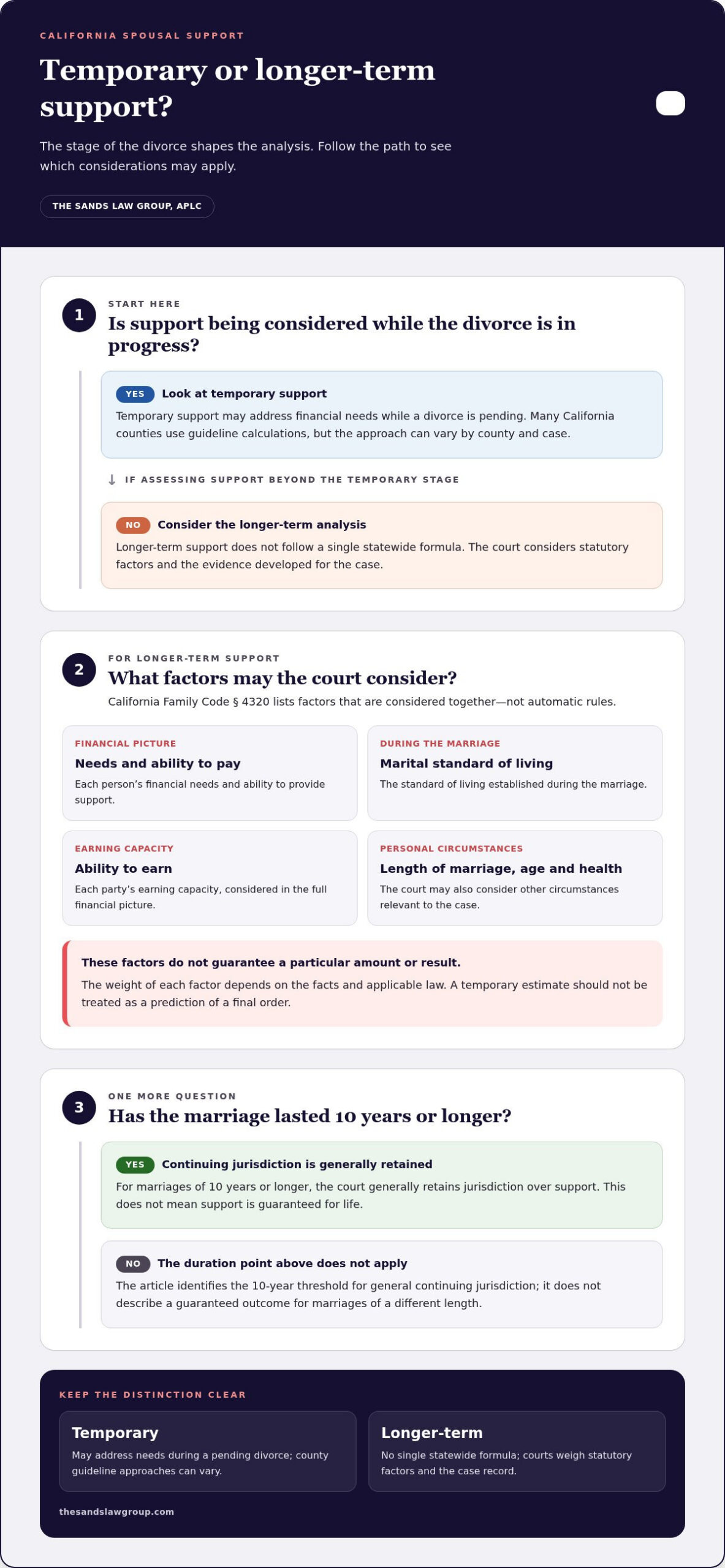
Spousal support, sometimes called alimony, is financial support one spouse or former spouse pays the other under a court order or agreement. The legal analysis is not the same at every stage of a divorce. Temporary support may be considered while a case is pending, while longer-term support involves a different analysis and evidence developed for that decision.
What factors may the court consider?
For longer-term support, California courts consider statutory factors under California Family Code § 4320. These include each person’s needs and ability to pay, the marital standard of living, and each party’s earning capacity. The court may also consider the length of the marriage, age and health, and other circumstances relevant to the case.
These factors are considerations, not automatic rules. For example, one spouse’s reduced income may matter, but its significance depends on the full financial picture, including the other spouse’s resources and each person’s ability to earn. The weight of any factor depends on the facts and applicable law; none guarantees a particular amount or result. A spousal support lawyer can help organize relevant information and explain how the legal framework may apply to your situation.
How are temporary and longer-term support issues different?
Temporary support can address financial needs while a divorce is in progress. Many California counties use guideline calculations for temporary support, but the approach can vary by county and case. Longer-term support doesn’t follow a single statewide formula. Instead, the court considers statutory factors and the case record, including the marital standard of living and the parties’ circumstances.
The duration of a marriage can also affect the court’s continuing authority over support. For marriages of 10 years or longer, the court generally retains jurisdiction, but that doesn’t mean support is guaranteed for life. A temporary estimate should not be treated as a prediction of a final order. For a more detailed explanation of the calculations, see this California spousal support calculation guide.
If you’d like to discuss how these rules relate to your circumstances, you can schedule a conversation about your support matter.
What should you compare when choosing a spousal support lawyer?
Choosing counsel is a significant decision, particularly when support may shape immediate finances and future stability. Look beyond broad promises or polished marketing. Compare how each attorney approaches support issues, explains uncertainty, and responds to the priorities of the person seeking support or the person asked to pay. California Courts’ overview of California spousal support laws can provide background, while legal advice should be specific to your facts.
| What to compare | What a useful discussion may cover |
|---|---|
| Support-case experience | How the lawyer handles requests, responses, negotiations, court proceedings, and issues after an order is made. |
| Communication | Whether explanations are clear, questions are answered directly, and uncertainties are acknowledged. |
| Case strategy | How financial information may be organized, what options may be available, and what decision points could arise. |
| Local court familiarity | Whether the lawyer understands the relevant court process and can explain applicable local procedures without promising a result. |
Does the lawyer understand your position and priorities?
Notice whether the attorney asks about your income, expenses, obligations, and preferred resolution, rather than focusing only on a requested amount. A recipient may need advice on documenting financial needs and responding to questions about earning capacity. A payor may need to understand how income, necessary expenses, and ability to pay could be presented. In either role, a useful discussion considers immediate concerns alongside longer-term financial stability.
Questions to ask include: How might negotiation differ from court advocacy in my circumstances? What information could clarify the support issue? What decisions may I need to make next? Specific, balanced answers can help you understand the path ahead without suggesting that any factor guarantees an outcome.
How should you assess communication and case strategy?
Consider whether the lawyer listens carefully and explains risks, options, and unresolved questions in language you can follow. Ask how evidence may be evaluated, how negotiations could be approached, and what might happen if the matter proceeds to court. A clear strategy should connect proposed next steps to your financial facts and goals, while recognizing that the approach may need to adapt as information changes.
Compare the substance of the proposed steps, not just credentials or assurances. No particular title, strategy, or communication style guarantees a favorable decision. Look for counsel who treats your concerns seriously, gives realistic guidance, and helps you make informed choices.
How can you prepare for a spousal support lawyer consultation?
A first conversation can feel more manageable when you have key facts and questions in front of you. You don’t need a perfect file or every document before seeking advice, especially if a deadline or urgent financial concern needs attention. Bring what’s available, explain what’s missing, and let the lawyer help identify what may matter next.
Which records and facts may help frame the discussion?
Use this checklist to organize what you have:
- 1. Gather income records. Collect recent pay statements, tax returns, and other documents showing income or changes in earnings, if available.
- 2. Outline your monthly finances. Note regular expenses, debts, and household costs so you can describe your budget and financial needs or obligations.
- 3. Collect support-related papers. Bring any existing support orders, proposed agreements, financial disclosures, or court papers related to the matter.
- 4. Prepare a brief timeline. Record major marital and financial changes, such as separation, a job change, reduced income, or altered expenses. Include approximate dates if exact ones aren’t readily available.
- 5. Identify your priorities. Write down your immediate concerns and what you hope a workable resolution will address, whether you’re seeking support or responding to a request.
Keep sensitive financial records secure and share them through appropriate channels. Don’t alter, hide, or discard relevant financial information. If a document is unavailable, make a note of that rather than delaying urgent legal advice while trying to complete the file.
Which questions should you bring?
A short list can help you leave with clearer next steps. Consider asking:
- Based on the information available, what legal issues appear most important?
- What additional records or facts would help evaluate my options?
- What decisions or deadlines should I pay attention to at this stage?
- How do you approach communication and negotiation in a support matter?
- If negotiation doesn’t resolve the issue, how might court proceedings be handled?
A useful consultation should help you understand what is known, what remains uncertain, and what information could move the analysis forward. You don’t need to predict the outcome before speaking with counsel. The purpose is to give a spousal support lawyer a clearer picture of your situation and receive guidance shaped around your facts.
When you’re ready to discuss your circumstances, schedule a spousal support consultation.
How can The Sands Law Group guide your California spousal support matter?
Support questions can arise at different points in a divorce or legal separation. The right next step depends on what has happened so far and what remains unresolved. The Sands Law Group, APLC represents people seeking support and those asked to pay, helping clients pursue or respond to requests and address existing orders through establishment, modification, or enforcement proceedings.
What does representation look like across a support matter?
Representation starts with understanding the financial facts, the procedural stage, and your priorities. Counsel can assess available information, explain potential options, and identify questions that may need further documentation. Support may include preparing filings, negotiating with the other party, and advocating in court when needed. The approach should reflect your circumstances, whether you’re seeking support, responding to a request, or dealing with an order that may need to be changed or enforced.
For a recipient, representation may focus on presenting financial needs and relevant information clearly. For someone asked to pay, it may involve evaluating income, expenses, and the basis of the request. In either situation, legal advocacy addresses the evidence and applicable issues, not a promised support amount or court decision. A spousal support lawyer can help you understand what information may be important and prepare for decisions ahead.
The Sands Law Group, APLC serves clients in Los Angeles, Riverside, San Bernardino, and Kern. Its family-law practice handles negotiations, filings, and trial proceedings, allowing counsel to address support matters in the context of divorce or legal separation when relevant. A case-specific strategy can bring structure to a stressful process, whether the next step is an informed discussion or court advocacy.
What is a practical next step?
Start with your central concern: a support request you need to answer, a proposed agreement you’re considering, or a change in circumstances affecting an existing order. Available financial records and court papers can help frame the discussion, but you don’t need every detail resolved before asking for guidance.
Schedule a conversation through the The Sands Law Group, APLC consultation calendar to discuss your California spousal support matter. A focused discussion can help clarify the issues, identify useful next steps, and give you a more grounded understanding of your options without assuming how the matter will ultimately be resolved.
Take a clear next step in your support matter
Spousal support decisions can shape your financial future, but the right approach depends on your circumstances, the stage of your case, and the information available. When choosing a spousal support lawyer, look for clear advice about your options, a realistic discussion of risks, and a strategy grounded in your priorities, not promises of a particular result.
Preparing the financial records and questions you already have can make an initial conversation more focused. The Sands Law Group represents people seeking support and those asked to pay, including in matters involving establishment, modification, and enforcement of support orders. The firm serves clients in Los Angeles, Riverside, San Bernardino, and Kern.
If you’re ready to discuss your circumstances and possible next steps, schedule a consultation with The Sands Law Group. You don’t need every answer before you begin. A focused conversation can help clarify a difficult decision and support a more considered path forward.
Frequently Asked Questions
Is a spousal support lawyer necessary in California?
Not every support matter requires a lawyer, but individualized advice may be valuable when income is disputed, finances are complex, an agreement is being negotiated, or court proceedings are underway. A spousal support lawyer can explain how California law may apply to the facts and help you assess options and risks. Whether to seek representation depends on your circumstances, the urgency of the issue, and your ability to manage the process.
How does a spousal support lawyer help in a California divorce?
A lawyer can review financial information, explain relevant legal issues, prepare or respond to court filings, negotiate proposed terms, and advocate in court when needed. Counsel may represent either the spouse seeking support or the spouse asked to pay. The work depends on the case’s procedural stage and your goals. A lawyer can help you understand options and prepare a strategy, but can’t guarantee a particular order or outcome.
What does a California court consider when deciding spousal support?
California courts consider statutory factors that may include each party’s needs and circumstances, ability to pay, earning capacity, and the marital standard of living. For longer-term support, the analysis depends on the evidence and applicable law, rather than one universal formula. How a factor applies can vary from case to case. A lawyer can help explain how current rules relate to your financial information and support issue.
Can a spousal support lawyer represent the person paying support?
Yes. A person asked to pay support can obtain legal representation to understand the request, organize relevant financial information, assess proposed terms, and participate in negotiations or court proceedings. Counsel can explain potential options and risks while advocating within the law. Representation is not a promise of a specific payment amount or decision. The appropriate approach depends on the facts, existing orders or filings, and the person’s goals.
What documents should I bring to a spousal support lawyer consultation?
Bring available income records, recent tax documents, a monthly budget, relevant financial disclosures, and any existing support orders or proposed agreements. Court papers can also help the lawyer understand where the matter stands. A short timeline of important financial changes, such as a job change or altered expenses, may provide useful context. Don’t delay seeking advice because you lack a document; counsel can identify what else may be needed.
How do I choose a spousal support lawyer near Los Angeles or Riverside?
Compare lawyers based on relevant family-law experience, clear communication, their approach to negotiation and court proceedings, and how well they understand your priorities. Ask what information could help assess your situation and what next steps may involve. The Sands Law Group represents both support recipients and payors and serves Los Angeles, Riverside, San Bernardino, and Kern. A consultation can help you discuss your circumstances and the questions that matter to you.
Can a lawyer help modify or enforce a California spousal support order?
Yes. A lawyer can review an existing order and the circumstances surrounding a possible request to modify or enforce it, then advise on the legal process and help prepare relevant filings. Whether a change or enforcement action is appropriate depends on the order, evidence, circumstances, and current law. Don’t assume an order changes automatically when finances shift. Legal advice can help clarify what steps may be available in your situation.

Article by
Thomas D. Sands, Esq.
Thomas D. Sands is the founder and CEO of The Sands Law Group, APLC. A California attorney with more than two decades of experience, he represents clients in divorce and family law matters as well as civil litigation and real property disputes. His approach emphasizes attentive, practical, and cost-conscious representation.
Sands is a 2023 Litigator of the Year honoree of the American Institute of Trial Lawyers and a 2023 Lawyer of the Year honoree of the American Institute of Legal Professionals. His firm has also received recognition among the 2025 Best Law Firms in America, a 2026 Benchmark Best of award, and a 2026 Law Firm of the Year honor.
Article reviewed by
Thomas D. Sands, Esq.
Thomas D. Sands is the founder and CEO of The Sands Law Group, APLC. A California attorney with more than two decades of experience, he represents clients in divorce and family law matters as well as civil litigation and real property disputes. His approach emphasizes attentive, practical, and cost-conscious representation.
Sands is a 2023 Litigator of the Year honoree of the American Institute of Trial Lawyers and a 2023 Lawyer of the Year honoree of the American Institute of Legal Professionals. His firm has also received recognition among the 2025 Best Law Firms in America, a 2026 Benchmark Best of award, and a 2026 Law Firm of the Year honor.
TOLL-FREE: 855-SANDS4U