

Most people assume that dissolving a marriage is merely an administrative exercise in filing paperwork, but the legal reality is far more consequential. Treated correctly, the divorce process in California is a protective strategic framework designed to safeguard your parental bonds, secure community property, and preserve your long-term stability. What happens in the opening weeks of a case often dictates how your family’s future takes shape.
If you’re consumed by anxiety over diminished parenting time, undisclosed marital accounts, or the exhausting prospect of courtroom conflict, your concerns are completely justified. You don’t have to confront this intricate system in the dark. This guide provides a clear, chronological breakdown of every statutory requirement and procedural timeline, ensuring you understand precisely what to expect from your initial petition through the final decree. Ahead, explore the core legal stages, mandatory disclosure requirements, and protective measures necessary to navigate your California divorce with steady clarity and confidence.
Key Takeaways
- Understanding statutory residency rules and automatic restraining orders provides critical legal protection the moment you initiate the divorce process in California.
- Navigating the core procedural stages correctly ensures that initial petitions and service of process meet every statutory requirement to keep your timeline on track.
- Completing mandatory financial disclosures protects against undisclosed marital assets, shielding both your balance sheet and your long-term economic security.
- California community property mandates equal asset distribution, while custody determinations focus entirely on the best interest of your children to safeguard parental bonds.
- Achieving an enforceable final judgment requires careful strategic choices, whether negotiating a comprehensive marital settlement agreement or presenting your case at trial.
Understanding the California Divorce Process: Requirements and Immediate Protections
Filing for the dissolution of a marriage requires an immediate grasp of statutory parameters to avoid costly missteps. Unlike jurisdictions governed by fault-based systems in the broader context of Divorce in the United States, California functions strictly as a no-fault state under the California Family Code. Courts resolve marital ties exclusively on grounds of irreconcilable differences or permanent legal incapacity, effectively disregarding evidence of marital misconduct such as infidelity when granting a dissolution decree.
Statutory Residency and No-Fault Dissolution Grounds
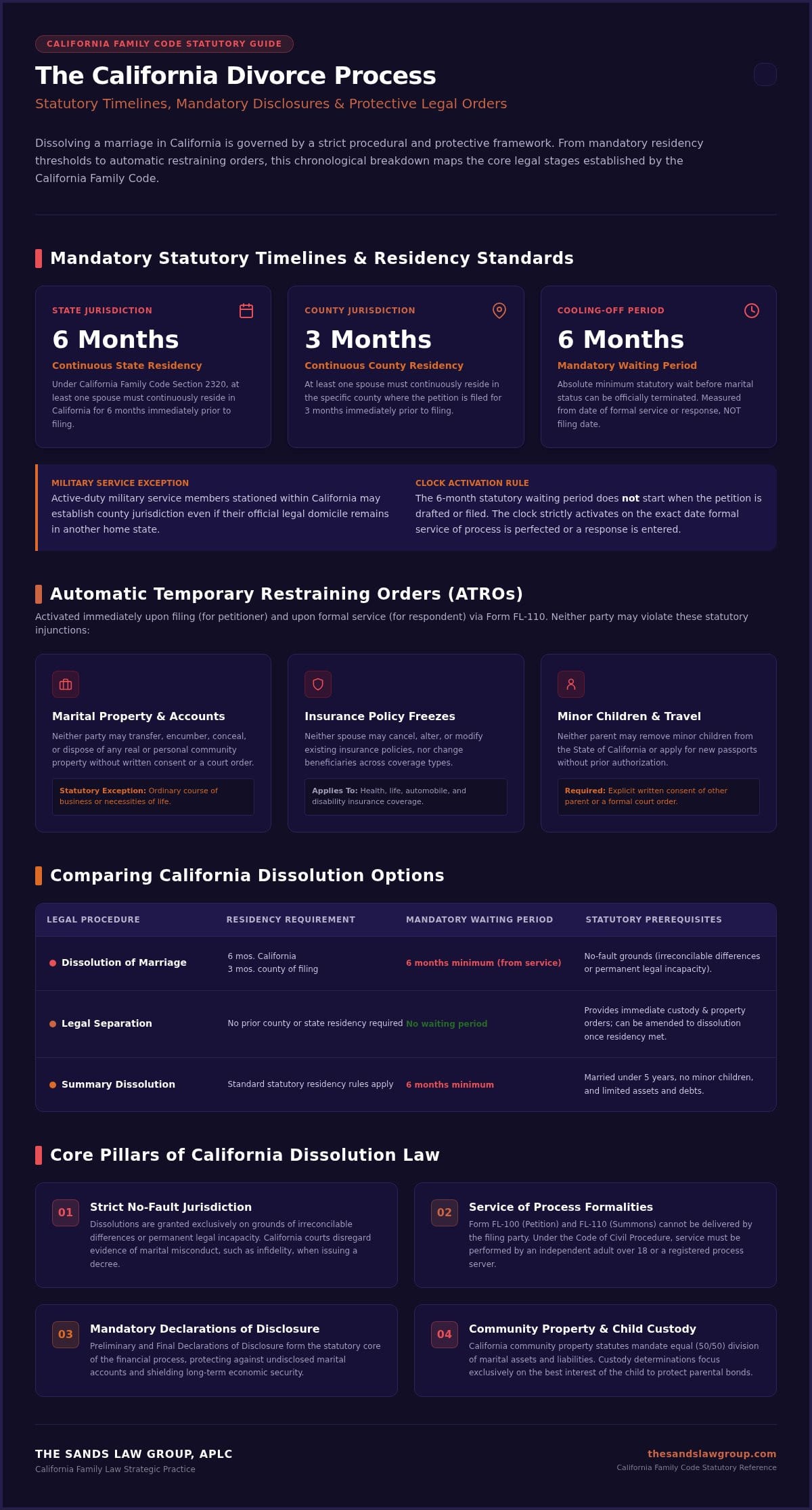
To establish jurisdiction, California Family Code Section 2320 imposes strict baseline prerequisites before you can initiate the divorce process in California. At least one spouse must satisfy two distinct residency requirements prior to submitting an initial petition:
- State residency: Continuous residence in California for at least six months immediately preceding the filing date.
- County residency: Continuous residence in the specific county of filing for at least three months immediately preceding the filing date.
For active-duty military service members stationed within California, statutory protections allow the establishment of county jurisdiction even if their official domicile remains in another home state. Once properly filed and formally served, California mandates an absolute six-month waiting period before marital status can be officially terminated, measured strictly from the date of formal service or response, rather than the initial filing date.
Automatic Temporary Restraining Orders (ATROs) Activated on Filing
The moment a petition is filed and the summons is issued, standard statutory injunctions take effect against the petitioner, binding the respondent as soon as service is perfected. These court orders, detailed directly on Form FL-110, protect both parties from sudden financial devastation or parental interference. Under these provisions, neither party may:
- Transfer, encumber, conceal, or dispose of any real or personal community property without written consent or a court order, except for the ordinary course of business or life necessities.
- Cancel, alter, or modify existing insurance policies, including health, life, automobile, and disability coverage, or alter named beneficiaries.
- Remove minor children from California or apply for new passports without prior written consent from the other parent or an explicit court order.
Legal Separation Versus Full Dissolution of Marriage
Spouses facing immediate conflict who do not yet meet the statutory residency timeline often elect to file for legal separation. Legal separation requires no waiting period or prior county residency, providing immediate access to court orders regarding child custody, support, and property preservation. Once the residency threshold is met, the petition can be formally amended to a dissolution of marriage.
Additionally, couples who have been married under five years, share no minor children, and hold limited assets and debts may qualify for a summary dissolution. For most couples, however, navigating the formal divorce process in California remains necessary to safeguard high-stakes assets and long-term parental bonds.
The Five Key Stages of Filing for Divorce in California
Treating court forms as routine paperwork overlooks how severely initial procedural choices impact personal custody and financial stability. The formal divorce process in California doesn’t simply end a marriage; it unfolds across five distinct procedural phases that transform an unresolved dispute into an orderly, binding resolution under California Superior Court oversight.
Filing the Initial Petition and Formal Service of Process
The proceeding officially begins when the petitioner drafts and files Form FL-100 (Petition for Dissolution) alongside Form FL-110 (Summons) and necessary county coversheets. Under the California Code of Civil Procedure, these documents cannot be delivered by the filing party. Instead, an independent adult over eighteen or a registered process server must personally serve the opposing spouse. While standard resources like the California Courts Self-Help Guide outline basic filing instructions, formally submitting Form FL-115 (Proof of Service of Summons) with the court clerk is what officially triggers the statutory six-month dissolution clock.
Responding to the Petition and Seeking Temporary Court Orders
Once served, the respondent has exactly thirty calendar days to file Form FL-120. Failing to respond within this strict statutory window risks a default judgment, which strips away your ability to contest property divisions or parenting arrangements. During this initial stage, either spouse can file a Request for Order (RFO) to secure essential pendente lite relief. These interim hearings establish enforceable temporary orders, including child support, spousal support, parenting schedules, and exclusive occupancy of the family home while the broader dissolution moves forward.
Discovery, Case Management, and Trial Preparation
Once temporary stability is secured, the case shifts toward formal evidentiary discovery and asset verification. Spouses exchange special interrogatories, demand financial records through requests for production of documents, and take formal depositions to inspect disputed claims or trace community assets. County local rules require attendance at periodic status conferences and a Mandatory Settlement Conference to encourage resolution before formal litigation. If disagreements persist, counsel prepares comprehensive trial briefs, witness lists, and judicial evidentiary exhibits for a bench trial before a Superior Court judge. Securing seasoned divorce legal representation ensures you preserve vital assets and defend your parental bonds at every stage of litigation.
Preliminary and Final Declarations of Disclosure: The Financial Core
Financial transparency represents the absolute cornerstone of California family law. Under California Family Code Section 721, spouses occupy a confidential relationship that imposes the highest duty of good faith and fair dealing. This fiduciary obligation governs every aspect of the divorce process in California, obligating both parties to provide unreserved, verified disclosure of all assets, liabilities, and income sources.
Fiduciary Responsibilities and Mandatory Financial Form Submission
Within sixty days of filing the petition or response, each party must prepare and serve a comprehensive preliminary declaration of disclosure. The core packet requires Form FL-140 alongside Form FL-142 (Schedule of Assets and Debts), which demands an exhaustive inventory of real estate, retirement accounts, business interests, and outstanding liabilities. Concurrently, parties must complete Form FL-150 (Income and Expense Declaration), attaching recent tax returns and paystubs. While procedural instructions in the California Courts Self-Help Guide to Divorce emphasize simple form submission, executing these filings accurately requires meticulous asset valuation to prevent forfeiture of separate property claims.
Uncovering Concealed Assets and Forensic Tracing Strategies
When one party attempts to shield wealth through suppressed business revenue, offshore transfers, or undocumented cryptocurrency holdings, standard forms are insufficient. Strategic counsel employs formal discovery tools, issuing third-party subpoenas directly to institutional banking entities and commercial establishments. Collaborating with forensic accountants allows advocates to trace commingled community and separate funds, dissect complex corporate balance sheets, and establish accurate historical earnings for fair support calculations.
Sanctions and Consequences for Breaching Disclosure Obligations
California courts treat intentional concealment with uncompromising severity. Under California Family Code Section 1101, a spouse who breaches fiduciary duties by concealing community property faces severe remedies. Judges retain statutory authority to award fifty to one hundred percent of the undisclosed asset directly to the aggrieved spouse, accompanied by mandatory attorney fees and cost sanctions. A fraudulent omission compromises the entire proceeding; tainted settlement agreements and judgments can be vacated years after entry, proving that honesty is not just an ethical requirement during the divorce process in California, but an absolute legal shield.
Navigating Child Custody, Property Division, and Spousal Support
Resolving the substantive pillars of marital dissolution demands an integrated strategy rather than addressing issues in isolation. Because parenting schedules directly dictate guideline child support calculations, and asset division influences spousal maintenance, every tactical decision carries compounding consequences. Protecting your parental bonds and personal wealth throughout the divorce process in California requires mastering these three core domains.
Community Property Division Versus Separate Property Claims
California operates under strict community property statutes mandating an equal division of net marital assets and liabilities. Assets acquired between the date of marriage and the date of separation are presumed community property, while assets owned prior, or acquired via gift or inheritance, remain separate. Complexity surges when separate and community interests blur. When marital income pays down the principal on a residence owned prior to marriage, counsel applies a Moore-Marsden calculation to apportion equity fairly. Similarly, dividing closely held businesses, executive stock options, and pensions demands rigorous analysis. Dividing retirement accounts specifically requires a Qualified Domestic Relations Order (QDRO) to transfer funds without triggering early withdrawal penalties or tax liabilities.
Child Custody and Comprehensive Parenting Plan Formulations
California family courts resolve parenting disputes through a single guiding mandate: the best interest of the child. The law distinguishes between legal custody, which confers decision-making authority over healthcare, education, and welfare, and physical custody, which governs residential schedules. Before a judge hears contested custody motions, parents must participate in mandatory mediation through county Family Court Services (FCS). Strategic preparation for this mediation ensures parental bonds are protected, resulting in detailed, enforceable parenting plans tailored to local Superior Court standards.
Determining Temporary and Long-Term Spousal Support Obligations
Support determinations follow two distinct statutory tracks. While temporary spousal support pendente lite is determined using computerized algorithms like DissoMaster, permanent post-judgment support strictly prohibits software formulas. Instead, judges must weigh the comprehensive statutory factors under California Family Code Section 4320, analyzing the marital standard of living, each spouse’s earning capacity, domestic contributions, and age and health. Marriages lasting over ten years qualify as marriages of long duration, meaning courts typically retain indefinite jurisdiction over spousal maintenance. Schedule a strategic consultation to secure qualified child custody and property division representation that shields your family and preserves your economic future.
Finalizing the Dissolution: Marital Settlement Agreements, Trial, and Judgment
Every proceeding reaches a definitive conclusion through either collaborative consensus or formal judicial adjudication. Bringing the divorce process in California to an enforceable close requires translating complex custody plans and property divisions into a binding judgment that prevents future ambiguity.
Drafting an Ironclad Marital Settlement Agreement (MSA)
When parties reach common ground, attorneys draft a comprehensive Marital Settlement Agreement (MSA). This detailed contract resolves every outstanding issue, including explicit asset distributions, exact parenting timeshares, debt indemnifications, and tax dependency exemptions. Once both spouses sign, counsel attaches the agreement to Form FL-180 (Judgment) as a stipulated judgment packet. Submitting this packet for judicial signature incorporates its terms directly into a court order, transforming contractual promises into immediately enforceable legal obligations.
Superior Court Trial Proceedings and Judicial Rulings
When high-conflict disputes resist negotiation, the matter heads to a formal bench trial before a Superior Court judge. Counsel presents direct testimony, conducts cross-examinations, introduces documentary exhibits, and calls financial or custody experts. Because judges hold broad discretion under the Family Code, trial advocacy requires sharp evidentiary precision. When complex rulings occur, requesting a formal Statement of Decision forces the court to explain the factual and legal basis of its determinations, establishing an indispensable record for any potential appeal.
Entering Judgment and Navigating Post-Judgment Modifications
A marriage doesn’t officially dissolve when a trial concludes or an agreement is signed; your single status is legally restored only on the effective date stamped on Form FL-190 (Notice of Entry of Judgment). Even after entry, changing circumstances often require post-judgment action. A substantial shift in income, involuntary job loss, or a child’s evolving developmental needs can justify filing a Request for Order to modify support or visitation. Whether structuring an uncontested resolution or litigating contested issues before a judge, secure experienced advocacy with The Sands Law Group, APLC today to guide you across the finish line.
Protecting Your Rights and Building Your New Beginning
Dissolving a marriage reshapes your family’s future, but procedural confusion shouldn’t jeopardize your legal rights. Successfully managing the divorce process in California requires steady preparation, from enforcing statutory restraining orders and conducting meticulous financial disclosures to crafting durable parenting plans. By approaching each milestone methodically, you replace vulnerability with a decisive, forward-looking legal strategy.
You don’t have to carry this burden alone during a season of profound personal transition. With extensive trial and negotiation proficiency across Los Angeles, Riverside, San Bernardino, and Kern county courts, our firm provides the resolute advocacy required to protect high-value assets and preserve your precious parental bonds. When you’re ready to secure your economic stability and protect what matters most, consult with a dedicated California family law attorney at The Sands Law Group, APLC. With experienced legal guidance and steadfast protection at your side, you can move toward the next chapter of your life with lasting clarity and peace of mind.
Frequently Asked Questions
How long does a standard divorce take to finalize in California?
A standard divorce takes a minimum of six months to finalize under California statutory law. This mandatory waiting period begins only after the respondent has been formally served with the summons and petition. Uncontested cases in Southern California jurisdictions like Los Angeles or Riverside can wrap up shortly after that six-month threshold. Contested divorces involving trials or complex asset disputes frequently take twelve to twenty-four months to resolve completely through the courts.
Can my spouse and I use the same divorce lawyer in California?
No, California ethical rules prohibit a single attorney from representing both spouses in an adversarial dissolution proceeding. Because the financial and parental interests of divorcing spouses are inherently adverse, dual representation creates an unresolvable conflict of interest under state professional conduct rules. While a neutral attorney may serve as an impartial mediator to help draft an agreement, both individuals need independent legal counsel to review terms, protect rights, and ensure informed consent before signing.
What happens if my spouse refuses to sign the divorce papers?
Your spouse can’t stop the divorce process in California simply by refusing to participate or sign paperwork. Once formal personal service is complete, the respondent has thirty days to file a response with the county court. If they fail to respond within that window, you can file a request to enter a default judgment. The judge can then proceed to issue a final judgment granting property division and custody orders without the non-responsive spouse’s input.
How is community property divided if one spouse owned a house before marriage?
The home remains the separate property of the original owner, but the marital community acquires a financial interest if community earnings paid down the mortgage. California courts apply the Moore-Marsden formula to determine the exact dollar amount of appreciation and equity attributable to marital funds. The non-owning spouse receives a calculated reimbursement share, ensuring neither party loses separate equity while compensating the community for contributions made across Los Angeles, Riverside, San Bernardino, and Kern county properties.
Can I receive spousal support while the California divorce case is pending?
Yes, you can petition the court for temporary spousal support immediately after filing the initial dissolution petition. Known as support pendente lite, these interim payments are requested by filing a Request for Order alongside a completed Income and Expense Declaration. California family judges use computerized calculation tools like DissoMaster to establish temporary payments quickly, maintaining financial equilibrium and covering essential living expenses until a permanent marital settlement agreement or final trial judgment resolves the case.
Is child custody always awarded fifty-fifty between parents in California?
No, California law doesn’t mandate an automatic fifty-fifty custody split between divorcing parents. Family Code Section 3011 requires judges to determine legal and physical custody based strictly on the best interest of the child. The court weighs multiple factors, including each parent’s historical caregiving role, parental stability, home environment, and any history of substance abuse or domestic violence, creating tailored parenting plans that protect children across Southern California family court systems.
What is an Automatic Temporary Restraining Order during a California divorce?
An Automatic Temporary Restraining Order (ATRO) is a set of statutory injunctions taking effect immediately upon filing and service of the summons. During the divorce process in California, ATROs legally freeze marital assets by prohibiting either spouse from selling community property, canceling insurance coverage, or altering designated beneficiaries without written consent or court approval. They also bar parents from taking minor children across state lines without the other parent’s explicit written permission or a judicial order.

Article by
Thomas D. Sands, Esq.
Thomas D. Sands is the founder and CEO of The Sands Law Group, APLC. A California attorney with more than two decades of experience, he represents clients in divorce and family law matters as well as civil litigation and real property disputes. His approach emphasizes attentive, practical, and cost-conscious representation.
Sands is a 2023 Litigator of the Year honoree of the American Institute of Trial Lawyers and a 2023 Lawyer of the Year honoree of the American Institute of Legal Professionals. His firm has also received recognition among the 2025 Best Law Firms in America, a 2026 Benchmark Best of award, and a 2026 Law Firm of the Year honor.








Leave A Comment