

What if the home you thought was yours alone includes a community share, or the house you built a life in can’t be divided as simply as splitting its value? Dividing real estate in california divorce starts with how the property is classified, then considers its equity, debt, and the contributions made during the marriage. The uncertainty can feel especially heavy when selling would disrupt your family or a buyout may be financially out of reach.
California generally treats property acquired during marriage as community property, but a home may be separate or partly separate. The name on the title alone doesn’t decide the issue. The purchase date, source of funds, mortgage payments, and records of improvements may all matter. Once the property’s character and net equity are assessed, possible options include selling and dividing the proceeds, arranging a buyout, or agreeing to defer a sale.
This guide explains which facts can shape classification, how mortgage debt and contributions affect the picture, and what to organize before settlement discussions or legal guidance. You’ll have a clearer framework for comparing practical options and planning your next steps.
Key Takeaways
- For dividing real estate in california divorce, identify whether each property is community, separate, or mixed before evaluating how it may be allocated.
- Compare the home’s estimated value with its secured debt, and remember that an estimate may differ from the valuation used to resolve the case.
- Weigh a sale, buyout, or continued shared ownership against your financial needs. A buyout must address both title and mortgage obligations.
- Prepare for negotiations by listing properties, gathering ownership and payment records, documenting debts, and noting disputed facts.
- Family-law counsel can assess property claims and valuation evidence, then help pursue settlement or address unresolved issues in court.
Dividing Real Estate in a California Divorce: What Determines Who Has an Interest?
Deciding what happens to a shared home can have consequences beyond finances. It may affect where you live, your children’s routines, and the stability you’re trying to preserve during divorce. Before considering a sale or buyout, determine who has a legal interest in the property and how that interest is characterized. The answer may not be as simple as whose name appears on the deed.
California generally treats property acquired during marriage as community property. Property owned before marriage or received by one spouse as a gift or inheritance is generally separate property. A home can also have mixed character. For example, one spouse may have owned it before marriage, while marital income later went toward mortgage payments or improvements. The timing and source of funds, along with available records, can shape the analysis. For a general overview of the concept, see Community Property in California.
Under California Family Code section 2550, courts generally divide the community estate equally, subject to applicable law and any valid agreement between the spouses. That doesn’t necessarily mean each asset must be split in half. One spouse might receive the home while the other receives other community assets, with the overall division accounting for the community estate’s value and liabilities. Separate-property interests are analyzed differently from the community portion.
When may real estate be separate, community, or mixed property?
Ownership before marriage and certain gifts or inheritances are common starting points for a separate-property claim. Real estate acquired during marriage is generally presumed to be community property, even if only one spouse is named on the deed. If separate and marital funds were both used to acquire or pay for a property, the analysis may be more involved. Purchase documents, bank statements, loan records, and evidence of later payments can help clarify the competing claims. The distinction between separate property and community property is often central to determining what is subject to division.
Does the name on the deed decide who owns the home?
The deed matters because it records how title is held, but it may not settle how the property is characterized in a divorce. Record title describes the ownership shown in official documents; it doesn’t necessarily reveal when the property was acquired or whether the purchase relied on separate or community funds. Deed language and the history of title changes can also be relevant. Review them alongside financial records rather than in isolation.
Title alone may not determine a home’s character in divorce; the timing and source of the funds used to acquire it can also matter. For dividing real estate in california divorce, organizing the deed, purchase records, and payment history can help distinguish established facts from issues that need closer analysis.
How California Divorce Can Affect Home Equity and Each Spouse’s Share
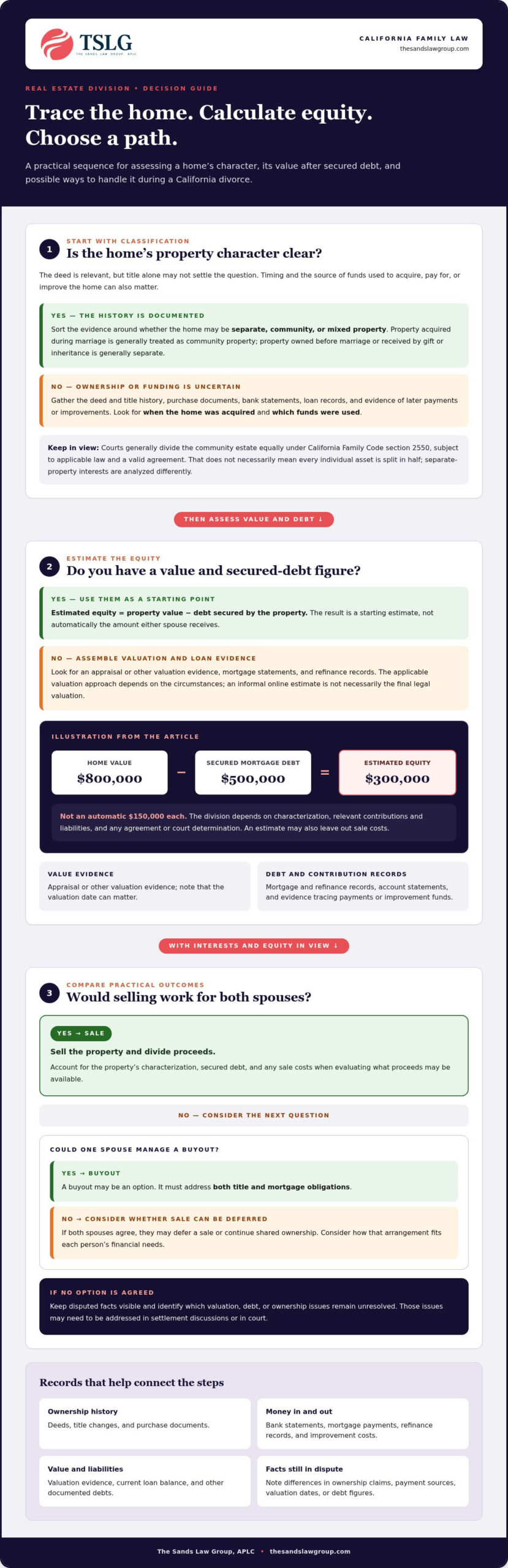
Once the property’s character is under review, the next question is what it may be worth after accounting for debt. Equity is generally the property’s value minus the debt secured by it, such as a mortgage. That calculation is a starting point, not necessarily the final amount available to either spouse. The value may be disputed, the debt balance can change, and the legal interests in the property still need to be determined.
For illustration only, if a home were valued at $800,000 and had $500,000 in secured mortgage debt, the estimated equity would be $300,000. That doesn’t mean each spouse automatically receives $150,000. The division depends on the property’s characterization, relevant contributions and liabilities, and any agreement or court determination. An estimate may also leave out costs associated with a sale.
What records help establish value, debt, and contributions?
Gather documents that show how the property was acquired, financed, and maintained. Purchase documents and deeds can help establish ownership history. Refinance records and mortgage statements can show loan changes and current balances. Account statements may help trace the source of down-payment funds and payments over time. An appraisal or other valuation evidence can help establish market value, while the mortgage balance helps distinguish gross value from estimated equity.
The date used to value a home can matter, particularly if its value or loan balance changed during the divorce. The applicable valuation approach depends on the circumstances and legal issues, so don’t treat an informal online estimate as a final legal valuation. If spouses rely on different dates, appraisals, or debt figures, those disagreements can affect negotiations and may need to be resolved as part of the case.
How can a home’s mixed character affect the division?
A property’s history may show contributions from both separate and community sources. For example, one spouse may have used separate funds for a down payment, while marital earnings later went toward mortgage principal. Improvements funded from different accounts may add another layer. Records identifying the source, timing, and purpose of payments can support tracing, but the legal treatment of each contribution depends on the facts.
Payments made after separation can also raise questions about who paid the mortgage or other property expenses and whether a reimbursement claim may apply. A claim isn’t automatic; the facts and applicable law matter. Preserve statements, receipts, loan records, and proof of payment instead of relying on memory. One home can contain more than one property interest, and its equity analysis may need to account for each interest separately.
Because value, debt, and contributions interact, reviewing them together provides a more useful picture than focusing on a single equity estimate. If you need help assessing property records and competing claims, discuss your property division concerns with California family-law counsel.
Should You Sell, Buy Out Your Spouse, or Keep the Property Together?
Once the property interests and finances are better understood, decide how to resolve ownership. Selling, arranging a buyout, or continuing to own the property together can each be workable, but none is right for every family. The practical choice depends on the home’s equity, each spouse’s ability to manage the financial obligations, housing needs, and whether both can reach an informed agreement.
When might selling the home be the more workable option?
A sale may make sense if neither spouse wants to keep the home or can manage its costs and financing alone. The sale price is used to pay secured debt and sale expenses; the remaining proceeds are then divided according to the spouses’ agreement or court orders, including any applicable adjustments. Before deciding, consider timing, who will occupy and maintain the property while it is listed, and potential tax consequences. The sale price isn’t the same as the amount each spouse ultimately receives.
Agreeing on sale terms in advance can help prevent disagreements during the process. A settlement can address how the listing price will be set, which expenses will be paid from the proceeds, how necessary repairs will be handled, and what happens if the spouses can’t agree on an offer. Tax treatment may depend on the facts, so consider it as part of the financial picture rather than assuming it from the anticipated sale price.
What should a spouse consider before agreeing to a buyout?
A buyout generally involves determining the home’s value, accounting for the mortgage and other agreed adjustments, and establishing any equalization payment owed to the spouse giving up an interest. These are separate steps. An agreed value doesn’t, by itself, establish the payment amount, and the property’s classification may affect the allocation. The agreement should also explain how and when ownership will transfer.
Mortgage responsibility needs separate attention. A divorce agreement between spouses doesn’t, by itself, release either borrower from an existing loan with the lender. If both remain liable on the mortgage, the spouse moving out may still face financial exposure even after transferring an ownership interest. Before finalizing a buyout, consider whether the spouse keeping the home can meet the loan obligations and what steps are needed to address the existing mortgage.
Continued co-ownership may be considered when an immediate sale or buyout is impractical, such as when the spouses agree to postpone a sale for a defined period. It takes more than a shared intention to decide later. A written plan can specify responsibility for mortgage payments, taxes, insurance, repairs, occupancy, and major decisions, as well as the date or conditions that will trigger a sale or other resolution.
No single outcome fits every case. In dividing real estate in california divorce, a sound decision accounts for the property interests, reliable financial information, each spouse’s housing and payment capacity, and clear, informed agreement. If those issues can’t be resolved together, they may require further negotiation or court involvement.
What to Gather Before Real Estate Division Negotiations
Preparation can make difficult property discussions more focused. Instead of relying on memory or an informal estimate, build a clear record of what properties exist, how they were acquired, what debt remains, and which facts are disputed. This is useful whether you’re considering a sale, buyout, or another resolution. Keep complete, accurate records, and don’t transfer, hide, or dispose of property to influence negotiations.
Work through the information in a practical sequence:
- List the properties. Include the family home and any other real estate, along with the names shown on the deed and your understanding of each spouse’s interest.
- Gather ownership and transaction records. Collect deeds, purchase documents, refinance records, and available appraisals or other valuation information.
- Document debts and payments. Assemble current mortgage statements and records of down-payment funds, principal payments, major improvements, and other property-related expenses.
- Estimate value and note unresolved facts. Record the basis for any value estimate, then identify disagreements about ownership, contributions, debt, or the appropriate valuation information.
Which property and financial documents should you organize?
Keep records together by property, and preserve complete statements rather than isolated pages. Mortgage and refinance documents can show how secured debt changed; account statements may help trace where down-payment funds or later payments came from. Deeds and purchase documents establish important parts of the ownership history. Valuation records can provide useful evidence, but distinguish an estimate from a value ultimately agreed upon or established in the case.
Create a current inventory of each property, known ownership interests, secured debts, and facts either spouse disputes. Note missing documents instead of filling gaps with assumptions. Broader questions about how real estate fits into the division of other marital assets are also relevant to California property division in divorce.
What should a written real-estate settlement resolve?
A clear agreement should state whether a spouse will receive the property or it will be sold, and explain how any sale proceeds or equalization payment will be handled. It should also allocate responsibility for the mortgage, taxes, insurance, maintenance, and occupancy until the arrangement is fully implemented. If a sale or transfer will happen later, specify the conditions and steps that will move it forward.
Implementation details matter. The agreement should address required documents, timing, how decisions about repairs or offers will be made, and what happens if a step can’t be completed as planned. A divorce settlement doesn’t, by itself, change a lender’s loan obligations, so address mortgage responsibility separately from ownership. Legal and tax consequences depend on the specific property and terms. Before finalizing an agreement for dividing real estate in california divorce, schedule a discussion about your property-division records with family-law counsel.
How California Family-Law Counsel Can Help You Resolve a Property Dispute
A disagreement about a home can combine financial pressure with questions about where each spouse will live and what happens next. Focused legal guidance can help organize records and competing claims into a clearer picture of the issues. In dividing real estate in california divorce, counsel can assess how the property was acquired, what evidence supports each spouse’s position, how secured debt affects the options, and what practical outcome each spouse is seeking.
How can legal guidance clarify a disputed home’s ownership and value?
Counsel can review the acquisition history alongside the deed, financing documents, mortgage records, and evidence of contributions. That review can help distinguish what is known from what remains disputed, such as the source of a down payment, the timing of payments, or the basis for a proposed valuation. The goal is to evaluate the available evidence and identify questions that may affect negotiation, not to promise a particular value or share.
Those facts can shape settlement proposals and, if necessary, the evidence presented in a case. For instance, when spouses disagree about whether funds came from separate or community sources, a documented payment history may be more useful than either spouse’s recollection alone. Counsel can also consider the property’s debt and each spouse’s housing and financial goals, so proposals address more than a headline estimate of value.
What happens when spouses cannot agree on the property?
Many property disputes are addressed through negotiation and settlement, but unresolved issues may proceed through family-court processes. The steps and requirements depend on the case. A focused strategy can identify which facts need support, organize relevant records, evaluate proposals, and clarify the outcome being requested. Court involvement is one possible stage, not an inevitable result of every disagreement.
A durable resolution should explain what happens to ownership and any sale or transfer, how payment and debt obligations will be handled, who may occupy the property during implementation, and what steps are needed to carry out the agreement. Clear terms can reduce the risk that an agreement resolves the immediate dispute but leaves practical questions unanswered. Consider legal and financial details together, particularly when the home and mortgage obligations don’t transfer at the same time.
The Sands Law Group, APLC represents clients in California divorce and complex property-division matters, including real estate, valuation, liabilities, and separate-property claims. The firm serves clients in Los Angeles, Riverside, San Bernardino, and Kern, and handles matters through settlement negotiations and, when needed, trial proceedings. If you’re weighing a property claim or need to understand your next steps, schedule a consultation.
Take the Next Step Toward a Stable Resolution
A property decision made during divorce can shape your financial flexibility and sense of stability long after the case is over. Before choosing a path, consider what you need your life to look like after the divorce, not only what seems simplest to resolve today. A workable outcome should reflect your priorities while accounting for the practical responsibilities you may carry forward.
Identify the questions you most need answered and the outcomes you hope to protect. That gives your discussions a clear purpose, even when the choices are difficult or your spouse’s priorities differ. The legal and financial details of dividing real estate in california divorce can be complex, but you don’t have to approach them without direction.
The Sands Law Group, APLC represents clients in divorce and complex property-division matters involving real estate, valuation, liabilities, and separate-property claims. For guidance on a strategy tailored to your circumstances, schedule a consultation.
Frequently Asked Questions
Can one spouse sell a California home before the divorce is final?
Possibly, but a spouse shouldn’t assume they can sell, transfer, or borrow against the home unilaterally after a divorce case begins. Automatic temporary restraining orders may restrict property transfers or changes to ownership, subject to applicable rules and exceptions. The precise restriction depends on the case documents and circumstances. Before signing a listing agreement or accepting an offer, review the filed documents and obtain case-specific legal guidance.
What happens if one spouse paid the mortgage after separation?
Post-separation mortgage payments may support a request for reimbursement or another adjustment, but paying the loan doesn’t automatically change ownership or guarantee repayment. The source of the money, how the home was used, any court orders, and the circumstances surrounding the payment may all matter. Keep bank statements, payment confirmations, and mortgage records, including records showing whether payments covered principal, interest, taxes, or insurance, for a fact-specific review.
Can one spouse keep the house without refinancing the mortgage?
Possibly, but a divorce agreement or judgment changing ownership doesn’t necessarily remove the other spouse from the lender’s loan contract. A spouse may transfer an interest in the home while remaining liable on a mortgage signed by both borrowers. Whether the person keeping the property can change or assume the loan depends on financing and lender requirements. The settlement should address the debt and steps for implementation, not rely on a title change alone.
Can a California court order the marital home sold?
A court-ordered sale can be one way to resolve a property dispute, but it isn’t automatic simply because spouses disagree. The appropriate outcome depends on the facts, each spouse’s property interests, available alternatives, and applicable law. In dividing real estate in california divorce, the court may need to address whether a sale, buyout, or another resolution is suitable. A spouse facing a proposed sale should review the claims and evidence with counsel before agreeing or objecting.
Does selling a home during divorce create capital gains tax?
A sale can have tax consequences, but whether capital gains tax is due depends on factors such as the home’s tax basis, sale proceeds, ownership, timing, and eligibility for an exclusion. A transfer between spouses connected with divorce may be treated differently from a later sale to a buyer. Don’t rely on a general estimate to determine your tax position; the timing and terms of the transaction call for fact-specific tax analysis.
How is a home handled if it was bought before marriage but paid for during marriage?
Buying a home before marriage may support a separate-property claim, while later payments can raise questions about whether community funds contributed to the property’s value or appreciation. The result depends on tracing the down payment and mortgage payments, the relevant records, and applicable law. Payments made during marriage don’t automatically make the entire home community property. Preserve the original purchase and loan documents, along with records showing the source of later payments.

Article by
Thomas D. Sands, Esq.
Thomas D. Sands is the founder and CEO of The Sands Law Group, APLC. A California attorney with more than two decades of experience, he represents clients in divorce and family law matters as well as civil litigation and real property disputes. His approach emphasizes attentive, practical, and cost-conscious representation.
Sands is a 2023 Litigator of the Year honoree of the American Institute of Trial Lawyers and a 2023 Lawyer of the Year honoree of the American Institute of Legal Professionals. His firm has also received recognition among the 2025 Best Law Firms in America, a 2026 Benchmark Best of award, and a 2026 Law Firm of the Year honor.
Article reviewed by
Thomas D. Sands, Esq.
Thomas D. Sands is the founder and CEO of The Sands Law Group, APLC. A California attorney with more than two decades of experience, he represents clients in divorce and family law matters as well as civil litigation and real property disputes. His approach emphasizes attentive, practical, and cost-conscious representation.
Sands is a 2023 Litigator of the Year honoree of the American Institute of Trial Lawyers and a 2023 Lawyer of the Year honoree of the American Institute of Legal Professionals. His firm has also received recognition among the 2025 Best Law Firms in America, a 2026 Benchmark Best of award, and a 2026 Law Firm of the Year honor.
TOLL-FREE: 855-SANDS4U