

Being handed a divorce summons is not merely a painful personal crisis; it is an immediate, binding legal event that fundamentally alters your daily reality. When confronted with complex court documents like the Summons and Petition, the fear of losing custody, savings, or the marital home can feel completely paralyzing. If you are trying to determine what to do when served divorce papers california law does not grant you time to retreat or process in isolation. While you might hope an informal conversation can resolve things quietly, informal talks won’t pause the statutory clock.
You deserve composed, protective guidance to navigate the critical first 30 days and protect your future. The moment you were served, automatic court orders took effect to freeze marital assets and restrict child relocation. This legal checklist provides a clear, sequential roadmap through your immediate legal obligations, showing you how to prevent a costly default judgment and prepare a measured, strategic response that safeguards your parental rights and financial stability.
Key Takeaways
- Decode the foundational documents in your packet, including the Summons (FL-110) and Petition (FL-100), to understand your spouse’s initial claims without panic.
- Identify the automatic legal restrictions under California Family Code Section 2040 that immediately freeze marital assets, insurance policies, and child relocation.
- Discover exactly what to do when served divorce papers california courts deliver, starting with calendaring your strict 30-calendar-day response deadline.
- Recognize the severe risks of delay or informal negotiation, which can expose you to an irreversible default judgment on property and custody.
- Prepare a deliberate, composed strategy that protects your parental relationship and financial stability through skilled family law representation.
Understanding the Summons: What Receiving California Divorce Papers Actually Means
Opening an envelope containing legal pleadings can provoke immediate dread, but receiving court documents does not signal that you have already lost your case. Under the California Family Code, valid service of process simply establishes personal jurisdiction over you. It formally opens the legal dispute; it does not grant your spouse’s wishes by default. Delivery typically occurs through in-person physical handoff by an adult process server, though it may also arrive via Notice and Acknowledgment of Receipt by mail, or through substituted service at your residence or workplace.
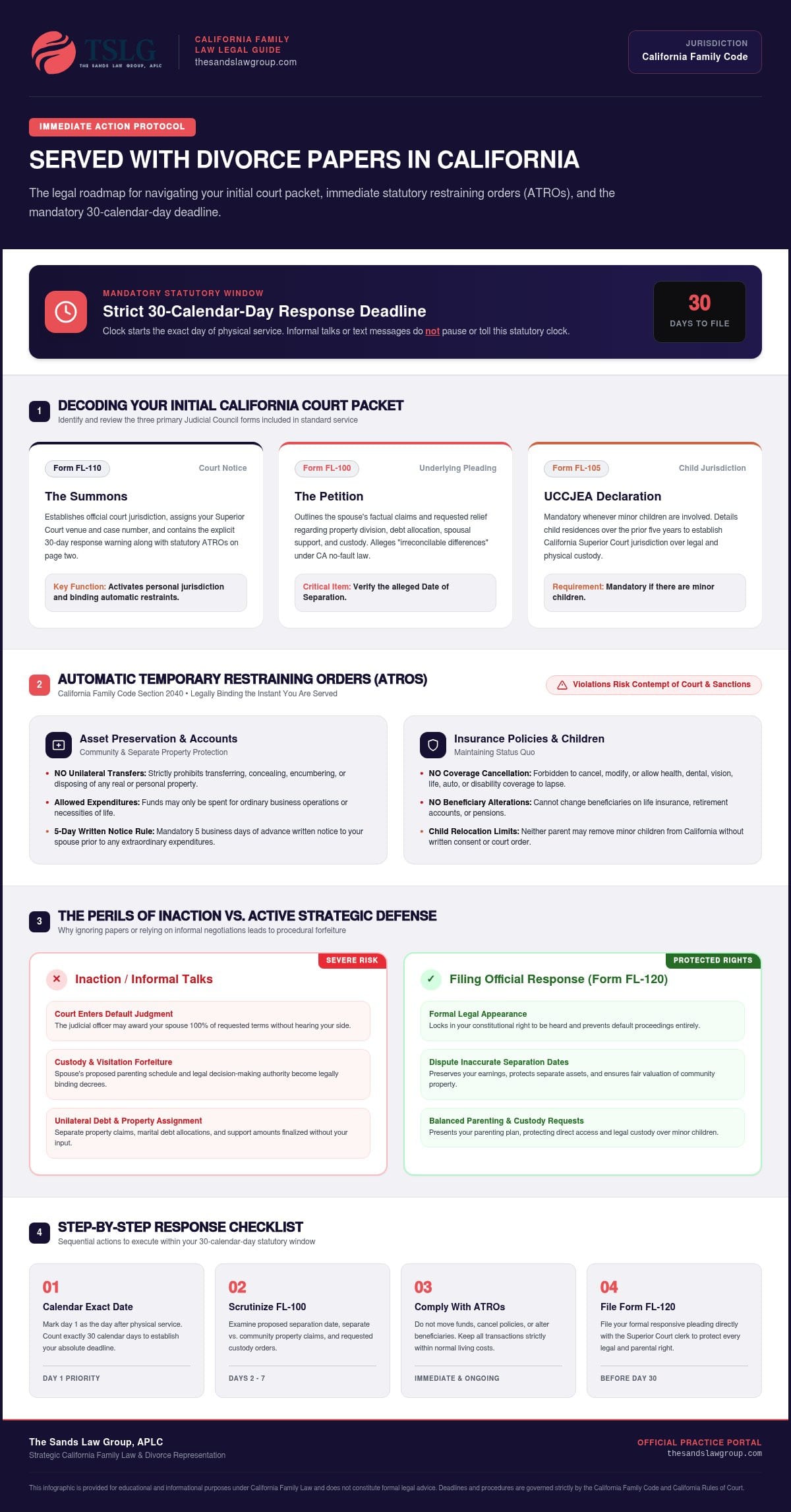
When assessing what to do when served divorce papers california residents must first inventory the exact packet received. A complete initial filing generally contains three primary Judicial Council forms:
- Summons (Form FL-110): The official court notice notifying you of the lawsuit and setting mandatory baseline restrictions.
- Petition (Form FL-100): The underlying pleading detailing your spouse’s factual claims and requested relief.
- UCCJEA Declaration (Form FL-105): The child custody jurisdiction declaration, mandatory whenever minor children are involved.
Deconstructing Form FL-110: The Judicial Council Summons
Form FL-110 identifies your assigned Superior Court venue and assigned case number, grounding your matter within a specific local courthouse. Critically, this document displays an explicit legal warning: you have exactly 30 calendar days from the date of physical receipt to respond. Text messages, casual phone calls, or informal settlement discussions with your spouse do not constitute a formal legal appearance. Only an official responsive pleading filed directly with the court clerk protects you against immediate procedural forfeiture.
Examining Form FL-100: Your Spouse’s Stated Requests
The Petition outlines what your spouse wants, not what the court has actually ordered. California operates as a no-fault divorce state, meaning the petition need only allege irreconcilable differences rather than marital misconduct. As you review FL-100, scrutinize the proposed date of separation, as this line determines when community earnings end and separate property resumes. While the petition outlines initial requests regarding property division, debt allocation, spousal support, and child custody, these checkmarks represent opening negotiating postures rather than binding judicial decrees.
Automatic Temporary Restraining Orders (ATROs): What You Must Not Do Immediately
The moment you receive the Summons, page two activates binding statutory injunctions known as Automatic Temporary Restraining Orders (ATROs). When evaluating what to do when served divorce papers california law leaves zero room for impulsive reactions. Under California Family Code Section 2040, these mutual orders take effect instantly upon the petitioner when filing, and upon the respondent upon service. They strictly mandate that neither spouse may disturb the marital status quo, establishing firm legal boundaries around community assets and parental obligations. Violating them risks severe evidentiary sanctions, liability for opposing legal fees, or even contempt of court.
Asset Preservation and Bank Account Restrictions
ATROs explicitly prohibit transferring, concealing, encumbering, or disposing of any property, whether community or separate. You may only spend funds for the ordinary course of business or the basic necessities of life. Before making extraordinary expenditures, you must provide five business days of written notice to your spouse and document where the money went. Draining savings accounts, liquidating stock portfolios, or hiding cash will quickly destroy your credibility before the bench.
Insurance Coverage and Beneficiary Designations
The law strictly forbids canceling, modifying, or allowing any health, dental, vision, life, automobile, or disability policy to lapse. You cannot drop your spouse or dependent children from employer-sponsored medical coverage. Similarly, you cannot alter beneficiary designations on retirement accounts or cash out life insurance policies. While reviewing the basic steps for filing for divorce helps clarify these baseline safeguards, maintaining current policies protects you against enormous liability if an emergency arises.
Travel and Relocation Prohibitions Involving Children
ATROs prohibit taking minor children across California state lines without the other parent’s written consent or a court order. Parents are equally barred from applying for or renewing passports for minors. While routine travel within state borders is permitted, attempting to relocate children across state borders will cause immediate judicial intervention and damage future custody claims. Before undertaking any non-routine transaction or travel plan, seeking guidance from experienced divorce counsel ensures your rights remain protected without violating mandatory statutory orders.
The 30-Day Response Roadmap: A Strategic Step-by-Step Checklist
Once you absorb the reality of the summons, moving decisively replaces panic with operational control. Understanding what to do when served divorce papers california requires a methodical approach that protects your rights before statutory windows snap shut. Securing your standing begins with immediate privacy safeguards: update all personal passwords, redirect sensitive legal correspondence to a private email or secure postal address, and avoid discussing litigation details on shared devices or family networks.
Step 1: Calculating Your Exact Response Deadline
The 30-day timeline counts calendar days, not business days, starting the day after personal service occurs. If your 30th day falls on a court holiday or weekend, your filing deadline automatically rolls to 5:00 PM on the next business day. If service occurred by mail with an acknowledgment form, the clock starts upon signing. Substituted service generally provides 40 days. Never rely on verbal reassurances from your spouse suggesting the divorce is on pause; absent a formal, written stipulation filed with the court, the statutory clock keeps running.
Step 2: Securing Vital Financial and Personal Records
California law mandates exchanging complete preliminary financial disclosures within 60 days of filing your responsive pleading. Proactively compiling these core documents protects community assets from intentional concealment and prepares you for mandatory disclosures:
- Tax and Income Proof: The last three years of state and federal tax returns, accompanying W-2s or 1099s, and your two most recent pay stubs.
- Banking and Investments: Complete statements for checking, savings, brokerage portfolios, 401(k) accounts, and private pensions.
- Debts and Real Estate: Current mortgage statements, grant deeds, outstanding vehicle loan balances, and credit card histories.
Step 3: Preparing and Filing Form FL-120 (Response)
Form FL-120 acts as your legal defense shield and official counter-petition. This document lets you affirm or dispute the date of separation stated in your spouse’s paperwork, which directly impacts whether recent earnings are classified as community property or separate assets. You will also assert your initial positions regarding legal and physical custody, spousal support, and property division. Once completed, a non-party adult must serve a filed-endorsed copy on your spouse’s attorney of record by mail or personal delivery, followed by filing proof of service with the Superior Court clerk.
The Perils of Inaction: Avoiding Costly California Default Judgments
Ignoring court papers is the costliest mistake a respondent can make. If 30 calendar days pass without a formal appearance on file, the petitioner can submit a Request to Enter Default (Form FL-165). Once default is entered, you are locked out of your own case. The court proceeds without your input, and judges routinely grant every request stated in your spouse’s initial petition. Overturning an entered default judgment under California Code of Civil Procedure Section 473 is exceptionally difficult, demanding rigorous proof of mistake, surprise, inadvertence, or excusable neglect within strict statutory timeframes.
How a True Default Compromises Your Financial Future
Entering default completely surrenders your right to contest asset division or debt distribution. The court may assign substantial marital debts entirely to your column while awarding prime community assets to your spouse. Furthermore, a judge can order permanent spousal support calculated entirely on your spouse’s unexamined assertions of your earning capacity. You also forfeit the opportunity to trace separate property claims, putting premarital savings, personal gifts, or family inheritances at immediate risk of division.
Custody Determinations Made Without Your Input
Silence in family court carries devastating consequences for parental relationships. When you fail to participate, child custody and visitation orders are established solely on your spouse’s declarations. The court can grant your spouse sole legal and physical custody, leaving you with restrictive or supervised visitation parameters that require arduous modification proceedings to reverse. Simultaneously, child support obligations will be calculated using unverified income numbers, imposing an onerous financial burden without your actual expenses ever being considered.
Default With Agreement: A Collaborative Alternative
Not every default is adversarial. In an amicable divorce, parties sometimes utilize a default with agreement, where the respondent saves on appearance fees while both parties draft and execute a comprehensive Marital Settlement Agreement (MSA). However, you should never allow a true procedural default to occur without an executed, legally enforceable contract in place. If you are questioning what to do when served divorce papers california legal timelines demand prompt, decisive strategy; contact The Sands Law Group, APLC to safeguard your parental rights and preserve your financial estate before deadlines expire.
Transitioning From Defense to Strategy: Custody, Property, and Representation
Moving past the initial emotional shock allows you to transform procedural defense into long-term strategic advantage. Once your responsive pleading is lodged with the court clerk, your focus shifts toward deliberate positioning, whether your case heads toward a private marital settlement agreement or courtroom trial advocacy. Identifying early on whether your matter trends toward cooperative resolution or high-conflict litigation dictates how you preserve evidence, calculate financial exposures, and structure necessary temporary orders.
Establishing Child-Centered Parenting Solutions
California law draws a sharp distinction between legal custody, which controls major healthcare, education, and religious decisions, and physical custody, which governs residential schedules. When custody disputes arise, Southern California Superior Courts mandate participation in Child Custody Recommending Counseling (CCRC) through Family Court Services. Reaching favorable outcomes in these sessions requires composed, child-centered presentations supported by objective school attendance logs, pediatric records, and established daily routines rather than interpersonal grievances.
Untangling Complex Community Property and Debt
Under California community property statutes, assets and debts acquired between the date of marriage and the date of separation belong equally to both spouses. Preserving separate wealth requires meticulous accounting under California Family Code Section 2640, especially when premarital capital, family inheritances, or personal gifts contributed to marital property acquisitions. Untangling high-value estates often involves collaborating with forensic accountants to determine business valuations, appraise real estate holdings, and draft Qualified Domestic Relations Orders (QDROs) to divide retirement plans without tax penalties.
The Value of Local Advocacy Across Southern California
Local procedural expectations and judicial tendencies vary across Los Angeles, Riverside, San Bernardino, and Kern County Superior Courts. When assessing what to do when served divorce papers california litigants benefit immensely from an advocate who pairs emotional empathy with resolute courtroom authority. Rather than resorting to abrasive, counterproductive theatrics, The Sands Law Group, APLC provides the steady guidance needed to manage complex valuations, safeguard parental relationships, and craft durable long-term resolutions. Taking decisive action begins with scheduling a confidential case evaluation to secure your legal footing.
Take Control of Your California Divorce Proceedings Today
Understanding what to do when served divorce papers california courts issue marks the vital boundary between forfeiting your voice to an adverse default judgment and actively protecting your future. By honoring mandatory statutory restraining orders, securing your essential financial documentation, and filing a timely legal response, you preserve your community assets and safeguard precious parental bonds.
You don’t have to carry this legal burden alone. With an exclusive focus on California family law litigation, The Sands Law Group, APLC provides steady, protective counsel across Los Angeles, Riverside, San Bernardino, and Kern County Superior Courts. Whether you face complex high-asset property division or high-stakes child custody negotiations, our seasoned team translates procedural chaos into a clear, strategic path forward. Schedule a confidential consultation with The Sands Law Group, APLC today to protect your rights and move forward with renewed confidence.
Frequently Asked Questions
What should I do on the exact day I am served with divorce papers in California?
Note the date, time, and method of delivery immediately, as this exact timestamp starts your 30-day countdown. Review the papers carefully without confronting your spouse in anger. When assessing what to do when served divorce papers california residents must secure private communications and avoid rash financial moves. Take a breath, keep the packet intact, and begin gathering financial paperwork to consult a dedicated family law attorney in your county.
Can I refuse to accept or sign divorce papers when a process server hands them to me?
Refusing to accept or touch the documents does not stop the divorce action or prevent valid service. In California, if a process server identifies you and leaves the papers at your feet or doorstep, service is legally complete under the law. Dodging a process server only wastes valuable preparation time and guarantees the 30-day clock keeps ticking toward default without your active defense.
What happens if I miss the 30-day deadline to respond to a California divorce summons?
Missing the deadline allows your spouse to file Form FL-165 to request an entry of default against you. If granted, the court can enter a final judgment dividing your assets, assigning debts, and setting child custody arrangements entirely based on your spouse’s requests. Setting aside a default judgment requires filing an expensive motion proving excusable neglect, which California judges grant only under narrow, compelling circumstances.
Can I take money out of our joint bank account after being served with divorce papers?
You cannot drain marital accounts or transfer community funds to separate accounts under California’s Automatic Temporary Restraining Orders (ATROs). You may only withdraw reasonable sums needed for standard daily living necessities or ordinary business operations. Withdrawing significant sums without written consent or court permission invites harsh judicial sanctions, mandatory attorney fee awards, and severe damage to your financial credibility before local family court judges.
Can I take my children out of state after being served with divorce paperwork?
You cannot take minor children out of California without the other parent’s prior written consent or an explicit court order. The restraining orders on page two of your summons strictly bar interstate travel and passport applications. Violating these orders can lead to urgent ex parte court hearings, mandatory law enforcement intervention, and long-term restrictions on your legal and physical custody rights in court.
Do I have to move out of the family home immediately after being served?
You have no legal obligation to leave the marital residence simply because you received a divorce summons. Both spouses retain equal occupancy rights until a judge issues a formal exclusive use order or domestic violence restraining order. Moving out impulsively can establish an unfavorable residential status quo for child custody or impact property reimbursement claims, so discuss your options with counsel before vacating.
What is the difference between Form FL-100 and Form FL-110 in California?
Form FL-110 is the court Summons, which establishes personal jurisdiction, states the 30-day response deadline, and lists binding automatic restraining orders. Form FL-100 is the Petition for Dissolution, which contains your spouse’s factual claims, marriage dates, and requested outcomes for property division, spousal support, and custody. The summons binds your immediate conduct, while the petition outlines the legal claims you must address in your response.
How do I respond if my spouse and I agree on everything and want an uncontested divorce?
If you agree on all terms, you can finalize your case without litigation through a default with agreement or by filing a joint petition. When determining what to do when served divorce papers california couples who agree can draft a comprehensive Marital Settlement Agreement resolving property division, support, and custody. Having a qualified attorney review the agreement protects your separate interests while ensuring your paperwork satisfies local county filing standards.

Article by
Thomas D. Sands, Esq.
Thomas D. Sands is the founder and CEO of The Sands Law Group, APLC. A California attorney with more than two decades of experience, he represents clients in divorce and family law matters as well as civil litigation and real property disputes. His approach emphasizes attentive, practical, and cost-conscious representation.
Sands is a 2023 Litigator of the Year honoree of the American Institute of Trial Lawyers and a 2023 Lawyer of the Year honoree of the American Institute of Legal Professionals. His firm has also received recognition among the 2025 Best Law Firms in America, a 2026 Benchmark Best of award, and a 2026 Law Firm of the Year honor.









Leave A Comment