

When spousal support payments are missed, start with the court order and a verified payment record. If the shortfall is disrupting your household finances, it’s understandable to want clear answers without escalating conflict unnecessarily. A spousal support enforcement attorney can review what the order requires, identify what appears unpaid, and explain possible next steps based on your circumstances.
Gather the support order, payment history, and communications about missed or partial payments. This guide explains California enforcement options that may apply and why a paying spouse who cannot meet the current terms generally needs to formally request a court modification rather than simply stop paying. The right approach depends on the order, the records, and the nature of the dispute.
The Sands Law Group, APLC represents both recipients and paying parties in spousal support enforcement matters in Los Angeles, Riverside, San Bernardino, and Kern. A review of your documents and circumstances can help clarify your options and identify a practical next step.
Key Takeaways
- Start with the current support order and a clear account of payments due, received, and still disputed.
- Enforcement options depend on the order, payment history, and case facts. The approach should fit the specific dispute.
- Preserve original documents and organize copies of payment records and communications by due date before taking action.
- A spousal support enforcement attorney can review the records and assess next steps for either the receiving or paying party.
- California counsel can help distinguish alleged nonpayment from partial payments, accounting issues, or claims of inability to pay.
Missed Spousal Support Payments in California: Start With the Order
A missed support payment can affect more than a monthly budget. It may disrupt rent, household expenses, and plans that depend on predictable income. Before deciding what to do, identify what the court ordered and compare it with what was paid. Enforcement means seeking compliance with an existing support order through applicable legal procedures. It is different from asking the court to set a new amount.
This distinction matters to both the recipient and the paying party. A recipient may be owed less than first assumed if payments or credits were overlooked. A paying party may face an inaccurate claim if the accounting omits documented transfers or other payments. A spousal support enforcement attorney can review the order and records before either party takes a consequential step.
Which document controls the support obligation?
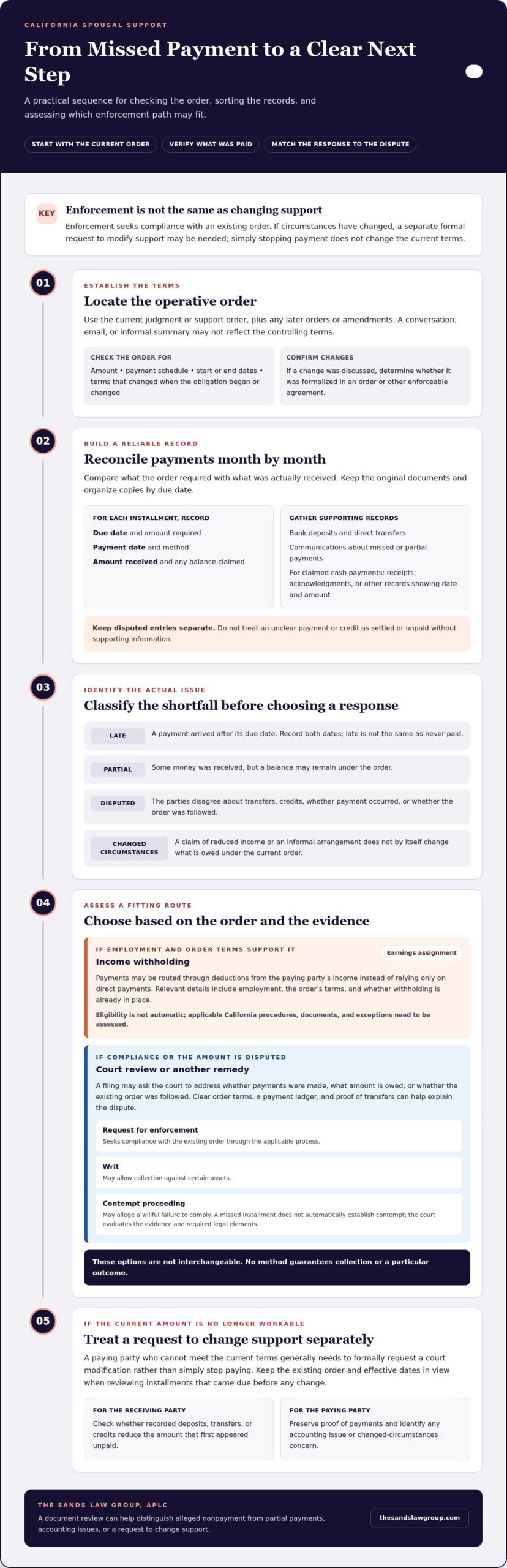
Locate the operative judgment or support order, along with any later orders or amendments. Check the amount, payment schedule, start or end dates, and any terms affecting when the obligation began or changed. A conversation, email, or informal summary may not reflect the current court order, so use the court documents as the basis for your accounting. If a change was discussed, determine whether it was formalized in an order or other enforceable agreement.
Enforcing an existing order is not the same as requesting a different amount. If circumstances have changed, a separate request to modify support may be needed. The order and its effective dates still matter when reviewing payments that came due before any change. For broader context on how support amounts may be determined, see this guide to California spousal support calculation. A general Alimony (Spousal Support) Overview can explain the concept, but it does not establish the terms of a particular California order.
Is the payment late, partial, or disputed?
Compare the amount due under the order with the amount actually received, month by month. Record each due date, deposit date, payment method, and amount still outstanding. A late payment is different from a payment that was never made. A partial payment may leave a balance rather than satisfy the full obligation.
Reconcile bank deposits, direct transfers, and any claimed cash payments or credits. For cash, look for receipts, messages acknowledging payment, or other records that show the date and amount. List disputed entries separately instead of counting them as settled or unpaid without support. A careful ledger can reveal gaps and reduce avoidable disagreements.
Changed circumstances need a separate review. A claim of reduced income, an informal arrangement, or a disagreement about credits does not by itself establish what is owed under the order. Preserve the documents and identify what is known, what is disputed, and what needs clarification. This gives an attorney a factual starting point for assessing whether the issue concerns missed installments, accounting, or a request to change support.
California Spousal Support Enforcement Options: What May Apply?
Once the order and payment history are clear, consider which legal route fits the dispute. California enforcement options are not interchangeable. Ongoing wages may make income withholding relevant, while disputed credits or disagreement about compliance may call for court review. The appropriate approach depends on the order’s terms, the payment record, and other case-specific facts. No method guarantees collection or a particular outcome.
A spousal support enforcement attorney can assess those details and help determine whether a direct payment mechanism, court filing, or another remedy may be appropriate. The goal is to pursue compliance with the existing order through the applicable process, not to assume that one procedure will resolve every case.
When might income withholding be considered?
Income withholding, sometimes called an earnings assignment, routes support payments through deductions from the paying party’s income rather than relying only on direct payments between former spouses. It may be considered when the person’s employment and the order’s terms support that approach. Relevant details include whether the person is employed, whether the order addresses withholding, and whether an income-withholding arrangement is already in place.
Those details do not establish automatic eligibility. The required California procedure, documents, and any applicable exceptions must be assessed against the current order and circumstances. If income or employment has changed, the practical effect may differ from a case involving stable wages. An attorney can help identify what information is needed before pursuing or responding to withholding.
When might a court hearing or other remedy be necessary?
Court review may be appropriate when the parties disagree about the amount owed, whether payments were made, or whether the existing order was followed. A filing can ask the court to address the dispute, but the evidence and procedural requirements matter. A reliable payment ledger, proof of transfers, and clear order terms can help explain the disagreement. Incomplete records may make it harder to resolve.
Depending on the case, potential remedies may include a request for enforcement, a writ that allows collection against certain assets, or a contempt proceeding alleging a willful failure to comply. These options have different legal standards and consequences. Contempt is not an automatic response to a missed installment. A court must evaluate the evidence and required legal elements before imposing any consequence. A person claiming inability to pay may need to present evidence relevant to that claim, while a recipient may need to establish what remains unpaid.
If child support is also being enforced for a child living with the custodial parent, the county child support agency may have a role in enforcing spousal support as well. Whether that route applies depends on the case. The facts should guide the choice, rather than pressure to escalate before the order and accounting have been reviewed.
Procedure and local court practices can affect the next step. A focused review can clarify which route fits your position, whether you are seeking payment or responding to an enforcement claim. You can schedule a discussion about your support enforcement options to consider a case-specific path forward.
What If Payments, Income, or the Order Are Disputed?
A support dispute can involve more than a claim that payments stopped. One party may report missed installments, while the other points to partial payments, transfers, or credits missing from the accounting. Financial hardship may also be part of the discussion. A fair assessment starts with the actual order and reliable records, without assuming either party is acting in bad faith.
Separate the issues before choosing a response: what the order required, what was paid, whether any credit is disputed, and whether someone is asking to change future support. These questions may require different evidence and legal steps. A spousal support enforcement attorney can help organize the issues and assess the position of either the recipient or the paying party.
How should readers handle disputed payment credits?
Prepare a month-by-month ledger using the order as the reference point. For each installment, record the amount due, due date, amount received, date received, and payment method. Compare each entry with supporting records, such as bank statements, transfer confirmations, canceled checks, receipts, and written communications about the payment.
Direct transfers or cash payments may be remembered differently by each party, so document what can be verified. Label an uncertain entry as disputed or unconfirmed rather than treating an estimate as fact. Keep records showing both payments and gaps. A complete timeline is more useful than a selection of entries that supports only one account.
Distinguish a payment from a claimed credit as well. A transfer may have occurred, while the parties disagree about what it was intended to cover. Preserve messages or other records that may clarify its purpose, and avoid changing the running balance until the entry has been reviewed against the order and available evidence.
What if the paying spouse’s circumstances changed?
A job loss, reduced income, or other financial change may be important, but it does not itself rewrite an existing court order. Under the California guidance described here, a paying spouse must formally request a modification. Until a court grants a change, the current order remains enforceable. Do not assume an informal agreement or unilateral reduction changes the amount due. Get legal guidance before altering payments, and preserve records of the circumstances and any steps taken to address them.
Keep modification separate from enforcement. An enforcement response addresses whether the current order was followed. A modification request asks the court to change support going forward. If the issue concerns temporary support while a family-law case is pending, the context may differ, as explained in this guide to temporary spousal support in California.
Clear records help both parties present the dispute accurately. A recipient can identify the amounts believed unpaid, while a paying party can document payments, credits, or financial changes relevant to the matter. The court’s assessment depends on the order, evidence, and applicable legal requirements, not assumptions about motive.
Spousal Support Enforcement Checklist: Prepare Before Taking Action
Preparation can make a support dispute easier to explain and assess. You do not need to resolve every disagreement before seeking guidance, but an organized file can separate confirmed facts from questions that still need review. Start with the controlling order, reconcile the payment history, organize relevant communications, and seek advice based on your circumstances.
Documents to assemble for an initial case review
Preserve original records and arrange copies chronologically by payment due date. Keep the current order and any later court orders together so the terms and dates are easy to compare. A spousal support enforcement attorney can use this organized record to evaluate the issue from either the receiving or paying party’s perspective.
- Orders and notices: Gather the current judgment or support order, later modifications, and court notices related to support or enforcement.
- Payment history: Prepare a month-by-month list of amounts due, amounts paid, dates received, and payment methods. Include an estimated balance, but label it as an estimate if entries remain uncertain.
- Financial records: Collect relevant account statements, transfer confirmations, canceled checks, receipts, and income information that helps explain payments or a claimed change in ability to pay.
- Communications: Save messages, letters, and emails about missed installments, payment credits, proposed arrangements, or disagreements over the amount due.
- Prior case activity: Note earlier filings, hearings, and agreements, and keep any related documents available. An informal arrangement may help explain the history, but do not treat it as a change to the court order.
Keep files readable and complete. Avoid writing on original documents. Instead, mark questions or disputed entries on a working copy. If a payment was made in cash or through an unusual channel, identify what documentation exists and what remains unclear.
Questions to clarify before seeking enforcement
Before a case review, identify which months and amounts appear undisputed, which you believe remain unpaid, and which entries are contested. Note known employment or income changes, payments made outside the usual method, and any explanation offered for a missed or reduced payment. This helps focus the discussion on issues that may affect the next step.
Record what has already happened, too. Include any court action, written payment proposal, or discussion of a possible change, along with its date and whether it was formalized. Distinguishing an informal conversation from a later court order can help clarify which terms govern.
Preparation summary
- Parties: Names of both parties
- Case number: As shown on court papers
- Order date: Include later modification dates
- Disputed period: List the months at issue
Once these materials are organized, you can discuss your next steps with counsel and receive a case-specific assessment of the order, records, and available path forward.
Choosing a Spousal Support Enforcement Attorney in Southern California
Unpaid support can create immediate financial strain. An enforcement dispute may also involve competing records, changed circumstances, or disagreement about what the court ordered. A spousal support enforcement attorney should help clarify those facts and explain the available legal path, whether you are seeking payment or responding to an enforcement claim.
The Sands Law Group, APLC represents both paying and receiving parties in spousal support enforcement matters in Los Angeles, Riverside, San Bernardino, and Kern. The firm reviews the order, payment history, and each party’s concerns without assuming that every missed or disputed payment has the same explanation.
What should a focused enforcement review cover?
A careful review starts with the current order and any later changes, then compares the payment chronology with claimed credits and the procedural history. An attorney can clarify whether your immediate concern is collecting documented unpaid support, responding to an allegation, or addressing both. The aim is to identify the relevant issues and discuss possible next steps, not to promise a result.
How can representation account for both sides?
For a recipient, an attorney can assess the unpaid amounts reflected in the records and consider which enforcement options may fit. For a paying party, an attorney can examine payment proof, disputed accounting, and changes in financial circumstances. This California spousal support lawyer guide offers broader context about legal representation in support matters.
Effective advocacy depends on careful preparation and a strategy tied to the facts. That may mean identifying a gap between the order and payment history, determining whether a claimed credit is supported, or distinguishing an enforcement issue from a request to modify support. An attorney can also explain procedural considerations that may affect how a matter is presented. The appropriate approach depends on the specific case.
For a productive review, bring the order, payment records, relevant communications, and a concise timeline of the disputed period. You do not need to resolve every disagreement before speaking with an attorney. Clearly marking what is known and what remains contested can help focus the discussion. The Sands Law Group can assess the records and help you consider a measured plan based on your position and objectives.
If you are ready to discuss your circumstances, schedule a consultation with The Sands Law Group.
Move Forward With a Clear Plan
An unpaid support dispute can feel difficult to manage, but you do not have to resolve every issue before taking a first step. A focused legal review can help clarify your priorities, identify unanswered questions, and shape a response that fits your circumstances. The Sands Law Group represents both paying and receiving parties in spousal support matters across Los Angeles, Riverside, San Bernardino, and Kern.
Working with a spousal support enforcement attorney can help you assess your options, whether you are seeking payment or responding to a claim. The next step is a conversation about your situation, not a commitment to a particular outcome. A considered plan can help you make informed decisions about what comes next.
Schedule a consultation with The Sands Law Group to discuss your circumstances and possible next steps.
Frequently Asked Questions
Can I enforce a spousal support order if my former spouse lives in another state?
Possibly, but the proper court and procedure depend on the order, where each party lives, and applicable interstate rules. Moving out of California does not automatically erase a support obligation, though enforcement may require additional steps in the other state. Gather the signed order, any later amendments, and a payment history. A spousal support enforcement attorney can assess which court may act and whether the order needs to be recognized or registered elsewhere. Similarly, if an enforcement or family dispute extends across borders to Israel, you may visit משרד עו”ד רות גבריאל for guidance on family law and related matters.
Can a California court enforce a temporary spousal support order?
Yes, a temporary order may be enforceable while it remains in effect, but its exact terms and timeline matter. A later order, for example, may have changed the amount or replaced the temporary arrangement. Review the signed order and subsequent court documents to establish which terms applied during the period in question. Do not rely on memory or an informal agreement. Have an attorney assess the documents before selecting a procedure.
What if my former spouse is self-employed and missed support payments?
Self-employment can make income information and collection more fact-specific, but it does not by itself determine whether support is owed. Preserve the order and payment records, and note verifiable information about business or income changes, such as a documented change in business operations. Do not treat estimates or assumptions about earnings as established facts. An attorney can assess the available evidence and explain possible lawful options without promising a particular recovery.
Can I enforce spousal support if the other party made some payments?
Yes, partial payments may leave an unpaid balance, but the amount should be determined from the order and complete payment record. Compare each installment due with payments received, including transfers made outside the usual channel. Keep confirmations and receipts, and list any claimed credits separately if their purpose is unclear. A reconciled account can help identify which amounts appear undisputed and which require more evidence or court review.
Can unpaid spousal support be enforced after the order ends?
Potentially. The end of future support does not necessarily eliminate amounts that became due earlier. California has no statute of limitations on the underlying support money judgment, which remains enforceable until paid. Contempt is a separate route, subject to a three-year period that starts anew with each missed payment. Because the appropriate procedure depends on the order and history, have an attorney review the relevant dates and later court documents.
Can someone be jailed for not paying spousal support in California?
Yes, jail may be a consequence of a contempt finding, but it is not automatic after a missed payment. A court must consider the evidence and apply the required legal and procedural standards, including whether the alleged failure was willful. The order, payment history, and evidence about ability to pay may be relevant. Before pursuing contempt or responding to an allegation, get advice based on current California law and the specific facts.
How long does spousal support enforcement take in California?
There is no single timeline for every enforcement matter. The schedule may depend on the court’s availability, filing and service requirements, the remedy requested, and whether the other party disputes the accounting. Disagreement about whether a transfer counted as support, for example, may require additional review. Organizing court papers and financial records can help make an initial case assessment more focused, but it cannot guarantee a hearing date or resolution by a particular time.

Article by
Thomas D. Sands, Esq.
Thomas D. Sands is the founder and CEO of The Sands Law Group, APLC. A California attorney with more than two decades of experience, he represents clients in divorce and family law matters as well as civil litigation and real property disputes. His approach emphasizes attentive, practical, and cost-conscious representation.
Sands is a 2023 Litigator of the Year honoree of the American Institute of Trial Lawyers and a 2023 Lawyer of the Year honoree of the American Institute of Legal Professionals. His firm has also received recognition among the 2025 Best Law Firms in America, a 2026 Benchmark Best of award, and a 2026 Law Firm of the Year honor.
Article reviewed by
Thomas D. Sands, Esq.
Thomas D. Sands is the founder and CEO of The Sands Law Group, APLC. A California attorney with more than two decades of experience, he represents clients in divorce and family law matters as well as civil litigation and real property disputes. His approach emphasizes attentive, practical, and cost-conscious representation.
Sands is a 2023 Litigator of the Year honoree of the American Institute of Trial Lawyers and a 2023 Lawyer of the Year honoree of the American Institute of Legal Professionals. His firm has also received recognition among the 2025 Best Law Firms in America, a 2026 Benchmark Best of award, and a 2026 Law Firm of the Year honor.
TOLL-FREE: 855-SANDS4U