

What if a custody decision isn’t about proving you’re the “better” parent, but showing which arrangement supports your child’s needs? If you’re searching for a best interest of child California custody lawyer, you may worry that accusations or conflict will eclipse the care you provide every day. Those concerns are understandable, but California courts focus on the child’s health, safety, and welfare, not a scorecard between parents.
Relevant facts may include any history of abuse, the nature and amount of contact with each parent, and habitual or continual illegal use of controlled substances or alcohol. Details about your child’s routine and caregiving can also help explain how a proposed parenting arrangement may support stability. Gathering clear, credible information can feel difficult when emotions are high, especially if you want to shield your child from conflict.
This article explains how California applies the best-interest standard, what evidence may be relevant, and how to prepare for a custody discussion with counsel without involving or pressuring your child. A custody lawyer can help organize the facts, assess proposed parenting arrangements, and explain your options based on your circumstances, without promising a particular result.
Key Takeaways
- Understand why California custody decisions focus on the child’s needs rather than which parent seems more deserving.
- Learn which statutory considerations may be relevant and why assumptions about custody can lead parents astray.
- Prepare a clear account of your child’s routine, needs, and workable parenting schedule using factual, dated records.
- A best interest of child california custody lawyer can help assess your information and clarify possible paths without promising an outcome.
- Find out when legal guidance may help you discuss parenting arrangements with a child-centered focus.
What Does the Best Interest of the Child Mean in a California Custody Case?
Uncertainty about your child’s future can make a custody dispute especially difficult. When parents disagree, it may feel as though the court must decide who is the better parent. California’s focus is different: the court applies the law to the child’s needs and the circumstances of the case, rather than simply rewarding one parent or punishing the other.
Definition: The best-interest standard is a child-centered legal test courts use to decide custody arrangements based on circumstances affecting the child’s health, safety, welfare, and well-being.
Which California law guides custody decisions?
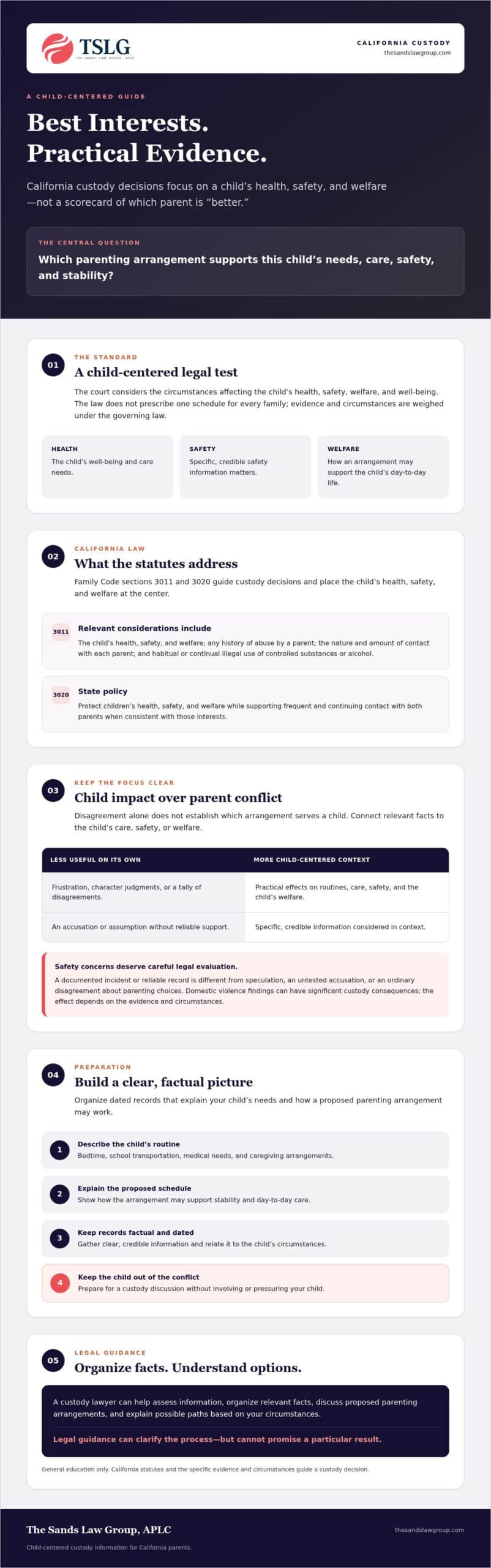
California Family Code sections 3011 and 3020 guide custody decisions. Section 3011 identifies the child’s health, safety, and welfare as central considerations. It also addresses matters such as established abuse history, the nature and amount of contact with each parent, and habitual or continual illegal use of controlled substances or alcohol. Section 3020 states the policy of protecting children’s health, safety, and welfare while supporting frequent and continuing contact with both parents when consistent with those interests.
These provisions don’t prescribe one schedule for every family. The court weighs the evidence and circumstances under the governing law. A general overview of the best interest of the child explains the broader principle, but California statutes, rather than a general summary, guide a California custody decision.
How is the child’s well-being different from parental conflict?
Adult conflict can be painful and disruptive, but disagreement alone doesn’t establish which parenting arrangement serves a child. The useful question is whether a specific fact connects to the child’s care, safety, or welfare. A parent’s frustration with the other parent, for example, is different from information showing that repeated schedule changes disrupt school routines or that parents struggle to share essential details about a child’s care.
Keep the focus on practical effects, not character judgments. Your child’s regular bedtime, school transportation, medical needs, and caregiving arrangements may help explain how a proposed schedule would work. Specific communication about the child can also be relevant when considered in context, rather than treated as a tally of every disagreement.
If you’re seeking a best interest of child california custody lawyer, case-specific legal guidance can help you understand which facts may be relevant and how to present them clearly. The Sands Law Group, APLC represents parents in custody and visitation matters in Los Angeles, Riverside, San Bernardino, and Kern. This article provides general education, not a prediction of a court’s decision or a substitute for advice about your circumstances.
What Factors Can a California Court Consider in a Custody Decision?
Once you understand the legal standard, the next question is which facts may help the court assess a proposed parenting arrangement. California law does not reduce that decision to a single checklist or award custody based on assumptions about which parent is more likable, has a particular job, or makes fewer complaints. Evidence is considered in context and in relation to the child’s welfare.
Under Family Code section 3011, relevant considerations include the child’s health, safety, and welfare; any history of abuse by a parent; the nature and amount of the child’s contact with each parent; and habitual or continual illegal use of controlled substances or alcohol. The state’s policy in California Family Code § 3020 also emphasizes children’s health, safety, and welfare while supporting frequent and continuing contact with both parents when consistent with those interests.
How can safety concerns affect the analysis?
Specific, credible safety information deserves careful legal evaluation. A documented incident or reliable record is different from speculation, an untested accusation, or an ordinary disagreement about parenting choices. Domestic violence findings can have significant custody consequences under California law, but the effect depends on the evidence and circumstances. If you believe your child faces an immediate safety risk, seek individualized legal advice promptly about appropriate next steps.
A child’s wishes may also be considered under Family Code section 3042. The court gives due weight to a child’s preference when the child has sufficient age and capacity to form an intelligent preference. A child who is 14 or older generally must be permitted to address the court unless doing so is not in the child’s best interest. This does not mean the child chooses the custody arrangement, and parents should not pressure a child to take sides.
Does California law require equal parenting time?
No. California law does not require equal parenting time in every case. The policy favoring frequent and continuing contact with both parents is subject to the child’s best interests, and the appropriate schedule depends on the family’s circumstances. Don’t assume a fixed split will suit every child. It can also help to distinguish decision-making authority from where a child lives; see this explanation of legal custody versus physical custody in California.
A best interest of child california custody lawyer can help assess how relevant evidence and a proposed schedule fit your situation, without guaranteeing a result. The Sands Law Group, APLC represents parents in custody and visitation matters in Los Angeles, Riverside, San Bernardino, and Kern. If you need case-specific guidance, learn more about child custody and visitation representation.
Common Misconceptions About the Best-Interest Standard: What Should Parents Know?
Custody disputes can make it feel as though every disagreement is a test of your worth as a parent. That is not the legal question. The court’s task is not to select the more deserving, popular, or persuasive parent. It is to assess the child’s circumstances and the evidence relevant to the child’s welfare. The California Courts self-help guide explains this child-focused approach in plain language.
Will a judge simply decide which parent is better?
No. Labels and personal criticism don’t replace relevant facts. A parent calling the other selfish, difficult, or “unfit” is not, by itself, proof that a particular custody arrangement would benefit the child. The court may consider whether evidence connects to the child’s care, safety, or stability. A disagreement about an adult’s choices, for example, is different from reliable information that a specific choice affects a child’s well-being.
Allegations aren’t automatic proof. Their source, detail, supporting evidence, and connection to the child’s welfare may all matter. That doesn’t mean a safety concern should be dismissed; it means the concern should be presented accurately and assessed in context. Nor does one factor decide every case: a parent’s income, willingness to cooperate, or a single incident does not guarantee a particular outcome. The significance of any fact depends on the circumstances and applicable law.
Does a difficult relationship between parents decide custody?
Not by itself. Communication problems between adults don’t automatically establish what parenting arrangement serves a child, though their practical effects may be relevant. Consider whether parents can share necessary information about school, health, or schedule changes, and whether a proposed plan provides workable ways to handle those needs. The aim is not to prove perfect harmony. It is to focus on the child’s experience and practical care.
Keep communication factual, respectful, and focused on the child where possible. Don’t create disputes to make the other parent look unreasonable, and don’t use your child as a messenger or ask them to take sides. Those tactics can add pressure without clarifying the child’s needs. A best interest of child california custody lawyer can help distinguish relevant evidence from assumptions, organize concerns in context, and explain options specific to your circumstances. Legal guidance can support preparation, but it can’t promise how a court will weigh the facts.
How Can You Prepare for a Child-Centered Custody Discussion?
Preparation is most useful when it turns a stressful, wide-ranging dispute into a clear account of your child’s day-to-day needs. You don’t need to prove that the other parent is a bad person. Focus on information that explains your child’s routine and how a proposed parenting arrangement could work in practice.
Start by listing your child’s usual schedule, caregiving responsibilities, school-related needs, relevant dated communications, and a proposed parenting plan that accounts for transitions and holidays.
What information may help explain your child’s needs?
Gather information in an organized, factual way. A simple timeline or calendar can show routines and changes without turning every disagreement into an accusation. Consider organizing:
- Routine and schedule: school and activity times, regular appointments, sleep routines, and transportation needs.
- Caregiving: who usually handles specific tasks, such as school drop-offs or arranging appointments, and when those responsibilities occur.
- Relevant communication: dated messages about the child’s schedule, care, or important decisions, saved with enough context to understand the exchange.
- Questions or concerns: specific issues you want to discuss, separated from assumptions about the other parent’s motives.
Keep your child’s privacy in mind. Don’t coach or pressure your child to provide statements, ask them to take sides, or use them to carry messages. Avoid intrusive or potentially unlawful evidence gathering, including accessing another person’s private accounts or making recordings without first getting legal advice about whether that is permitted. If you’re unsure whether material is appropriate to collect or share, ask counsel before acting.
How can you propose a workable parenting arrangement?
Build a proposal around your child’s actual routine, developmental needs, transitions, and each parent’s practical availability. Think through school-day logistics, where exchanges would occur, how holidays might be shared, and how parents could communicate necessary updates. A workable proposal should address foreseeable details while allowing room for the child’s needs to change. No single schedule fits every family.
If custody is part of a divorce, understanding the divorce process can help place the custody discussion in context. A best interest of child california custody lawyer can help organize relevant information and assess whether your proposed arrangement addresses your child’s needs. For case-specific help preparing for a custody discussion, discuss child custody and visitation representation with The Sands Law Group, APLC, which serves clients in Los Angeles, Riverside, San Bernardino, and Kern.
When Can a California Custody Lawyer Help Protect a Child-Centered Approach?
Legal guidance may be useful when you’re unsure which facts matter, how an existing order applies, or whether a proposed parenting arrangement addresses your child’s needs. A lawyer can explain relevant California law, review available information, and help you consider possible paths forward. That guidance is specific to your circumstances, not a promise of a particular custody result.
What should you discuss during an initial legal consultation?
To make the discussion more focused, prepare a concise timeline of important events, copies of any current custody orders, and questions about your child’s circumstances. You might ask how the lawyer evaluates evidence, explains possible options, and approaches settlement discussions. Share both facts that support your concerns and details that may complicate them. Counsel needs the full context before assessing possible legal strategies.
It may also help to identify what you hope a workable arrangement would address, such as an existing schedule, transitions, or a proposed change. Clear questions can help you understand what information is still needed and what steps may be available, without assuming every disagreement requires a court hearing.
How can counsel support a stable path forward?
A lawyer can help you understand the terms of an existing order, evaluate a proposed change, and organize relevant information around your child’s needs. Parents may be able to resolve some issues through settlement discussions; other matters may require court advocacy. Neither route guarantees an outcome. The best way forward depends on the facts, the law, and the issues in dispute.
The goal is measured, child-focused advocacy, not escalating conflict or promising to “win.” The Sands Law Group, APLC represents parents in child custody and visitation matters, including parenting arrangements and post-judgment modifications, in Los Angeles, Riverside, San Bernardino, and Kern. A best interest of child california custody lawyer can offer case-specific guidance on how the law may apply to your circumstances.
If you’re considering legal guidance, you can learn about custody and visitation representation and decide whether a discussion would help clarify your options.
Take a Clear, Child-Focused Next Step
California custody decisions turn on the child’s best interests, not a contest over which parent is more deserving. Relevant facts should be considered in context, and a practical parenting proposal can help keep the discussion centered on the child’s routine, needs, and stability. Because every family’s circumstances are different, legal guidance can help you understand how the law may apply without promising a particular outcome.
A best interest of child california custody lawyer can help you organize information, evaluate parenting arrangements, and understand possible paths forward. The Sands Law Group, APLC represents parents in child custody and visitation matters, including initial parenting plans and post-judgment modifications, in Los Angeles, Riverside, San Bernardino, and Kern.
If you’re ready to explore case-specific guidance, learn about child custody and visitation representation. Contact The Sands Law Group, APLC to discuss your custody and visitation concerns and understand your options. With clear information and thoughtful preparation, you can take a steadier step toward a plan that keeps your child’s needs at the center.
Frequently Asked Questions
What does best interest of the child mean in California custody cases?
It means the court evaluates custody through the child’s needs and welfare, rather than deciding which parent is more deserving. California law directs attention to the child’s health, safety, and welfare, alongside other relevant circumstances. The court applies those principles to the evidence in the particular case, so the same facts may carry different weight in different families. The standard guides the decision, but it doesn’t guarantee a particular arrangement.
What factors do California courts consider when deciding child custody?
Courts consider the child’s health, safety, and welfare, and may consider any established history of abuse, the nature and amount of contact with each parent, and habitual or continual illegal use of controlled substances or alcohol. California’s custody laws also express a policy favoring frequent and continuing contact with both parents when consistent with the child’s interests. No single factor automatically determines the outcome; the court weighs relevant evidence in context.
Does California automatically give parents equal custody time?
No. California does not automatically require an equal division of parenting time. The law supports frequent and continuing contact with both parents when that is consistent with the child’s best interests, but a parenting schedule should reflect the circumstances of the child and family. Legal custody, which concerns major decisions, is also distinct from physical custody, which concerns where the child lives. A court may order different arrangements for each.
Can a child choose which parent to live with in California?
No. A child doesn’t simply choose the parent or decide the custody outcome. Under California law, the court must consider and give due weight to a child’s wishes when the child has sufficient age and capacity to form an intelligent preference. A child who is 14 or older generally must be allowed to address the court unless the court finds that doing so isn’t in the child’s best interests. Parents should not pressure children to take sides.
What evidence can help show what is in a child’s best interest?
Relevant, well-organized information may help explain the child’s circumstances. Examples include a dated calendar of parenting time, records of caregiving responsibilities, school or appointment schedules, and communications about the child’s needs. Keep material factual and in context, rather than using it to attack the other parent. Avoid intrusive or unlawful evidence gathering, and don’t coach or involve the child in collecting information. A lawyer can help assess what may be relevant.
Should I hire a custody lawyer for a California best-interest case?
A lawyer may help clarify the applicable law, organize relevant information, and assess a proposed parenting arrangement or available options. A best interest of child california custody lawyer can also explain possible settlement discussions or court advocacy, without promising a specific result. Case-specific guidance can help you prepare questions and understand your choices.
Can a California custody order be changed if circumstances change?
Yes, a California custody order may be changed, but a change in circumstances doesn’t automatically alter the existing order. The legal standard can depend on the type of order and the situation, so it’s important to review the order and facts before acting. The Sands Law Group assists parents with post-judgment custody and visitation modifications in Los Angeles, Riverside, San Bernardino, and Kern. Legal advice can help clarify whether seeking a modification may be appropriate.

Article by
Thomas D. Sands, Esq.
Thomas D. Sands is the founder and CEO of The Sands Law Group, APLC. A California attorney with more than two decades of experience, he represents clients in divorce and family law matters as well as civil litigation and real property disputes. His approach emphasizes attentive, practical, and cost-conscious representation.
Sands is a 2023 Litigator of the Year honoree of the American Institute of Trial Lawyers and a 2023 Lawyer of the Year honoree of the American Institute of Legal Professionals. His firm has also received recognition among the 2025 Best Law Firms in America, a 2026 Benchmark Best of award, and a 2026 Law Firm of the Year honor.









Leave A Comment