

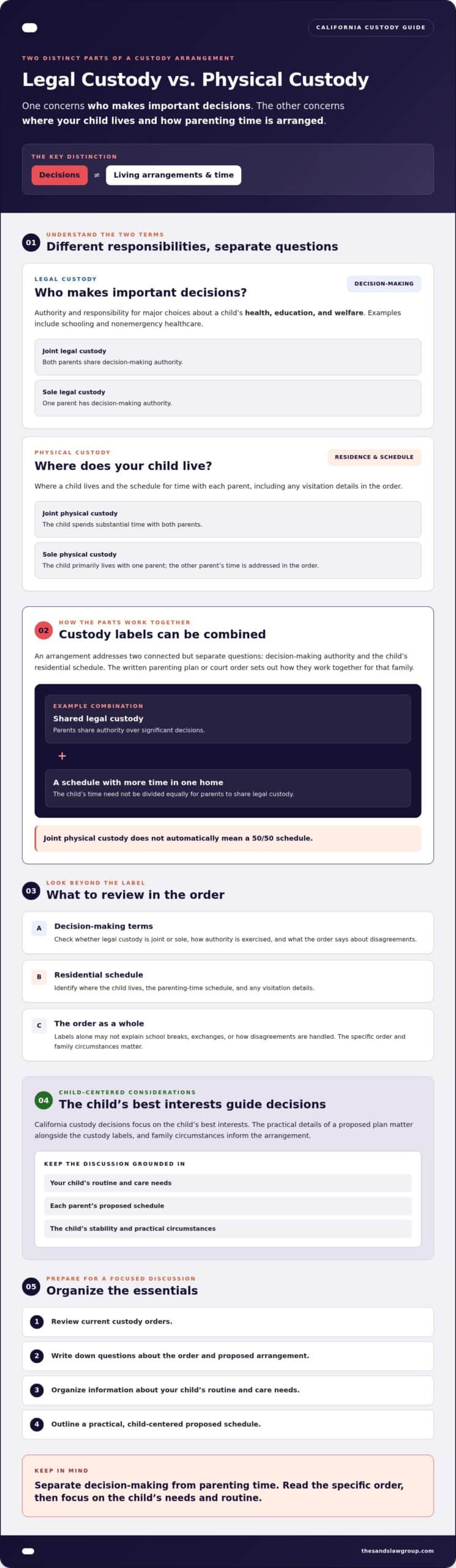
What if sharing custody doesn’t mean sharing every major decision or dividing the week equally? If you’re trying to understand legal custody vs physical custody california, the distinction matters: legal custody concerns who makes important decisions for your child, while physical custody concerns where your child lives and how parenting time is arranged. Joint custody can apply to either, and joint physical custody doesn’t automatically mean a 50/50 schedule.
It’s understandable to feel uncertain when a custody arrangement affects both your child’s daily routine and your role as a parent. California courts focus on the child’s best interests, so the practical details of a proposed plan matter alongside the labels in an order.
This article explains how legal and physical custody differ, how the terms can be combined, and what child-focused circumstances may shape a disputed arrangement. It also explains what to organize before discussing options with counsel, including your child’s routines, care needs, and each parent’s proposed schedule. Knowing which questions to ask can help you focus the discussion on your child’s stability.
Key Takeaways
- Understanding legal custody vs physical custody california can help you separate decision-making authority from your child’s parenting-time schedule.
- Custody labels can be combined in different ways, so review the specific terms of an order rather than assuming what a schedule allows.
- California custody decisions focus on the child’s best interests, with family circumstances informing the arrangement.
- Before discussing options, review current orders, identify your questions, and organize information about your child’s needs and routine.
- A practical, child-centered proposed schedule can help you prepare for a focused discussion with counsel.
Legal Custody vs. Physical Custody in California: What Does Each Term Mean?
Custody labels describe different parental responsibilities, not a parent’s worth or the strength of a parent-child relationship. In legal custody vs physical custody california cases, legal custody concerns who makes important decisions for a child, while physical custody concerns the child’s living arrangements and time with each parent. These responsibilities can be addressed separately, so one label doesn’t automatically determine the other.
For a foundational, non-jurisdictional overview of legal custody and physical custody, the general distinction is between decision-making and a child’s residence. In California, the specific terms of the court order and the facts of the family’s case determine how those responsibilities apply.
| Custody type | What it addresses |
|---|---|
| Legal custody | Authority and responsibility for important decisions about a child’s health, education, and welfare. |
| Physical custody | Where a child lives and the schedule for time with each parent. |
What decisions fall under legal custody?
Legal custody concerns major choices affecting a child’s upbringing, such as schooling or nonemergency healthcare. With joint legal custody, both parents share decision-making authority. With sole legal custody, one parent has that authority. Neither arrangement follows automatically from a parent’s preference or from the physical schedule. Read the order carefully to see how decisions must be shared or exercised, including what it says about disagreements.
What does physical custody describe?
Physical custody addresses a child’s living arrangements and parenting-time schedule. An order may provide for joint physical custody, meaning the child spends substantial time with both parents, or sole physical custody, meaning the child primarily lives with one parent while the other parent’s time is addressed in the order. Joint physical custody doesn’t necessarily mean an equal division of time. Review the schedule and any visitation details alongside the custody terms.
These categories can be combined in different ways. For example, parents may share legal custody while following a schedule in which the child spends more time in one home. They can still share authority over major decisions. The labels alone don’t explain how school breaks, exchanges, or disagreements are handled. Those details depend on the order and the family’s circumstances.
How California Legal and Physical Custody Orders Work Together
A custody arrangement addresses two connected but separate questions: who has authority to make important decisions, and how the child’s time is divided between homes. The written parenting plan or court order sets out how those parts work together for a particular family. For instance, parents might share legal custody while the child follows a schedule with more overnights in one home. This is an example of a possible combination, not a recommendation for a specific case.
Legal custody concerns decision-making authority; physical custody and parenting-time provisions describe the child’s residential schedule. The best interests of the child standard provides broader context for why arrangements are tailored to children and families rather than determined by labels alone. The terms in an individual California order remain central.
Can parents share legal custody but have different schedules?
Yes. Shared legal custody doesn’t, by itself, establish equal overnights or equal parenting time. A schedule may account for a child’s needs, each parent’s practical circumstances, and the terms of the order. For example, parents could share authority over significant decisions while following a schedule that gives the child different amounts of time in each home. This is a general illustration, not legal advice. For a question about a specific decision, consult the written order rather than relying on the custody label alone.
What should parents look for in a custody order?
Read the order as a whole. Identify the provisions addressing:
- Legal custody: Whether decision-making authority is joint or sole, and how the order directs parents to exercise it.
- Physical custody and parenting time: Where the child lives, the schedule, and any visitation details.
- Practical arrangements: Instructions about parent communication, exchanges, or resolving disagreements, if included.
A provision in one part of the order may not answer every question raised by another. If wording seems unclear or provisions appear to conflict, individualized legal guidance can help you understand how the order applies to your family. The Sands Law Group, APLC represents parents in California custody and visitation matters. Learn about California child custody representation.
Does Joint Custody Mean Equal Time in California? Common Misconceptions
No. Joint legal custody does not, by itself, mean equal physical custody or equal parenting time. The terms address different parts of an arrangement, and a label alone can’t tell you how many nights a child will spend in each home. The California Courts guide to legal and physical custody explains the distinction between these custody concepts and between joint and sole custody. For a particular family, the written order and applicable law matter.
That distinction is central to understanding legal custody vs physical custody california. Read the schedule as its own set of provisions rather than inferring it from a legal-custody label. A label also can’t guarantee what a court will order. Outcomes depend on the circumstances and the child’s needs.
Does joint physical custody always mean a 50/50 schedule?
No. “Joint physical custody” doesn’t establish an exact division of overnights or time. A schedule can allocate different amounts of time to each parent under the terms of the order. For example, an illustrative plan might have a child spend school nights primarily in one home and scheduled weekends with the other parent. That example isn’t a prediction of how a judge would rule or a recommendation for a particular family.
To understand a proposed or existing arrangement, look at the actual calendar provisions, including regular weeks, holidays, school breaks, and exchanges if they’re addressed. If the schedule and custody labels seem inconsistent, don’t rely on assumptions. Seek clarification based on the full order and your circumstances.
Does one custody label determine who makes every decision?
No single label answers every practical question. Legal custody provisions concern important decisions about a child, while routine choices during parenting time, such as meals or bedtime, differ from major decisions about education or healthcare. The order’s specific language and applicable law guide how parents share authority. Avoid assuming that one parent can make every decision or that every choice requires joint approval.
Co-parenting communication can make shared decision-making more workable, but ongoing conflict may make the order’s procedures especially important. Read any directions about consultation, communication, or resolving disagreements before acting on a disputed issue. If the wording is unclear, individualized legal guidance can help explain how it applies.
Safety concerns require particular care. If domestic violence or another risk to a child is alleged, the details may affect the appropriate custody analysis and should receive prompt, individualized legal review. A general description of joint or sole custody can’t resolve those circumstances. Focus on the facts, relevant documentation, and the current order.
What California Courts Consider When Making Custody Arrangements
When parents disagree about an arrangement, the court focuses on the child’s welfare, not which parent presents the stronger personal preference. California Family Code section 3011 identifies factors relevant to a child’s best interests, including health, safety, and welfare. Section 3020 also describes the state’s policy of protecting children’s health, safety, and welfare. These standards guide decisions about custody and parenting time, but no single fact automatically determines the outcome.
California custody decisions must protect the child’s health, safety, and welfare. (Cal. Fam. Code §§ 3011, 3020.) In a legal custody vs physical custody california discussion, that focus applies to both decision-making arrangements and the child’s residential schedule. A child’s need for continuity, relevant health or safety concerns, and the family’s circumstances may all matter. The court considers the situation as a whole; a particular factor doesn’t guarantee a specific result.
How does the child’s best interest guide custody decisions?
The best-interest standard asks what arrangement serves the child, rather than which parent should be rewarded or penalized. Relevant circumstances may include the child’s health and safety, established routines, relationships, and each parent’s ability to meet the child’s needs. The California Courts custody guide offers general information, but applying the law to a family’s facts requires attention to current orders and circumstances.
What information can parents organize before a court discussion?
Preparation can help keep a difficult discussion specific and child-centered. Gather materials that show the existing arrangement and your child’s practical needs, such as:
- Current custody orders, parenting plans, and any later modifications.
- A proposed schedule, along with school calendars and relevant activity or appointment dates.
- Factual information about caregiving responsibilities, routines, and health or educational needs.
- Relevant parent communications, preserved in context and without commentary or alteration.
Organize records around your child’s needs rather than collecting material simply to criticize the other parent. If safety is a concern, note the specific events and available documentation, and seek individualized legal advice about appropriate next steps.
Local filing, mediation, and hearing procedures may differ. Parents in Los Angeles, Riverside, San Bernardino, and Kern should check current California Courts guidance and the relevant county superior court’s resources rather than rely on general descriptions of procedure. For help evaluating custody options in light of your family’s facts and existing orders, consider discussing your California custody matter with counsel.
How to Prepare for a California Custody Discussion and Find Guidance
A custody discussion can feel less overwhelming when you approach it in a clear sequence: review the current orders, write down what you need clarified, organize facts about your child’s life, and seek advice tailored to your family. If custody questions arise during a divorce, the California Divorce Process Guide may also help you understand how custody issues fit into the broader process.
What should you bring to a custody consultation?
Gather documents that show what is in place and what you are considering. A focused set of records can make it easier to discuss how legal custody vs physical custody california applies to your circumstances:
- Current custody orders, parenting plans, and related court documents.
- The existing parenting schedule and a proposed schedule, including school breaks or recurring activities that affect timing.
- A brief timeline of important events and a written list of questions about decision-making, parenting time, or possible changes.
- Factual notes about your child’s routine, school, health needs, and caregiving arrangements.
Keep the information specific and relevant. For example, describe your child’s school-day routine or a recurring care responsibility rather than making broad claims about the other parent. A practical proposed schedule should explain how it could support your child’s needs and daily stability, not frame the dispute as a contest to defeat the other parent.
When can a family law attorney help?
An attorney can review the actual order, help identify how its terms apply, and discuss proposed arrangements or questions about a possible post-judgment modification. Individualized review matters because general information can’t account for every family’s circumstances or resolve unclear wording in a specific order.
This article is for educational purposes only. It isn’t legal advice and can’t assess your order or determine what arrangement is appropriate for your family. The Sands Law Group, APLC represents parents in custody and visitation matters, including parenting plans and post-judgment modifications, in Los Angeles, Riverside, San Bernardino, and Kern. For tailored guidance about your circumstances, Discuss your California custody questions with The Sands Law Group, APLC.
Move Forward With a Clearer Custody Plan
Understanding legal custody vs physical custody california starts with separating decision-making authority from the child’s living arrangements and parenting-time schedule. These parts of a custody order can work together in different ways, and joint custody doesn’t automatically mean equal time. The order’s specific terms and the child’s circumstances matter.
Before a custody discussion, review current orders, note what you need clarified, and organize child-focused information about routines, care, and a workable proposed schedule. California custody decisions center on the child’s best interests, but general information can’t determine how the law applies to your family or interpret an individual order.
The Sands Law Group, APLC represents parents in legal custody, physical custody, and visitation matters, and assists with initial parenting plans and post-judgment modifications. Its stated service area includes Los Angeles, Riverside, San Bernardino, and Kern. For guidance tailored to your circumstances and applicable orders, Discuss your California custody questions with The Sands Law Group, APLC. With clear information and thoughtful support, you can approach the next conversation with your child’s needs at the center.
Frequently Asked Questions
What is the difference between legal custody and physical custody in California?
Legal custody concerns a parent’s authority to make important decisions about a child’s health, education, and welfare. Physical custody describes the child’s living arrangements and parenting-time schedule. The distinction in legal custody vs physical custody california cases matters because the two types can be arranged separately. For example, parents may share legal decision-making while the child spends more time in one home. The court order and family circumstances determine how the arrangement operates.
Does joint legal custody mean equal parenting time in California?
No. Joint legal custody means parents share decision-making authority as described in their order. It doesn’t set the child’s schedule or require equal parenting time. Parenting time is addressed separately through physical custody and visitation provisions. For instance, an order could provide for joint legal custody while giving one parent more school-night overnights. Read the actual schedule and order rather than assuming “joint custody” means a 50/50 division.
Can one parent have sole legal custody and the parents still share physical custody?
Yes. Legal and physical custody address different responsibilities, so an arrangement may grant one parent sole legal custody while providing that the child spends substantial time with both parents. The order’s terms control how that combination works, including the parenting schedule and each parent’s role. Sole authority over major decisions doesn’t necessarily mean the other parent has no parenting time. For a specific arrangement, review the complete order and get advice based on its wording.
What does joint physical custody mean in California?
Joint physical custody generally means a child spends significant periods living with each parent, according to the court order. It doesn’t necessarily mean an equal split of overnights or time. Review the order for its actual schedule, including provisions for regular weeks, holidays, school breaks, or exchanges. Those details, rather than the label alone, show how parenting time is structured for that family.
How do California courts decide legal and physical custody?
California courts make custody decisions based on the child’s best interests, considering relevant circumstances such as the child’s health, safety, and welfare. California Family Code sections 3011 and 3020 address factors and policy relevant to custody decisions. No single factor automatically determines legal or physical custody, and a general description can’t predict an outcome. Parents in Los Angeles, Riverside, San Bernardino, or Kern should check current court guidance and seek advice tailored to their case.
Can a California custody order be changed?
Yes, a parent can ask the court to change a custody order, but a requested change isn’t automatic. The process and legal standard may depend on the type of order and the circumstances, and the court’s focus remains the child’s best interests. Before taking steps, review the current order and identify what has changed and why a different arrangement may better address the child’s needs. An attorney can explain how those facts may apply.
What should I do if my California custody order is unclear?
Read the entire order, including any attached parenting plan and later modifications, since one provision may clarify another. Note the specific language that seems unclear and the decision or schedule question it affects. Don’t rely on assumptions or make a major change based only on an uncertain interpretation. A family law attorney can review the wording and explain options based on your circumstances. The Sands Law Group, APLC represents parents in custody matters in Los Angeles, Riverside, San Bernardino, and Kern.

Article by
Thomas D. Sands, Esq.
Thomas D. Sands is the founder and CEO of The Sands Law Group, APLC. A California attorney with more than two decades of experience, he represents clients in divorce and family law matters as well as civil litigation and real property disputes. His approach emphasizes attentive, practical, and cost-conscious representation.
Sands is a 2023 Litigator of the Year honoree of the American Institute of Trial Lawyers and a 2023 Lawyer of the Year honoree of the American Institute of Legal Professionals. His firm has also received recognition among the 2025 Best Law Firms in America, a 2026 Benchmark Best of award, and a 2026 Law Firm of the Year honor.









Leave A Comment