

Contested divorce is fundamentally an exercise in strategic risk management, not emotional retaliation. When a spouse refuses to negotiate in good faith, partnering with a seasoned contested divorce attorney California courts respect transforms acute vulnerability into calculated, steady protection. It’s entirely natural to feel unsettled by the reality of litigation. You shouldn’t have to carry the dread of losing precious parenting time, watching community assets vanish behind questionable accounting, or enduring protracted battles across crowded Southern California courtrooms.
You deserve absolute clarity during this transitional storm. In the guide ahead, you’ll gain a clear, strategic understanding of how contested proceedings unfold in California family law courts, showing you exactly how experienced legal counsel protects your assets and parental rights. We examine the critical stages of high-conflict litigation, proven methods for dividing complex property equitably, and proactive measures to reach an enforceable resolution with minimal unnecessary delay and emotional trauma.
Key Takeaways
- Understand the precise threshold where negotiations break down, helping you recognize when disputes over assets or parenting time demand formal litigation.
- Discover how California’s community property mandates work in practice, and learn why rigorous documentary tracing is essential to preserve your separate property.
- Demystify the court timeline from initial filings through mandatory financial disclosures, ensuring procedural deadlines never compromise your position.
- Learn how partnering with a skilled contested divorce attorney California courts respect protects you from procedural traps and chronic courtroom backlogs.
- Gain actionable strategies for securing fair custody arrangements and equitable asset division while minimizing emotional exhaustion and unnecessary delays.
Contested vs Uncontested Divorce in California: Understanding the Legal Threshold
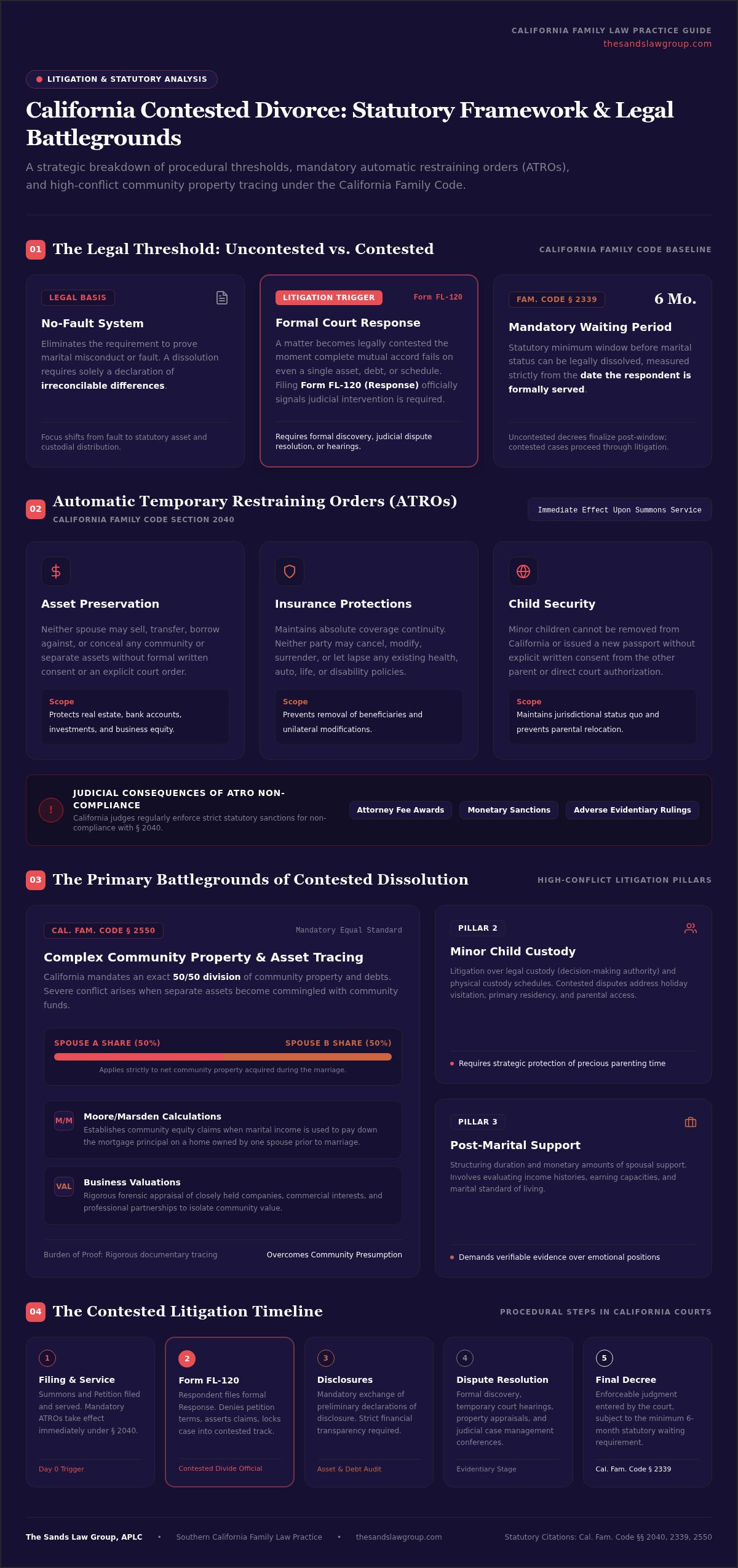
Ending a marriage in California does not require proving moral wrongdoing or marital fault. As the pioneer of the modern no-fault divorce system, the state requires only a declaration of irreconcilable differences to grant a dissolution. Yet, eliminating fault does not eliminate conflict. A divorce becomes legally contested the moment spouses cannot reach complete, mutual accord on key issues: dividing marital property, determining child custody, or structuring spousal support. Even with shared intentions to remain civil, the transition from an amicable separation to active litigation often happens swiftly.
Every California dissolution must satisfy the mandatory six-month waiting period established under Family Code Section 2339, counted from the date the respondent is formally served. While an uncontested matter quietly moves toward a final decree once that statutory window closes, a contested case enters the court system for structured dispute resolution. Securing guidance from a seasoned contested divorce attorney California families rely on ensures that temporary communication breakdowns do not devolve into procedural traps.
When Does an Amicable Separation Become a Contested Case?
True uncontested dissolutions require total consensus. Both parties must execute written agreements resolving every single statutory issue, from real estate equity down to holiday visitation schedules. If a dispute arises over a single retirement account, business valuation, or parenting day, the case shifts into contested territory.
Procedurally, the divide becomes official once the respondent files a formal Response (Form FL-120) with the superior court. This filing formally denies the petitioner’s specific requests, preserves statutory rights, and signals to the family law judge that judicial intervention, formal discovery, or temporary hearings will be required.
The Protective Power of California ATROs
Litigation brings immediate legal safeguards. The moment a summons is issued and personally served, California Automatic Temporary Restraining Orders (ATROs) take effect instantly under Family Code Section 2040. These orders serve as an essential financial and parental shield:
- Asset preservation: Neither spouse may sell, transfer, borrow against, or conceal community or separate assets without written consent or a court order.
- Insurance protections: Existing health, auto, life, and disability policies cannot be canceled or modified.
- Child security: Minor children cannot be removed from California or issued a new passport without explicit written consent from the other parent or the bench.
ATRO violations carry severe consequences. California judges regularly penalize non-compliant parties with attorney fee awards, monetary sanctions, or adverse evidentiary rulings. In high-conflict disputes, working with a strategic contested divorce attorney California courts trust ensures these statutory protections remain strictly enforced while your broader rights are preserved.
The Primary Battlegrounds in California Contested Marital Dissolutions
While the administrative steps outlined in California’s official divorce process appear linear on paper, substantive disputes quickly stall progress. In high-conflict proceedings, disagreements generally converge around three central pillars: the division of high-value property, the custody of minor children, and the duration of post-marital support. Resolving these core disputes requires moving beyond emotional grievances to focus strictly on statutory standards and verifiable evidence.
Complex Community Property and Separate Asset Tracing
California Family Code Section 2550 mandates an equal 50/50 division of community property and community debts. However, marital balance sheets rarely divide cleanly. Conflict surfaces when separate assets become inextricably linked with community funds during the marriage. Key challenges include:
- Moore/Marsden calculations: Establishing community equity claims when marital income paid down the principal mortgage on a residence owned by one spouse prior to marriage.
- Business valuations: Appraising closely held companies, professional partnerships, or deferred executive compensation.
- Commingled investments: Tracing the origin of funds across mixed 401(k) balances, pensions, and stock portfolios to protect pre-marital wealth.
Child Custody, Visitation, and Parenting Plan Disputes
California custody litigation centers entirely on the best interests of the child standard under Family Code Section 3011. The court evaluates parental fitness, emotional bonds, stability, and any history of domestic violence. Under Family Code Section 3044, an established finding of domestic violence within the past five years creates a strong rebuttable presumption against awarding sole or joint custody to the perpetrating parent.
Before any judge will hear a contested custody motion, parents must complete court-ordered Child Custody Recommending Counseling. When high-conflict issues persist, such as relocation disputes or parental alienation, having an experienced contested divorce attorney California parents trust is critical to preserving your parental rights and securing an enforceable parenting schedule.
Spousal Support Determinations Under Family Code Section 4320
Support orders vary dramatically depending on the stage of litigation. Early on, courts rely on county guideline software to establish temporary support awards that maintain financial stability. Final support determinations, however, strictly adhere to the fourteen statutory factors of Family Code Section 4320. Judges balance the marital standard of living against documented earning capacities, health, and domestic contributions. For marriages lasting ten years or longer, classified as marriages of long duration under Family Code Section 4336, the court retains indefinite jurisdiction, meaning support obligations lack an automatic statutory termination date.
The California Contested Divorce Timeline: From Filings to Final Judgment
While an amicable separation can finalize shortly after California’s statutory six-month waiting period, high-conflict litigation typically spans twelve to twenty-four months. Establishing statutory legal grounds for divorce through Form FL-100 is merely the threshold. Once formal conflict begins, moving through the superior court system demands strict adherence to procedural milestones where strategic preparation directly dictates long-term outcomes.
Filing, Financial Disclosures, and Emergency Temporary Orders
Litigation officially begins when the petition and summons are served, initiating a strict thirty-day window for the respondent to file Form FL-120. Within sixty days of filing, California law compels both spouses to exchange Preliminary Declarations of Disclosure. These comprehensive schedules of assets, debts, and income are signed under penalty of perjury.
Because final judgments take months or years to secure, urgent financial realities cannot wait. Filing a Request for Order (RFO) allows an experienced contested divorce attorney California clients rely on to secure critical temporary orders. These pendente lite hearings establish interim child custody, award child support, allocate temporary spousal maintenance, and order contribution toward attorney fees.
Evidentiary Discovery and Expert Witnesses
Uncovering concealed assets requires aggressive formal discovery rather than passive reliance on voluntary disclosures. While standard forms ask basic questions, uncovering true financial baselines involves specialized legal tools:
- Subpoenas and production requests: Compelling unredacted banking records, brokerage statements, and corporate ledgers directly from financial institutions.
- Interrogatories and depositions: Submitting tailored interrogatories and taking sworn depositions to trap inconsistent claims regarding hidden revenue or side businesses under oath.
- Forensic experts: Retaining forensic accountants to conduct cash-flow analyses and trace diverted funds, alongside vocational evaluators who assess an underemployed spouse’s true earning capacity.
Mandatory Settlement Conferences and Family Court Trial
California superior courts prioritize settlement, requiring spouses to participate in a formal Mandatory Settlement Conference (MSC) before allocating precious courtroom trial time. During the MSC, counsel present detailed settlement briefs to a settlement judge or family law pro tem to resolve remaining disputes without further trial expenses.
If an unyielding stalemate remains, the case proceeds to a bench trial. California family law matters are decided solely by a judge, never a jury. Securing your future in trial hinges on procedural precision, introducing authenticated exhibits, and having a skilled contested divorce attorney California courtrooms respect examine expert witnesses to defend your rights.
Strategic Realities in Southern California Family Courts
State statutes establish the boundaries of marital dissolution, but local courtroom realities dictate how efficiently your case proceeds. Superior courts across Southern California manage some of the heaviest family law caseloads in the country. When an adversarial spouse turns every disagreement into a procedural fight, litigation expenses climb quickly without providing any legal advantage. Achieving resolution requires strategic composure and practical familiarity with regional judicial administration.
Navigating Court Congestion in Los Angeles, Riverside, San Bernardino, and Kern
Family law branches throughout Los Angeles, Riverside, San Bernardino, and Kern counties face chronic calendar congestion. A standard motion can take months just to secure a preliminary hearing date before a judge.
Each county enforces strict local rules governing evidentiary limits, brief formatting, and mandatory readiness conferences. In disputes where local calendar delays threaten financial stability or parental access, an insightful contested divorce attorney California litigants turn to can request tailored relief or explore alternative forums. Retaining a private mediator or a retired judge acting as a judge pro tem allows parties to resolve complex property and custody disputes without waiting on crowded public dockets.
Cost-Containment Strategies in High-Conflict Dissolutions
Uncontrolled hostility drives up legal costs faster than any other factor. Protecting your future requires approaching litigation with financial discipline rather than emotional reaction:
- Targeting high-impact issues: Channel resources into business valuations, separate property tracing, and workable custody terms rather than spending thousands fighting over depreciated personal property.
- Focused evidentiary discovery: Direct tailored document requests and subpoenas straight to third-party institutions rather than paying for broad, open-ended paperwork disputes.
- Fee-shifting under Family Code Section 2030: When one spouse controls the majority of community income, the court can order that spouse to contribute toward the other’s legal representation to maintain parity.
If your divorce faces stubborn delays or unreasonable opposition, contact The Sands Law Group to schedule a strategic consultation and protect your legal position.
Why Experienced Representation Matters: Partnering with The Sands Law Group
Litigation is not an arena for personal retribution. In contentious family law disputes, performative hostility rarely impresses a judge; instead, it rapidly depletes marital assets and deepens emotional distress. Resolving complex disputes over community wealth, business holdings, and child custody requires an experienced contested divorce attorney California clients trust to substitute volatile conflict with calculated, evidence-driven advocacy.
Dignified Strength in High-Conflict Courtrooms
Courtrooms across Los Angeles, Riverside, San Bernardino, and Kern counties reward preparation over theatrics. When an opposing party deploys procedural gamesmanship, bad-faith discovery stalls, or psychological intimidation, having a dedicated legal advocate serves as a vital shield. Guided by principal attorney Thomas Sands, The Sands Law Group focuses exclusively on family law matters, cutting through manufactured friction to hold the opposing side strictly accountable to statutory mandates.
Our approach pairs assertive trial readiness with steady negotiation discipline. By establishing credible financial baselines and clear documentation early, we consistently negotiate from a position of undeniable strength. You remain informed, prepared, and confident at every juncture, eliminating the anxiety of the unknown.
Securing Your Future and Moving Forward
A successful outcome extends beyond the final decree; it must create lasting stability for your family and finances. Ambiguous agreements invite future motions to modify and renewed conflict. We construct detailed, enforceable court orders that definitively resolve property division, establish unambiguous parenting schedules, and protect separate assets from post-judgment dispute.
Navigating acute domestic upheaval is daunting, but you don’t have to carry the legal burden alone. When high stakes demand calm authority, meticulous preparation, and proven courtroom litigation experience, choosing the right contested divorce attorney California provides makes all the difference. Take the first proactive step toward reclaiming your peace of mind and your future: Contact The Sands Law Group, APLC to discuss your situation and craft a personalized legal strategy.
Reclaim Your Certainty and Move Forward with Strategic Advocacy
A contested dissolution doesn’t have to dismantle your life or deplete your hard-earned assets. By leveraging immediate statutory protections like ATROs, maintaining rigorous financial documentation, and refusing to engage in wasteful courtroom hostility, you preserve your dignity and establish long-term stability.
When facing persistent opposition across crowded Southern California courtrooms, you need a steady advocate who understands local judicial rules. The Sands Law Group focuses exclusively on family law litigation and complex custody disputes, serving families across Los Angeles, Riverside, San Bernardino, and Kern counties. Guided by principal attorney Thomas Sands, our firm provides the calm authority and calculated preparation necessary to navigate acute crisis with confidence.
Securing your parental bonds and equitable asset division begins with decisive action. Partnering with a skilled contested divorce attorney California courts respect ensures your rights remain shielded at every hearing and negotiation table. Take charge of your tomorrow today: Protect your family and financial future with The Sands Law Group, APLC. A stable, secure chapter for your family lies ahead.
Frequently Asked Questions
What officially makes a divorce contested under California law?
A divorce is officially contested when the respondent files a formal Response (Form FL-120) disagreeing with any relief requested in the initial petition. Disagreements over custody schedules, asset characterization, or spousal support trigger contested status. In counties like Los Angeles and Riverside, this filing informs the court that judicial intervention, case management conferences, or evidentiary hearings will be required instead of entering an uncontested summary or default judgment.
How long does a contested divorce take in California superior courts?
A contested divorce in California typically takes between 12 and 24 months to conclude, depending on factual complexity and local court congestion. Although California enforces a mandatory six-month statutory waiting period, severe calendar backlogs across Los Angeles, Riverside, San Bernardino, and Kern county courthouses extend litigation timelines. Working with a dedicated contested divorce attorney California residents trust helps streamline discovery, prevent unnecessary continuances, and keep the proceeding moving forward efficiently.
Can a contested divorce be settled without going to a final trial?
Yes, the vast majority of contested divorces resolve through negotiated settlements before reaching a full bench trial. Superior courts actively encourage resolution by mandating events like Child Custody Recommending Counseling and Mandatory Settlement Conferences. Litigants frequently resolve remaining property disputes and parenting schedules during these structured conferences or through private mediation, allowing parties to formalize an enforceable marital settlement agreement without incurring trial expenses.
How is property divided in a California contested divorce?
California courts divide community property and liabilities equally down the middle under Family Code Section 2550, while separate property remains with the acquiring spouse. Assets acquired from the date of marriage until legal separation are presumed community property. When separate assets have been commingled with marital funds, or community earnings contributed to separate real estate, parties must present meticulous tracing records and expert valuations to ensure an equitable, lawful distribution.
What happens if my spouse hides assets during a contested divorce?
California family court judges impose severe monetary and evidentiary sanctions against any party caught concealing assets or intentionally misrepresenting financial disclosures. Under Family Code Section 1101, a judge can award the victimized spouse up to 100 percent of an undisclosed asset, alongside mandatory attorney fees. Strategic discovery, including forensic account tracing and formal depositions, helps uncover diverted funds and holds non-compliant spouses accountable under perjury laws.
Can I request that my spouse pay my attorney fees in California?
Yes, you can request that the court order your spouse to contribute toward your legal representation under California Family Code Section 2030. These need-based awards ensure parity of legal resources so one party cannot use significant financial advantages to overpower the other in court. Retaining an experienced contested divorce attorney California families rely on allows you to present a compelling financial case for immediate interim fee contributions.
How does a judge determine child custody in a high-conflict divorce?
California judges determine child custody by evaluating the best interests of the child standard under Family Code Section 3011. Family courts in jurisdictions like San Bernardino and Kern evaluate parental fitness, continuity of care, domestic violence allegations, and each parent’s willingness to facilitate frequent contact. Judges rely heavily on recommendations from court-appointed mediators and evidentiary testimony rather than personal disputes to create durable legal and physical custody orders.

Article by
Thomas D. Sands, Esq.
Thomas D. Sands is the founder and CEO of The Sands Law Group, APLC. A California attorney with more than two decades of experience, he represents clients in divorce and family law matters as well as civil litigation and real property disputes. His approach emphasizes attentive, practical, and cost-conscious representation.
Sands is a 2023 Litigator of the Year honoree of the American Institute of Trial Lawyers and a 2023 Lawyer of the Year honoree of the American Institute of Legal Professionals. His firm has also received recognition among the 2025 Best Law Firms in America, a 2026 Benchmark Best of award, and a 2026 Law Firm of the Year honor.









Leave A Comment