

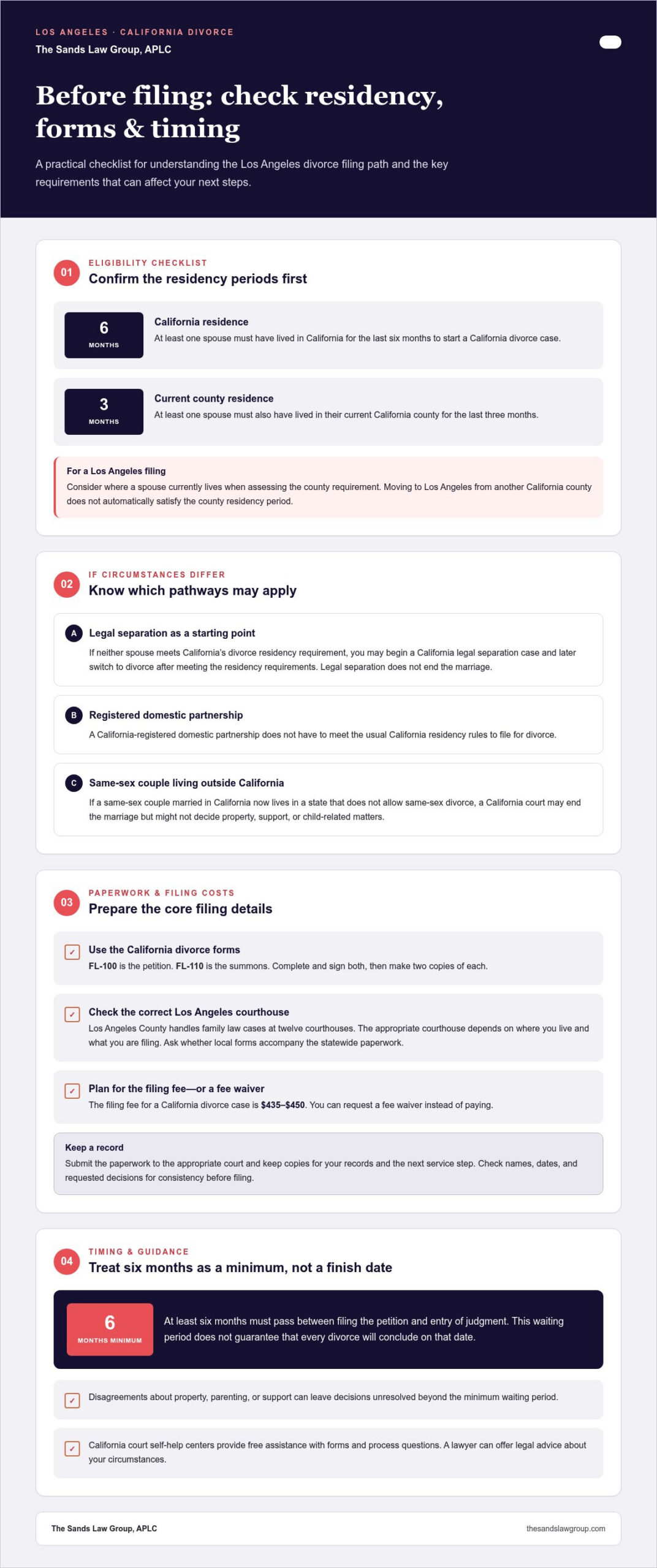
To understand how to file for divorce in Los Angeles, first confirm that at least one spouse has lived in California for the last 6 months and in their current county for the last 3 months; California Courts states the county residency requirement. The petition uses form FL-100, and the summons uses form FL-110, according to California Courts. The filing fee for a California divorce case is $435-$450, and you can request a fee waiver instead of paying.
It’s understandable to want a clear view of the requirements and costs before taking a step that affects your family, finances, and future. The process has specific forms and deadlines, but breaking it into stages can make the next decision easier to manage.
This guide explains how to check eligibility, file the required forms, arrange service, and complete financial disclosures. It also covers fee waivers, extra forms for parents, and where to find help with filing in Los Angeles, so you can approach the process with greater clarity.
Key Takeaways
- Confirm California residency eligibility first: California Courts says at least one spouse must have lived in the current county for the last 3 months.
- Plan for the court filing fee of $435-$450, or learn how to request a fee waiver if you qualify.
- Prepare the required financial disclosures carefully, since complete and accurate information helps move property and support issues forward.
- If you have children under 18, include form FL-105 with the additional paperwork required for your case.
- Consider legal or court self-help assistance to understand the filing process, service requirements, and the six-month minimum before a divorce judgment can be entered, according to California Courts.
Help from a lawyer or court self-help center
Choose between self-help information, legal representation, or both based on the decisions your divorce involves. In Los Angeles, the courthouse and practical filing steps depend on where you live and the issues in your case.
-
Request Temporary Court Orders
Identify any immediate concerns, such as a parenting schedule or household bills, and gather documents that relate to them. California court self-help centers provide free assistance with forms and process questions, while a lawyer can offer legal advice about your circumstances. Clarify which requests and supporting information apply before filing, and keep copies of everything you submit.
Use an agreement where you and your spouse can resolve an issue, but don’t treat an informal discussion as a court order. California Courts states that at least six months must pass between filing the petition and entry of judgment. That waiting period does not answer immediate concerns, so address urgent issues separately through the appropriate court process.
-
Find Local Court Forms
Confirm the correct Los Angeles courthouse and forms before submitting paperwork. Los Angeles County handles family law cases at twelve courthouses; the appropriate courthouse depends on where you live and what you’re filing. A self-help center may be able to offer guidance on forms and the filing process.
For a California divorce, the petition is form FL-100 and the summons is form FL-110, according to California Courts. Complete and sign the forms, then make two copies of both. Submit the paperwork to the appropriate court and keep copies for your records and the next service step. Check names, dates, and requested decisions for consistency before filing.
Ask whether local forms accompany the statewide paperwork. Forms used in another county or for a different filing issue may not fit your Los Angeles case. If you’re unsure how a question relates to requests about property or parenting, get guidance before signing.
-
Prepare for an Uncontested Divorce or Summary Dissolution
For an uncontested divorce, consider whether you and your spouse agree on ending the marriage and the decisions your filings must address. California divorce forms ask whether you want a divorce or legal separation and whether you seek decisions about child custody, support, or property. If an issue remains disputed, the court may need to decide it; don’t assume the case is uncontested.
To file for an uncontested divorce or summary dissolution in California, complete the applicable paperwork and submit it to the court; a summary dissolution is an option only for spouses who meet its requirements. California Courts says spouses married for less than five years may meet one listed condition, so review the full criteria with court self-help staff before choosing this route.
Divorce paperwork addresses property, debts, child custody, and support through the decisions requested. Agreement can resolve those issues, while unresolved disputes may require court decisions. Bring a clear list of assets, debts, parenting concerns, and support questions to a lawyer or self-help center so the guidance speaks to your situation.
Am I Eligible to File for Divorce in Los Angeles?
Check California residency first, then confirm whether Los Angeles County is the right place to file. If you don’t meet the residency requirements for divorce, legal separation may offer another starting point.
-
Check California and Los Angeles County Residency
Confirm how long at least one spouse has lived in California and in the current county. To start a California divorce case, at least one spouse must have lived in California for the last six months. California Courts says at least one spouse must also have lived in their current California county for the last 3 months.
For a Los Angeles filing, consider the county where a spouse currently lives when assessing the county requirement. Moving to Los Angeles from another California county, for example, doesn’t automatically satisfy the county residency period. Note where each spouse lives and when any move occurred before choosing a filing location.
If neither spouse meets California’s residency requirement for divorce, legal separation can be a first step. You may begin a California legal separation case and later switch to divorce after meeting the residency requirements. Legal separation does not end the marriage, so consider whether that distinction fits your immediate needs.
A California-registered domestic partnership doesn’t have to meet the usual California residency rules to file for divorce. A separate situation may apply when a same-sex couple married in California now lives in a state that doesn’t allow same-sex divorce. A California court may end the marriage, but might not decide property, support, or child-related matters.
-
Account for the Divorce Waiting Period
Account for the required waiting period when planning your next steps. California Courts states that at least six months must pass between filing the petition and entry of judgment. This is a minimum, not a guarantee that every divorce will conclude on that date.
How long does a divorce take in Los Angeles, including California’s six-month waiting period? According to California Courts, a judgment cannot be entered until at least six months after the petition is filed. Disagreements about property, parenting, or support can leave decisions unresolved beyond that minimum.
Use the waiting period to organize information, discuss possible agreements, and identify disputed issues. If you and your spouse agree on some matters, note what remains unresolved before deciding whether to seek legal guidance. The court still needs to address outstanding issues before the case can conclude.
Review your residency timeline and case circumstances with a divorce lawyer about California eligibility if the correct filing path remains unclear. A focused discussion can help you understand how residency, legal separation, and unresolved issues affect your next step.
Divorce filing fees and fee waivers
Prepare the filing payment or fee waiver request along with your completed divorce papers. Filing, service, and your spouse’s response are separate steps, so keep track of each one.
If your spouse does not respond, the divorce is not automatically finalized. California Courts says the respondent should file a response within thirty (30) days after being served; follow the court’s next procedural steps if that deadline passes without a response.
- Plan for the court filing fee. The filing fee for a California divorce case is $435-$450. Include this expense in your filing plan, but don’t confuse the court fee with attorney fees or other case expenses. If you can’t afford the filing fee, you can request a fee waiver instead of paying. Consider the fee and waiver option before submitting paperwork, so payment does not become an avoidable obstacle.
A divorce filing may also apply to a registered domestic partnership. Organize the relevant paperwork and payment or waiver request together, and check that names and case details match across the forms.
- Choose an available filing method. California divorce forms can be filed in person or by mail, and online filing may also be available. If you need urgent delivery of time-sensitive documents or case paperwork across the region, a dedicated same-day courier like Ways Messenger can ensure materials arrive quickly and securely. Choose a method that lets you submit the completed paperwork to the court and keep copies. Before mailing forms, review each page and retain a complete copy for your records.
After completing the forms, submit them to the court, pay the filing fee or request a fee waiver, and obtain copies for service. Keep the paperwork you submitted with any court-stamped copies or filing confirmation you receive. These records help you track completed filing steps and outstanding tasks.
- Arrange service after filing. The other spouse or partner must be served after the divorce forms are filed. Someone other than the spouse who filed must deliver the papers. Don’t serve the papers yourself. Arrange for another person to complete service and keep a record of when and how it occurred.
Proper service matters because a California divorce case cannot move forward until service is completed correctly. Filing alone does not complete this step if the other person has not received the papers. Keep service records with your court copies and address any delivery problem before assuming the case can proceed.
- Track the response deadline. Once served, the respondent should file a response within thirty (30) days, according to California Courts. Note the service date and use it to track this deadline. A response can identify which requests the other spouse disputes, so keep incoming court papers organized and read them promptly.
If no response arrives by the deadline, don’t assume the case has ended or that every requested decision has been approved. The filing spouse must still follow the court’s required process. Keep proof of filing and service available when seeking guidance about what comes next.
Additional forms for parents with children
If you and your spouse have children under 18, include the additional child-related paperwork in your California divorce preparation. Organize the form alongside your petition, and review the information carefully before filing.
- Complete form FL-105. Spouses with children under 18 must also fill out the Declaration under Uniform Child Custody Jurisdiction and Enforcement Act, form FL-105. Set this form aside with your divorce paperwork so it is not overlooked while you complete the petition and summons. Read each question carefully, answer consistently, and review the completed declaration before signing. If a question is unclear, seek help from a California court self-help center or a lawyer rather than guessing.
- Gather information before filling out the declaration. Set aside records and notes that help you answer the form accurately. For example, organize your children’s names and relevant family information before you begin. Compare your answers with the other divorce forms, especially names and dates, and correct inconsistencies before submitting. Careful preparation can help you spot missing details and avoid rushed or incomplete answers.
- Separate child-related decisions from other divorce requests. California divorce forms ask whether you want court decisions about child custody or support, as well as property. Make a clear list of parenting questions that need resolution, such as where the children will stay and how parenting time should be arranged. Use the list to prepare, not as a substitute for completing the court’s forms. Distinguish agreed points from unresolved concerns so you can describe your requests clearly.
- Review the complete filing packet. Place FL-105 with the other completed divorce paperwork and check that every form refers to the same spouses and children. Confirm that you have answered each applicable question and signed where required by the form. Keep a copy of the completed declaration with your records, then submit it as part of the paperwork for your case. If custody or support issues are difficult to resolve, legal guidance can help you prepare focused requests concerning the children.
Financial disclosures and discovery
Build a clear financial picture before discussing property, debts, or support. Organized records help you identify what you know, what remains unclear, and which questions may need answers during your divorce.
- Gather records for income and expenses. Collect documents showing money coming into and leaving your household, such as pay statements, tax returns, bank statements, and bills for recurring expenses. Keep records from different accounts separate and note what each document covers. If income varies, such as with seasonal work or commissions, gather examples that show the changes rather than relying on one unusually high or low month.
Use a simple list to connect each record with a question. A bank statement may help explain deposits, while a household bill may clarify recurring costs. When a document can provide a clearer account, don’t rely on memory alone.
- List property and debts. Create separate inventories of assets and amounts owed. Include items such as a home, vehicle, savings account, credit card balance, or personal loan. For each, record whose name appears on the account or document and where you found the information. Keep estimates separate from documented balances so a preliminary list doesn’t appear more certain than the records support.
Note questions beside entries that need clarification. For example, flag a loan connected to a vehicle or a deposit that doesn’t match the income records. This helps you and your legal representative focus on specific gaps rather than sorting through papers without a plan.
- Organize financial questions for discovery. Discovery is a way to seek information relevant to unresolved issues in a case. Write down what you need to understand, such as an unexplained account, a disputed debt, or income that differs from the records available to you. Pair each question with the document or explanation that could help answer it.
Keep questions direct and factual. Rather than assume what a transaction means, identify the date or account entry and ask what it represents. Keep copies of the records you review and add new information to the same organized file.
- Compare information before negotiating. Review both sides of the financial picture before discussing property division or support. A list of assets without related debts may be incomplete, just as income records alone may not explain regular household expenses. Mark what matches, what conflicts, and what information is still needed.
For focused guidance on financial records and questions in your divorce, schedule a discussion about your case. Bring your organized lists and the specific issues you want to address.
The Sands Law Group, APLC: Divorce Legal Representation
The Sands Law Group, APLC provides Divorce Legal Representation in contested and uncontested proceedings. When questions about financial disclosures, property division, or support make the next step difficult to assess, the firm can represent you through the divorce process.
When parenting arrangements are part of the case, The Sands Law Group also provides Child Custody and Visitation Representation. Spousal Support Representation and Property Division Representation address other important decisions that may affect your future. Consider legal representation when you need help addressing disputed issues, preparing your position, or moving from paperwork toward resolution.
To discuss your divorce and possible next steps, contact The Sands Law Group, APLC or visit thesandslawgroup.com.
Take the Next Step Toward a Clearer Path
Deciding how to file for divorce in Los Angeles is one part of preparing for what comes next. Consider how you want to approach unresolved family decisions, including parenting arrangements, financial support, and the transition to separate households. A thoughtful plan can help keep your priorities in view through difficult conversations and legal decisions.
The Sands Law Group, APLC provides Divorce Legal Representation, Child Custody and Visitation Representation, and Spousal Support Representation. If you need representation for a divorce or related family-law issues, a conversation can help you explain your concerns and discuss possible next steps. Share the matters you want addressed, such as parenting schedules or support questions, so the discussion can focus on your circumstances.
Contact The Sands Law Group, APLC to discuss your situation. Taking one considered step can help you move forward with greater clarity and confidence.
Frequently Asked Questions
What are the residency requirements to file for divorce in Los Angeles County, California?
At least one spouse must meet California’s state and county residency requirements to start a divorce case. That spouse must have lived in California for the last 6 months and in their current California county for the last 3 months; California Courts identifies the county requirement. If you recently moved to Los Angeles County, note your move date and prior county of residence. People who don’t meet the divorce residency requirements may begin with legal separation.
Where do I file divorce papers in Los Angeles County, and can I file online?
File with the Los Angeles County family law courthouse that handles your location and filing issue. The county has twelve courthouses for family law cases, and the appropriate courthouse depends on where you live and what you’re filing. California divorce forms may be filed in person or by mail, and online filing may also be available. Confirm the correct courthouse and filing method before submitting your paperwork.
What forms are required to start a divorce in California?
Start with form FL-100, the Petition, and form FL-110, the Summons, according to California Courts. The forms request information such as spouses’ names, marriage or domestic partnership date, and the decisions sought. If you and your spouse have children under 18, include form FL-105, the Declaration under Uniform Child Custody Jurisdiction and Enforcement Act. Review the completed forms together so names and other details match across the paperwork.
What is the Los Angeles County divorce filing fee, and how can I request a fee waiver?
The filing fee for a California divorce case is $435-$450. If paying the fee presents a financial barrier, request a fee waiver from the court rather than submitting payment. Include the waiver request with your filing paperwork and follow the court’s instructions for submitting it. Keep copies of the forms and any court response. A waiver concerns the court filing fee, not the cost of legal representation.
What are the steps and deadlines for serving divorce papers in California?
After filing, arrange for someone other than the spouse who filed to serve the other spouse or partner. Keep a record of completed service, because the case cannot move forward until service is completed correctly. The respondent should file a response within thirty (30) days after being served, according to California Courts. Record the service date and organize any response papers with your filed copies.
Can I file for divorce in Los Angeles without a lawyer, and where can I get legal help?
California court self-help centers offer free assistance with forms and process questions. If you’re learning how to file for divorce in Los Angeles without a lawyer, these centers can help you understand paperwork and procedural steps. The Sands Law Group, APLC provides Divorce Legal Representation, Child Custody and Visitation Representation, and Spousal Support Representation. This information is for general informational purposes only and does not constitute legal advice. Contacting The Sands Law Group does not create an attorney-client relationship until a formal agreement is signed.

Article by
Thomas D. Sands, Esq.
Thomas D. Sands is the founder and CEO of The Sands Law Group, APLC. A California attorney with more than two decades of experience, he represents clients in divorce and family law matters as well as civil litigation and real property disputes. His approach emphasizes attentive, practical, and cost-conscious representation.
Sands is a 2023 Litigator of the Year honoree of the American Institute of Trial Lawyers and a 2023 Lawyer of the Year honoree of the American Institute of Legal Professionals. His firm has also received recognition among the 2025 Best Law Firms in America, a 2026 Benchmark Best of award, and a 2026 Law Firm of the Year honor.









Leave A Comment