

How to survive a divorce financially starts with knowing what you own, what you owe, and what you may need to live on after separation. Gather bank and retirement account statements, debt records, and tax returns for the prior three years, then build a realistic budget based on expected income and expenses. A clear financial picture can help you weigh decisions about support, property, and future costs.
It’s understandable to feel unsettled when shared household finances are about to change. Organizing documents and making a plan cannot remove every uncertainty, but it can help you approach decisions with greater clarity and protect your ability to meet everyday needs.
This guide covers the financial and legal records to organize, how to plan a post-divorce budget, and when professional financial help may be useful. It also explains how to weigh assets by accessibility and future costs, so you can consider a proposed division alongside the resources you’ll need now.
Key Takeaways
- Organize financial records early so you can make decisions from a clear picture of income, assets, and obligations.
- Build a post-divorce budget around expected take-home income and essential expenses, then identify where adjustments may be needed.
- Compare assets by access, timing, and potential tax impact, not just by their stated value.
- Use financial professionals to clarify complex questions about cash flow, retirement accounts, and future planning.
- Consider legal representation when decisions about support, property division, or parenting arrangements affect your financial stability.
1. How Will I Survive Financially After Divorce?
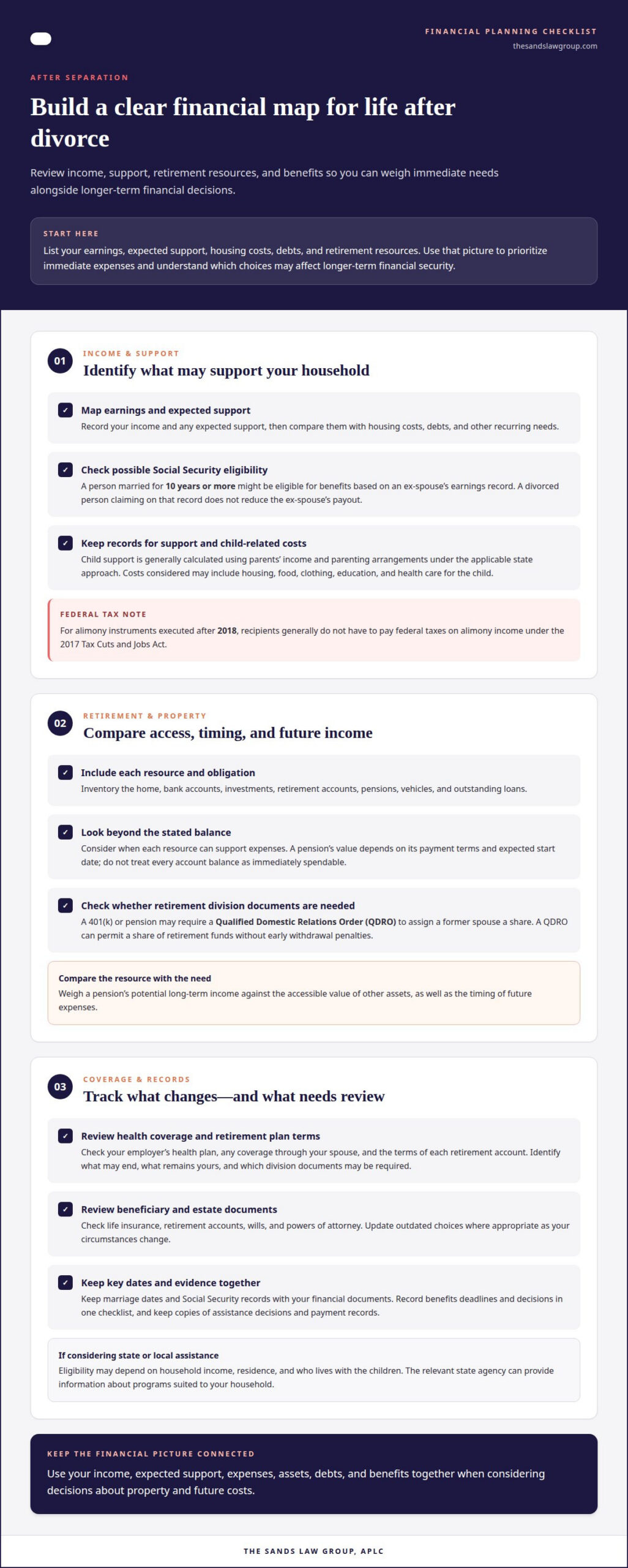
Start by mapping the income, benefits, and assets that may support you after separation. List your earnings, expected support, housing costs, debts, and retirement resources. This gives you a practical starting point for prioritizing immediate expenses and understanding which choices may affect your longer-term financial security.
Social Security may be part of that picture. According to the Social Security Administration, a person married for 10 years or more might be eligible for benefits based on an ex-spouse’s earnings record. A divorced person claiming on that record does not reduce the ex-spouse’s payout. Keep marriage dates and Social Security records with your financial documents so you can assess eligibility accurately.
Support also affects your available income. For alimony instruments executed after 2018, recipients generally do not have to pay federal taxes on alimony income under the 2017 Tax Cuts and Jobs Act, according to the Internal Revenue Service. Child support is generally calculated using parents’ income and parenting arrangements under the applicable state approach; expenses considered may include housing, food, clothing, education, and health care for the child. Keep records of recurring child-related costs to understand how the household budget is affected.
Retirement benefits require careful attention before property terms are finalized. A pension’s value depends on its payment terms and expected start date, while a 401(k) or pension may require a Qualified Domestic Relations Order (QDRO) to assign a former spouse a share. A QDRO can permit a share of retirement funds without early withdrawal penalties. Compare the long-term income from a pension with the accessible value of other assets, rather than treating every account balance as immediately spendable.
Health coverage and retirement benefits depend on the plan and divorce arrangements. Review your employer’s health plan, any coverage through your spouse, and the terms of each retirement account. Identify what may end, what remains yours, and which division documents may be required. Record deadlines and decisions in one benefits checklist.
Review beneficiary designations and estate documents as your circumstances change. Check life insurance, retirement accounts, wills, and powers of attorney, and update outdated choices where appropriate. State or local assistance may depend on household income, residence, and who lives with the children. Contact the relevant state agency for information about applying for programs suited to your household, and keep copies of decisions and payment records.
2. Getting help from financial professionals
Choose professional help based on the decision at hand. A divorce attorney can explain legal issues involving property, support, and settlement terms. A financial professional can model post-divorce cash flow, savings, and retirement needs. A tax professional can identify questions related to asset transfers or support. Write down your priorities before scheduling conversations.
Build a coordinated team instead of asking one professional to answer every question. Your attorney can clarify proposed settlement language, while a financial planner compares its possible long-term effect on monthly income. A certified public accountant can review tax records, and a mortgage professional can explain how income and debt affect a home loan application.
Prepare a short agenda for each meeting. Bring relevant account statements, pay records, debt details, and proposed settlement terms. Ask a financial planner to compare scenarios, such as keeping or selling the home. Ask an accountant which tax questions need answers before you accept an asset or support arrangement.
Make sure each professional works from consistent information. Use one updated spreadsheet for income, expenses, savings, credit balances, and property values. Record the source and date of each estimate. If your attorney reviews a proposed agreement, share the same budget assumptions used in financial planning so the legal and practical effects can be considered together.
Lawyer and mediation costs depend on the case and are provided after a quote request; factors include the work involved, case complexity, and how many issues remain disputed. To manage legal expenses, organize records, send focused questions, and use meetings to resolve specific decisions. Clear communication helps keep time directed toward necessary work.
A mediator can help spouses discuss unresolved terms, while each person may seek legal advice about their own position. Mediation does not replace understanding an agreement’s financial consequences. For example, compare proposed monthly support with expected housing costs, insurance, and debt payments to assess how the terms fit your budget.
Professional guidance can be especially useful when one decision affects several areas. Refinancing a mortgage may affect monthly cash flow, credit, and home equity. Dividing retirement assets can raise questions about timing and taxes. Discuss linked concerns with the relevant professionals, and ask them to explain their assumptions in plain language.
Before each meeting, identify the decision, documents, and questions that matter most. Afterward, write down the advice, unresolved points, and next steps. If you need help understanding legal options or settlement terms, schedule a conversation about your divorce to discuss the issues affecting your financial plan.
3. Matching asset liquidity to future financial needs
Start with a complete inventory of assets and debts, then consider when each resource can support your expenses. Include the home, bank accounts, investments, retirement accounts, pensions, vehicles, and outstanding loans. For each item, record its owner, balance or estimated value, related debt, and access restrictions. This makes it easier to compare a proposed division with your immediate cash needs and longer-term plans.
State law shapes how marital property and debts are divided. Equitable distribution applies in more than 40 U.S. states. Arizona, California, Idaho, Louisiana, Nevada, New Mexico, Texas, Washington, and Wisconsin divide property 50/50 between spouses, regardless of its origin or either spouse’s projected financial needs. Identify your state’s approach before evaluating settlement proposals; property classification and the treatment of debts affect the practical result.
A matching split by stated value may not provide matching financial security. Consider a $300,000 marital home representing 50% of the marital estate: keeping it also means planning for ongoing housing costs. A $100,000 IRA is not equivalent to $100,000 in a checking account because tax liability can affect what you receive. Compare each asset’s likely usable value, access terms, and expenses before treating balances as interchangeable.
Timing matters, too. A pension may not begin paying benefits for 15 years, while rent, utilities, and food require current income. If one spouse receives a delayed retirement benefit and the other needs liquid funds, equal face values may leave one household short. Consider how each asset supports the next stage of your career, housing, and retirement plans.
To protect your credit and organize joint bank accounts or credit cards, list every account, card, balance, and authorized user. Review your credit report, note joint obligations, and keep payment records. Plan account changes around bill payments and access, then document agreements about shared balances. Closing an account does not necessarily erase a joint debt, so track who is responsible and whether payments continue.
Preserve asset value while decisions are pending. Keep mortgage, insurance, tax, and maintenance payments current where possible, and save receipts for property expenses. Before selling investments or withdrawing retirement funds, understand the potential tax consequences and penalties. For a home, obtain a current valuation and account for its mortgage balance and expected upkeep. A documented valuation and debt list can show the difference between an asset’s apparent value and what it may contribute to future needs.
4. Planning a post-divorce budget
Turn the settlement into a working budget by listing income and expenses separately. Record take-home pay, support payments, housing, utilities, food, transportation, insurance, and debt obligations. Use account records to estimate recurring costs, then note annual expenses such as vehicle registration or school costs. A realistic budget shows what remains after essentials, not just the income and assets available on paper. For many readers, this is a practical first step in understanding how to survive a divorce financially.
Build your budget around your current household, rather than copying spending from the former shared household. Separate needs from adjustable expenses, then compare each category with expected income. Include costs that may change after a move, such as commuting, childcare, or maintaining a home alone. If support or employment income changes, revise the totals and identify which discretionary expenses could be reduced first.
Make retirement readiness part of the plan, even when immediate bills feel more urgent. Estimate contributions, employer benefits, and expected retirement income using the statements and plan details available to you. Professional retirement and insurance specialists, such as Safe Harbor Financial Resources, can help evaluate your long-term income options and protect your assets. Women ages 55 to 64 have, on average, 30% less saved for retirement than men. That comparison reinforces the value of reviewing your own savings, rather than assuming a settlement alone will meet future needs.
Give future expenses a place in the budget before they arrive. List near-term goals with a 3-5 year horizon, such as replacing a vehicle, moving, or paying for career training. Estimate when each cost is likely to arise, then set a savings target that fits available income. If you’re planning how to survive a divorce financially, keep these goals distinct from regular bills so a planned expense doesn’t unexpectedly consume money reserved for essentials.
Inventory every debt and liability, including credit cards, personal loans, and home-related borrowing. Note balances, interest terms, minimum payments, and who is responsible under the settlement. For individuals managing immediate transition costs or looking into financing options, resources like ILoveYourLoans provide access to personal and installment loans. Prioritize high-interest credit-card debt before home-loan debt, while continuing required payments on each obligation. This approach can reduce the amount lost to costly interest and clarify how much monthly income remains for savings.
Make emergency savings part of your financial plan. Decide which unexpected costs the reserve should cover, such as an urgent repair or temporary income disruption. Review the budget regularly and compare planned spending with actual statements. If expenses exceed income, adjust flexible categories and revisit major commitments, such as housing or transportation, before relying on retirement funds.
5. Gathering financial and legal documents before divorce
Organize a private financial file before discussions begin. Gather tax returns for the prior three years, recent pay records, bank and investment statements, and current loan or credit-card balances. Include account numbers, ownership details, and statement dates. These records can establish income, assets, and liabilities across the marriage more reliably than memory or incomplete estimates.
Check account access as carefully as balances. Confirm whether you’re a signatory on each bank account and whether you can access the relevant financial logins. List accounts, institutions, usernames, and recurring payments. Store copies securely somewhere you can access independently. If a statement is missing, record the account and period needed so you can track the gap.
Gather records showing how assets and debts arose. Examples include home purchase and mortgage documents, vehicle titles, retirement statements, business records, loan agreements, and proof of major payments. Keep records of separate or inherited property with the related account history. A clear paper trail can help identify ownership claims and obligations before a division is agreed.
Legal and household records matter, too. Collect your marriage certificate, any existing marital agreement, insurance policies, estate documents, and prior court orders. If you have children, organize records of childcare, education, medical expenses, and current parenting arrangements. These materials can clarify recurring household costs and the terms that may need attention during negotiations.
Create a simple index listing each document’s name, date, account or property, and storage location. Save digital copies in a secure folder, and keep original documents together. Preserve complete records without editing statements or removing pages, so dates and transactions remain clear. If you share a document with a professional, note what you sent and when. This system makes it easier to compare financial information and spot missing periods.
Use the file to prepare focused questions before discussing settlement terms. For example, match a mortgage statement to the home’s title and payment history, or compare retirement statements across years. Keep a record of what both spouses agree is accurate and what remains disputed. If missing records or conflicting ownership claims complicate your next steps, schedule a conversation about your divorce documents and the decisions they inform.
The Sands Law Group, APLC: Divorce Legal Representation
The Sands Law Group, APLC provides divorce legal representation for people facing decisions about separation, finances, and family arrangements. Legal counsel can help you understand issues involving property division, spousal support, or parenting terms before you agree to a settlement. The firm also represents clients in child custody and visitation matters, where parenting arrangements can shape household schedules and expenses.
Bring your organized financial records and specific questions about proposed terms. Legal representation can help you understand how divorce decisions relate to property, support, custody, and visitation, so you can assess their effects before moving forward. If these issues are affecting your financial plans, contact The Sands Law Group, APLC or visit thesandslawgroup.com.
Make Your Next Financial Decision With Clarity
A financial plan should be something you can revisit as circumstances change, not a fixed document that adds pressure during an already difficult transition. Choose an upcoming decision, identify the information it depends on, and write down a practical next step. This can turn the question of how to survive a divorce financially into a manageable process, rather than a problem you must solve all at once.
Before agreeing to important terms, consider how they fit your day-to-day needs and long-range priorities. If questions about your divorce, support, property, or parenting arrangements remain unresolved, speaking with counsel can help you understand the choices ahead and prepare for your next decision.
Arrange a conversation about your divorce-related legal questions and take the next step at a pace that feels considered. With a clearer view of the decision ahead, you can keep moving toward greater financial stability.
Frequently Asked Questions
How Will I Survive Financially After Divorce?
Separate immediate cash needs from decisions that affect your longer-term financial position. List reliable income, essential bills, and changing payments, then note the next due date for each obligation. For example, if a move changes your commute, include transportation costs in your monthly plan. A clear order of priorities can make it easier to decide what needs attention first.
What should I do financially first when preparing for divorce?
Start by establishing a reliable picture of your personal cash flow and account access. Note which bills are paid automatically, where your pay is deposited, and which accounts or cards are shared. Keep a dated record of recurring payments and balances so you can compare later changes with a clear starting point. Avoid major financial commitments until you understand how they fit your expected post-separation income.
How do I create a post-divorce budget and estimate living expenses?
Use take-home income and actual spending records, then separate fixed costs from flexible expenses. Account for less frequent costs by setting aside part of each expense during the months before it is due. For example, spread an annual insurance premium across the months in your budget rather than treating it as a surprise. Compare planned expenses with available income and adjust discretionary categories first.
How is spousal support calculated, and how long does it last?
Courts may award alimony to help a person maintain a reasonable standard of living and rebuild financial independence. The amount and duration depend on the support terms and the financial circumstances considered in the case. Review proposed payments alongside each person’s income, essential expenses, and future needs. A written order or agreement should clearly explain the payment amount, schedule, and conditions that affect its duration.
What are the tax consequences of divorce, including filing status and splitting assets?
Divorce can affect filing status, the tax treatment of support, and the value of transferred assets. The Internal Revenue Service states that different federal tax rules apply to alimony instruments executed after 2018 and instruments executed before 2019. For filing and asset division, organize the agreement, account records, and tax documents together. This helps a tax professional distinguish the consequences of each term instead of treating the settlement as one transaction.
How do I handle the marital home, mortgage, and refinancing after divorce?
Compare the home’s ongoing costs with the income available to the person who plans to keep it. Include mortgage payments, insurance, property taxes, utilities, and maintenance in the same monthly estimate. Refinancing also involves income, debts, and loan terms. A home that appears affordable based on its current payment may strain a budget once repairs and other household costs are included.
What financial documents should I gather before filing for divorce?
Gather records showing balances, ownership, and transaction history, including statements for bank accounts, investments, loans, and retirement plans. Keep copies of property titles, mortgage records, insurance policies, and tax returns. Note the statement period and account owner for each file. If two records show different balances, preserve both and note their dates to help explain timing differences during financial review.
What financial mistakes should I avoid during divorce proceedings?
Avoid relying on verbal estimates, overlooking taxes or ongoing costs, or agreeing to terms without understanding their effect on your monthly cash flow. Don’t hide assets or alter financial records; preserve accurate documents and communicate clearly. The Sands Law Group, APLC serves people dealing with divorce matters in Los Angeles, Riverside, San Bernardino, and Kern. Its website information is general only, not legal advice, and contact does not create an attorney-client relationship until a formal agreement is signed.

Article by
Thomas D. Sands, Esq.
Thomas D. Sands is the founder and CEO of The Sands Law Group, APLC. A California attorney with more than two decades of experience, he represents clients in divorce and family law matters as well as civil litigation and real property disputes. His approach emphasizes attentive, practical, and cost-conscious representation.
Sands is a 2023 Litigator of the Year honoree of the American Institute of Trial Lawyers and a 2023 Lawyer of the Year honoree of the American Institute of Legal Professionals. His firm has also received recognition among the 2025 Best Law Firms in America, a 2026 Benchmark Best of award, and a 2026 Law Firm of the Year honor.









Leave A Comment