

In San Bernardino, California courts generally decide child custody based on the child’s best interests, prioritizing safety, health, and welfare while considering whether ongoing contact with both parents benefits the child. A San Bernardino child custody lawyer can explain the difference between legal custody, physical custody, and visitation, which sets parenting time and schedules.
It’s understandable to worry that divorce or support disputes could disrupt your child’s routine. This article explains the factors courts consider, how custody and child support relate, and what legal representation may involve. It also covers how mediation and court proceedings can shape decisions, helping you consider next steps with your child’s needs in mind.
Key Takeaways
- Understand how custody and visitation orders set parenting responsibilities and time-sharing, and what conduct may violate an order.
- See how child support is calculated and how changes in a parent’s circumstances may support a request to modify payments.
- Learn how divorce, legal separation, and a child’s residence can affect the custody process and where a case is handled.
- Recognize the factors courts weigh when assessing a child’s best interests, including safety, family relationships, and parents’ ability to cooperate.
- Explore how legal representation can help address custody and visitation alongside related divorce and support issues.
Child Support and Custody: Is There a Happy Medium?
In California, custody orders address legal and physical custody, while visitation sets parenting time and schedules. Child support is a separate financial obligation, but both arrangements can affect a child’s day-to-day stability.
Custody and Visitation Orders
A California order can assign legal custody, physical custody, or both, and set when each parent spends time with the child. Review its terms for decision-making responsibilities, exchanges, communication, and any visitation limits.
For example, an order may specify pickup locations and who makes decisions about schooling. Violations can include denying scheduled visitation, withholding a child without a valid reason or court approval, or ignoring transportation and communication arrangements.
Filing for Custody in San Bernardino County
To request custody or visitation orders, you must have an active legal case. Married parents can seek orders through a divorce, legal separation, annulment, or a case for custody and support of minor children.
Unmarried parents must file to establish paternity or seek custody and support orders for minor children. In a paternity case, parents can ask the court to determine legal parentage and issue custody, visitation, and child support orders.
In San Bernardino County, the courthouse for a custody matter depends on where the child lives. California courts may lack authority to decide custody or visitation if the child has not lived in California for at least six months.
Custody Case Timelines
There is no single timeline for every San Bernardino County custody case. The process depends on whether parents agree, which orders they request, and whether the court must resolve disputed issues.
Court-assigned mediation is typically the first phase in California custody cases. It aims to help parents reach an agreement or produce a recommendation about custody and visitation. Unresolved issues may require further court proceedings.
Prepare by identifying which decisions need an order, such as parenting time or exchanges. Specific proposals that account for your child’s routine can help focus mediation and any later court discussion.
Visitation Rights
Visitation describes the time a child spends with a parent under the schedule in an order. Both parents should follow its terms, including exchange arrangements and communication protocols, rather than making unilateral changes.
Safety concerns can affect custody and visitation. A California family court may restrict either when a parent has engaged in partner or child abuse, even if the abuse did not result in a conviction. Address violence through the legal process rather than ignoring an existing order.
Changes in a child’s needs may support a request to modify custody terms. Child support remains connected to the family’s circumstances: the San Bernardino County Superior Court uses the California Guideline Child Support Calculator to determine amounts, and payments usually continue until age 18. They may continue until age 19 if the child remains in high school, lives at home, and cannot support themselves.
Are you searching for a top family law lawyer in San Bernardino, California?
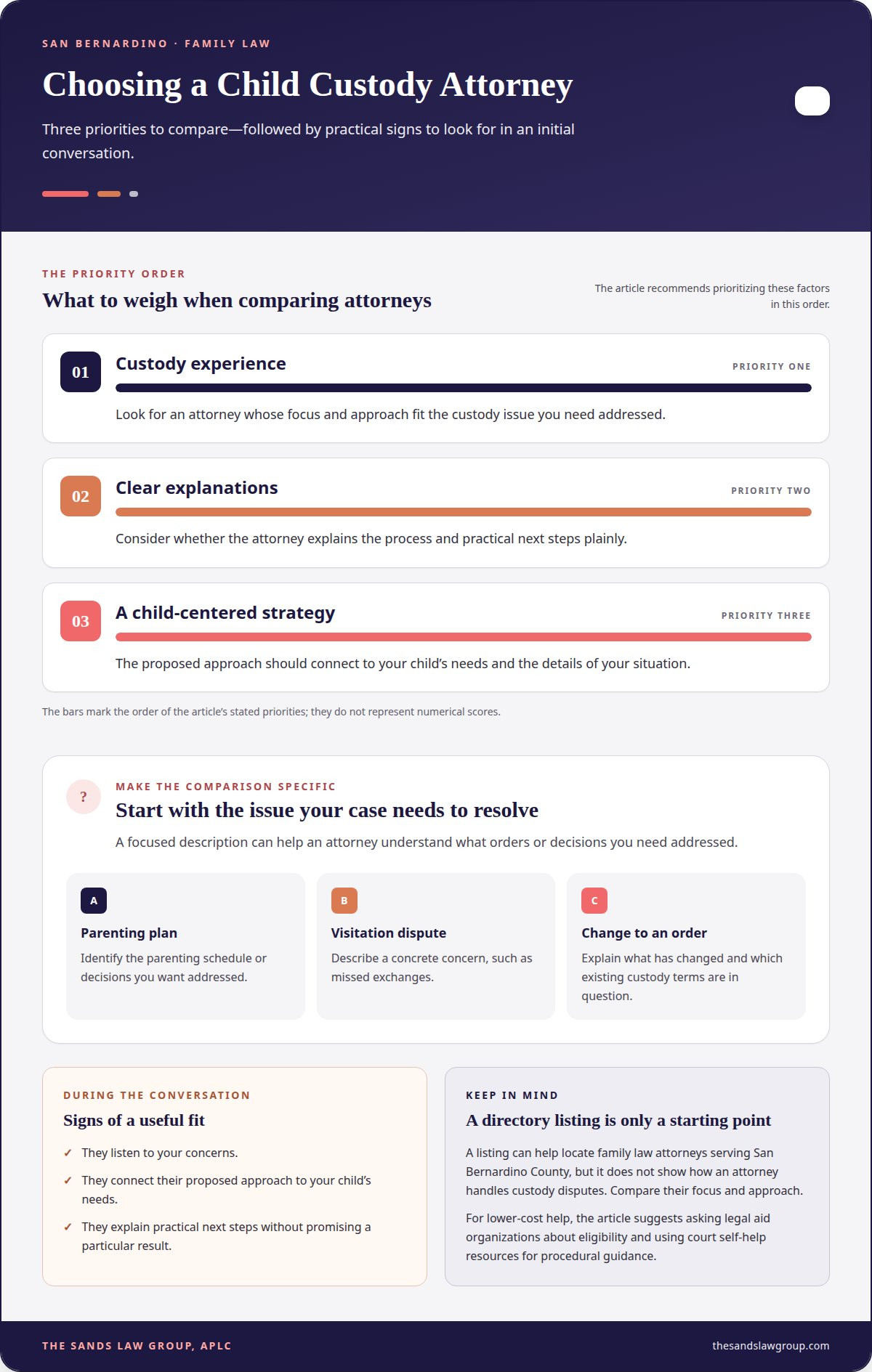
When comparing San Bernardino child custody attorneys, prioritize custody experience, clear explanations, and a strategy grounded in your child’s needs. To find a lawyer, use a family law attorney directory to identify attorneys serving San Bernardino County, then compare their focus and approach; for lower-cost help, ask legal aid organizations about eligibility and use court self-help resources for procedural guidance.
Comparing Child Custody Attorneys
Start by identifying what your case requires: a parenting plan, a resolution to a visitation dispute, or changes to an existing order. Consider whether an attorney explains the process clearly, listens to your concerns, and connects the proposed approach to your child’s needs.
A directory can help you locate family law attorneys, but a listing alone doesn’t show how they handle custody disputes. During an initial conversation, describe a concrete concern, such as missed exchanges, and consider whether the attorney explains practical next steps without promising a particular result.
San Bernardino and Riverside County Family Law
San Bernardino and Riverside are separate counties, so identify which county is connected to your family law case before considering courthouse procedures. For a San Bernardino County custody matter, the correct courthouse depends on where the child lives. A Riverside County case may involve a different court location and process.
Family law cases can involve custody, visitation, divorce, and support questions together. Write down which orders or decisions you need addressed, such as a parenting schedule during divorce proceedings. A focused summary helps an attorney understand whether custody issues stand alone or relate to other family law concerns.
Mediation and appeals require different considerations. In California custody cases, court-assigned mediation typically comes first and aims to help parents reach an agreement or recommendation about custody and visitation. Prepare to explain your proposed schedule and the practical reasons for it, such as school routines or exchange arrangements.
An appeal is different from negotiating a parenting plan or seeking a change based on a child’s needs. If you’re concerned about a custody judgment, organize the relevant court papers and ask an attorney to assess whether appellate review fits your situation. Disagreeing with the outcome alone does not determine which legal steps may apply.
For lower-cost assistance, ask legal aid organizations about eligibility and use court self-help resources for procedural guidance. Mediation can support discussions between parents, but it is not the same as having an attorney represent your interests. A focused discussion can help clarify your custody questions; schedule a conversation about custody concerns.
Mediation can help parents address custody disputes and consider ways to preserve stability for their family. It gives parents an opportunity to make decisions themselves rather than leaving them to the court.
Custody in divorce and legal separation
Divorce and legal separation can both require parents to resolve custody, visitation, and financial questions. In San Bernardino County, a divorce filing requires one spouse to have lived in the county for at least 3 months and in California for at least 6 months, according to California Courts. The correct courthouse depends on where either spouse lives. These requirements make residence an important early consideration.
Custody decisions and property division address different parts of a family’s transition. A parenting proposal might cover school-week routines, holidays, and transportation, while a property proposal addresses how assets and debts should be divided. Keeping these issues distinct helps clarify what needs agreement and what remains disputed. Disagreement about a home, for example, does not establish the parenting schedule a child needs.
California divorce takes at least 6 months and 1 day after the other person is served or a Response is filed to finalize. That period is not an automatic finish line: the required process must be completed, and a judge must sign the final judgment. Parents should therefore distinguish the divorce timeline from the work of resolving custody and property issues. A pending judgment does not, by itself, explain the parenting arrangement.
Married parents may also file for legal separation when seeking custody or visitation orders. The filing route can affect which case includes parenting requests, so identify whether the matter involves divorce, legal separation, annulment, or custody and support. Then organize the questions that need decisions, such as weekday care, holiday schedules, and school-related choices.
Children’s views may be part of the custody picture, but California law sets no specific age at which a preference must be considered. A court may give more weight to the preference of a 16-year-old than a 6-year-old, while still weighing other custody factors. The child’s preference is not the only consideration. Parents can focus proposals on practical needs, such as consistent school transportation and sibling relationships.
When abuse is raised, the court may restrict a parent’s custody or visitation even if the abuse did not lead to a conviction. If you are concerned about violence, address it through the legal process rather than treating a divorce filing as a substitute for a safety-focused order. Clear records and specific requests help define the protection or parenting terms being sought.
A person filing for divorce in California may qualify for a fee waiver if they meet certain requirements. Parents considering this filing route can keep that possibility in mind as they organize custody requests.
Best interests of the child
California courts generally decide custody according to the child’s best interests, prioritizing safety, health, and welfare. They also favor frequent, ongoing contact with both parents when it benefits the child. In San Bernardino, the question is how a proposed arrangement meets this child’s needs, not which parent makes the stronger accusation.
Several parts of family life can inform that assessment. A child’s age, sibling relationships, cultural background, religious upbringing, and family traditions may matter. For example, a schedule that keeps siblings together and allows a child to maintain important traditions may support continuity. Each factor is considered in light of the child’s circumstances.
Safety concerns carry particular weight. A history of abuse or neglect, including violence between parents, is relevant to a custody decision. California courts may restrict custody or visitation when a parent has engaged in partner or child abuse, even without a criminal conviction. Specific information about the conduct helps the court understand the concern and its connection to parenting arrangements.
Parents’ ability to communicate and cooperate also matters. For a school decision requiring timely discussion, a workable plan should explain how each parent receives information and participates. If communication has been difficult, a proposal could set practical boundaries, such as using written messages for schedule changes. The aim is to show how the plan can support the child’s welfare.
Describe a child’s needs through daily examples, not broad claims about which parent is better. School attendance, medical appointments, sibling relationships, and familiar routines can explain why a schedule works. Connect each request to the child’s actual needs, such as preserving established activities or consistent care.
Substance-use concerns require careful presentation. In a California custody matter, a judge may require independent corroboration of illegal drug abuse, such as documentation from a rehabilitation facility. A general accusation may not establish what happened or how it affects the child. Relevant records and specific examples can clarify the concern without turning the dispute into unsupported character claims.
To prepare a child-focused proposal, organize the information around the child’s life:
- Describe school, care, and activity routines that the schedule should preserve.
- Identify sibling relationships, cultural practices, or religious traditions the plan should accommodate.
- Explain any safety concern with specific conduct and relevant supporting information.
- Show how parents can share decisions and communicate about the child’s needs.
This approach keeps the focus on the child’s interests and the practical effects of each proposed arrangement. A clear plan addresses safety, stability, and meaningful parental contact when that contact serves the child.
Child custody representation
For a San Bernardino custody case, prepare existing court orders, case filings, a parenting calendar, relevant messages, and records that explain your child’s routine. Organize each item by date and connect it to a specific issue, such as missed exchanges or a proposed school-week schedule.
Representation begins by clarifying what you need the court to decide. That may include legal decision-making, physical care, visitation terms, or changes to an existing order. A focused account separates facts from conflict: identify the current arrangement, the problem, and the practical order you’re requesting.
Create a timeline of important events as a preparation step. Include dates for changes in care, school or medical needs, parenting communications, and disputed exchanges. Keep each entry factual, and preserve original messages or records when available. An organized account helps your attorney assess and present your position.
Evidence should relate to the child’s needs and the requested arrangement. A school schedule, for example, may explain transportation demands, while a calendar can show how caregiving has been shared. Relevant written communications can clarify what parents discussed. Avoid sending a large, unsorted collection. A brief index with each document’s date and subject makes review more efficient.
Your attorney can help turn a parenting proposal into workable terms. Instead of asking for “more time,” specify the days, exchange points, holiday arrangements, and decision-making provisions you seek. Account for school attendance, activities, and travel between households. Clear terms reduce uncertainty about each parent’s responsibilities.
If mediation is part of the process, representation can help you prepare a concise proposal and identify unresolved issues. Parents, for example, may agree on weekday care but disagree about holiday exchanges. Separating agreed points from disputed ones keeps discussions focused and clarifies what still requires a court decision.
During court proceedings, counsel can organize filings, explain the issues, and present your position using relevant records and a child-focused plan. Share developments promptly, such as a new school schedule or change in caregiving. Keep communications factual and preserve records, because messages written during conflict may later become part of the case.
- Gather current orders, filings, calendars, and relevant communications.
- Build a dated timeline of the events connected to your concerns.
- Write a specific parenting proposal addressing schedules and decisions.
- Separate points of agreement from issues that remain contested.
These steps help make your concerns clear and keep the child’s needs central. Schedule a discussion about child custody representation to consider how an attorney can present your position.
The Sands Law Group, APLC: Child Custody and Visitation Representation
The Sands Law Group, APLC represents parents in child custody and visitation matters, including disputes over parenting schedules and decision-making. Consider legal representation when you need to establish an arrangement, address a disagreement, or respond to a request that could affect your child’s routine.
When custody issues arise during divorce, related legal questions may involve divorce representation, spousal support, or property division. Coordinating these matters can clarify how parenting arrangements fit into the broader family transition. The appropriate approach depends on the issues in your case and the orders you need.
If you’re ready to discuss your family’s circumstances and possible next steps, contact The Sands Law Group, APLC.
Take the Next Step With a Clear Plan
A custody dispute can make important decisions feel urgent, but a deliberate next step can help clarify the issues. Identify the outcome you’re seeking, the concerns that need attention, and the questions you want answered. This preparation gives a conversation with a San Bernardino child custody lawyer a clear starting point.
The Sands Law Group, APLC offers Child Custody and Visitation Representation, Divorce Legal Representation, and Spousal Support Representation. When parenting arrangements overlap with divorce or support concerns, legal guidance can help you understand how these issues fit together and which decisions need attention.
You don’t need to resolve every question before seeking counsel. Start with the concern affecting your family most, whether it’s a proposed schedule, a current disagreement, or planning for divorce. A focused discussion can help you consider a practical path forward while keeping your child’s needs in view.
Contact The Sands Law Group, APLC to discuss your custody concerns. A thoughtful conversation can be a constructive step toward greater clarity for you and your family.
Frequently Asked Questions
What are California’s child custody and visitation laws?
California custody law gives courts a child-centered framework for deciding parenting arrangements. Both parents have an equal opportunity to obtain custody, and decisions aren’t based on a parent’s sex. A child’s preference may be considered, but there’s no fixed age when it must be considered. This information is for general informational purposes only and does not constitute legal advice.
How does San Bernardino County Family Court decide child custody?
The court assesses the child’s best interests using the family’s circumstances, not a parent’s gender or a single preference. A proposed schedule, for example, can be considered alongside the child’s school routine, sibling relationships, and each parent’s ability to cooperate. Parents connected to Los Angeles, Riverside, San Bernardino, or Kern should identify where the child lives and which county’s court is handling the case.
How can I modify or enforce a child custody order in San Bernardino County?
To seek a change, explain how the child’s needs have changed and request an order through an active legal case. To address a violation, identify the specific order term and record what happened, such as a missed visitation exchange or ignored transportation arrangement. Keep dated messages and notes about each event. A clear record can distinguish a recurring issue from a misunderstanding and focus attention on the order’s terms.

Article by
Thomas D. Sands, Esq.
Thomas D. Sands is the founder and CEO of The Sands Law Group, APLC. A California attorney with more than two decades of experience, he represents clients in divorce and family law matters as well as civil litigation and real property disputes. His approach emphasizes attentive, practical, and cost-conscious representation.
Sands is a 2023 Litigator of the Year honoree of the American Institute of Trial Lawyers and a 2023 Lawyer of the Year honoree of the American Institute of Legal Professionals. His firm has also received recognition among the 2025 Best Law Firms in America, a 2026 Benchmark Best of award, and a 2026 Law Firm of the Year honor.









Leave A Comment