

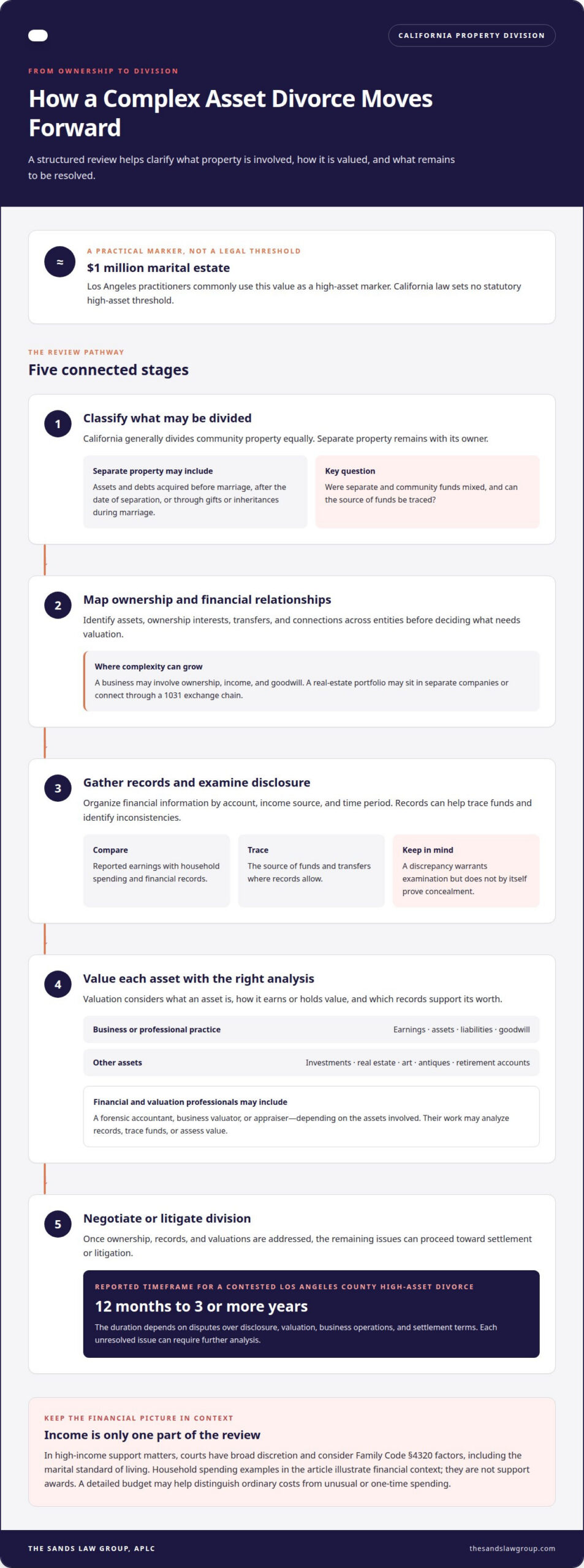
A $1 million marital estate is commonly used as a practical marker of a high-asset divorce in Los Angeles, but it isn’t a statutory threshold. California generally divides community property equally, while separate property remains with its owner; according to the California Legislature, this can include assets and debts acquired before marriage, after the date of separation, or through gifts or inheritances during marriage. A complex asset divorce lawyer in Los Angeles can help identify which property may be divided and how complicated assets should be valued.
If you’re looking for a complex asset divorce lawyer in Los Angeles, the key questions are often not just what your assets are worth, but how and when they were acquired, whether separate and community funds were mixed, and whether income or property has been disclosed. This article explains California’s community property rules, the financial issues that can make a divorce complex, and how valuation and disclosure are addressed. It also outlines how these questions can shape property division.
Key Takeaways
- Understand how California’s community-property rules distinguish assets acquired during marriage from separate property, and why tracing funds can matter.
- See why a business or professional practice may need careful valuation, including attention to goodwill and compensation arrangements.
- Learn how financial records and forensic accounting can help identify concealed income, hidden assets, or the source of funds.
- Recognize how household spending and other circumstances may inform high-income spousal-support decisions.
- Explore how legal representation can address property division, support, and related family-law issues in a complex divorce.
What Happens When a Spouse Conceals Income or Assets?
When reported earnings do not appear to match household spending, support and property division may require a closer financial review. A spouse may report modest income while business revenue, investment accounts, or regular transfers point to a different financial picture. Financial professionals can help analyze and value complex assets, including accounts that are difficult to trace. A discrepancy warrants examination, but does not by itself prove concealment.
High-income spousal support doesn’t follow an automatic formula in California; courts have broad discretion and may depart from guideline calculations at high income levels. Courts consider the factors in Family Code §4320, including the marital standard of living. For example, household spending of $50,000 per month may inform that analysis in a Los Angeles divorce. In high-income California support cases, $40,000 or $60,000 per month in household spending can also illustrate the financial context. These examples are not support awards; they show why income alone may not capture the marriage’s financial circumstances.
In a high-net-worth divorce, support analysis may consider earnings alongside recurring expenses, assets, and each spouse’s financial circumstances. A detailed budget can distinguish ordinary household costs from unusual or one-time spending. For example, documented expenses for housing, travel, and household staff may help establish the marital standard of living. This context can matter when one spouse controls business income or investment information. A lawyer can organize the relevant evidence and explain how it relates to support.
Child support is addressed under California’s guidelines, though high-net-worth cases may involve a wider range of financial circumstances. The court retains jurisdiction over child support and custody arrangements during a divorce. A parenting plan should keep children’s needs, stability, and practical care arrangements in view. Spousal support and child support serve different purposes, so income information may be relevant to both without making their calculations interchangeable.
When comparing complex asset divorce lawyers in Los Angeles, consider how each attorney handles financial disclosure, support issues, and coordination with financial professionals. Ask for a clear explanation of the proposed process, including how it addresses business records, property division, children’s needs, and unresolved financial questions.
Depending on the assets involved, a legal and financial team may include an attorney, forensic accountant, business valuator, or appraiser. The attorney addresses the legal issues, while financial professionals analyze records, trace funds, or assess value. A closely held company, for example, calls for different analysis from an investment account. Coordinated review can clarify which income and assets matter to support discussions and property division.
When financial information is incomplete, a complex asset divorce lawyer can help identify the questions that need attention before negotiations proceed. Organizing records by account, income source, and time period may reveal inconsistencies that a single statement does not. A careful review gives spouses a clearer basis for discussing support, custody arrangements, and the financial terms of separation.
What Makes a Divorce “High-Asset” in Los Angeles?
Los Angeles family law practitioners commonly use a marital estate value of $1 million as a practical high-asset marker, but California law sets no statutory threshold. Businesses, professional practices, real estate, investments, and layered ownership can make valuation and division complex.
Valuing Businesses and Other Assets
A thorough valuation considers what an asset is, how it earns or holds value, and which records support its worth. A business or professional practice may require analysis of earnings, assets, liabilities, and goodwill. Investments, real estate, art, antiques, and retirement accounts call for different valuation methods. Appraisals and financial records help clarify value and support informed decisions about marital property.
Dividing Business and Multi-Entity Holdings
Privately held businesses can involve ownership interests, income, and goodwill, so division requires understanding both the entity and its connection to the marital estate. Multi-entity holdings add another layer: a real estate portfolio might include properties held through separate companies or connected through a 1031 exchange chain. Mapping ownership, transfers, and financial relationships helps identify what is being valued and divided.
The work generally proceeds from identifying assets and ownership, to gathering records, obtaining valuations, and negotiating or litigating division. A contested high-asset divorce in Los Angeles County can take 12 months to 3 or more years. The time depends on disputes over disclosure, valuation, business operations, and settlement terms; each unresolved issue can require further analysis.
Protecting privacy requires careful handling of sensitive business and family information. Store financial records securely, limit access to people involved in the legal and valuation process, and avoid discussing disputed finances or case details in public posts. For a business owner, a deliberate communication plan can reduce unnecessary exposure of company information while valuation and property division proceed.
When comparing attorneys, ask how they address business valuation, ownership across multiple entities, expert coordination, and settlement options. A complex asset divorce lawyer should explain the proposed steps in plain language, identify the records and specialists the case may require, and connect each valuation issue to the property division decision it informs. An attorney can also address how business continuity, tax implications, and personal interests relate to the overall case.
If asset ownership or business value is disputed, discussing property division concerns can help clarify the issues and the next steps.
California community property division
California generally divides community property equally, even when an asset is titled to one spouse. Characterization comes first: the court must distinguish community assets from separate property before division.
Characterizing Marital and Separate Property
According to the California Legislature, assets and debts acquired before marriage, after the date of separation, or through gifts or inheritances during marriage are separate property. Community property generally includes assets and debts acquired during marriage, regardless of whose name is on the title.
Commingling can make it harder to characterize property. For example, depositing an inheritance into a joint account used for household expenses may complicate proof of the funds’ separate source. A transmutation can change property from separate to community, while tracing records may help establish where funds originated. A spouse seeking reimbursement for separate funds contributed to a community asset must trace those funds from their separate source into the asset.
Valuing and Dividing Marital Property
California Family Code §2550 governs division of community property in a divorce. The general equal-division rule applies to the community estate, but identifying what belongs in that estate requires attention to acquisition dates, ownership records, and financial history. A home purchased during marriage, for example, may require review of its purchase funds and later contributions.
Valuation should reflect an asset’s nature, not just its statement balance. A business interest, investment account, or real estate holding may require records clarifying its value and ownership. For stock options and restricted stock units, the Hug and Nelson formulas are methods relevant to division. The applicable formula and supporting records can affect how the marital portion is calculated.
Considering Tax Basis, Liquidity, and Control
Two assets with similar values may offer different practical benefits. Tax basis can affect the financial consequences of a later sale, while liquidity describes how readily an asset can be converted to cash. For example, a brokerage account may be easier to divide or access than a privately held business interest or a residence.
Control matters as well. One spouse may operate a company while the other receives an asset or payment as part of the division. A balanced proposal considers value alongside access, income potential, and responsibility for ongoing costs. Comparing these factors helps assess whether a proposed division will work beyond the immediate settlement.
In a California divorce, the sequence matters: characterize the property, establish its value, then consider a division that accounts for each asset’s practical features. This approach clarifies which property is involved and what each spouse would receive.
Forensic accounting and hidden assets
When income reports and financial records do not align, a structured review can clarify the assets and earnings involved. Forensic accounting can help trace funds, examine transactions, and support valuation of a complex marital estate.
Working with Financial Experts
A forensic accountant can analyze records for patterns that may need explanation, such as transfers between accounts or income that differs from reported business activity. Appraisers and business valuators can assess particular assets. The attorney connects the legal questions with the financial analysis, focusing expert work on issues relevant to disclosure, valuation, and property division.
A useful review begins by organizing available records by account, income source, and time period. Bank statements, business records, investment documents, and tax filings can be compared for consistency. For example, regular transfers from a company to a personal account may need to be considered alongside reported earnings and household spending. An unexplained difference merits investigation, but does not alone establish that assets were concealed.
Undisclosed property may include offshore accounts, investments, or funds held through business entities. A financial expert can trace the movement and origin of money, then explain how the findings relate to the marital estate. For a spouse concerned that assets are missing, this process replaces assumptions with records that can be reviewed and presented during negotiations or court proceedings.
Reviewing Financial and Investment Assets
Stocks, investment accounts, retirement accounts, and deferred compensation each require attention to statements, ownership, and relevant transaction history. A balance on one statement may not show when funds were acquired or how an account changed during marriage. Reviewing statements across relevant periods can clarify the asset’s current value and what information is needed for division.
Real estate, art, antiques, and other financial assets may require different valuation methods. An appraisal, for example, can help establish the value of property or artwork, while account records can clarify investment holdings. When spouses have multiple properties and investment accounts, a coordinated inventory helps keep individual holdings from being overlooked. Each item should be connected to its title, records, and valuation evidence.
Financial analysis can help distinguish separate funds from community funds when money has moved between accounts or contributed to an asset. Tracing those transfers explains the financial history behind property and supports a more informed discussion of division. An agreement based on incomplete account information may leave important questions unresolved. Expert findings can help the legal team identify issues that need attention before terms are finalized.
Complex and high-asset divorce representation
A complex divorce can involve business interests, executive compensation, real estate, retirement accounts, support, and disputed financial disclosures. In Los Angeles County, the central task is coordinating these issues so valuation, settlement terms, and each financial decision fit together.
A complex asset divorce lawyer in Los Angeles handles the legal work involved in identifying, valuing, and dividing complicated marital assets. The attorney may coordinate with accountants, investigators, appraisers, and real estate or corporate law specialists while addressing spousal support and challenges to a premarital agreement.
Each professional has a distinct role. An accountant analyzes financial records, an appraiser assesses property, and a business valuator examines a company interest. The divorce attorney connects those findings to legal questions, identifies information gaps, and considers how proposed terms affect the overall settlement. This coordination matters when one decision, such as retaining a business, affects other property or support discussions.
- Map the financial issues: Identify business interests, executive compensation, real property, and retirement benefits requiring attention.
- Coordinate specialist analysis: Match each valuation or tracing question with an appropriate financial professional.
- Assess division options: Compare proposed allocations alongside liquidity, business operations, and support concerns.
- Resolve disputed terms: Address disagreements through negotiation, mediation, or litigation as the circumstances require.
Retirement benefits may raise questions about a Qualified Domestic Relations Order (QDRO), while a premarital agreement may lead to disputes over validity or ambiguous language. These issues can affect division and should be considered alongside the broader estate. Coordinated review helps ensure that an agreement about one asset does not leave unresolved questions elsewhere.
Negotiation and mediation can help spouses address financial interests and resolve disputes where possible. A settlement should account for the practical consequences of dividing a business, assigning real property, or arranging support. If negotiations do not resolve contested questions, the attorney can prepare to present relevant financial evidence and legal arguments in court.
For high-profile Los Angeles families, privacy may also be part of the case strategy. Managing press and publicity can help limit effects on a client’s business, brand, and family. The legal team can consider how communications and sensitive records are handled, particularly when public attention could affect business operations or children.
If business interests, executive compensation, or disputed disclosures complicate your divorce, schedule a conversation about your divorce concerns and the issues requiring legal attention.
The Sands Law Group, APLC: Divorce Legal Representation
The Sands Law Group, APLC provides divorce legal representation for people navigating complex financial and family law decisions. When business interests, disputed asset values, or questions about undisclosed income complicate property division, legal representation can help organize the issues and clarify possible paths toward resolution.
Representation can also address spousal support and, when children are involved, child custody and visitation. These matters can affect one another, so a coordinated approach keeps financial decisions and family needs in view throughout the divorce.
If you’re considering next steps in a complex divorce, contact The Sands Law Group, APLC to discuss your circumstances.
Move Forward With a Clearer Plan
A complex divorce can make financial and family decisions feel urgent all at once. You do not have to resolve every question in one conversation. A practical starting point is to identify the decisions that feel most pressing, note where information remains unclear, and consider what legal guidance may help you move forward.
Working with a complex asset divorce lawyer in Los Angeles can bring structure to the process. The Sands Law Group, APLC can discuss your circumstances and the legal issues affecting your divorce. Start by outlining your priorities, including immediate concerns about family arrangements or financial decisions, to give the conversation a practical focus.
Taking that step doesn’t require having every record or answer in hand. It can simply create space to discuss what matters most and consider a path forward with care. Contact The Sands Law Group, APLC to discuss your situation and possible next steps.
Frequently Asked Questions
How is separate property traced after years of commingling?
Tracing uses financial records to connect an asset or contribution to its original source. Bank statements, transfer histories, and account records, for example, may show whether inherited funds entered a joint account and how they were used. Forensic accounting can help reconstruct transactions across multiple years and accounts. The available records can affect whether a separate-property claim can be distinguished from community funds.
How is support set when income is far above the guideline schedule?
California courts have broad discretion in high-income spousal-support cases and may depart from the guideline formula. Family Code §4320 factors and the marital standard of living inform the analysis; income is considered alongside the broader financial circumstances. A detailed picture of recurring household expenses, assets, and each spouse’s financial situation can help explain the support request or response. There is no automatic high-income formula that determines the result.
How much of my wealth can I keep in my divorce?
The answer depends first on which assets are community property and which are separate property. California generally divides community property equally, while separate property can include assets acquired before marriage, after separation, or through gifts or inheritances during marriage. A spouse’s total wealth is not necessarily divided as one pool. Ownership history, records showing the source of funds, and changes in how property was held can affect its characterization.
Is an equal split of the estate actually equal?
An equal division of community property does not always give each spouse assets with the same practical value. A residence, investment account, and private business interest may differ in liquidity, control, income potential, and ongoing responsibilities. Keeping a property, for example, may also mean managing its costs, while an account may be easier to access. Considering these consequences helps show whether a proposed distribution is workable, not just equal on paper.
Will my spouse be entitled to a large amount of alimony?
Not automatically. California has no automatic formula for high-income spousal support, and courts have broad discretion. Family Code §4320 factors and the marital standard of living guide the analysis, together with the spouses’ financial circumstances. Household spending can provide context, but it doesn’t alone establish a support amount. The financial record and circumstances of the marriage shape the evaluation, whether a spouse is seeking support or responding to a request.
How are assets divided in a California divorce under community property law?
California generally divides community assets and debts equally, regardless of whose name appears on a title. California Family Code §2550 governs division of community property. Separate property is treated differently, including qualifying property acquired before marriage, after separation, or through gifts or inheritances during marriage. The process requires classifying assets and liabilities before determining what falls within the community estate; title alone doesn’t settle every characterization question.
How are businesses and professional practices valued in a Los Angeles divorce?
Valuation may examine a company’s financial records, assets, liabilities, earnings, and goodwill. A professional practice may require analysis distinct from real estate or investment accounts, and ownership structures can affect which records are reviewed. Business valuators and other financial experts may assist with the assessment. For divorces involving Los Angeles, Riverside, San Bernardino, or Kern, The Sands Law Group, APLC provides divorce representation. This information is for general informational purposes only, does not constitute legal advice, and contacting the firm does not create an attorney-client relationship until a formal agreement is signed.
How are stock options, RSUs, and other executive compensation divided in divorce?
Stock options and restricted stock units require review of grant documents, vesting schedules, and the circumstances surrounding each award. California divorce cases may use the Hug or Nelson formulas to address stock options and RSUs. The appropriate analysis depends on the award and relevant facts, so grant and employment records can help clarify what is being evaluated. Deferred compensation may also require separate attention when assessing executive benefits and property division.

Article by
Thomas D. Sands, Esq.
Thomas D. Sands is the founder and CEO of The Sands Law Group, APLC. A California attorney with more than two decades of experience, he represents clients in divorce and family law matters as well as civil litigation and real property disputes. His approach emphasizes attentive, practical, and cost-conscious representation.
Sands is a 2023 Litigator of the Year honoree of the American Institute of Trial Lawyers and a 2023 Lawyer of the Year honoree of the American Institute of Legal Professionals. His firm has also received recognition among the 2025 Best Law Firms in America, a 2026 Benchmark Best of award, and a 2026 Law Firm of the Year honor.









Leave A Comment