

The marital standard of living matters, but it doesn’t dictate a spousal-support award. In California, courts consider it as one of 14 statutory factors under Family Code section 4320, which provides factors to weigh rather than a formula. How the marital standard of living informs spousal support depends on the spouses’ finances, needs, and circumstances.
It’s understandable to expect both former spouses to maintain the lifestyle they shared during marriage, especially when separating into two households raises housing costs. But spousal support decisions consider the marital standard of living alongside each person’s reasonable needs and the paying spouse’s ability to pay.
This article explains how courts assess the marital standard of living, what financial records and spending patterns can reveal, and how the benchmark may relate to support modifications. It also explores why post-divorce housing costs can make a comparable lifestyle difficult to sustain, and how those practical realities fit into the support analysis.
Key Takeaways
- Understand how a supported spouse’s income and reasonable needs are weighed alongside the paying spouse’s ability to pay.
- Learn which changes in circumstances may support a request to modify an existing order.
- See how spending, savings, investments, and financial records can help show the lifestyle established during marriage.
- Consider why maintaining one shared lifestyle across two households may be financially difficult, especially when housing costs rise.
- Recognize how legal representation can help address support questions alongside related divorce matters such as custody and property division.
How Courts Use Marital Standard for Spousal Support
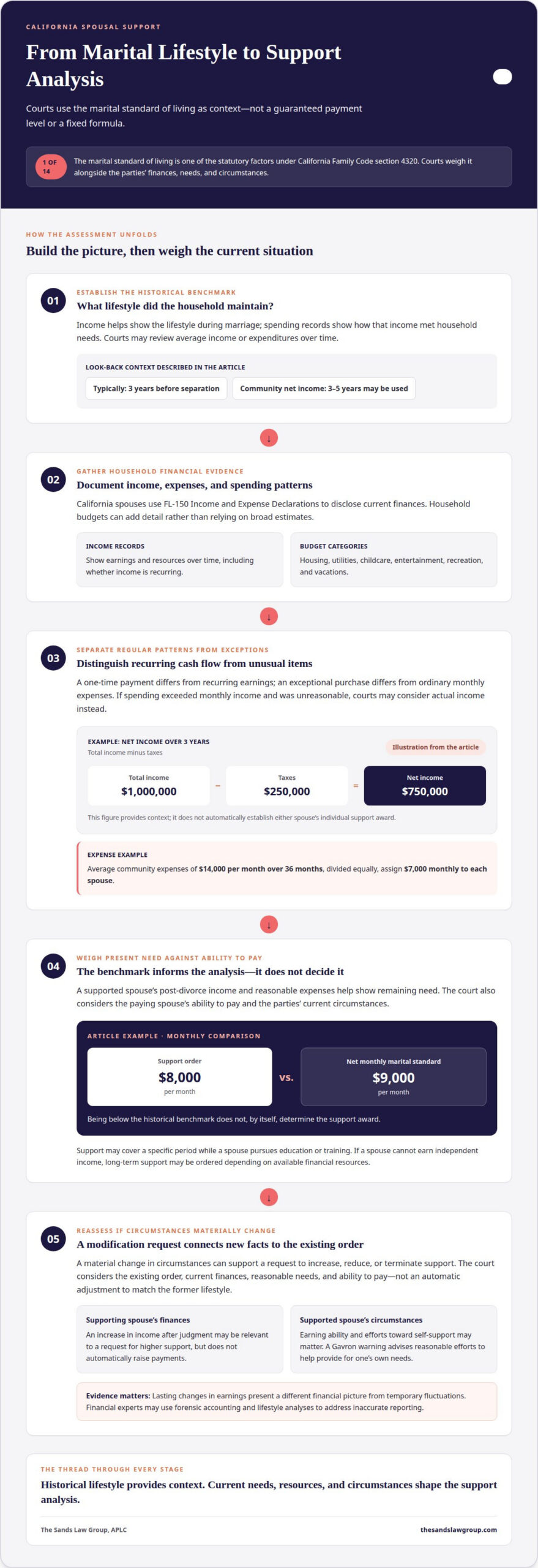
California courts weigh the marital standard of living alongside the spouses’ current finances and needs. Courts may consider the marital standard of living alongside other circumstances when deciding support, rather than applying a fixed formula. A marital standard of living spousal support assessment uses the former lifestyle as context, not as a guaranteed payment level.
The marital standard does not alone determine how long support lasts. A support order may cover a specific period while a spouse pursues education or training.
Post-Divorce Income and Support Needs
A supported spouse’s post-divorce income and reasonable expenses help show the financial need remaining after separation. This comparison matters because a court considers both that need and the paying spouse’s ability to pay. For example, an order of $8,000 per month falls below a $9,000 net monthly marital standard of living, but the difference alone doesn’t determine the award.
The court considers whether support meets the supported spouse’s reasonable needs in light of the marital standard. If that spouse cannot earn an independent income, long-term support may be ordered, depending on available financial resources. In a marital standard of living spousal support review, current income and needs matter alongside the historical benchmark.
Income and the Marital Lifestyle
Income helps show the lifestyle spouses maintained during marriage, while spending records reveal how that income met household needs. Courts may assess average income or expenditures over time. California courts typically examine the three years before separation and may use community net income over three to five years.
For example, $1,000,000 in total income minus $250,000 in taxes leaves $750,000 in net income over a three-year period. That figure offers context, but it doesn’t automatically establish each spouse’s individual support award.
Household Financial Records
Financial records document the income and expenses behind a claimed lifestyle. California spouses use FL-150 Income and Expense Declarations to disclose current finances; household budgets can also itemize housing, utilities, childcare, entertainment, recreation, and vacations. These details help explain the family’s situation rather than relying on broad estimates.
Non-recurring income and unusual expenditures should be distinguished from regular cash flow. A one-time payment differs from recurring earnings, just as an exceptional purchase differs from ordinary monthly expenses. If average community expenses were $14,000 per month over 36 months, an equal division assigns $7,000 monthly to each spouse. If spending exceeded monthly income and was unreasonable, courts may consider actual income instead. Underreported income or overstated expenses can distort the assessment; financial experts may use forensic accounting and lifestyle analyses to address inaccuracies.
MSOL as a benchmark for support modification
A California support order reflects the circumstances considered when it was made, but later financial changes can affect what remains reasonable. A material change in circumstances can support a request to modify spousal support. The marital standard provides context, but the changed circumstances must relate to the existing order.
How do changes in income or lifestyle affect support based on the marital standard of living? If the supporting spouse’s income increases after the divorce judgment, the supported spouse may seek an upward modification. Changes in either party’s finances may prompt a reassessment of current needs and ability to pay.
Income Changes and Modification
Modification adjusts an existing support obligation after a material change in circumstances. For example, a supporting spouse’s increased income after judgment may be relevant to a request for higher support. The court considers the existing order and both parties’ current finances, rather than treating increased income as an automatic increase in payments.
The marital standard is a benchmark, not a formula. A request should connect an income change to the supported spouse’s reasonable needs and the paying spouse’s ability to contribute. The timing and nature of the change matter: a lasting change in earnings presents a different financial picture from a temporary fluctuation. Courts assess the evidence in light of the circumstances underlying the existing order.
Changes Affecting the Supported Spouse
The supported spouse’s circumstances can also affect a modification request. A change in the ability to earn income, or in efforts toward self-support, may be relevant. A Gavron warning advises a supported spouse to make reasonable efforts to help provide for their own needs.
Failure to heed a Gavron warning may constitute a change in circumstances that warrants modification. The court can consider the warning alongside the person’s current finances and the reasons behind their employment situation. The marital lifestyle does not, by itself, require payments to remain unchanged regardless of changed circumstances.
Modification or Termination
For a California spousal support order, the key issue is whether circumstances materially changed after the order was made. A party may seek an increase, reduction, or termination, but the marital standard alone does not dictate the result. The request must relate to the parties’ current financial positions and the basis for the existing order.
When modifying, terminating, or setting aside a support order, a court may include a statement of decision if a party requests one. This can explain the court’s reasoning and how it considered the relevant circumstances.
Presenting the Changed Circumstances
A focused request connects the change to the existing order. Identify what changed, when it happened, and how it affects current income, needs, or ability to pay. For instance, distinguish a lasting income increase from a short-term variation and explain its effect on the parties’ finances.
If you’re considering a support-order change, discussing a support-order modification can help clarify how the changed circumstances relate to the existing order and its financial assumptions.
Marital standard of living and comparable post-divorce lifestyle
After divorce, the resources that once supported one household must support two. In California, the marital lifestyle helps put post-divorce needs in context, but it does not promise that both former spouses can preserve every part of it.
In spousal support cases, the marital standard of living means the lifestyle spouses enjoyed during marriage, including housing, shopping, dining, schooling, and vacations. Courts assess it using evidence of the couple’s finances and lived experience, rather than a required mathematical formula.
The factor’s legal role varies by state because support laws differ. In California, courts consider the marital standard as part of the statutory analysis for long-term spousal support.
Defining the Marital Standard of Living
The marital standard describes the couple’s general station in life and the reasonable needs associated with it. In In re Marriage of Smith, California case law describes it as reasonable needs commensurate with the parties’ general station in life.
For the reader, this means the court considers more than a list of monthly bills. It may look at the duration of the marriage and major shifts in income or spending. A community earning $10,000 net per month provides a financial reference point, not a guaranteed support amount.
Assessing Spending, Savings, and Investments
A lifestyle analysis examines spending patterns, savings, and investments to understand how the couple used and retained resources. A modest day-to-day budget may not show the entire financial picture.
For example, regular deposits to retirement accounts, savings accounts, or other investments can show that saving was part of the established lifestyle. California courts may consider these patterns even when spouses lived modestly. They may also weigh non-financial contributions, such as raising children or supporting a spouse’s career, when assessing the marital partnership.
Financial Records of the Marriage
Historical records help establish the couple’s actual financial patterns and support a grounded assessment. Courts and financial experts may review income statements, tax returns, bank statements, and expense receipts.
Comparing records from different periods can reveal changes in income, spending, or savings during the marriage. For instance, tax returns may show declining earnings while account statements reveal continued investment contributions. A lifestyle analysis brings these records together to assess the supported spouse’s needs and the paying spouse’s ability to pay.
State Differences in Lifestyle Factors
States can assign different weight to marital lifestyle because each applies its own support framework. In California, it is one statutory factor courts consider for long-term spousal support, rather than a standalone formula.
That distinction matters if a divorce involves more than one state or a move during proceedings. The governing state’s law determines how this factor fits with income, resources, and other relevant circumstances. In a California case, lifestyle evidence belongs within California’s support analysis, not a universal rule.
Housing costs and post-divorce living arrangements
After a marriage ends, two households must cover costs once shared under one roof. This shift can make a comparable post-divorce lifestyle financially difficult, even when support addresses some of the difference.
Housing Costs After Separation
Housing is a central expense because each former spouse may need a separate place to live. Consider the example of monthly community expenses that include $4,000 in housing costs: the marital standard of living is allocated at $9,000 net per month to each party. That benchmark helps frame needs, but it doesn’t mean both households can preserve the same home or spending pattern.
The practical comparison is between the former household budget and each person’s post-divorce circumstances. A spouse who stays in the family home may face different costs from one who moves. Separate housing can also mean separate utilities and household expenses, replacing savings from sharing one residence. These added obligations matter when evaluating what support can reasonably address.
Temporary Maintenance During Divorce
Temporary maintenance may help cover living expenses while a divorce is pending. In Colorado, an applicant must demonstrate financial need and inability to pay basic expenses. The immediate question is whether available resources can meet necessities during the case, not whether either party can recreate the marriage’s entire lifestyle.
For example, a spouse facing separate housing costs before property division is resolved may struggle to cover basic expenses. Temporary maintenance can address that interim situation. It differs from long-term support, which involves a broader assessment of the parties’ finances and circumstances after divorce, rather than only expenses during the pending case.
Financial Changes After Divorce
Once a couple separates, the same income often must support two homes. It may not be financially feasible for both former spouses to maintain separately the lifestyle they shared during marriage. Support can help meet some needs, but a court cannot award more than the couple’s available financial resources.
That limit matters when housing costs rise significantly or the former household relied on debt to sustain its spending. Courts generally will not require either spouse to keep taking on debt to fund a lifestyle beyond the couple’s means. An attorney can help explain how housing costs, income, and other obligations interact in the specific circumstances, so a request reflects both need and ability to pay.
Marital standard of living as a spousal-support factor
In California, the marital standard of living is part of a broader support analysis. It gives the court context for reasonable needs, rather than dictating an automatic award.
Family Code section 4320 directs courts to weigh multiple circumstances when determining long-term spousal support. The marital standard is relevant, but it operates alongside each spouse’s finances and ability to pay. There’s no required mathematical formula for measuring the standard or converting it into a monthly order.
That distinction matters. A court’s findings address whether support meets the supported spouse’s reasonable needs in light of the lifestyle established during marriage. The award must also reflect available financial resources. If the couple’s resources cannot fund both households at the former level, the court cannot create funds by ordering support beyond those resources.
Usually, the statutory analysis is the central framework, with the marital standard considered within it. In rare cases, the standard may need separate consideration. For example, a couple may have lived modestly while regularly saving or investing; current spending alone might not capture their full financial pattern. The court can weigh that history alongside other relevant circumstances.
The standard also does not guarantee that either former spouse will continue enjoying every feature of the marriage’s lifestyle. Instead, it helps assess needs against resources and the parties’ circumstances. A former spouse’s later financial success does not automatically entitle the supported spouse to share in that increase beyond the standard used when the award was made. A material change in circumstances can still raise a modification question.
Support orders may address a transition toward greater financial independence. For example, an order may provide support for a specific period while a spouse obtains education or training. The court considers needs and ability to pay; the marital standard alone does not establish the order’s duration.
For the reader, the practical takeaway is to connect the marital lifestyle to the support question being decided. Explain how the established standard relates to current needs, available resources, and any requested order. A lawyer can help frame those issues in a spousal-support case. Discuss your spousal-support circumstances when you need guidance applying these factors to your case.
The Sands Law Group, APLC: Divorce Legal Representation
The Sands Law Group, APLC represents people addressing spousal support within the broader financial decisions of divorce. When the marital standard of living, current needs, and ability to pay are disputed, the firm provides legal representation focused on those issues and the relevant financial circumstances.
The firm also represents clients in property division, child custody, and visitation matters when those issues are part of a family case. These decisions can affect the financial and family arrangements being resolved, so coordinated legal representation can keep the related issues in view.
If you need representation for divorce or spousal support, book a Free Case Evaluation with The Sands Law Group, APLC.
Move Forward With a Clear Financial Picture
Divorce reshapes more than a monthly budget. It can change where you live, how you plan for future needs, and what financial stability means for your family. A useful next step is to consider how the marital standard of living informs spousal support decisions alongside the life you’re building now.
Before important choices become fixed, focus on decisions that affect your long-term stability. Consider what financial questions remain unresolved, how housing fits into your plans, and whether support arrangements reflect your circumstances. When discussions around separation and finances become strained, conflict resolution resources such as conflictmanager.com.au can provide helpful guidance for managing family disputes constructively. Legal representation can help you understand the issues and make considered decisions without losing sight of your priorities.
The Sands Law Group, APLC represents people in divorce and spousal support matters, as well as child custody and visitation cases. If you’re ready to discuss your circumstances, schedule a conversation with The Sands Law Group, APLC. A thoughtful next step can help you approach the decisions ahead with greater clarity.
Frequently Asked Questions
How does marital standard of living affect alimony or spousal support amounts?
The marital standard gives courts context for evaluating reasonable needs, but it does not produce an automatic payment amount. In California cases, the court considers the marital lifestyle alongside statutory factors and each spouse’s finances. For people in Los Angeles, Riverside, San Bernardino, or Kern, this article provides general information only and does not constitute legal advice. Contacting The Sands Law Group, APLC does not create an attorney-client relationship; one begins only after a formal agreement is signed.
What evidence is used to prove the marital standard of living?
Courts may consider financial records that corroborate how income was received and used during marriage. For example, bank activity can be compared with reported earnings, while receipts may clarify whether a claimed expense reflects regular household spending. A financial expert’s analysis can help reconcile conflicting records. The aim is a coherent account of the couple’s finances, rather than an unsupported estimate from either spouse.
How do courts balance marital standard of living with each spouse’s ability to pay?
Courts weigh the supported spouse’s reasonable needs against the paying spouse’s actual financial ability and available resources. A past lifestyle does not require an order that exceeds what the couple can afford. For example, if current income has fallen, the historical lifestyle remains relevant, but the court must also assess present finances. The analysis considers both parties’ circumstances, rather than treating the former standard as a payment guarantee.
Can a spouse maintain the marital standard of living after divorce?
Sometimes, but maintaining the same lifestyle is often difficult because one household becomes two, creating separate housing and other costs. The result depends on available income, support, property, and each person’s expenses. A spouse may preserve some parts of the former lifestyle while changing others, such as housing or discretionary spending. Courts generally will not require either former spouse to take on continuing debt just to sustain a lifestyle beyond the couple’s means.
What are common mistakes when estimating marital expenses for spousal support?
Common errors include treating irregular income as dependable, counting an unusual purchase as a recurring expense, and overlooking costs paid from shared accounts. Underreporting income or overstating expenses can distort the assessment and contribute to an unfair order. Relying on memory without reconciling figures against financial records is another pitfall. Separating regular household costs from one-time items helps present a more accurate picture of the couple’s finances.

Article by
Thomas D. Sands, Esq.
Thomas D. Sands is the founder and CEO of The Sands Law Group, APLC. A California attorney with more than two decades of experience, he represents clients in divorce and family law matters as well as civil litigation and real property disputes. His approach emphasizes attentive, practical, and cost-conscious representation.
Sands is a 2023 Litigator of the Year honoree of the American Institute of Trial Lawyers and a 2023 Lawyer of the Year honoree of the American Institute of Legal Professionals. His firm has also received recognition among the 2025 Best Law Firms in America, a 2026 Benchmark Best of award, and a 2026 Law Firm of the Year honor.









Leave A Comment