

What if a parenting plan’s most important feature isn’t an equal-looking schedule, but one your child can rely on week after week? If you’re unsure how to divide school nights, holidays, exchanges, or major decisions, a parenting plan attorney Los Angeles parents consult can help turn those concerns into specific proposed terms grounded in your child’s needs.
It’s understandable to worry that negotiations or court involvement could deepen conflict. A practical plan can’t resolve every disagreement, but clear schedules, responsibilities, and communication expectations may reduce uncertainty about what happens next. The goal isn’t to create a perfect arrangement on paper. It’s to develop terms that reflect your family’s daily realities and can be followed.
This article explains how counsel can help develop an initial parenting plan or address a request to modify an existing arrangement. You’ll learn which details make schedules and exchanges clearer, how to address decision-making responsibilities, and what information to gather before seeking legal advice in Los Angeles, Riverside, San Bernardino, or Kern. Preparing those details can help you discuss your child’s routines and needs with greater clarity.
Key Takeaways
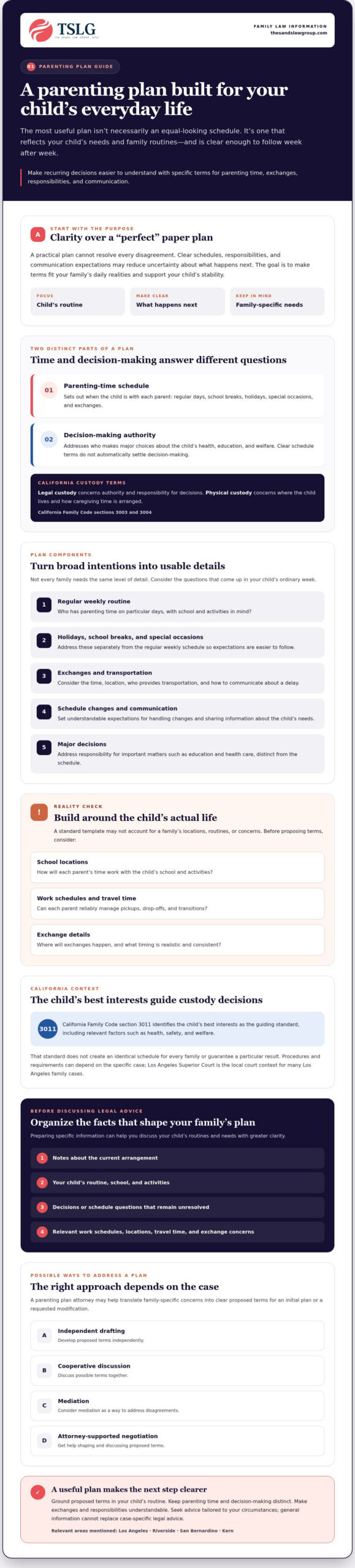
- Build proposed plan terms around your child’s routine, including parenting time, holidays, exchanges, and how schedule changes will be handled.
- Keep decision-making authority for important issues distinct from the schedule that sets when each parent cares for the child.
- A parenting plan attorney los angeles parents consult can help translate family-specific concerns into clear proposed terms, whether the matter involves an initial plan or a requested modification.
- Before seeking legal advice, organize factual notes about current arrangements, your child’s routine, and decisions that remain unresolved.
- Consider whether independent drafting, cooperative discussion, mediation, or attorney-supported negotiation may suit your circumstances. The appropriate path depends on the case.
Why a Los Angeles Parenting Plan Needs to Work Beyond the Courtroom
Separation can make ordinary parenting decisions feel unusually difficult: who handles school-day transitions, how holidays are divided, and how parents communicate about a child’s needs. A calm, practical plan can give those recurring questions structure. The goal isn’t to predict every future disagreement. It’s to make the arrangement clear enough to guide daily life and support the child’s stability.
A parenting plan is a proposed set of terms addressing custody, parenting time, and related arrangements. The phrase Parenting plan is also used more broadly for agreements that organize how parents care for and make decisions about their children. In California family cases, court documents commonly use the terms “custody” and “visitation.” The precise terms and procedures that apply can depend on the case and current requirements of the Los Angeles Superior Court.
What a California parenting plan is meant to address
California law distinguishes legal custody from physical custody. Legal custody concerns a parent’s authority and responsibility to make decisions about a child’s health, education, and welfare. Physical custody concerns where the child lives and how caregiving time is arranged. These concepts are addressed in California Family Code sections 3003 and 3004. A schedule and decision-making provisions serve different purposes, so a plan should address each clearly.
Under Family Code section 3011, custody decisions are guided by the child’s best interests and relevant factors that include health, safety, and welfare. That standard doesn’t produce an identical schedule for every family or guarantee a particular result. Parents can use the upcoming custody comparison article to explore how legal and physical custody differ. For advice about how those concepts apply to your circumstances, speak with a qualified family law attorney.
Why Los Angeles family circumstances matter
A workable arrangement must fit the child’s life outside the courthouse. Before proposing terms, consider:
- School locations: How will each parent’s time work with the child’s school and activities?
- Work schedules and travel time: Can each parent reliably manage pickups, drop-offs, and transitions?
- Exchange details: Where will exchanges occur, and what timing is realistic and consistent?
Los Angeles Superior Court is the relevant local court context for many Los Angeles family cases, but applicable procedures and requirements should be confirmed for the specific matter. A template may offer a starting point, yet no standard schedule accounts for every family’s locations, routines, or concerns. Whether you’re in Los Angeles, Riverside, San Bernardino, or Kern, a parenting plan attorney los angeles parents consult can help turn family-specific facts into clear proposed terms. General information can’t replace advice tailored to an individual case.
What to Include in a Los Angeles Parenting Plan
A useful plan turns broad intentions into answers to ordinary questions: who has parenting time on a particular day, where an exchange takes place, and how parents will handle an important school or health decision. The California Courts Self-Help Guide explains custody and parenting plans in California. Use it as general information, then consider which terms fit your child and family. Not every family needs the same level of detail, but vague arrangements can leave recurring decisions open to interpretation.
Keep two issues distinct. Decision-making authority addresses who makes major choices, such as those involving education and health care. The parenting-time schedule sets out when the child is with each parent. A plan may need to address both, but clarity in one area doesn’t automatically resolve the other.
Schedules, holidays, exchanges, and transportation
Start with the regular weekly routine, then address school breaks, holidays, and special occasions separately. For exchanges, think through the practical details: time, location, who provides transportation, and how a parent should communicate about a delay. Specific terms can make expectations easier to understand without requiring a plan to dictate every minor interaction.
Illustrative example, not a recommended schedule for every family: If one parent usually collects a child after school, a proposed term could identify the school as the exchange location on school days and describe what happens when school is closed. Whether that arrangement makes sense depends on the child’s routine, the parents’ circumstances, and any relevant safety concerns.
Decision-making, communication, and changing circumstances
Consider how the plan will address major decisions about education, health care, and other significant aspects of the child’s welfare. It may also help to specify how parents will share important information, such as school notices or appointment details, and how they’ll communicate when a decision requires discussion. Clear expectations can reduce uncertainty, but they can’t ensure parents will agree in every situation.
- Identify the issue: Which decisions need shared input or a defined process?
- Set a communication approach: What information should be shared, and how will parents raise time-sensitive concerns?
- Revisit changed circumstances: A move, a shift in work hours, or a change in a child’s needs may prompt a review of whether current terms remain workable.
Safety concerns, substantial conflict, or unusual family circumstances call for individualized legal guidance rather than a generic template. A parenting plan attorney los angeles parents consult can help translate those facts into proposed terms and explain options for addressing an existing arrangement. If you’re weighing which provisions fit your situation, you can discuss your custody and parenting plan circumstances with The Sands Law Group, APLC.
Do You Need a Parenting Plan Attorney in Los Angeles?
Speaking with an attorney doesn’t have to mean choosing a more combative path. Legal advice can help you understand your options, identify unclear terms, and make deliberate proposals before you commit to an arrangement. A parenting plan is intended to organize parenting responsibilities, as described in this legal definition of a parenting plan, but how to shape one depends on your family’s circumstances and California law.
Some parents begin by drafting ideas independently, then discuss them cooperatively. Others work through proposals in mediation or have lawyers support negotiations. These approaches aren’t interchangeable, and none guarantees agreement, a particular custody outcome, or a faster resolution. The right process depends on factors such as the level of disagreement, the clarity of existing orders, and whether each parent can participate safely and constructively.
When legal guidance may be especially useful
Individual advice may be valuable when parents disagree about a complex schedule, disputes keep recurring, a possible relocation raises questions, or an existing court order is unclear. Contested facts or significant differences over parenting time can also make it harder to assess which proposed terms are workable and how they relate to the current arrangement.
Safety concerns need careful attention. If you believe someone is in immediate danger, contact local emergency services or an appropriate professional resource. For non-immediate concerns, seek guidance from a qualified professional who can consider the specific facts. This article offers general information, not advice about what you should do in a particular case.
How counsel can support a child-focused process
A parenting plan attorney los angeles parents consult may review proposed terms, identify wording that leaves room for conflicting interpretations, and help prepare for negotiation. For instance, “reasonable notice” may not resolve a disagreement unless the parents understand what notice means in their circumstances. Counsel can help examine whether the language answers the practical question without adding unnecessary restrictions.
Legal support can also help keep proposals focused on the child’s needs rather than parental grievances. A discussion about a pickup arrangement, for example, can center on the child’s school routine, travel demands, and a predictable transition. That reframing doesn’t erase conflict, but it can give parents a more concrete issue to address.
Mediation and court procedures may depend on the case and current Los Angeles County requirements, so confirm applicable procedures rather than relying on a general description. Each matter turns on its facts and governing law. A lawyer can explain potential paths and help you weigh them, but can’t promise that the other parent will agree or that a court will adopt a specific proposal.
How to Prepare for a Parenting Plan Attorney Consultation
Preparing for a consultation doesn’t require you to solve every disagreement in advance. A clear, factual picture of your child’s routine and the questions still open can help a parenting plan attorney los angeles parents consult understand your situation and discuss practical next steps. Organize what you know, distinguish current arrangements from proposed changes, and note where you need legal guidance.
Gather the information that explains your family’s routine
Start with the details that affect day-to-day parenting. A school calendar, activity schedule, and work commitments can help show what a proposed schedule would need to accommodate. Include practical transportation constraints, such as travel between school and each parent’s home. Bring copies of existing custody orders or written agreements, and note any differences between what those documents say and what has been happening in practice.
Keep notes neutral and specific. Rather than writing that exchanges are “always difficult,” record the dates and circumstances of the incidents that concern you. A short timeline can help counsel understand important changes, recurring issues, and questions that remain unresolved. You don’t need to make legal conclusions. Focus on what happened and how it affects the child’s routine.
Consultation preparation checklist
- Gather school schedules, regular activities, and relevant work commitments.
- Note transportation limits and the current exchange routine.
- Collect existing custody orders and written parenting agreements.
- Record where actual practice differs from the written arrangement.
- Prepare a brief, factual timeline and list unresolved questions.
- Identify your priorities, areas of flexibility, and concerns for legal advice.
Set priorities and questions for the consultation
Before meeting, identify which needs feel essential for your child’s stability and where you may be open to alternatives. For example, a consistent school-night routine might be a priority, while the precise exchange location could be flexible. Separate those priorities from frustrations with the other parent. That distinction can help keep the discussion focused on workable terms.
Consider asking how the attorney approaches negotiation, mediation, and court preparation; how client communication typically works; and what the representation would cover. Ask directly about the process and legal fees, since terms and costs should be discussed with the firm rather than assumed from general information. These questions can help you assess whether the approach fits your needs without creating an expectation of a particular result.
If you’re preparing to discuss an initial parenting plan or a possible change to an existing arrangement, contact The Sands Law Group, APLC about your custody circumstances.
Next Steps With a Los Angeles Parenting Plan Attorney
Once you’ve identified your child’s needs and the questions a plan must answer, counsel can help organize the next decisions. An attorney may review existing custody orders or written agreements, clarify your goals, identify disputed terms, and consider practical constraints such as school routines, work schedules, and transportation. From there, proposed terms can be drafted and reviewed for clarity before you decide how to proceed.
What to expect after seeking counsel
The next step depends on the circumstances of your case. Parents may reach agreement through discussion, take part in mediation, or ask the court to address unresolved issues. Which options apply, and what procedures are required, depend on the case and current Los Angeles Superior Court practices. Confirm the applicable requirements with counsel rather than assuming another family’s process will be the same.
There’s no reliable way to predict how quickly the matter will progress, whether the other parent will agree, or what outcome a court may reach. The value of legal guidance is in understanding the issues, reviewing proposed language, and making informed decisions about available next steps, not guaranteeing a particular result.
Discuss your parenting-plan questions with The Sands Law Group
The Sands Law Group, APLC represents parents in child custody and visitation matters, including initial parenting plans and post-judgment modifications. A parenting plan attorney los angeles parents consult can help assess how a proposed arrangement relates to existing orders and the family’s specific circumstances. The firm serves clients in Los Angeles, Riverside, San Bernardino, and Kern. Bring your organized notes, identify the terms you’re uncertain about, and ask questions about your options and the process.
If you’re considering an initial plan or changes to an existing arrangement, discuss your parenting plan concerns with The Sands Law Group.
Build a Plan Around Your Child’s Next Chapter
A practical parenting plan turns your child’s needs into clear, workable terms, from parenting time and exchanges to important decisions. The right details depend on your family’s circumstances. Organized notes about routines, existing arrangements, and unresolved questions can help you prepare for informed legal advice.
A parenting plan attorney los angeles parents consult can help assess proposed terms and explain possible next steps, whether you’re developing an initial plan or considering changes to an existing arrangement. The Sands Law Group, APLC focuses exclusively on family law and represents parents in child custody and visitation matters, including initial parenting plans and post-judgment modifications in Los Angeles, Riverside, San Bernardino, and Kern.
If you’re ready to discuss your family’s circumstances and questions, contact The Sands Law Group about your parenting plan. A conversation can help you consider a steadier path forward for your child.
Frequently Asked Questions
What does a parenting plan attorney do in Los Angeles?
A parenting plan attorney helps a parent understand custody and parenting-time options, assess proposed terms, and prepare for negotiation or court proceedings when needed. Counsel may review existing orders, identify unclear language, and help shape proposals around the child’s routine and family circumstances. The Sands Law Group, APLC represents parents in child custody and visitation matters, including initial plans and post-judgment modifications in Los Angeles, Riverside, San Bernardino, and Kern.
Do I need an attorney to create a parenting plan in California?
No, California parents may work on a proposed parenting plan without hiring an attorney, but legal advice can be useful when terms are disputed or circumstances are complex. Consider consulting counsel if you’re uncertain about existing orders, safety concerns, relocation, or how a proposed schedule may affect your child. A parenting plan attorney los angeles parents consult can explain options based on the facts, but cannot guarantee agreement or a particular court decision.
What should a California parenting plan include?
A California parenting plan commonly addresses legal custody, physical custody, parenting time, and arrangements for holidays, school breaks, and exchanges. Parents may also need to clarify how they’ll handle major decisions about education and health care, share important information, and communicate about schedule changes. The right level of detail depends on the child and family. Clear terms can reduce ambiguity, though they can’t prevent every disagreement or anticipate every future circumstance.
How does Los Angeles custody mediation work?
In Los Angeles County, contested custody cases require parents to complete the court’s free online “Our Children First” orientation before mediation, according to current court information. Mediation gives parents an opportunity to address custody and parenting-time issues with a neutral mediator. Some cases may also be ordered to the court’s “Between Two Parents” online co-parenting course. Procedures and requirements can vary, so confirm current instructions with Los Angeles Superior Court or your attorney.
Can parents create a parenting plan without going to court?
Yes, parents may discuss and develop proposed parenting terms through cooperative discussions or other resolution processes, and some reach agreement without asking a judge to decide disputed issues. Whether an agreement should be submitted to court or formalized in an order depends on the circumstances, including whether a case or order already exists. Before relying on an informal agreement, consider getting legal guidance about how it relates to any current court orders.
Can a parenting plan be changed after a court order?
A parent may seek to modify a custody or parenting-time order when circumstances change, but a change isn’t automatic. The appropriate steps depend on the existing order, the facts, and current California and local court procedures. Avoid assuming that a new informal arrangement replaces a court order. An attorney can review the order, discuss the proposed changes, and explain how to pursue a modification through the applicable process.
What should I bring to a parenting plan attorney consultation?
Bring any existing custody orders or written agreements, plus organized notes about your child’s school schedule, activities, exchanges, and each parent’s practical constraints. A brief factual timeline can help explain where current practice differs from the written arrangement. Also list unresolved decisions, your child-related priorities, areas where you may be flexible, and questions about process, representation, and legal fees. These materials help counsel understand your circumstances without requiring you to resolve disputes beforehand.

Article by
Thomas D. Sands, Esq.
Thomas D. Sands is the founder and CEO of The Sands Law Group, APLC. A California attorney with more than two decades of experience, he represents clients in divorce and family law matters as well as civil litigation and real property disputes. His approach emphasizes attentive, practical, and cost-conscious representation.
Sands is a 2023 Litigator of the Year honoree of the American Institute of Trial Lawyers and a 2023 Lawyer of the Year honoree of the American Institute of Legal Professionals. His firm has also received recognition among the 2025 Best Law Firms in America, a 2026 Benchmark Best of award, and a 2026 Law Firm of the Year honor.









Leave A Comment